Technical Takeaways
- DeFi and Hybrid Financial Anonymity: The TTP has decoupled its financial pipeline from the traditional international banking system by blending local, trade-based hawala networks with privacy-focused digital assets (XMR) and non-custodial wallets, effectively bypassing Western financial monitoring grids like FinCEN.
- Exploitation of Integration Deficits: Modern radicalization pathways ignore broad public propaganda in favor of insular, end-to-end encrypted (E2EE) channels that target cultural integration gaps within Western diaspora communities, creating low-signature support networks invisible to traditional law enforcement profiling.
- South Asian Proxy Activation Risks: Any tactical deployment of Sunni militant groups like HTS by the US against Iran will trigger an immediate, asymmetric counter-response from IRGC Quds Force-controlled networks (such as the Zainabiyoun Brigade) inside Pakistan and Afghanistan, placing Western assets under immediate threat of retaliatory kinetic strikes.
Bottom Line Up Front (BLUF)
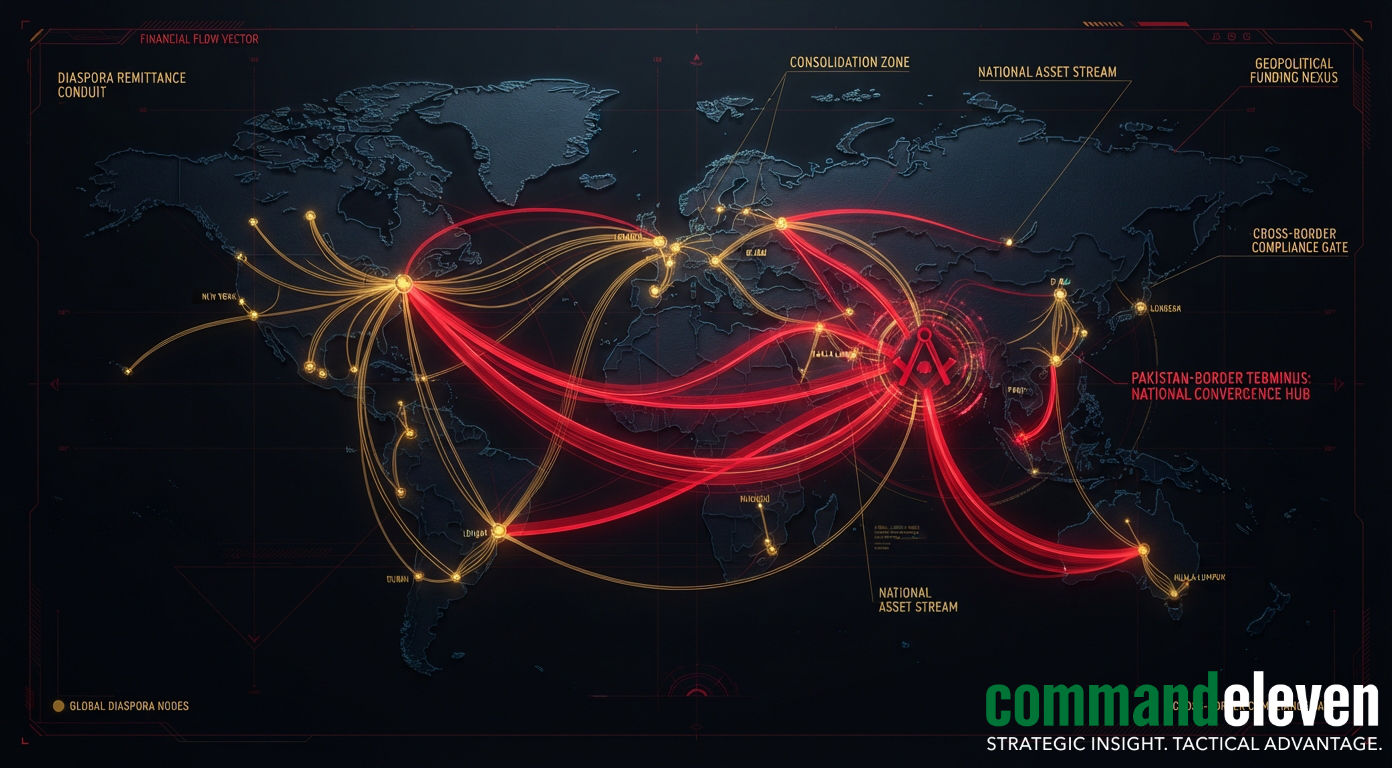
Transnational funding mechanics and radicalization pathways supporting the Tehreek-e-Taliban Pakistan (TTP) have mutated into highly insular, digitally native networks embedded within Western Hemisphere diaspora communities. By shifting away from traceable, traditional banking infrastructure and exposed public recruiting fora, threat actors now leverage decentralized finance (DeFi) architectures, peer-to-peer digital asset privacy tokens, and end-to-end encrypted messaging ecosystems. These channels allow them to exploit unintegrated Western diaspora enclaves, establishing a resilient, low-signature logistical sanctuary that generates significant capital for border-zone operations while remaining beneath the detection thresholds of Western domestic intelligence agencies.
Transnational Diaspora Exploitation & Radicalization Pathways
The contemporary TTP radicalization doctrine has shifted from broad public outreach to a highly targeted approach that exploits vulnerabilities within Western Hemisphere diaspora communities, particularly in North America and Western Europe. This evolution responds directly to increased physical border defenses and enhanced travel tracking systems, which make the direct infiltration of foreign fighters into the Pakistan-Afghanistan border region logistically difficult. Consequently, the TTP focuses on turning sympathizers within the West into decentralized logistical nodes.
The recruitment process exploits the slow pace of cultural integration within specific, isolated pockets of the migrant diaspora. TTP digital recruitment operatives – frequently operating from safe houses in Kabul and Jalalabad – systematically monitor Western diaspora discussion boards, regional linguistic social groups, and localized political fora. They target young, unintegrated first- and second-generation individuals who exhibit signs of cultural isolation or political grievances regarding Western foreign policy.
Once an asset is identified, the interaction is quickly migrated off public platforms into closed, end-to-end encrypted (E2EE) channels on applications like TamTam, Signal, and Matrix. Rather than using overt, high-visibility jihadist imagery that triggers automated keyword filters, recruiters employ tailored psychological operations. They frame the regional conflict through localized, ethnocentric lenses, presenting the TTP as a necessary defense of regional autonomy and religious identity against state overreach.
This hyper-localized recruitment strategy builds a highly insular network of independent cells across Western metropolitan areas. These individuals do not attend mainstream community centers or display outward signs of radicalization, making them invisible to traditional community-led counter-radicalization programs. These insular diaspora nodes serve as a virtual sanctuary, providing the TTP with a pool of trusted assets inside the Western Hemisphere capable of executing long-term logistical, financial, and operational support tasks without breaking standard domestic profiling parameters.
Logistical Safe Havens & Low-Signature Support Networks
The safe havens established by the TTP within the Western Hemisphere are not defined by physical training encampments or weapons caches; instead, they function as distributed, low-signature support networks integrated directly into the legitimate commercial structures of major Western cities. These nodes provide the global insurgency with critical non-kinetic capabilities, including document fraud, identity manipulation, and specialized procurement loops for dual-use technologies.
A primary function of these domestic safe havens is managing the identity pipelines required for cross-border movement and asset protection. Embedded nodes within the diaspora who hold legitimate Western citizenship or permanent residency status are leveraged to secure valid travel documents, open shell corporate bank accounts, and establish clean digital footprints. By manipulating local administrative systems, these networks generate clean identities that allow high-value TTP procurement agents or leadership figures to travel internationally without triggering watchlists managed by INTERPOL or Western border agencies.
Furthermore, these domestic networks serve as specialized procurement cells for high-grade tactical hardware. TTP military commissions routinely issue requirements for specific dual-use consumer technologies that are tightly restricted or unavailable in the open markets of Pakistan and Afghanistan. Western-based cells systematically purchase these items in small, unnoticeable quantities through standard e-commerce platforms and retail outlets. The hardware catalog includes:
- High-resolution thermal imaging optics and night-vision monoculars.
- Commercial unmanned aerial vehicle (UAV) telemetry kits and signal range extenders.
- Advanced software-defined radios (SDR) and encrypted mesh-networking field gear.
- Ballistic-grade protective equipment and specialized tactical computing platforms.
Once acquired, these components are distributed across legitimate commercial freight-forwarding networks, mislabeled as standard consumer electronics or automotive parts, and shipped through circuitous maritime and air routes traversing transit hubs in the Middle East or Central Asia before arriving in the border zone. This decentralized logistics model distributes the supply chain across hundreds of independent points, ensuring that the interdiction of a single package cannot compromise the broader procurement network.
Financial Micro-Pipelines: Hawala Nodes & Digital Assets
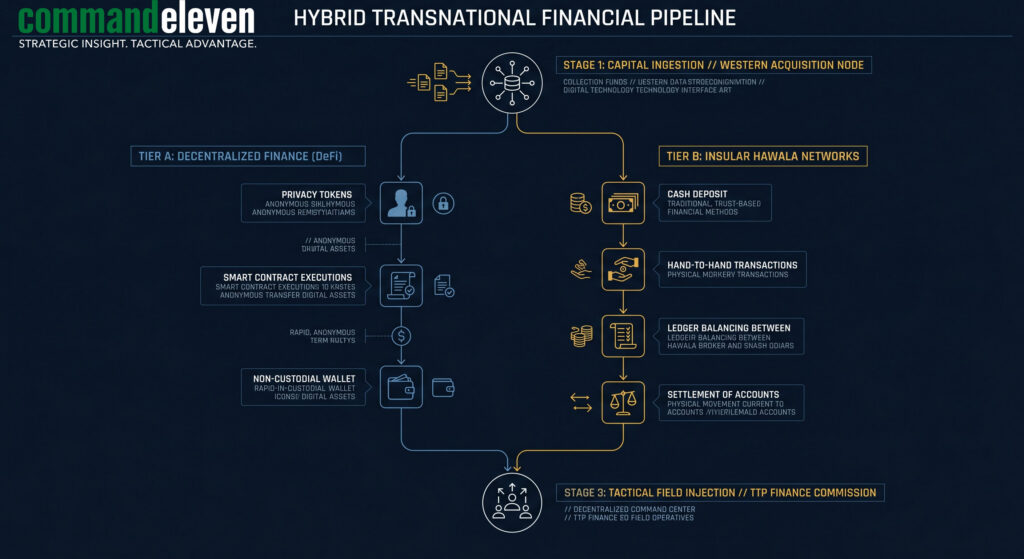
The financial infrastructure supporting the TTP from the Western Hemisphere has undergone a major technological upgrade, combining ancient informal value transfer systems with modern decentralized financial protocols. This hybrid model protects the group’s capital flight from the tracking systems used by Western financial intelligence units, such as the US Department of the Treasury’s Financial Crimes Enforcement Network (FinCEN).
The traditional leg of this matrix relies on insular hawala networks operating under the radar within migrant commercial districts in cities like New York, Toronto, London, and Frankfurt. Capital is deposited as cash with a trusted domestic broker, eliminating any paper trail or connection to the formal banking grid. The domestic broker communicates the transaction value via encrypted text to a counterpart broker in Peshawar, Kabul, or Quetta, who releases the equivalent value in local currency directly to TTP financial agents. The cross-border balancing of these ledger balances is rarely executed via direct cash shipments; instead, it is hidden within complex trade-based money laundering schemes involving the over-invoicing and under-invoicing of imported consumer goods, textiles, or electronics moving through regional transit hubs.
Concurrently, the TTP Finance Commission has integrated advanced digital asset protocols to build rapid, high-volume financial micro-pipelines. The system systematically avoids transparent public blockchains like Bitcoin, opting instead for privacy-centric digital tokens such as Monero (XMR) and utilizing decentralized, non-custodial wallet architectures that do not require Know Your Customer (KYC) verification.
Western-based funding nodes ingest cash or structured corporate revenues, convert the fiat currency into digital assets via peer-to-peer (P2P) exchanges or unregulated over-the-counter (OTC) desks, and route the tokens through decentralized mixers and automated swapping protocols. Once the transaction trail is thoroughly obscured, the assets are transferred to wallets controlled by the TTP Finance Commission. These digital assets are then liquidated into local fiat currency through complicit exchange houses operating in permissive jurisdictions, providing the insurgency with a continuous, untraceable flow of capital to fund field intelligence operations, purchase weapons, and pay monthly stipends to active combat units along the border.
Resource Allocation & Tactical Field Injection
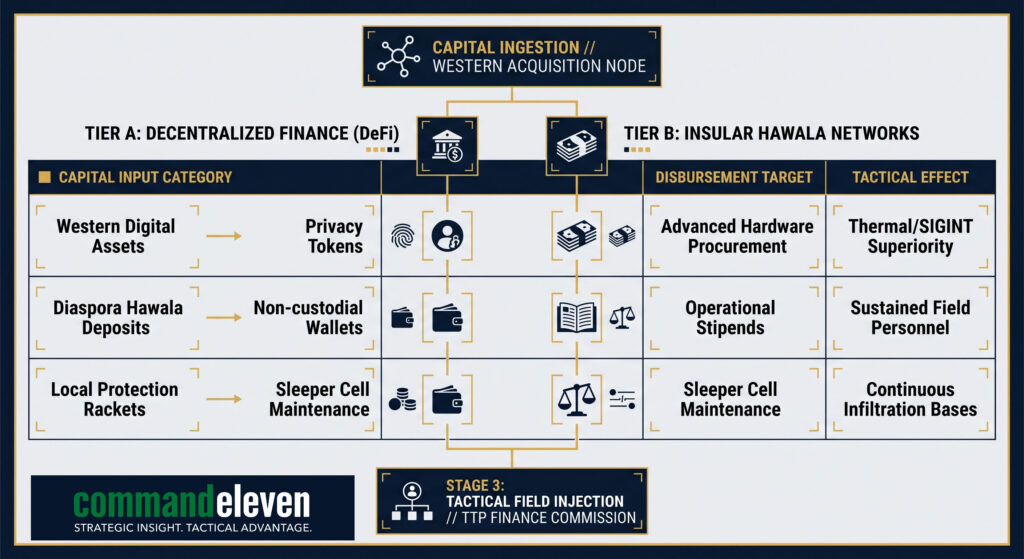
Once capital is generated and routed through these transnational pipelines, the TTP Finance Commission executes a strict resource allocation protocol designed to maximize the kinetic impact of every dollar received. The deployment of funds is managed via centralized accounts, ensuring that local commanders cannot divert transnational financial inputs for unauthorized regional operations or personal enrichment.
The primary destination for Western-generated capital is the direct subsidization of the TTP’s advanced weapons procurement program. While standard small arms and ammunition are cheaply sourced from regional illicit markets and legacy stocks, advanced tactical gear – such as anti-aircraft components, anti-tank guided missiles (ATGMs), and sophisticated electronic countermeasure (ECM) equipment – requires significant hard-currency investments. Transnational funding pipelines provide the liquid capital necessary to secure these systems from corrupt state actors, regional arms brokers, and black-market syndicates operating across Central Asia and the Middle East.
Beyond hardware acquisition, transnational capital injections are utilized to sustain the human infrastructure of the insurgency. The TTP maintains a standardized salary structure for its active combat personnel, providing consistent monthly payouts to fighters and additional functional bounties for successful kinetic operations against high-value targets, such as military officers or counter-terrorism personnel. Furthermore, a substantial portion of these funds is permanently allocated to the maintenance of the group’s elaborate safe-house network and internal intelligence apparatus within Pakistani urban centers, ensuring that embedded sleeper cells remain fully funded, housed, and logistically supported during extended pre-operational reconnaissance phases.
The RUMINT Variable: Iranian Geopolitical Friction & Proxy Re-Alignments
The rumor intelligence (RUMINT) detailing the Trump administration’s active consideration of utilizing Hay’at Tahrir al-Sham (HTS) as an asymmetric proxy weapon against the Iranian regime represents a volatile geopolitical variable that would instantly scramble the threat dynamics within Sector Alpha. Should Washington formalize a tactical partnership with HTS in the Levant, the cascading effects will fundamentally alter the operational posture of both state and non-state actors along the Pakistan-Afghanistan border.
The primary regional consequence of this policy shift would be an immediate hardening and aggressive mobilization of Iranian-backed proxy infrastructure inside Pakistan and Afghanistan. The Islamic Revolutionary Guard Corps (IRGC) Quds Force has spent over a decade building, training, and cataloging extensive Shia militant networks across South Asia, most notably the Zainabiyoun Brigade composed of Pakistani nationals and the Fatimiyoun Division composed of Afghan Hazaras. Originally deployed as expeditionary forces in the Syrian theater, significant cohorts of these battle-hardened fighters have returned to their home territories, remaining organized as active, insular sleeper cells under direct IRGC command.
If the US weaponizes HTS against Iranian assets in the Levant, Tehran will view this as a coordinated transnational assault on its sovereign survival, necessitating an immediate, asymmetric counter-offensive across all available theaters. Within Sector Alpha, the IRGC Quds Force is highly likely to activate its South Asian proxy networks to execute deniable, high-intensity retaliatory strikes against Western targets. The target profiling matrix for these Iranian-aligned cells would include:
- Western diplomatic facilities, consular offices, and cultural centers in major regional hubs.
- Logistical transit lines, commercial interests, and corporate personnel operating within Balochistan and Sindh.
- High-value state military and intelligence installations perceived as providing tacit facilitation to Western operational objectives.
This proxy mobilization would introduce a highly chaotic, multi-sided conflict matrix along the border. The TTP, while primarily focused on its domestic anti-state campaign, would face intense structural pressure to navigate this sectarian and geopolitical friction. Because the TTP maintains complex relationships with various regional actors and ideological factions, any escalation between Iranian proxies and Western assets would force the group to choose between maintaining its localized focus or striking tactical alliances with anti-Iranian elements to secure new funding channels, further complicating the tracking and targeting matrices for Western intelligence collectors.