
Technical Takeaways
- Consolidation of Fragmented Registries: The Damascus “Safe City” protocol uses data structures captured from the predecessor SSG structure to build a centralized, national identity database that merges biometric validation, facial recognition, and vehicle telemetry into a single population-control tool.
- Transnational Surveillance Axis: The Syrian deployment completes a closed loop of authoritarian governance technologies, combining Chinese-derived hardware configurations used in Afghanistan with Russian-assisted data-analytics software deployed in Iran to automate population tracking in conflict zones.
- Liquidation of HUMINT Capabilities: Continuous automated surveillance and behavioral anomaly tracking make maintaining traditional Western HUMINT networks inside Damascus dangerous, generating deep intelligence deficits for Western policymakers as traditional informant lines are systematically identified and eliminated.
Bottom Line Up Front (BLUF)
The Syrian Transitional Government (STG) in Damascus is rapidly deploying the “Safe City” electronic and biometric surveillance infrastructure across major urban centers. This system integrates population-control frameworks developed by the predecessor Syrian Salvation Government (SSG) in Idlib with high-fidelity facial recognition models, automated vehicle tracking, and centralized identity registries. By completing a closed technical loop with Chinese-derived architectures in Afghanistan and Russian-assisted frameworks in Iran, the Damascus deployment establishes a comprehensive authoritarian surveillance model in high-conflict zones. This infrastructure permanently eliminates historical collection blind spots, locks down urban dissident movement, and provides state security organs with absolute population tracking metrics.
The Evolution of the Damascus “Safe City” Architecture
The deployment of the “Safe City” protocol in Damascus represents a major technological leap for the Syrian state’s internal security apparatus. Historically, the regime relied on fragmented, human-intelligence-heavy surveillance models managed by competing intelligence directorates. These legacy frameworks were plagued by bureaucratic silos, slow processing times, and an inability to track targets across different administrative boundaries. The contemporary “Safe City” architecture fixes these vulnerabilities by replacing manual oversight with an integrated, AI-driven electronic net.
The blueprint for the Damascus deployment relies heavily on data structures and population-control registries captured from the Syrian Salvation Government (SSG) during administrative handovers in northern Syria. The SSG spent years refining local biometric tracking models, digital municipal registries, and local informant tracking arrays within the Idlib enclave.
Following the transition to the Syrian Transitional Government (STG) in Damascus, technical teams consolidated these regional data nodes into a singular, national database housed at a centralized facility managed by the Ministry of Interior and General Security.
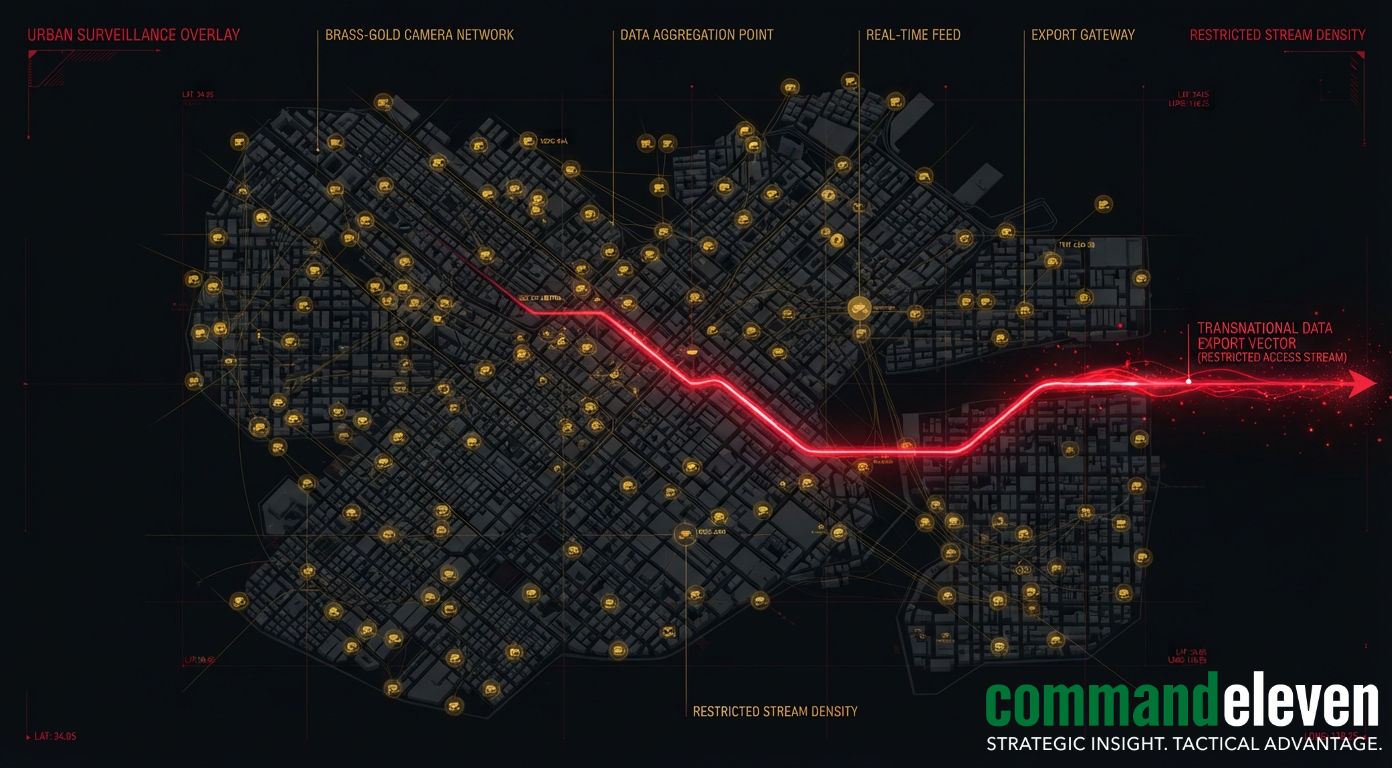
This consolidated data layer is paired with an expansive physical surveillance grid. Network engineers have installed thousands of high-definition, internet-protocol (IP) optical sensors across all entry and exit corridors, primary transit choke points, diplomatic quarters, and dense commercial sectors of Damascus.
These sensors are linked via a dedicated fiber-optic network to a centralized command center, bypassing standard commercial internet infrastructure to prevent signal interception or disruption by non-state actors. This ensures a continuous flow of real-time telemetry into the state’s analytical engine.
Technical Specifications: Biometrics, Facial Recognition, and Vehicle Tracking
The technical foundation of the Damascus “Safe City” protocol relies on three integrated automation layers: high-fidelity facial recognition, automated license plate recognition (ALPR), and real-time biometric validation loops. These systems process continuous data streams simultaneously, generating a live tracking matrix of the city’s population.
High-Fidelity Facial Recognition Engine
The facial recognition layer uses advanced deep-learning algorithms trained on centralized population registries, passport databases, and military intelligence watchlists. The optical nodes deployed at checkpoints and public intersections feature integrated edge-computing capabilities. This allows individual camera housings to extract facial geometry, convert it into an encrypted mathematical string, and cross-reference it against the central “Person of Interest” (POI) database in milliseconds. The system operates effectively under adverse conditions, utilizing infrared illumination to maintain tracking accuracy during nighttime hours and employing predictive models to bypass basic facial disguises, headwear, or aging variations.
Automated License Plate Recognition (ALPR) & Vehicle Telemetry
Vehicle movement throughout the capital is tracked via a dense network of specialized ALPR cameras positioned at every major intersection and perimeter checkpoint. This system captures vehicle license plates, cross-references them against vehicle registration logs, and logs the precise time, speed, and direction of transit. The tracking software features vehicle-signature analysis capabilities, which evaluate the make, model, color, and unique physical defects of a vehicle. This allows the system to identify cloned or forged license plates by detecting mismatches between the physical vehicle chassis and the registration data, instantly triggering local checkpoint alerts.
Real-Time Biometric Validation Loops
At physical transit terminals and major administrative checkpoints, the STG has replaced traditional identity documents with automated biometric verification kiosks. Passersby are required to interface with optical iris scanners and digital fingerprint collectors linked directly to the national identity database.
This verification loop eliminates the utility of forged physical documents or identity theft, as the individual’s live biological data must match the centralized registry to grant transit authorization or access to state services, locking down the physical movement of unregistered or clean-skin dissident elements.
The Authoritarian Surveillance Loop: China, Russia, and the Levant
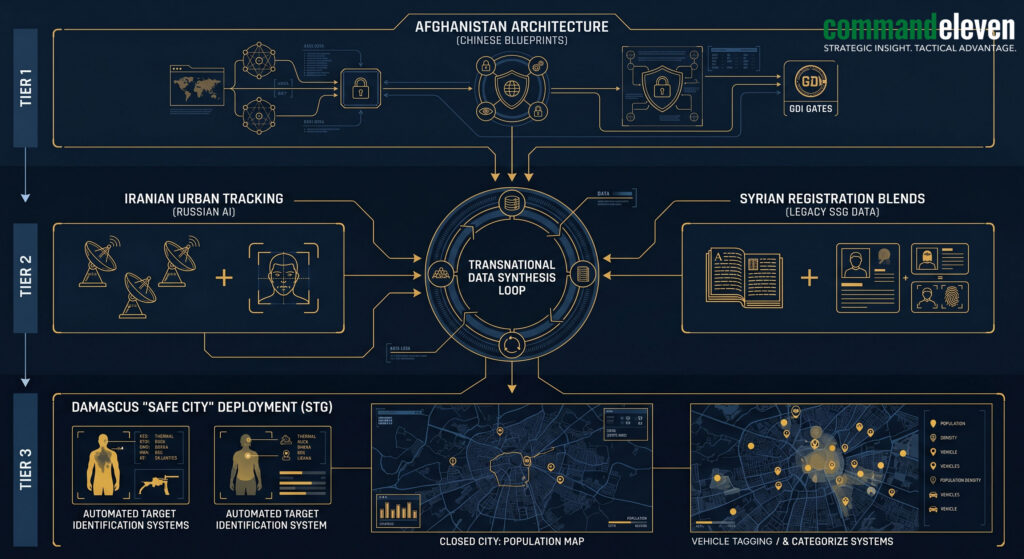
The deployment of the Damascus “Safe City” protocol completes a closed technical loop of authoritarian population-control models operating across high-conflict zones. This transnational framework represents a distinct axis of surveillance tech sharing, where Chinese-derived architectures and Russian-assisted software models are adapted to maximize state survival in volatile environments.
In Afghanistan, the Ministry of Interior (MoI) and General Directorate of Intelligence (GDI) have built an expansive urban surveillance net using blueprints and infrastructure templates inherited from Chinese telecom giants like Huawei and ZTE. This architecture focuses on the integration of the Electronic Tazkira (national digital ID card) with Automated Biometric Identification Systems (ABIS) and Automated Fingerprint Identification Systems (AFIS) at provincial checkpoints. This provides the regime with absolute vetting capabilities over rural-to-urban population shifts.
In Iran, the regime utilizes Russian-assisted AI data-mining software and network interception protocols to monitor digital dissent, track urban unrest, and manage automated facial recognition tracking networks across major municipal hubs. This software specializes in cross-referencing physical location telemetry gathered from cellular networks with social media activity and public surveillance feeds.
The Damascus “Safe City” protocol blends these two operational concepts into a single, high-intensity model. The STG utilizes Chinese-style hardware configurations and biometric integration strategies to manage its physical checkpoints, while deploying Russian-style data-analytics and network-tracking frameworks to monitor population movement and detect patterns of political dissent. This integration turns the Levant into an advanced testing ground for automated authoritarian governance, proving that fragmented post-conflict states can achieve absolute population control by automating their internal security matrices.
Deep Intelligence Deficit and Western Blind Spots
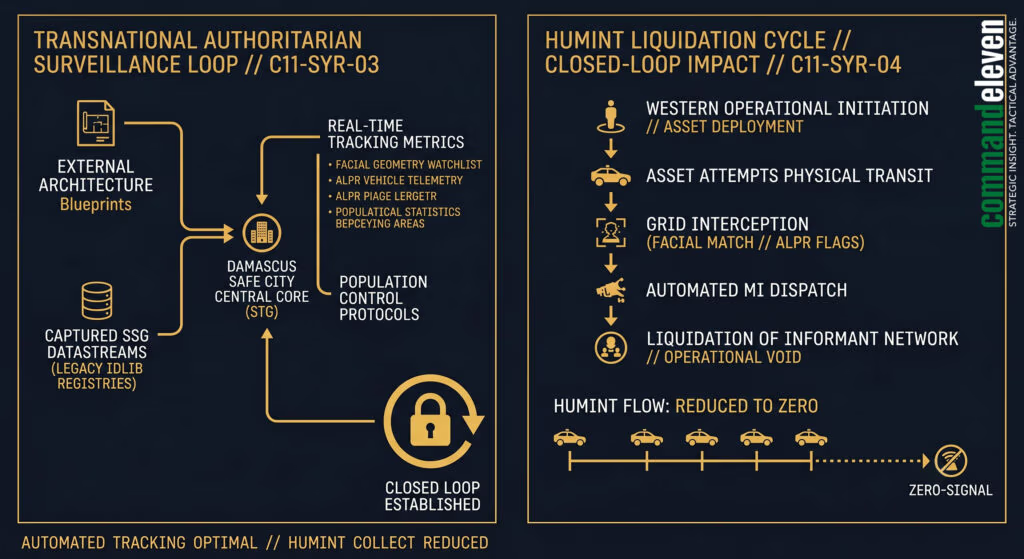
The rapid deployment of automated surveillance grids across high-conflict regions creates a deep intelligence deficit for Western agencies like the CIA, MI6, and partner European services. The transition from human-managed security setups to an automated, closed-loop surveillance models breaks the traditional mechanics of Western intelligence collection in the Middle East.
Historically, Western intelligence operations in Damascus and the wider Levant relied heavily on human intelligence (HUMINT) networks. Case officers recruited informants within state ministries, military departments, and local municipal councils to secure operational data, target profiles, and policy directives. However, the introduction of the “Safe City” protocol makes maintaining these informant networks dangerous.
Every individual operating within the capital is subjected to continuous biometric tracking and automated behavioral anomaly detection. If an informant shifts from their standard daily routine to attend an unlogged meeting, accesses a restricted administrative database, or communicates via an unauthorized digital node, the “Safe City” analytics engine flags the anomaly.
This triggers immediate investigation by state security, leading to the identification and elimination of the informant network.
This vulnerability forces Western agencies to scale back physical HUMINT collection inside high-surveillance zones to protect assets. This creates a critical collection gap, leaving Western policymakers blind to the internal political dynamics, strategic re-alignments, and covert operations planned within Damascus, while state actors operate with complete operational security behind an impenetrable electronic shield.
The RUMINT Variable: US-HTS Facilitation and Regional Tracking Blowback
The volatile rumor intelligence (RUMINT) suggesting that the Trump administration is considering a covert proxy relationship with HTS to counter Iranian networks in Syria introduces an explosive variable into the “Safe City” tracking matrix. This policy shift would turn the surveillance infrastructure into a weapon of proxy warfare, causing significant blowback for Western assets.
Should Washington initiate tactical coordination or intelligence sharing with HTS in the Levant, HTS networks will seek to penetrate the Damascus surveillance grid to locate and target Iranian-backed assets, Hezbollah logistics units, and state security commanders. However, because the “Safe City” architecture is fully integrated and monitored by state military intelligence alongside Russian technical advisers, any attempt by HTS to breach or manipulate the network will be quickly detected.
This friction introduces two primary regional blowback loops:
- Technical Interception of Western Intelligence Streams
- Any specialized cyber-intrusion tools, satellite imagery data, or tactical tracking coordinates shared by Western intelligence with HTS to help them bypass Damascus security checkpoints will be exposed to the “Safe City” telemetry engine.
- State technical units, working with Russian electronic warfare teams, will analyze these intercepted inputs to map Western collection methodologies, decode encrypted data formats, and develop effective countermeasures, neutralising Western technical superiority across the theater.
- Targeted Elimination of Western Assets via Compromised Data
- If HTS operatives or Western field personnel rely on forged identities or modified biometric profiles to enter Damascus for covert operations, the “Safe City” closed loop will flag them. By cross-referencing live iris scans and facial geometry against captured legacy SSG datasets and national registries, the system will identify the profile anomalies.
- This data will be routed directly to state security squads and Iranian-backed external operations networks, leading to the rapid capture of Western assets and providing the regime with powerful geopolitical leverage against Washington.