
Technical Takeaways
- Monopolization of Technical Brokerage: The Haqqani Network has transformed its cross-border smuggling network into a centralized technology clearinghouse, managing the import, testing, and distribution of advanced electronic assets for diverse non-state actors along the border.
- Degradation of State Tactical Superiority: The proliferation of Software-Defined Radios (SDR), frequency-hopping transceivers, and multi-band jammers has neutralized the historical monopoly of state forces over military communications, turning the border region into a highly transparent electronic battlespace.
- Transnational Technology Regurgitation: Any covert distribution of advanced Western military hardware to groups like HTS in the Levant will lead to the leakage and transit of those assets through the HQN matrix into the hands of South Asian threat groups, rapidly expanding the threat profile facing Western targets.
Bottom Line Up Front (BLUF)
The Haqqani Network (HQN) has solidified its position as the primary technological and intelligence broker along the Pakistan-Afghanistan border, orchestrating a sophisticated electronics and hardware proliferation matrix. Overcoming historical ideological rivalries, HQN operates a multi-tiered distribution network that channels advanced signals intelligence (SIGINT) equipment, military-grade electronic warfare (EW) modules, and commercial unmanned aerial system (UAS) components to the Islamic State Khorasan Province (ISKP), Tehreek-e-Taliban Pakistan (TTP), Balochistan Liberation Army (BLA), and Hay’at Tahrir al-Sham (HTS). This black-market technological optimization has systematically upgraded the survival capacity, tactical coordination, and anti-access/area-denial (A2/AD) capabilities of non-state actors across multiple theaters.
HQN as the Regional Technological Nexus
The contemporary operational profile of the Haqqani Network (HQN) has evolved beyond its traditional role as an asymmetric militant force into a highly specialized, transnational technology broker. Leveraging its institutionalized dual-footprint—holding senior administrative portfolios within the Islamic Emirate of Afghanistan (IEA) while maintaining independent control over covert cross-border smuggling corridors—HQN has established a monopoly over the inflow and distribution of advanced electronic assets along the Pakistan-Afghanistan border.
This proliferation framework relies on HQN’s unique capacity to exploit state-level logistics loops, diplomatic channels, and commercial import exemptions. HQN procurement units operating out of regional trade hubs, primarily Dubai, Guangzhou, and Islamabad, manage a network of front companies that import dual-use electronics under the guise of municipal infrastructure development, commercial telecommunications upgrades, and agricultural technology components.
Once these shipments arrive at port entries, they are routed through secure HQN-controlled warehouses in Kabul, Miram Shah, and Khost, where technical teams sort, test, and re-catalog the hardware based on operational requirements.
By functioning as a centralized technical clearinghouse, HQN has decoupled the acquisition of specialized military technology from localized militant logistics pipelines. Individual non-state actors no longer need to maintain complex international procurement pipelines; instead, they interface directly with HQN intermediaries within the border zone to purchase pre-configured, battle-ready hardware. This technical broker model ensures a steady supply of state-grade electronics to the regional insurgency, while providing HQN with immense geopolitical leverage and a continuous stream of hard-currency revenue to finance its independent state-building initiatives.
Proliferation Architecture: Downstream Distribution Matrices
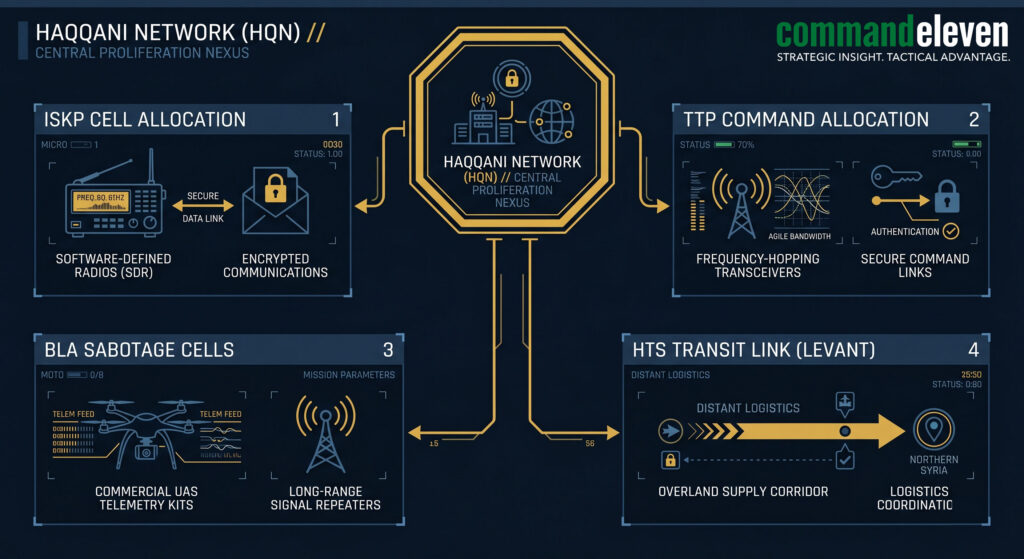
The downstream distribution architecture managed by HQN is a clinical, market-driven matrix that services a diverse array of non-state actors. Hardware allocations and technical sharing protocols are dictated by cash liquidity, geopolitical alignment, and tactical utility, allowing HQN to orchestrate technical upgrades across deeply disparate threat groups.
The ISKP & TTP Tactical Linkage
Despite the open conventional conflict between the IEA and the Islamic State Khorasan Province (ISKP), HQN elements maintain a covert, transactional relationship with ISKP field commanders, alongside their overt ideological alliance with the TTP. HQN systematically channels advanced SIGINT and communication equipment to both entities, including tactical Software-Defined Radios (SDR), frequency-hopping hand-held transceivers, and intercepted military-grade encryption keys. This sharing of communication assets allows both TTP and ISKP cells to monitor state security forces’ radio traffic, execute real-time operational deconfliction, and protect their command structures from state-directed electronic interception campaigns.
The Balochistan Liberation Army (BLA) Vector
The proliferation route extending to the BLA represents a transactional alignment focused on upgrading the group’s kinetic capabilities against strategic infrastructure. HQN supplies the BLA with commercial unmanned aerial system (UAS) components, long-range signal repeaters, and GPS-guidance chips. This technological injection has enabled the BLA to transition from basic guerrilla ambushes to executing synchronized, drone-assisted stand-off attacks against security outposts, industrial centers, and diplomatic personnel, significantly expanding their operational reach.
The Hay’at Tahrir al-Sham (HTS) Supply Route
The most distant leg of the HQN proliferation matrix runs through a series of intermediaries into northern Syria, feeding the HTS logistical core. HQN leverages its established trade links through the Iranian overland corridor and Turkish commercial markets to move specialized sub-components, including thermal optics modules, laser rangefinder components, and advanced encryption chipsets. HTS utilizes these assets to optimize its local arms manufacturing units (Manufacturing and Development Administration), integrating the high-grade components into locally produced weapon systems and surveillance arrays to secure technical superiority in the Levant theater.
Technical Catalog: SIGINT and Electronic Warfare Integration
The technical inventory circulated by HQN consists of specialized electronic warfare (EW) and signals intelligence (SIGINT) hardware designed to degrade the conventional superiority of state forces. Rather than distributing large conventional platforms, HQN focuses on low-signature, high-utility sub-components that can be easily integrated into standard insurgent field kit.
| Hardware Category | Specific Nomenclature / Variant | Target Functional Deployment |
| SIGINT Scanning | HackRF One / Software-Defined Radio | Broad-spectrum radio interception, localized cellular IMSI-catching, convoy radar monitoring. |
| Encrypted Comms | Harris Falcon III RF-7800 Series (Replica/Intercepted) | Tactical frequency-hopping voice networks, secure command node links, drone telemetry. |
| Electronic Counter | Custom Commercial Multi-Band Jammers | Neutralizing remote IED triggers, disrupting military drone control signals, checkpoint isolation. |
| Tactical Optics | FLIR Boson / Thermal Core Configurations | Custom sniper weapon sight integration, perimeter surveillance, nighttime kinetic navigation. |
The integration of these technologies follows a structured, modular approach. For example, the distribution of SDR platforms like the HackRF One allows field cells to conduct real-time tactical electronic reconnaissance. Insurgent teams position these lightweight scanners near military bases or along patrol routes to capture, log, and map the signal signatures of state security convoys.
This data is then compiled to identify gaps in checkpoint communications or map routine patrol schedules based on radio traffic anomalies, transforming a basic insurgent cell into a highly capable electronic surveillance unit.
Concurrently, the proliferation of custom commercial multi-band jammers has significantly degraded the effectiveness of state counter-terrorism operations. These portable units are engineered to flood local radio frequencies, neutralizing cellular and radio-controlled IED triggers during conventional military sweeping sweeps, or blocking the transmission lines of tactical security teams during sudden kinetic ambushes. This tactical use of electronic counter-measures isolates forward military detachments, prevents them from requesting air support or reinforcing columns, and allows insurgent teams to complete complex assaults with minimal risk of external intervention.
Operational Impact on Border Security Metrics
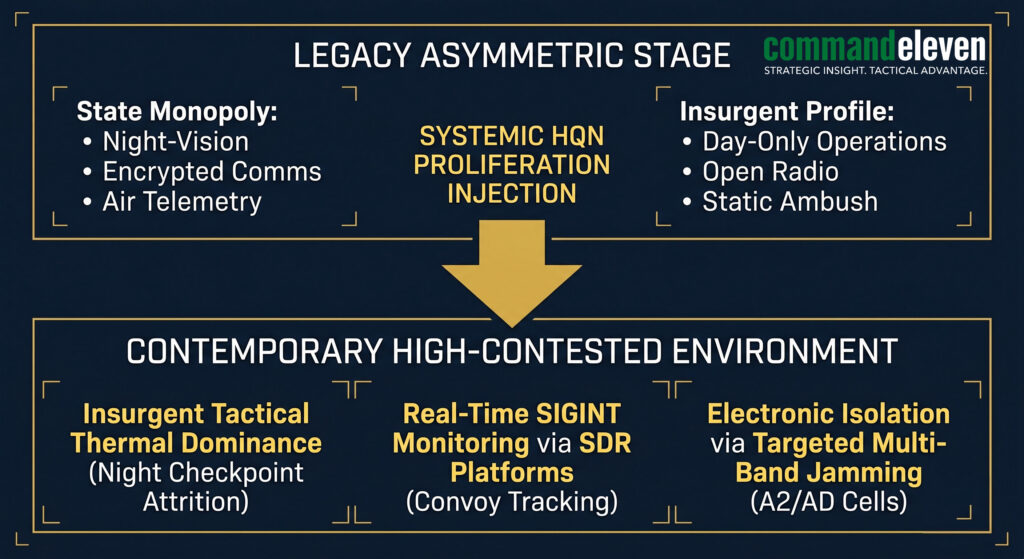
The systematic distribution of these advanced electronic assets by HQN has fundamentally altered border security metrics along the Pakistan-Afghanistan border, stripping state security forces of their historical technological and operational advantages. The traditional asymmetric landscape—where state forces maintained a monopoly over night-vision capabilities, encrypted communications, and aerial reconnaissance—has been replaced by a highly contested, transparent electronic battlespace.
The primary operational indicator of this shift is the sharp increase in effective long-range, nighttime kinetic operations executed by TTP and ISKP cells. Equipped with HQN-supplied thermal cores and night-vision monoculars integrated into Western-spec M4 carbines, insurgent sniper units now systematically target security checkpoints during zero-visibility windows. These operations target checkpoint sentries, communication towers, and power infrastructure, causing significant psychological attrition among forward security personnel and forcing state forces to withdraw from isolated outposts into consolidated, hard-site garrisons.
Furthermore, the proliferation of advanced communication gear has accelerated the tactical coordination speed of insurgent networks. By operating over secure, frequency-hopping digital networks that resist standard military jamming, decentralized field units can coordinate multi-pronged, simultaneous assaults across broad geographic sectors.
Real-time field intelligence—including live video feeds from commercial reconnaissance drones and intercepted military radio logs—is pushed directly to forward tactical commanders via encrypted messaging arrays. This fluid data flow allows insurgent units to out-maneuver state response columns, isolate targets with high precision, and maintain a high operational tempo that keeps conventional counter-terrorism forces on the defensive.
The RUMINT Variable: Transnational Escalation Dynamics
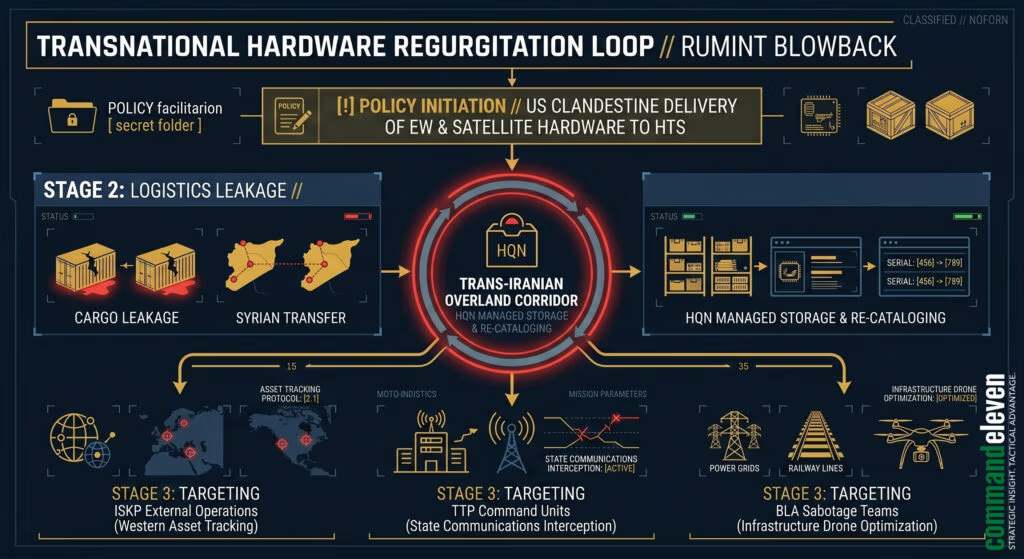
The volatile rumor intelligence (RUMINT) suggesting that the Trump administration is considering a covert proxy relationship with HTS to counter Iranian influence in Syria represents a highly destabilizing variable that will instantly ripple through the HQN technological network, creating significant blowback loops for Western assets globally.
Should Washington begin formalizing a proxy framework with HTS, providing the group with advanced electronic assets, encrypted satellite terminals, and precision counter-UAS hardware, HQN’s transnational proliferation network will serve as a primary transit line to monetize and redistribute these advanced systems. HTS procurement agents, operating via established financial and logistical connections with HQN intermediaries, will systematically export excess or compromised Western hardware out of the Levant back into the South Asian theater.
This transaction loop introduces two major transnational blowback vectors:
- Ingestion of Advanced US Technology by Regional Threat Actors
- Western-grade electronic warfare gear, advanced tactical communication kits, and encryption software delivered to northern Syria will be back-channeled through the HQN matrix into the hands of TTP, ISKP, and BLA cells operating along the Pakistan-Afghanistan border.
- These groups will leverage the newly acquired Western hardware to map and neutralize the electronic communication arrays used by regional Western diplomatic facilities, while upgrading their local anti-access/area-denial (A2/AD) capabilities to intercept state and allied reconnaissance platforms, significantly expanding the domestic threat envelope.
- The ISKP External Operations Activation Loop
- The acquisition of state-grade Western tracking and communication gear through the HQN corridor will instantly supercharge the external operations directory of ISKP.
- As detailed in the forthcoming tactical annex, ISKP specializes in remote-controlled operational planning targeting the Western Hemisphere. Access to advanced encryption systems and SIGINT scanning modules will allow ISKP external operations controllers to build secure, uninterceptable digital command lines linking their central planners with radicalized sleeper cells embedded inside North America and Western Europe.
- With Western domestic intelligence networks are currently focused on tracking state-level peer competitors, the early signatures of an ISKP cell utilizing advanced encryption gear to plan domestic mass-casualty attacks will likely be missed, exposing the homeland to a highly destructive, technologically optimized asymmetric campaign.