
Technical Takeaways
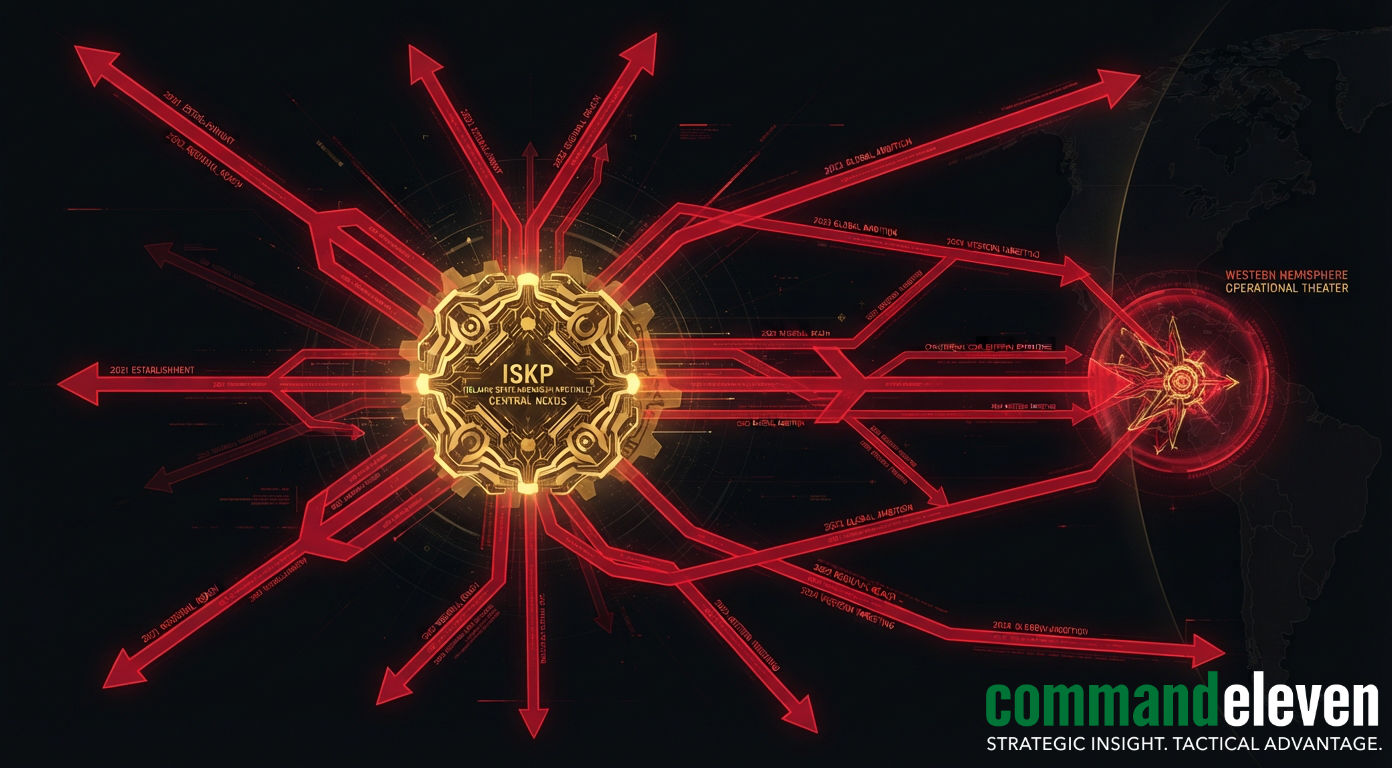
- Centralization of Global Striking Power: ISKP has evolved from a localized affiliate into the primary command hub for all ISIS external operations, building an independent, resilient operational directory in Central and South Asia that functions despite the attrition of core Levant structures.
- The Remote-Controlled Doctrine: Contemporary ISKP operations bypass traditional travel-tracking grids by managing the entire plot lifecycle remotely via encrypted applications, using peer-to-peer privacy tokens (XMR) and localized dual-use hardware procurement to minimize detection signatures.
- Transnational Technical Blowback: Any attempt by the US to utilize HTS as a proxy in Syria will provide ISKP with an explosive ideological recruitment narrative, while accelerating the leakage of advanced Western encryption hardware into Khorasan to secure uninterceptable command lines targeting the Western Hemisphere.
Bottom Line Up Front (BLUF)
Islamic State Khorasan Province (ISKP) has structurally transformed from a localized regional threat into the centralized command nexus for all ISIS external operations. While the ISIS core leadership in the Levant has faced persistent attrition, ISKP has established a redundant, highly resilient external operations directory based within Central and South Asia. This network systematically bypasses traditional Middle Eastern transit hubs by leveraging advanced multi-lingual media operations to radicalize, recruit, and mobilize Central Asian and European diaspora networks. Operating via remote-controlled operational planning, encrypted applications, digital asset financing, and decentralized logistical cutouts, ISKP coordinates complex, high-impact operations inside the Western Hemisphere and Europe completely independent of physical contact with the core leadership.
The Mutation of ISKP into a Global Command Hub
The evolution of ISKP from a regional affiliate into the primary external operations engine of the global ISIS network represents a critical structural mutation that remains widely misunderstood by Western intelligence networks. Historically categorized as a localized containment threat confined to eastern Afghanistan and parts of northwestern Pakistan, ISKP utilized the security vacuum following the 2021 Western withdrawal from Kabul to systematically rebuild its administrative, financial, and external plotting capabilities.
This structural shift was formalized following the sustained degradation of the ISIS core command structure in Syria and Iraq. As successive top-tier leaders in the Levant were eliminated by conventional state counter-terrorism campaigns, the global shura council decentralized its external operations directory, shifting the primary funding lines, technical expertise, and operational authority to the ISKP leadership core in Afghanistan. This transition effectively decoupled the group’s external striking capacity from the geographical constraints of the Middle East.
Under this new mandate, ISKP built a highly specialized organizational node known as the Al-Azaim Foundation for Media Production and its parallel external operations wing. This command node operates independently of the group’s local guerrilla wing (Wilayah Khorasan), which manages ongoing kinetic campaigns against the Islamic Emirate of Afghanistan (IEA) and Pakistani security forces. By separating its local operational assets from its transnational operations bureau, ISKP ensures that intense counter-insurgency pressure inside its home theater cannot disrupt its long-range external plotting lines targeting international capitals.
Transnational Recruitment Architecture & Diaspora Infiltration
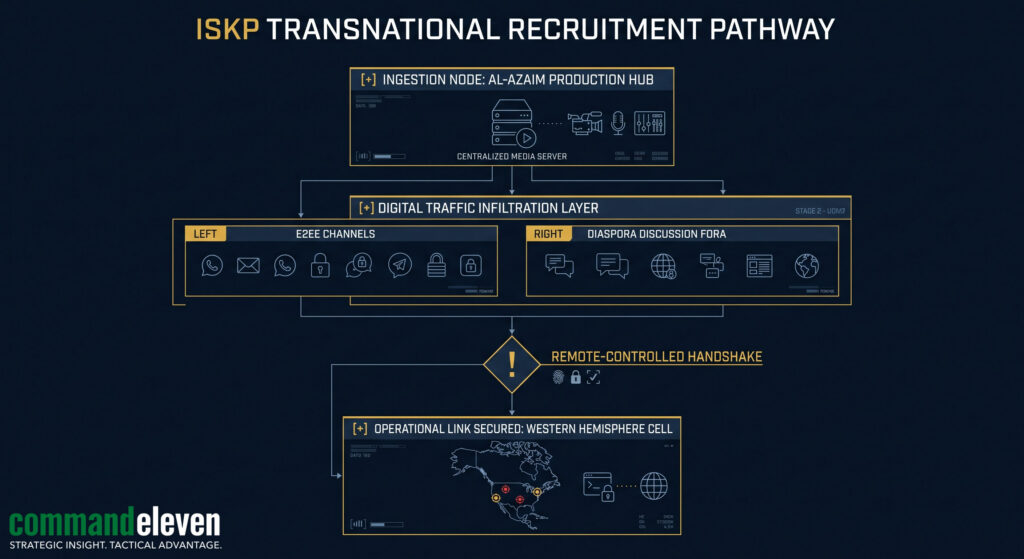
The primary operational asset that enables ISKP to project force into the Western Hemisphere is its highly sophisticated, multi-lingual recruitment architecture. While legacy jihadist networks historically relied on Arabic-language outputs that required complex translation chains to reach Western audiences, ISKP has engineered a diverse propaganda machine that outputs content simultaneously in English, Russian, Tajik, Uzbek, Pashto, Urdu, and Farsi.
This linguistic capability is specifically engineered to target unintegrated Central Asian and European diaspora networks residing inside Western nations. ISKP operational planners recognize that first- and second-generation migrant workers from Central Asia moving through Russia, Turkey, Europe, and North America often face acute social isolation, economic marginalization, and identity displacement. The Al-Azaim media framework systematically exploits these integration gaps, utilizing high-production-value digital essays, audio briefings, and encrypted chat loops to frame global geopolitical grievances through localized ethnic and religious lenses.
The recruitment pathway is highly clinical:
- Broad-Spectrum Infiltration: Operatives deploy targeted multi-lingual media across public social media platforms and message boards frequented by diaspora communities.
- Algorithmic Screening: Recruiters monitor interaction metrics, identifying users who consistently download, share, or comment on radicalized materials.
- Encrypted Migration: Once a potential asset is identified, communication is migrated away from public view into highly secure, end-to-end encrypted (E2EE) platforms like Telegram, Signal, or private Matrix servers.
- Operational Isolation: The asset is placed under the direct command of a dedicated external operations controller based in Khorasan. This individual completely isolates the recruit from local community structures, preparing them for remote-controlled operational deployment without ever requiring physical contact or travel to a foreign training camp.
The Remote-Controlled Operational Model
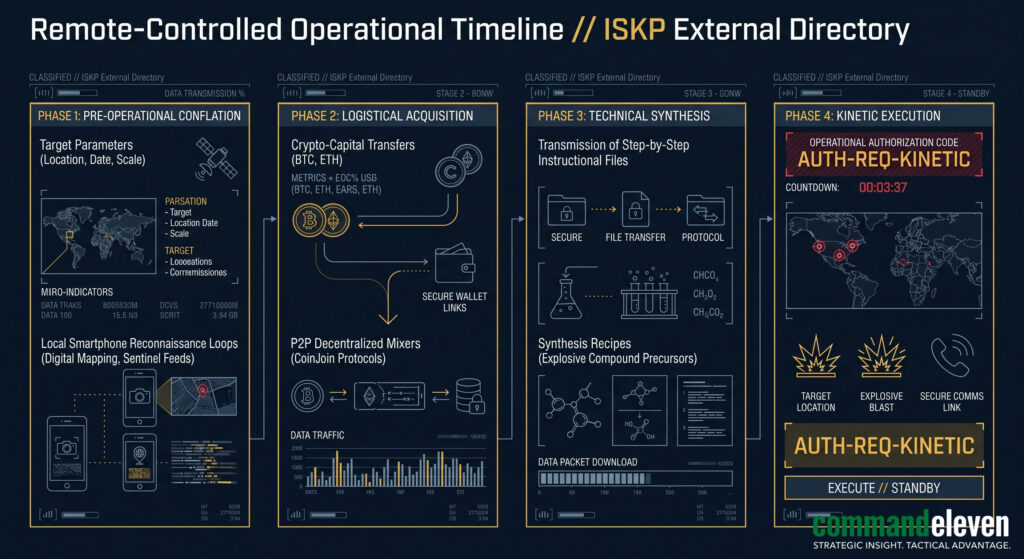
The contemporary ISKP operational doctrine relies on a “remote-controlled” attack model that eliminates the requirement for physical travel, centralized training infrastructure, or direct logistical handovers inside the target nation. This model minimizes the signature of the plot, preventing detection by traditional counter-terrorism monitoring grids designed to track foreign fighter travel or heavy financial anomalies.
Under this framework, the entire life cycle of an attack – from initial radicalization and target selection to tactical reconnaissance, hardware assembly, and final execution – is managed remotely via encrypted digital channels. The external operations planner based in the border region acts as a virtual handler, guiding the domestic asset through every phase of the operational blueprint.
To secure hardware assets without triggering local law enforcement flags, the remote handler instructs the domestic asset to exploit standard consumer technology and open-source information. Tactical blueprints are transmitted via encrypted file shares containing step-by-step video instructions on how to synthesize homemade explosive compounds (such as TATP or HMTD) using easily accessible household chemicals and beauty supply precursors.
If firearms are required, the handler guides the asset through local illicit black markets or instructs them to purchase semi-automatic platforms through legal channels using loopholes in domestic gun control regulations.
Financial facilitation is executed exclusively through peer-to-peer digital asset networks, systematically avoiding the formal banking system and traditional money transfer services. The ISKP financial desk transfers micro-grants using privacy-focused tokens (XMR) or structured Tether (USDT) transfers routed through non-custodial wallets and decentralized mixers.
These digital funds are liquidated by the domestic asset via peer-to-peer over-the-counter (OTC) exchanges or local cryptocurrency ATMs, providing the cell with immediate cash liquidity to purchase rental vehicles, secure safe rooms, and finalize hardware assembly under the continuous direction of the remote planner.
Target Profiling & Western Hemisphere Vulnerabilities
The target profiling matrix developed by the ISKP external operations directory prioritizes high-visibility, low-complexity strikes designed to maximize civilian casualties, generate intense psychological trauma, and cause systemic economic disruption within Western capitals. By shifting away from heavily fortified government or military installations, the group focuses its striking capacity on highly vulnerable, fluid environments that defy continuous security monitoring.
Key target categories within the Western Hemisphere include:
- International Transit Hubs and Aviation Corridors: Targeting civilian mass-transit nodes, subterranean rail links, and airport ground access infrastructure during peak operational windows. These environments offer high crowd density and guarantee instant transnational media coverage.
- Large-Scale Public Assemblies and Cultural Venues: Organizing synchronized small-arms or explosive assaults against crowded entertainment venues, shopping corridors, and major sports stadiums. The fluid nature of these crowds prevents the effective deployment of permanent security barriers, exposing soft targets to sudden kinetic interventions.
- Diplomatic and Sovereign Institutional Enclaves: Launching targeted strikes against softer diplomatic missions, international non-governmental organization (NGO) headquarters, and symbolic international corporate facilities to project an image of global operational reach and undermine state protective guarantees.
The vulnerability of the Western Hemisphere to this specific threat model is elevated by the current blind spots within domestic counter-terrorism frameworks. Because federal agencies like the FBI, CIA, and partner European services have redirected their primary analytical grids, surveillance capabilities, and field personnel toward state-level peer competitors, the quiet, low-signature indicators of a remote-controlled ISKP plot are highly likely to be missed.
A self-radicalized diaspora asset using commercial encryption apps and localized procurement methods generates almost no high-visibility signals, allowing the plot to advance smoothly to the final execution phase without triggering automated intelligence watchlists.
The RUMINT Variable: US-HTS Alignment and Multi-Theater Blowback Loops
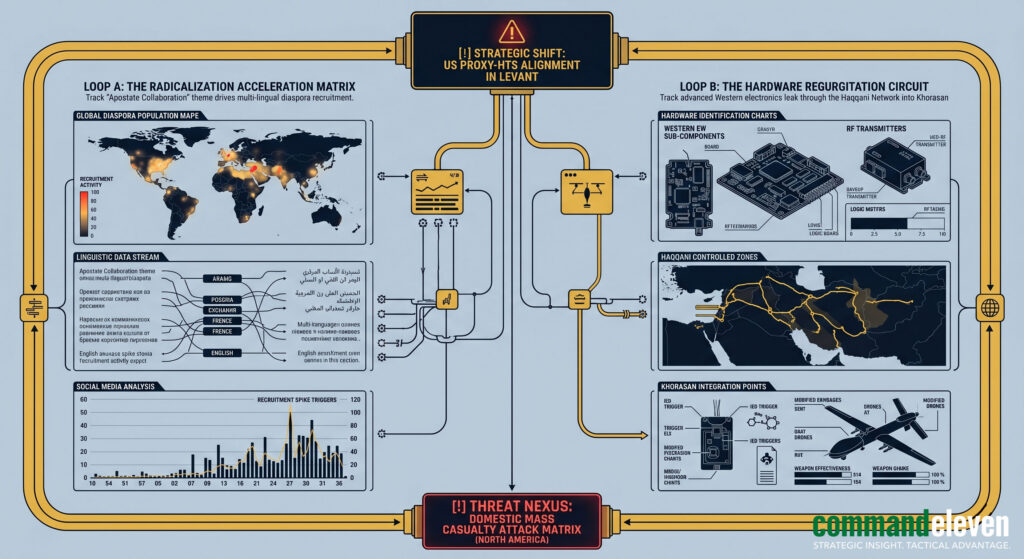
The volatile rumor intelligence (RUMINT) suggesting that the Trump administration is actively considering a covert proxy alignment with Hay’at Tahrir al-Sham (HTS) to counter the Iranian regime in Syria represents an explosive variable that will instantly supercharge the external operations capacity of ISKP, creating dangerous blowback loops inside the Western Hemisphere.
Should Washington formalize a relationship with HTS – providing the group with advanced signals intelligence equipment, encrypted communication gear, and specialized financial facilitation channels – the resulting disruption of the Syrian theater will provide ISKP with immense operational opportunities. Despite their shared Sunni alignment, ISKP views HTS as apostate collaborators due to their tactical willingness to interface with Western state actors. Consequently, ISKP external planners will weaponize this policy shift to accelerate their global recruitment and domestic targeting matrices.
This proxy alignment introduces two direct multi-theater blowback loops:
- The Weaponization of the “Apostate Collaboration” Narrative
- ISKP’s media apparatus will immediately leverage a US-HTS alignment to produce a high-intensity propaganda campaign across all linguistic channels. By framing HTS as a compromised proxy of Western imperialism, ISKP will effectively hollow out the recruitment base of more moderate regional factions.
- This narrative will resonate strongly within unintegrated diaspora networks, driving radicalized elements away from localized Syrian-centric groups directly into ISKP’s global external operations directory, rapidly expanding the pool of potential domestic strike assets inside the West.
- Technical Ingestion of Leaked Western Hardware
- As detailed in the core dossier (Dossier Charlie-1), advanced Western military equipment, satellite terminals, and encryption packages delivered to northern Syria will inevitably leak through corrupt supply lines into the Haqqani Network’s regional technology clearinghouse. HQN will redistribute these advanced systems directly to ISKP external operations hubs in Khorasan.
- Access to state-grade Western encryption modules and SIGINT scanning hardware will allow ISKP central planners to build secure, uninterceptable digital command lines linking their external operations directory with sleeper cells inside North America and Western Europe.
- With Western domestic intelligence networks currently focused on tracking state-level peer competitors, the early signatures of an ISKP cell using advanced encryption gear to plan domestic mass-casualty attacks will be missed, exposing the homeland to a highly destructive, technologically optimized asymmetric campaign.