
Technical Takeaways
- Systemic Collection Deficits: The prioritization of peer-competitor nation-states by the ODNI, CIA, and FBI has drained resources from counter-terrorism desks, dismantling the long-term domestic HUMINT networks required to penetrate insular threat cells.
- Exploitation of Structural Buffers: Transnational threat networks utilize unintegrated diaspora enclaves as physical and operational shields, executing recruitment, fundraising, and procurement tasks inside Western metropolitan zones without triggering high-level federal watchlists.
- Asymmetric State Retaliation Risk: Any formal or informal US policy alignment with HTS in the Levant will trigger an immediate domestic response from the IRGC Quds Force, mobilizing Unit 910 sleeper cells to execute kinetic strikes against critical infrastructure and soft targets within the Western Hemisphere.
Bottom Line Up Front (BLUF)
Strategic reorientations within the US and allied intelligence communities have generated critical collection deficits regarding domestic counter-terrorism vectors. The systemic redirection of resources toward peer-competitor nation-states by the FBI, CIA, ODNI, and partner agencies has inadvertently created pronounced operational blind spots within insular, unintegrated Western diaspora communities. By shifting away from tactical profiling and human intelligence (HUMINT) operations in these enclaves, the Western intelligence framework has lowered its defenses against low-signature, decentralized threat networks. This intelligence deficit, combined with the presence of hidden logistical safe havens, significantly increases vulnerability to asymmetric domestic attacks against soft targets, transport nodes, and critical infrastructure within the Western Hemisphere.
Posture Shifts Within the Western Intelligence Community
The contemporary Western intelligence architecture is undergoing its most significant structural realignment since the post-9/11 counter-terrorism expansion. Confronted by accelerating geopolitical competition, the Office of the Director of National Intelligence (ODNI), the Central Intelligence Agency (CIA), and the Federal Bureau of Investigation (FBI) have systematically redirected their primary collection, analysis, and operational assets away from non-state actors toward peer and near-peer nation-state adversaries.
This strategic reorientation has fundamentally transformed the internal asset allocation models of the intelligence community. Counter-terrorism divisions, which previously commanded priority funding, specialized personnel pools, and advanced surveillance access, have experienced steady budget attrition and personnel drawdowns. Specialized tactical teams and counter-terrorism analyst cadres have been reassigned to desks monitoring state-level electronic warfare, cyber-kinetic networks, and regional conventional mobilizations.
The structural impact of this transition is an acute degradation of long-term tracking networks focused on asymmetric threats. Within the domestic space, the FBI’s Joint Terrorism Task Forces (JTTFs) have experienced a reallocation of field agents toward counter-intelligence and corporate espionage investigations.
Concurrently, the CIA’s counter-terrorism operations have reduced their footprint in traditional regional sanctuaries, limiting the forward collection pipelines that historically provided early warnings of transnational threat vectors. This systemic posture shift operates under the strategic assumption that non-state actors are secondary threats that can be managed via automated technical means, creating a critical vulnerability that sophisticated insurgent networks exploit by adjusting their operational profiles.
Core Collection Deficits and Profiling Deficits
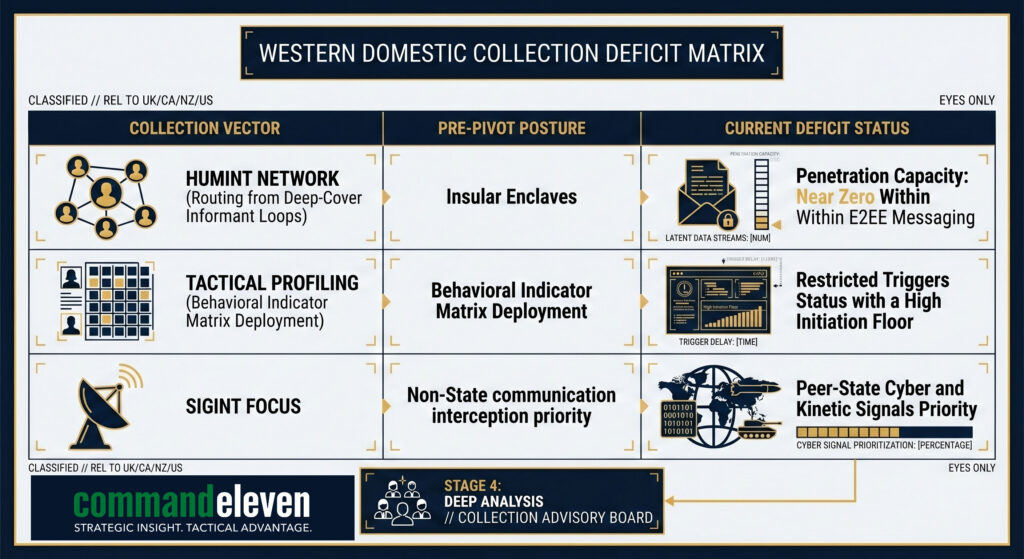
The primary consequence of this nation-state pivot is the emergence of deep collection deficits across both domestic and foreign intelligence fields. The most severe degradation has occurred within the human intelligence (HUMINT) framework, which remains the only reliable methodology for intercepting insular, non-state plotting.
Domestic intelligence agencies have largely dismantled the long-term, deep-cover informant networks that previously monitored radicalization nodes within insular metropolitan enclaves. This deficit is reinforced by an institutional shift away from proactive tactical profiling. Fearing political friction and judicial challenges regarding over-reach, federal agencies have restricted the parameters under which field offices can initiate preliminary assessments on suspected radicalization hubs.
The resulting tracking gap means that individuals executing early-stage logistical operations – such as identity manipulation or localized fundraising – rarely trigger the automated behavioral matrices used by counter-terrorism databases.
Concurrently, signals intelligence (SIGINT) capabilities managed by the National Security Agency (NSA) face technical limits when encountering the communications methodologies used by modern threat actors. The widespread adoption of end-to-end encrypted (E2EE) messaging applications and decentralized, serverless communication networks has degraded the efficacy of broad-spectrum metadata collection.
Because current SIGINT priorities prioritize tracking foreign state-level cyber threats, the processing power allocated to identifying low-signature, localized non-state communications has decreased. This allows specialized insurgent networks to coordinate logistical steps beneath the collection thresholds of Western agencies.
Infiltration Dynamics Within Unintegrated Diaspora Enclaves
As Western intelligence collection assets decrease, the operational space available to transnational threat networks within unintegrated diaspora enclaves expands. These enclaves, found across major urban centers in North America and Western Europe, provide a protective social buffer that shields clandestine cells from external law enforcement detection.
Infiltration does not rely on high-profile public recruitment campaigns. Instead, it occurs through insular, peer-to-peer social networks, underground religious study circles, and private linguistic cultural associations. Threat networks leverage these spaces because they operate with minimal oversight from municipal authorities or broader community leadership.
Within these unintegrated pockets, radicalization agents exploit cultural isolation and localized grievances to quietly build a distributed, low-signature support base.
The social insularity of these enclaves creates a high-barrier operating environment for law enforcement. External investigators or unvetted personnel stand out immediately, neutralizing traditional local police intelligence tactics. Furthermore, because these communities often maintain a deep distrust of federal law enforcement agencies, cooperative tips and community-led security interventions are rare.
Clandestine cells exploit this dynamic to establish stable safe houses, route illicit capital through local commercial fronts, and manage cross-border procurement pipelines within the heart of Western metropolitan zones, effectively using the host nation’s legal and social frameworks as a protective shield.
Domestic Attack Vulnerability Mapping
The intersection of collection deficits, reduced profiling parameters, and unmonitored domestic safe havens has elevated the vulnerability of the Western Hemisphere to an asymmetric domestic attack. Without reliable HUMINT indicators to disrupt plots during the planning phase, the threat timeline shifts from early-stage interdiction to active incident response.
The contemporary target profiling matrix favored by decentralized transnational networks prioritizes low-cost, high-impact operations against vulnerable targets that require minimal specialized hardware or prolonged logistical trails:
- Mass-Transit Infrastructure: Targeting regional rail networks, commercial aviation ground infrastructure, and major metropolitan transit hubs during peak traffic windows. These environments are difficult to secure continuously and guarantee maximum economic and psychological disruption.
- Soft Targets and Public Assemblies: Orchestrating synchronized small-arms or IED assaults against dense commercial corridors, public venues, and cultural gatherings. These operations require minimal pre-operational coordination, making them difficult to detect via standard technical SIGINT.
- Energy and Critical Telecommunications Infrastructure: Executing localized sabotage against vulnerable nodes within the electrical grid, pipeline valves, or regional cellular communication arrays. These tactics leverage open-source data to disrupt state security operations and cause widespread systemic paralysis.
These attack profiles do not require complex cross-border logistical lines or specialized training camps. By relying on locally sourced components, consumer technology, and self-radicalized personnel embedded within secure diaspora enclaves, modern threat actors can execute a complete operational cycle without generating the intelligence signatures that Western agencies are currently tracking.
The RUMINT Variable: US-HTS Alignment and Iranian Proxy Blowback
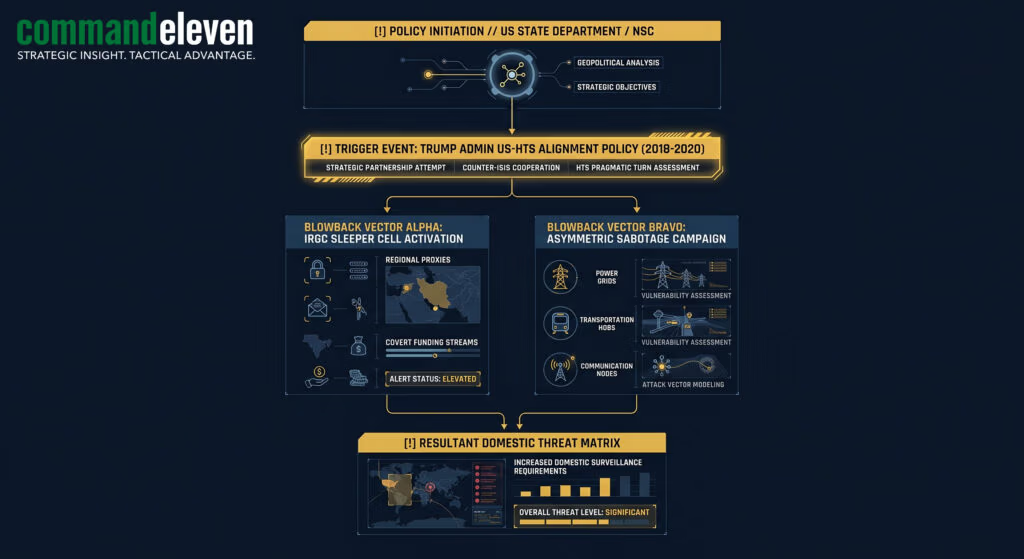
The volatile rumor intelligence (RUMINT) regarding the Trump administration’s potential deployment of Hay’at Tahrir al-Sham (HTS) as an asymmetric proxy against the Iranian regime represents a major threat multiplier for domestic vulnerabilities within the Western Hemisphere. If Washington executes this policy shift, it will alter the domestic threat matrix, exposing North American targets to retaliatory campaigns by state-directed covert cells.
The primary domestic risk stems from the immediate activation of Iranian-backed covert infrastructure already embedded within the United States and Canada. The Islamic Revolutionary Guard Corps (IRGC) Quds Force, alongside the Ministry of Intelligence and Security (MOIS), maintains an established network of sleeper cells, commercial fronts, and dual-national operational assets inside the Western Hemisphere.
Historically, these networks have focused on intelligence collection, corporate surveillance, and the tracking of dissident groups. However, under direct orders from Tehran, these entities can transition into kinetic execution assets.
Should the US align with HTS – a group Iran views as an existential extremist threat – Tehran will respond symmetrically by striking the American domestic space. The IRGC’s external operations wing, Unit 910, specializes in long-range asymmetric retaliation, utilizing highly disciplined, insular cells that operate independently of standard diplomatic covers.
The target selection for an Iranian-directed domestic counter-offensive would bypass hard military sites in favor of infrastructure nodes where past intelligence collection has identified vulnerabilities:
- Critical Energy and Port Infrastructure: Executing coordinated cyber-kinetic attacks or physical sabotage against major maritime shipping facilities, electrical switching substations, and critical energy pipelines.
- Diplomatic and Federal Administrative Targets: Launching targeted assassination campaigns or explosive assaults against soft diplomatic sites, federal security personnel, and think-tank installations associated with the policy change.
- High-Value Diaspora and Corporate Facilities: Striking high-visibility corporate offices, banking infrastructure, and prominent diaspora institutions to maximize economic costs and induce societal panic.
This domestic blowback loop would overwhelm current Western counter-terrorism frameworks. Because the FBI and ODNI have reduced their internal monitoring of non-state and proxy networks to focus on state-level conventional signals, the early indicators of an IRGC sleeper cell mobilization would likely be missed, exposing the domestic homeland to a highly destructive, state-sponsored asymmetric campaign.