
Technical Takeaways
- Tactical Realpolitik Supremacy: HTS and Hezbollah have decoupled their ideological hostility from their logistics requirements, establishing an overland supply corridor through northern Syria that secures transit revenues for HTS and critical hardware pathways for Hezbollah.
- Sanctions Insulated Clearing Matrix: The transaction settlement layer avoids traditional financial tracking systems by combining trade-based money laundering schemes inside local commodity markets with privacy-centric digital assets ($XMR$), preventing Western financial intelligence detection.
- Transnational Technology Leakage: Any attempt by the US to leverage HTS as an asymmetric proxy against Iran will result in the leakage of advanced Western tactical gear and intelligence data into the Hezbollah pipeline, while triggering immediate retaliatory strikes by Unit 910 sleeper cells inside the Western Hemisphere.
Bottom Line Up Front (BLUF)
Despite pronounced sectarian and ideological divergence, Hay’at Tahrir al-Sham (HTS) and Hezbollah have established a transactional logistical alliance within the Syrian theater. Operating as a critical, high-capacity supply chain broker, HTS manages a complex overland transport corridor traversing northern Syria to facilitate the secure movement of military-grade hardware, dual-use technology, and state-subsidized contraband into Lebanon. This relationship is driven entirely by mutual strategic survival: HTS secures significant transit revenues and access to specialized hardware markets to fund its state-building initiatives, while Hezbollah maintains a redundant supply line alternative to counter intensive conventional interdiction campaigns targeting its traditional transit hubs.
The Logistics Corridor: Northern Syria to Lebanon
The operational relationship between Hay’at Tahrir al-Sham (HTS) and Hezbollah is anchored on a contiguous overland logistics corridor that snakes through shifting zones of control in northern and western Syria. This corridor bypasses the high-visibility international highways that are continuously monitored by Western, Israeli, and state-level signals intelligence platforms, utilizing instead a network of secondary roads, rural transport tracks, and industrial bypasses.
The supply chain begins in procurement hubs and port entries adjacent to HTS-controlled territory in northwestern Syria. Once cargo is processed and cleared by HTS customs authorities, it is routed south through secure transfer zones in the Idlib and western Aleppo countryside. The route bypasses major state urban centers by cutting through the rural interfaces of Hama and Homs provinces, eventually terminating at designated border hand-off points along the unmonitored mountainous terrain of the anti-Lebanon border region, primarily near the northern Bekaa Valley.
To maintain high-volume throughput without attracting aerial surveillance or triggering automated satellite imagery detection anomalies, HTS and Hezbollah utilize a decentralized commercial cover strategy. Shipments are broken down and concealed within legitimate commercial freight operations, primarily agrarian transport, heavy construction machinery components, and industrial chemical shipments.
Vehicles are registered to front companies with clean corporate profiles, and drivers are equipped with authentic transit documentation issued by complicit regional administrative offices. This commercial blending ensures that shipments move smoothly through checkpoints managed by various local militias and state forces, establishing a reliable, low-signature logistics line capable of operating continuously during high-intensity regional kinetic escalations.
Hardware Proliferation and Contraband Vectors
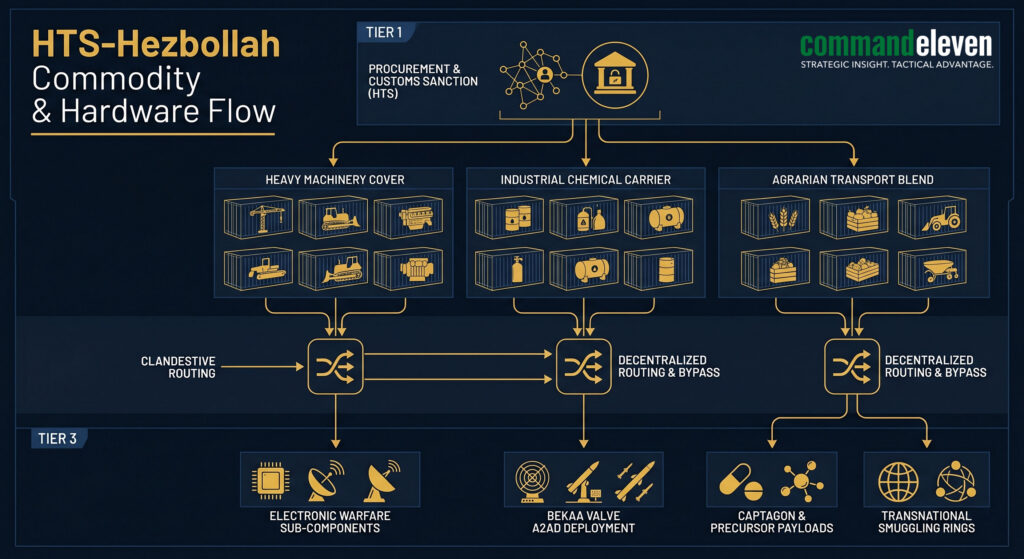
The cargo profiles traversing the HTS-brokered logistics corridor are highly diversified, reflecting the immediate operational shortfalls of Hezbollah and the financial requirements of the HTS administrative core. The transit network deliberately avoids large-scale, high-signature hardware deployments like ballistic missile frames, focusing instead on high-value, low-footprint electronic components, dual-use machinery, and illicit revenue-generating commodities.
A critical vector of this proliferation network involves the transport of advanced electronic warfare (EW) components, automated telemetry kits, and guidance system chipsets. These sub-components are procured by HTS-linked front companies operating in European and Asian markets, shipped into northern entry points, and then transferred to Hezbollah logistics units. The technical inventory frequently includes:
- Unmanned Aerial Vehicle (UAV) engine parts, carbon-fiber frames, and encrypted line-of-sight command links.
- Commercial GPS-jamming modules and software-defined radio (SDR) motherboard arrays.
- High-grade optical sensors, laser rangefinders, and localized cooling units for night-vision targeting matrices.
Concurrently, the corridor functions as a primary pipeline for illicit financial commodities, most notably Captagon (fenethylline) and refined chemical precursors. HTS facilitates the secure passage of industrial-scale chemical shipments required by production facilities in southern Syria and Lebanon, while managing the northward transit of finished narcotic payloads destined for international smuggling rings operating out of northern ports. By taxing these illicit shipments at every internal border crossing and checkpoint, HTS generates millions in liquid hard currency, while providing Hezbollah with a secure, deniable supply chain to fund its localized paramilitary payrolls.
Financial Symbiosis and Clearing Mechanics
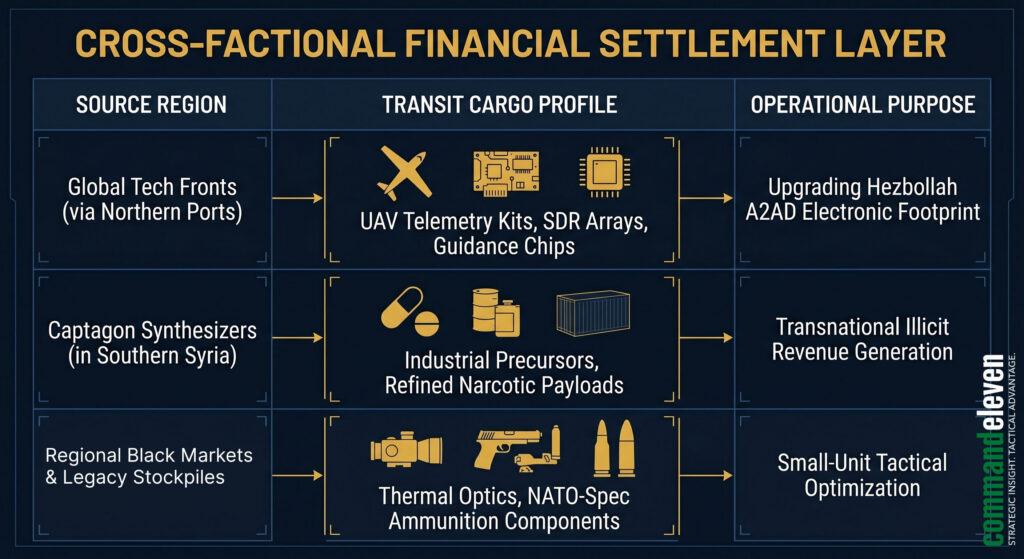
The operational continuity of this cross-factional supply chain requires a resilient financial clearing mechanism that operates completely independently of the traditional banking system. Because both HTS and Hezbollah are subject to strict international sanctions and global asset-freezing orders, the transaction settlement layer relies on a highly structured combination of trade-based money laundering (TBML), digital asset routing, and cash-vault deliveries.
The clearing cycle is managed through independent financial cutouts operating in regional commercial centers, primarily Istanbul, Beirut, and Damascus. When a shipment is scheduled, Hezbollah financial controllers do not execute a direct payment to HTS accounts; instead, they deposit fiat capital with trusted, non-aligned over-the-counter (OTC) exchange houses. These funds are then neutralized through complex trade-based schemes, such as purchasing consumer electronics or construction materials from international suppliers, which are subsequently shipped into HTS territory to replenish local markets managed by the group’s corporate entities.
For rapid, high-value technical transactions, the financial network utilizes privacy-focused digital asset protocols. Payments are executed via peer-to-peer (P2P) token transfers using non-custodial wallet systems that pass through decentralized tumbling networks. This digital capital is transferred directly to wallets managed by the HTS General Security Service, which liquidates the assets through complicit gold and currency brokers operating in permissive jurisdictions. This hybrid clearing model eliminates the risk of financial intelligence interception, ensuring that both organizations maintain continuous liquidity while expanding their joint logistics footprint.
Operational Deconfliction Protocols
To prevent tactical friction between field units operating along the borders of their respective territories, HTS and Hezbollah maintain a permanent, low-visibility operational deconfliction framework. This coordination layer does not imply an ideological alliance or strategic merging of political goals; rather, it functions as a highly clinical, transactional communications network designed to protect high-value assets from accidental kinetic engagements.
Deconfliction is executed through a dedicated joint coordination cell composed of middle-ranking intelligence officers and logistics commanders from both groups. This cell operates via secure, encrypted satellite communication links and regular in-person meetings at non-aligned border villages. The primary functions of this deconfliction node include:
- Route and Scheduling Synchronization: Coordinating the exact transit windows and geographic routes for high-value logistics convoys to ensure they do not cross paths with active localized military operations or state-level security sweeping sweeps.
- Visual and Signal Signature Management: Standardizing specific marking protocols, vehicle transponder signatures, or electronic verification codes that allow field units at local checkpoints to instantly recognize authorized transport vehicles without conducting invasive cargo inspections.
- Crisis Mitigation Frameworks: Establishing rapid-response contact protocols to immediately freeze movement and defuse tensions if a field detachment intercepts or detains a convoy due to localized command breakdowns.
This clinical approach ensures that the supply chain remains functional even during periods of open political hostility between the broader coalitions to which each group belongs, maximizing the operational survival of both networks.
Transnational Blowback: RUMINT, Israel, and the Western Hemisphere
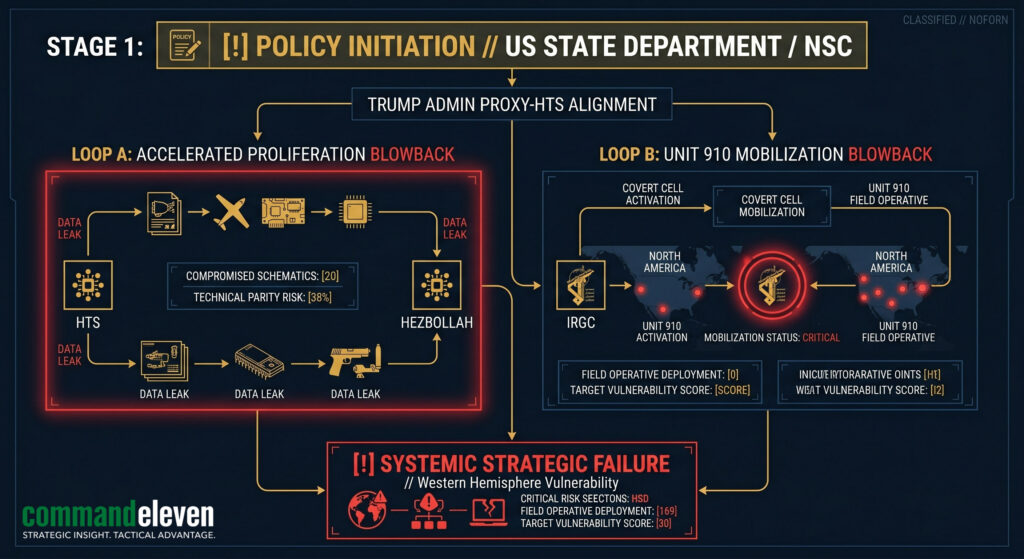
The potential activation of the Trump administration’s proposed proxy relationship with HTS to counter Iranian influence in Syria represents a volatile variable that will instantly alter the strategic calculation of the HTS-Hezbollah logistics network, triggering deep blowback vectors across both the Levant and the Western Hemisphere.
Should Washington begin providing tactical facilitation, intelligence streams, or sanctions relief to HTS as a tool to disrupt Iranian networks, the group will face a severe operational dilemma. While HTS central leadership would welcome Western resources to consolidate its governance structure in Damascus, it cannot immediately sever its logistics link with Hezbollah without triggering an existential conflict with both Hezbollah and the remaining IRGC proxy elements inside Syria. Consequently, HTS is highly likely to pursue a double-game strategy: accepting Western backing while maintaining covert, high-premium supply lines to Hezbollah through deniable, third-party logistics cells.
This double-game introduces two major transnational blowback vectors:
- Accelerated Technological Proliferation to Hezbollah
- Western military hardware, advanced encrypted communication components, and precision intelligence data provided to HTS will inevitably leak into the Hezbollah logistics pipeline. Hezbollah will leverage its financial leverage and established clearing mechanics to purchase these advanced Western systems directly from corrupt HTS logistics officers, rapidly upgrading its anti-access/area-denial (A2/AD) electronic warfare capabilities against conventional state actors.
- Mobilization of Domestic Sleeper Cells in the West
- The formalization of a US-HTS partnership will be interpreted by Tehran and Hezbollah as a direct threat to the survival of the resistance axis, triggering an immediate, asymmetric counter-offensive outside the primary theater of operations. Hezbollah’s external operations wing, Unit 910, alongside embedded IRGC Quds Force sleeper networks inside the United States and Canada, will be activated to execute retaliatory kinetic strikes.
- Since Western domestic intelligence agencies are currently focused on tracking state-level peer competitors, the early signatures of a Unit 910 mobilization targeting critical infrastructure, shipping nodes, and soft diplomatic targets will likely be missed, exposing the domestic homeland to a highly destructive, state-sponsored asymmetric campaign.