Technical Takeaways
- The Supremacy of Reflexive Control: Modern psychological subversion does not rely on coercion or overt censorship. Success is achieved when an adversary alters the informational baseline so completely that the target population voluntarily executes actions that damage their own nation, believing they are acting on personal conviction.
- The Weaponization of Existing Fault Lines: Adversaries rarely manufacture entirely new grievances. Instead, they operate as vulture opportunists, using precision distribution vectors to identify, widen, and permanently enflame pre-existing historical, ethnic, or sectarian fractures within the target state.
- Content Fact-Checking is Obsolescent: Attempting to debunk weaponized narratives after they achieve saturation is an ineffective defensive strategy due to the psychological stickiness of first impressions. Effective defense requires cognitive inoculation (prebunking) to expose subversion methodologies before exposure occurs.
Executive Summary

This dossier deconstructs the psychological layer of the cognitive battlespace, focusing on the strategic deployment of weaponized narratives to exploit historical, ethnic, and sectarian fault lines. Adversaries have transitioned from classical informational distribution to advanced reflexive control models.
By systematically feeding a target population tailored informational components, adversaries alter the target’s baseline perception of reality. This manipulation causes the target to voluntarily make decisions that advance the adversary’s strategic goals. The ultimate objective is the degradation of national cohesion, leading to the erosion of public willpower and the collapse of state resilience from within.
Analytical Deconstruction: The Tripartite Lifecycle
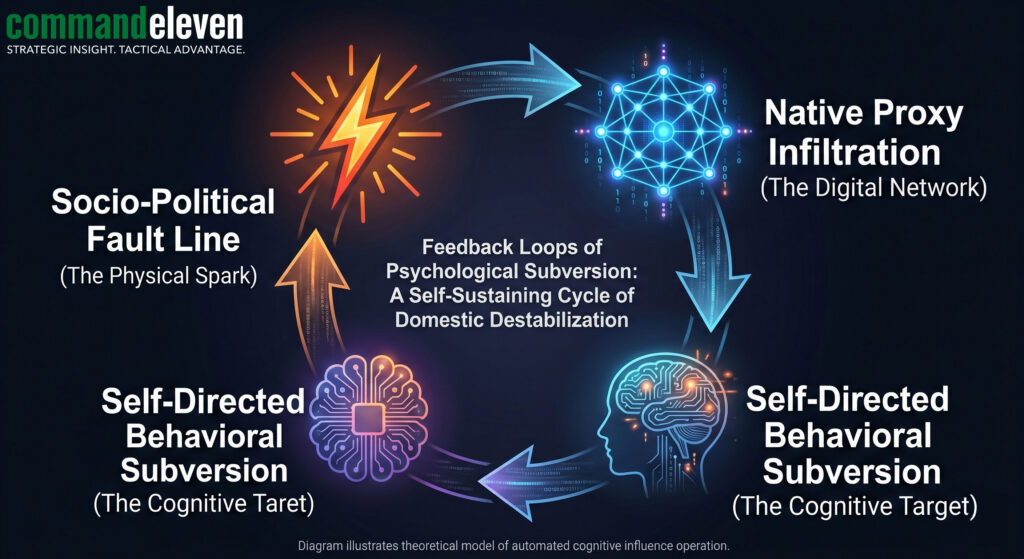
The Kinetic Trigger (Physical & Ingestion Layer)
The lifecycle initiates by mapping and monitoring existing domestic vulnerabilities. These focus on persistent institutional trust deficits, generational grievances, or socio-economic disparities.
The kinetic trigger occurs when an adversary exploits a real-world flashpoint—such as a localized policy failure, economic shock, or civil dispute—and introduces tailored disinformation artifacts to act as an accelerant.
The Algorithmic Vector (Distribution & Logic Layer)
The distribution apparatus avoids overt foreign state media channels, opting instead for native proxies and automated bot networks to infiltrate organic digital spaces.
By mimicking native language syntax and cultural markers, the algorithmic vector bypasses institutional defenses. It embeds the weaponized narrative deep within trusted community channels, ensuring the hostile injection is perceived as authentic domestic discourse.
The Cognitive Impact (Human & Behavioral Domain)
The systemic execution of the weaponized narrative drives deep psychological subversion, moving through three operational stages:
- Erosion of Shared Epistemic Reality: Coordinated narrative tracks inject intense skepticism into all mainstream information channels. As the boundary between verifiable fact and fabricated fiction blurs, the target populace enters a state of cognitive paralysis, defaulting to hyper-partisan defensive postures.
- Exploitation of Reflexive Control: The adversary does not force an action; rather, they alter the informational baseline so the target arrives at a predetermined conclusion independently. The target’s resulting behavioral choices (e.g., civic non-compliance, rioting, or policy paralysis) are executed voluntarily, concealing the external origin of the manipulation.
- Psychological Attrition: Continuous exposure to conflicting, high-anxiety narrative variants breaks down psychological resilience. This sustained stress response exhausts the mental processing capacity of both the general public and the leadership cadre, severely compromising national willpower during a crisis.
Threat Matrix: Narrative Subversion Vectors
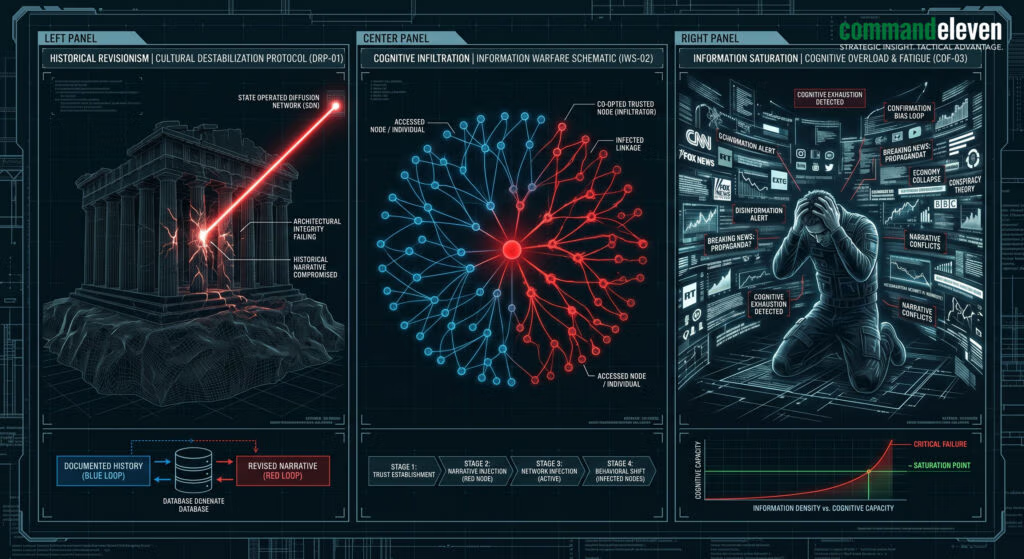
The table below outlines the primary methodologies employed by adversarial intelligence services to execute identity-driven psychological subversion.
| Vector Methodology | Operational Mechanism | Strategic Subversive Objective |
| Historical Revisionism | Amplifying and distorting historical grievances via micro-targeted multimedia campaigns. | Invalidating the founding principles of the state and eroding generational patriotism. |
| Cognitive Infiltration | Co-opting domestic influencers and civic leaders to champion divisive, adversary-aligned narratives. | Mainstreaming radical viewpoints by passing them through trusted native gatekeepers. |
| Information Saturation | Flooding the information ecosystem with contradictory explanations of a singular crisis event. | Inducing absolute cognitive exhaustion, forcing the population to abandon objective analysis. |
Strategic Defensive Counter-Measures
Defensive frameworks must transition from defensive debunking to proactive psychological hardening:
- Cognitive Inoculation (Pre-bunking): Deploying systematic public communication campaigns that expose the structural manipulation techniques used by adversaries before the population encounters the hostile narrative payload.
- De-Anonymization of Information Chains: Implementing cryptographic source-verification and origin-tracking standards for civic information, forcing accountability across digital platforms.
- Civic Narrative Hardening: Cultivating robust, unifying national narratives anchored in objective truth to bridge domestic fault lines and reduce the psychological traction of adversary-led subversion campaigns.
Cognitive Warfare: The Battle for the Human Domain
- Strategic Preface – The Battle for the Human Domain
- Cognitive Warfare Infrastructure Analysis: Data Chokepoints & Subsea Cables – Foundation
- The Architecture of Cognitive Dominance – Part 1
- Algorithmic Amplification and Echo Chambers in Cognitive Warfare – Part 2
- Weaponized Narratives and Psychological Subversion – Part 3 (you are here)
- Algorithmic Amplification Vectors – Brief