
Technical Takeaways
- Outrage as an Architectural Requirement: Modern recommender engines prioritize moral outrage and identity-threat narratives because these stimuli generate the highest velocity-of-engagement coefficients. Polarization is an engineered feature of engagement-maximization models, not an accidental byproduct.
- Deconstruction of Independent Reality: Strategic exploitation of collaborative filtering systematically removes moderating data from a user cohort’s feed. This creates total epistemic isolation, leaving the target population incapable of processing objective facts that contradict their algorithmically conditioned environment.
- Physical-Logical Dependency: The algorithmic vector depends completely on structural platform telemetry, such as dwell-time tracking and psychographic profiling. Cognitive defense requires structural interventions at the logical layer, including algorithmic circuit breakers and strict data-harvesting restrictions, rather than simple content-level fact-checking.
Executive Summary
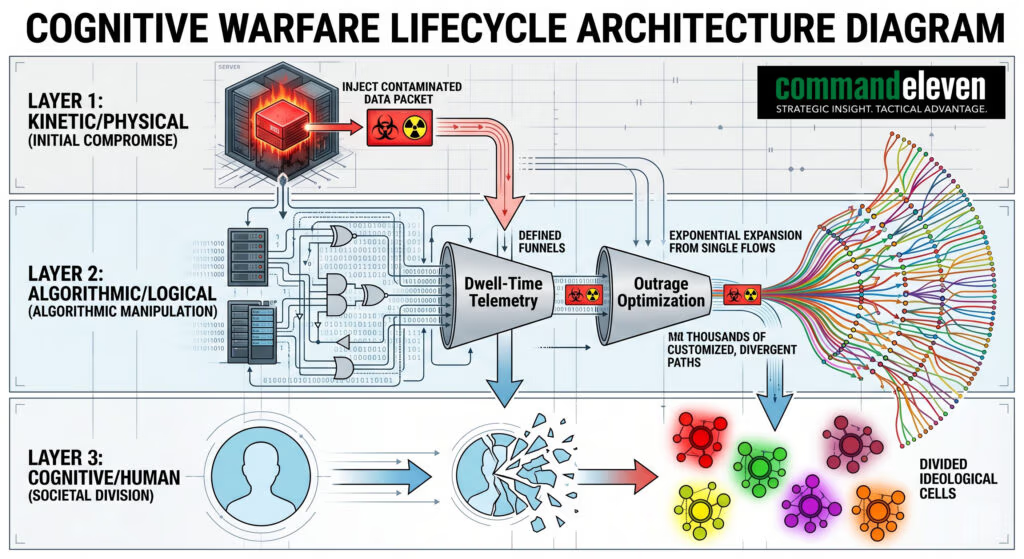
This dossier deconstructs the logical layer of the cognitive battlespace, focusing on how engagement-maximization algorithms are weaponized to achieve structural polarization. Modern information routing architectures do not function as neutral pipelines. Instead, they optimize for hyper-reactive emotional states, primarily outrage, to maximize user retention.
Adversarial elements exploit this architectural vulnerability by engineering information payloads that align with platform optimization models. This process converts organic social media infrastructure into an automated, precision-guided delivery system for psychological subversion. The end state is the fragmentation of the target populace into closed, ideologically pure echo chambers, paralyzing collective national decision-making.
Analytical Deconstruction: The Tripartite Lifecycle
The Kinetic Trigger (Physical & Ingestion Layer)
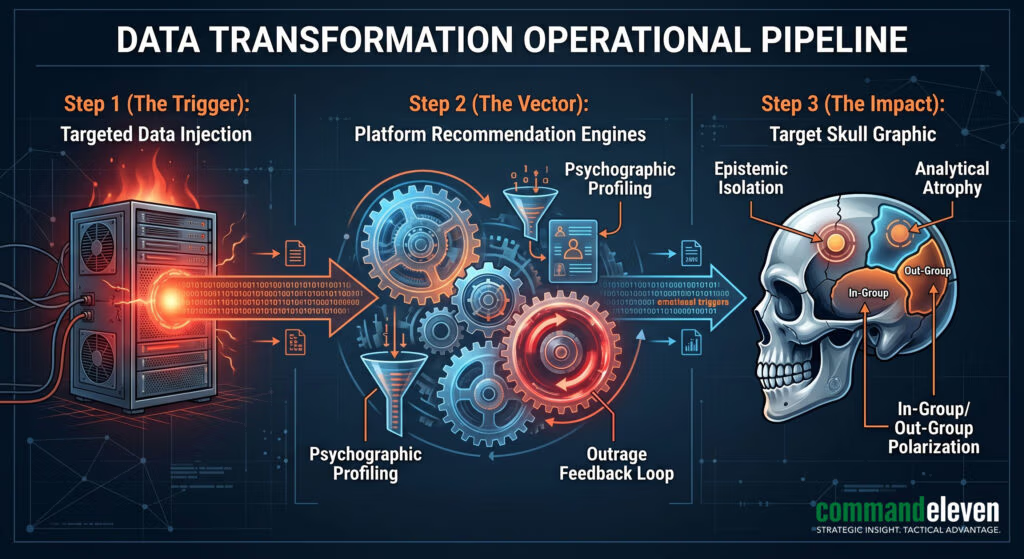
The lifecycle initiates with the strategic injection of a polarizing data payload into the digital ecosystem. This trigger can take the form of an engineered leak, a highly contextualized misrepresentation of a local security incident, or a high-fidelity synthetic asset.
The adversary selects ingestion points based on pre-mapped demographic vulnerabilities. It targets specific regional, ethnic, or political fault lines to ensure immediate traction within a localized user base.
The Algorithmic Vector (Distribution & Optimization Layer)
Once ingested, the platform’s native recommendation architecture drives the transmission mechanism. The algorithmic vector operates through three distinct structural phases:
- Psychographic Profile Mapping: Recommender engines construct detailed psychographic profiles of users based on behavioral telemetry, including dwell time, click-through rates, and interaction history. This data allows for the automated identification of cognitive vulnerabilities at the individual and cohort levels.
- Outrage Optimization Loops: Platform logic prioritizes content that generates high velocity-of-engagement metrics (shares, comments, emotional reactions). Because moral outrage and identity-threat narratives yield the highest engagement coefficients, the algorithm actively promotes polarizing content to adjacent profiles, bypassing standard factual verification delays.
- Echo Chamber Solidification: As a cohort interacts with the amplified payload, the recommender system continuously refines its feedback loop. It systematically filters out dissenting perspectives or moderating information, creating a closed-loop informational vacuum.
The Cognitive Impact (Human & Behavioral Domain)
The systemic execution of the algorithmic vector yields deep psychological degradation across the targeted population:
- Epistemic Isolation: Targets lose the capacity to process objective reality outside their algoritmically defined environment. External facts are reflexively dismissed as hostile propaganda.
- Hyper-Sensitization of In-Group/Out-Group Dynamics: The continuous reinforcement of threat narratives hardens tribal identities. The out-group is progressively dehumanized, lowering the threshold for political violence or civic non-compliance.
- Analytical Atrophy: The rapid-fire delivery of emotionally charged stimuli induces cognitive fatigue. This process degrades slow-system analytical reasoning, forcing the target population to rely entirely on fast-system emotional heuristics.
Threat Matrix: Structural Vulnerabilities
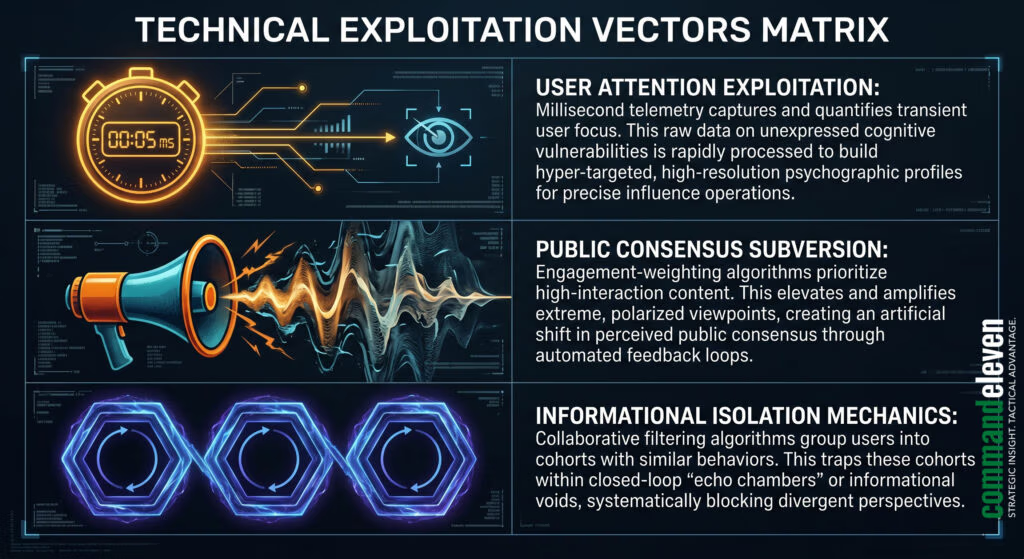
The table below outlines how specific structural components of modern platform architecture are exploited to execute cognitive subversion campaigns.
| Platform Component | Technical Exploitation Mechanism | Strategic Subversive Objective |
| Dwell-Time Telemetry | Tracking millisecond pauses on content to map unexpressed anxieties or biases. | Automated calibration of psychographic profiles for micro-targeted operations. |
| Engagement Weighting | Rewarding shares and reactions over passive views, giving disproportionate visibility to polarizing extreme views. | Artificially shifting the Overton window to manufacture a false sense of popular consensus. |
| Collaborative Filtering | Grouping users with similar consumption habits and serving identical downstream content. | Systemic eradication of alternative viewpoints, locking the cohort into an absolute echo chamber. |
Strategic Defensive Counter-Measures
Defensive architectures must shift from reactive content debunking to systemic logical interventions:
- Algorithmic Circuit Breakers: Implementing automated protocols that reduce the distribution velocity of unverified, high-outrage content during active national security crises or electoral periods.
- Friction Injection: Mandating interface design adjustments, such as prompt confirmations before sharing, to disrupt rapid-fire emotional heuristics and force analytical engagement.
- Data Privacy Sovereignty: Restricting bulk psychographic data harvesting and profiling by non-state tech entities to prevent foreign intelligence services from acquiring precision-targeting blueprints.
Cognitive Warfare: The Battle for the Human Domain
- Strategic Preface – The Battle for the Human Domain
- Cognitive Warfare Infrastructure Analysis: Data Chokepoints & Subsea Cables – Foundation
- The Architecture of Cognitive Dominance – Part 1
- Algorithmic Amplification and Echo Chambers in Cognitive Warfare – Part 2 (you are here)
- Weaponized Narratives and Psychological Subversion – Part 3
- Algorithmic Amplification Vectors – Brief