
Key Judgments
- [CONFIRMED] – FBI Director Kash Patel reported the Bureau disrupted 640 terrorism plots in 2025 – more than double the 299 disrupted in 2020, and part of a documented multi-year upward trend. According to the Institute for Strategic Dialogue, 2025 saw the first successful ISIS-inspired attacks on US soil in eight years, alongside five additional disrupted plots and six material-support arrests, with all but one incident involving perpetrators under the age of 20.
- [CONFIRMED] – The January 1, 2025 New Orleans Bourbon Street attack, in which Shamsud-Din Jabbar killed 14 people after pledging allegiance to ISIS, was the deadliest of at least four additional ISIS-inspired plots or attacks documented in this dossier between late 2025 and August 2026: a March 7, 2026 bombing plot targeting protesters outside New York’s Gracie Mansion (two teenage suspects, ages 18 and 19); a December 2025 New Year’s Eve plot targeting a North Carolina grocery store and restaurant (an 18-year-old suspect who pledged bayat to ISIS and left notes targeting “Jews, Christians and LGBTQ individuals”); an August 2026 plot targeting the New York State Capitol in Albany; and a multi-state material-support conspiracy (Kansas, California) involving attempted drone purchases to support attacks on US service members overseas.
- [CONFIRMED] – This series’ preceding Muslim Brotherhood in America series and this dossier document analytically distinct phenomena. The Muslim Brotherhood network examined in that series is an institutional-influence and historical terrorism-financing story, adjudicated most significantly through the 2008 Holy Land Foundation prosecution. The threat examined in this dossier is a live, ongoing pattern of ISIS- and, in isolated cases, AQ-inspired lone-actor and small-cell violence, radicalized primarily online. This dossier does not conflate the two, and flags any claimed connection between them as requiring independent, case-specific evidence.
- [ASSESSED] – The youth concentration in ISIS-inspired plotting documented above – nearly all cases in the 2025-2026 window involving suspects under 20 – mirrors the age profile CommandEleven Intelligence documented in Part I’s discussion of “764” recruitment, though the two phenomena are ideologically unrelated. CommandEleven Intelligence assesses this convergence reflects a broader pattern of online radicalization pipelines reaching younger populations across ideologically opposed movements, a structural observation about the information environment rather than evidence of any operational connection between the networks.
- [ASSESSED] – CommandEleven Intelligence assesses the March 1, 2026 Austin shooting by Ndiaga Diagne – in which the attacker was reportedly seen wearing clothing referencing both “Property of Allah” and Iranian iconography before killing three people – as a case requiring caution rather than firm ideological classification; FBI San Antonio’s own public characterization as of this writing is a “potential matter of terrorism,” not a confirmed ideological attribution.
The Reactivated Threat
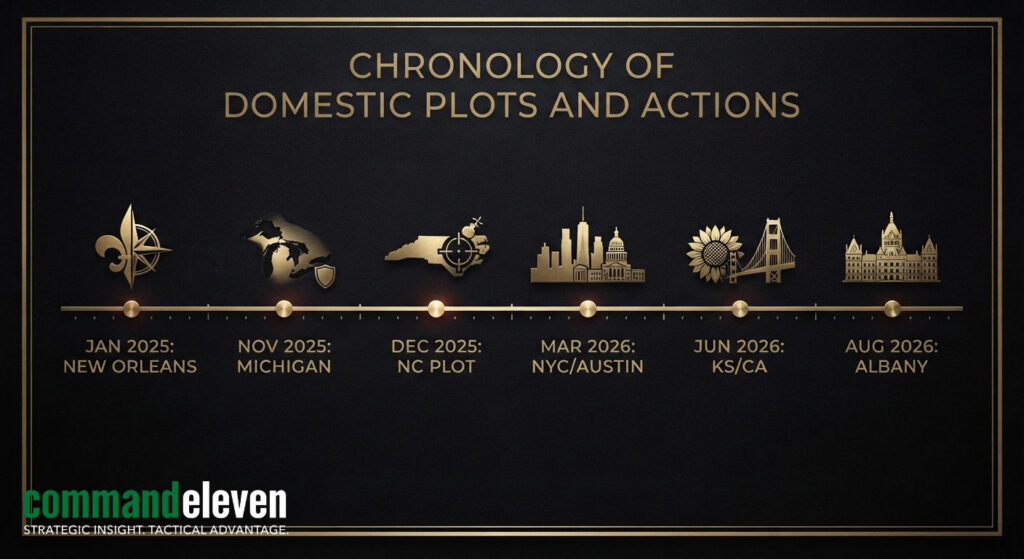
For eight years prior to 2025, the United States had not experienced a successful ISIS-inspired attack on domestic soil – a gap reflecting both degraded ISIS core capability following its territorial defeat and sustained US counterterrorism pressure on the group’s external-operations capacity. That gap closed on January 1, 2025, when Shamsud-Din Jabbar drove a truck into a crowd on New Orleans’s Bourbon Street, killing 14 people, after pledging allegiance to ISIS. Part II of CommandEleven Intelligence’s Muslim Brotherhood series examined the unresolved question of Jabbar’s specific radicalization pathway; this dossier treats the New Orleans attack instead as the opening incident of a documented, ongoing pattern rather than an isolated event.
That pattern has continued through 2026: two teenagers charged with an attempted bombing outside New York’s Gracie Mansion in March, reportedly seeking to exceed the scale of the 2013 Boston Marathon bombing; an 18-year-old North Carolina man arrested days earlier for a detailed New Year’s Eve plot against a grocery store and restaurant, whose recovered notes specifically named Jewish, Christian, and LGBTQ people as targets; an August 2026 plot against the New York State Capitol; and a cross-state material-support conspiracy in which three men allegedly pledged allegiance to ISIS and pooled funds to purchase drones intended for use against US service members overseas. FBI arrests connected to ISIS-inspired plotting have occurred with enough frequency across 2025-2026 that Director Patel’s public accounting of 640 total disrupted plots for 2025 – more than double the 2020 figure – represents, on this dossier’s read, a genuine escalation rather than a statistical artifact of expanded federal reporting practices alone, though this dossier cannot fully rule out the latter as a contributing factor without independent methodology review.
A Youth Radicalization Pattern, Not a Youth Radicalization Pipeline
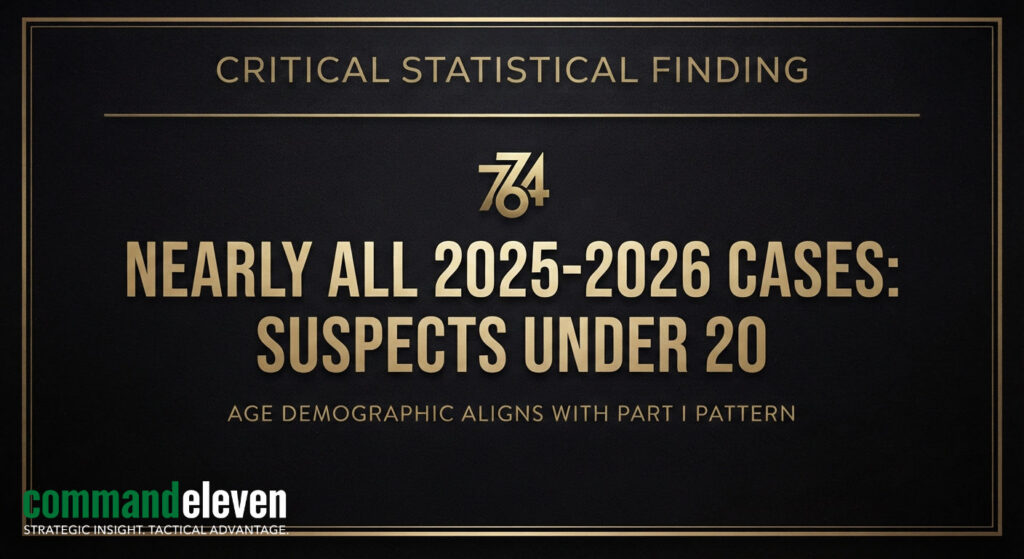
[ASSESSED – analytical observation, not evidence of connection] A striking pattern across the cases is age: with one documented exception, every perpetrator or arrested plotter in this dossier’s 2025-2026 dataset was under 20 years old. This dossier draws a structural parallel – not an operational one – to the discussion of “764” and its documented targeting of minors: both phenomena appear to reflect an online radicalization environment increasingly effective at reaching adolescents rapidly, regardless of the ideology on offer. CommandEleven Intelligence has found no evidence of overlap between ISIS-inspired online radicalization networks and 764 or its affiliated NVE networks; the parallel here is about the information ecosystem’s structure, not a shared actor set.
What This Dossier Does Not Claim About the Muslim Brotherhood Connection
Because this series’ Part III sits downstream of a five-part Muslim Brotherhood series, it is worth stating plainly what connection this dossier does and does not draw. The Muslim Brotherhood network documented in that series is an organizational, financial, and historically terrorism-financing story – its most serious adjudicated conduct (the HLF prosecution) involved material support to Hamas, not incitement of the kind of lone-actor ISIS-inspired violence catalogued in this dossier. No case examined in this dossier’s Section I has a documented organizational link to any entity examined in the Muslim Brotherhood series.
- [DATA DEFICIT] – This dossier does not rule out that individual radicalization pathways in some of these cases may intersect with institutions examined in that series – Part II of the Muslim Brotherhood series flagged the unresolved Houston mosque/CAIR pattern specifically as an open question – but no case in this dossier’s dataset provides direct evidence of such a link, and this dossier does not manufacture one.
The Iran Dimension
CommandEleven Intelligence’s prior Iran Homeland Threat dossier examined a distinct, state-linked threat vector – IRGC-affiliated sleeper-cell capability operating on a conditions-based trigger model. The Austin shooting flagged in Key Judgment 5 illustrates why these categories must be kept analytically separate even when individual incidents blend symbolism: a perpetrator’s iconography referencing both Islamist and Iranian themes does not, absent further evidence, establish either a coordinated state-linked attack or a conventional ISIS-inspired one.
- [DATA DEFICIT] – This dossier treats the Austin case as unresolved and flags it for revision once FBI San Antonio’s investigation reaches a public conclusion, rather than assigning it to either category prematurely.
Series Continuity
Part IV closes this series with a synthesis of lone-actor mobilization patterns across all three preceding ideological categories – right-wing accelerationism, left-wing violent extremism, and the Islamist-inspired threat examined here – alongside the domestic financing streams that cut across all three.
Sourcing Base (Confidence-Tiered, with Links)
CONFIRMED – Primary/Official Record:
- Fox Baltimore/TNND, “FBI says US disrupted 640 terror plots last year as threats intensify” (Kash Patel statement, 2020-2025 comparison)
- US Department of Justice, “FBI Disrupts Alleged New Year’s Eve Attack, Man Charged with Attempting to Provide Material Support to ISIS“
- US Department of Justice, “Multiple Suspects Charged for Having Firearms in Conspiracy to Provide Material Support to ISIS“
- NBC News, “FBI thwarts an alleged ISIS-inspired plot to bomb New York Capitol“
- NBC News, “3 US men arrested on charges of plotting to support ISIS” (Kansas/California drone case)
- DomesticTerrorism.com, “First Austin, now NYC: ISIS-inspired attacks test Homeland Security” (Gracie Mansion plot detail, Austin shooting detail)
ASSESSED – Credible Secondary Reporting:
- The Gateway Pundit – Institute for Strategic Dialogue data on 2025 ISIS-inspired attacks/plots/arrests
- Fox News, “FBI disrupts alleged ISIS-inspired New Year’s Eve attack plot targeting NC grocery store, fast food restaurant”
Excluded from this dossier: Any claim of direct organizational or operational connection between the Muslim Brotherhood network examined in CommandEleven Intelligence’s prior series and any ISIS-inspired lone-actor case examined here. No such evidence was located; this dossier flags the theoretical possibility raised by the unresolved Houston question without asserting it as established.
The US Domestic Threat Landscape Series
- Right-Wing Accelerationism and “764” – The Ideology That Wants Collapse
- Left-Wing Violent Extremism – A New Designation, Tested in Court
- Radical and Extremist Islam – The Reactivated Lone-Actor Threat
- Europe as the Leading Indicator – Testing the Transatlantic Terror Thesis
- Synthesis – Mobilization, Financing, and the Shape of the Domestic Threat