Key Judgments
- [CONFIRMED] – Across the four preceding parts of this series, a consistent mobilization pattern recurs regardless of ideology: online radicalization environments – encrypted messaging, gaming-adjacent platforms, and decentralized forums – now function as the dominant pathway toward violence for right-wing accelerationist actors (Part I), a subset of left-wing violent actors (Part II), and ISIS-inspired lone actors (Part III), with a documented concentration of very young perpetrators across the right-wing/764 and Islamist categories specifically.
- [CONFIRMED] – Domestic and foreign-linked extremist financing increasingly relies on the same set of low-barrier tools regardless of ideology: crowdfunding platforms (documented use by both January 6-linked right-wing defendants and, separately, Hamas-linked campaigns) and cryptocurrency (documented use by white-supremacist accelerationist actors, Hezbollah-linked facilitators, and Hamas’s military wing, which reportedly shifted from Bitcoin to the more fungible stablecoin USDT after 2021).
- [CONFIRMED] – US and allied government financial-sanctions bodies have begun applying the same designation tools across ideological lines: Treasury’s OFAC has sanctioned both the Nordic Resistance Movement (white-supremacist) and, per this series’ Part IV and prior CommandEleven Intelligence reporting, Hamas- and Hezbollah-linked financial facilitators, while the State Department has formally designated the Terrorgram Collective and the EU has designated The Base – placing right-wing accelerationist and Islamist/Iran-proxy financial networks under parallel, if separately administered, counter-financing regimes for the first time.
- [ASSESSED] – The evidentiary record supports high confidence in the mobilization-pathway and financing-tool convergence described above. It supports lower, more carefully bounded confidence in Part IV’s leading-indicator thesis, which this dossier reaffirms as suggestive – one confirmed case (West Bloomfield) following a documented European wave – rather than a validated predictive model.
- [ASSESSED] – CommandEleven Intelligence assesses that the most significant policy gap this series identifies is not detection but categorization: financial and platform-based countermeasures built for a single ideological threat category (originally foreign terrorist organizations, then right-wing accelerationism) are only now being extended, unevenly and amid active legal contestation, to left-wing and Iran-proxy domestic threats – a gap this series’ Part II examined in detail regarding the legal basis for the Antifa designation specifically.
The Mobilization Throughline
This series’ four preceding parts describe a domestic threat landscape unified less by ideology than by pathway. Part I’s “764” network radicalizes and coerces minors through online-only relationships, with no physical cell structure required. Part III’s ISIS-inspired plotters – nearly all under 20 in the 2025-2026 cases this dossier catalogued – followed a comparable pattern of rapid online radicalization, distinct in ideological content but structurally similar in mechanism and age profile. Part II’s Prairieland defendants coordinated via encrypted messaging before their attack. Part IV’s European accelerationist synagogue plotters (the UK teenager linked to The Base, the German 19-year-old targeting Halle) fit the same youth-and-online-radicalization profile documented domestically.
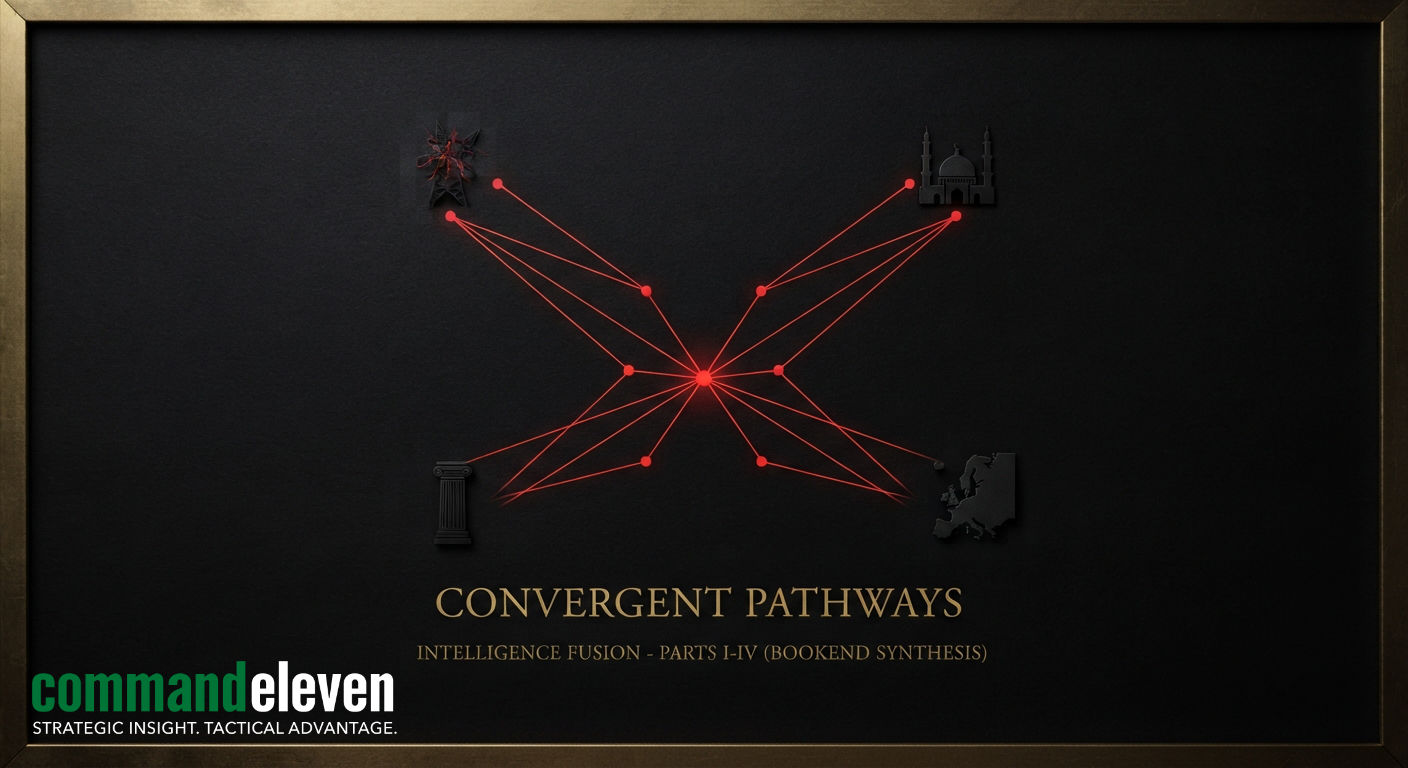
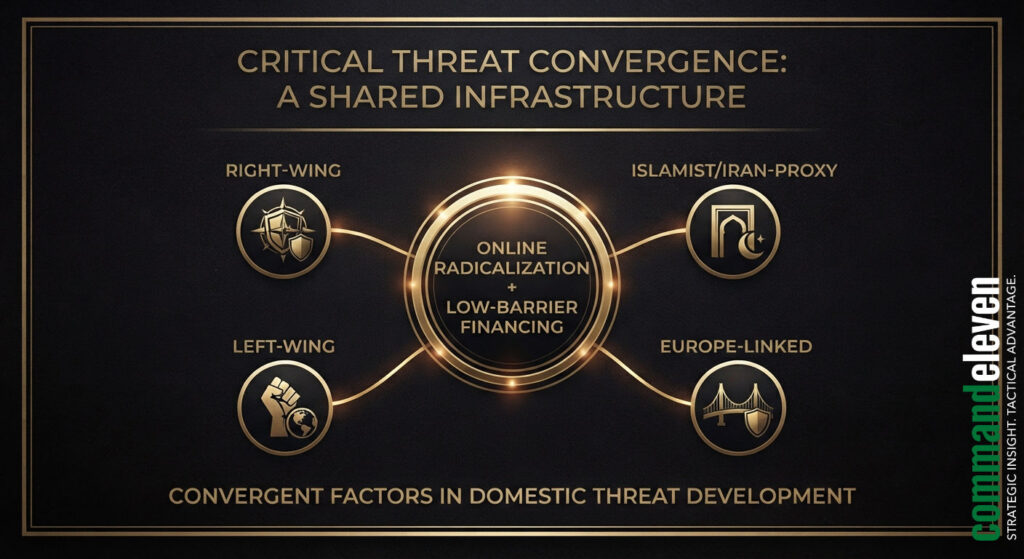
- [ASSESSED] – CommandEleven Intelligence assesses this convergence as the single most important finding of this series: the ideological content varies sharply across these four categories, but the infrastructure enabling radicalization – encrypted platforms, algorithmically-amplified content, communities that provide belonging alongside extremist content – is increasingly shared. This is a structural observation about the information environment, not evidence that these ideologically opposed networks coordinate with each other or share membership.
Financing Across Ideological Lines
Domestic and Iran-proxy terrorism financing has converged on two low-barrier mechanisms regardless of ideological content. Crowdfunding platforms – GiveSendGo prominently among them – hosted at least 320 extremist-linked campaigns raising a combined $6.2 million between 2016 and mid-2022 per ADL tracking, the large majority tied to January 6 legal-defense and related right-wing causes; separately, Hamas-linked crowdfunding campaigns have used similar platform mechanics to solicit donations under humanitarian framing.
Cryptocurrency financing shows a comparable cross-ideological pattern, though Chainalysis’s most recent tracking found overall crypto donations to extremist groups declining globally even as white-supremacist, nationalist, and antisemitic financing specifically grew in Europe. On the Iran-proxy side, Hamas’s military wing shifted from Bitcoin to the more fungible USDT stablecoin after 2021, reportedly raising over $130 million by that method following October 7, 2023; a June 2023 seizure by Israel’s National Bureau for Counter Terror Financing recovered roughly $1.7 million in cryptocurrency tied to a Hezbollah/Quds Force financial facilitator. On the right-wing accelerationist side, the same underlying blockchain infrastructure has financed smaller-scale but ideologically consistent activity, prompting the OFAC and State Department designations noted in Key Judgment 3.
- [DATA DEFICIT] – This dossier does not have visibility into the comparative total scale of financing across these categories with confidence – Hamas’s reported crypto totals significantly exceed documented right-wing accelerationist figures, but methodology differences across the sourcing reviewed make a precise cross-category comparison unreliable. This dossier reports the mechanisms as converging, not the dollar totals as equivalent.
What This Series Does Not Claim
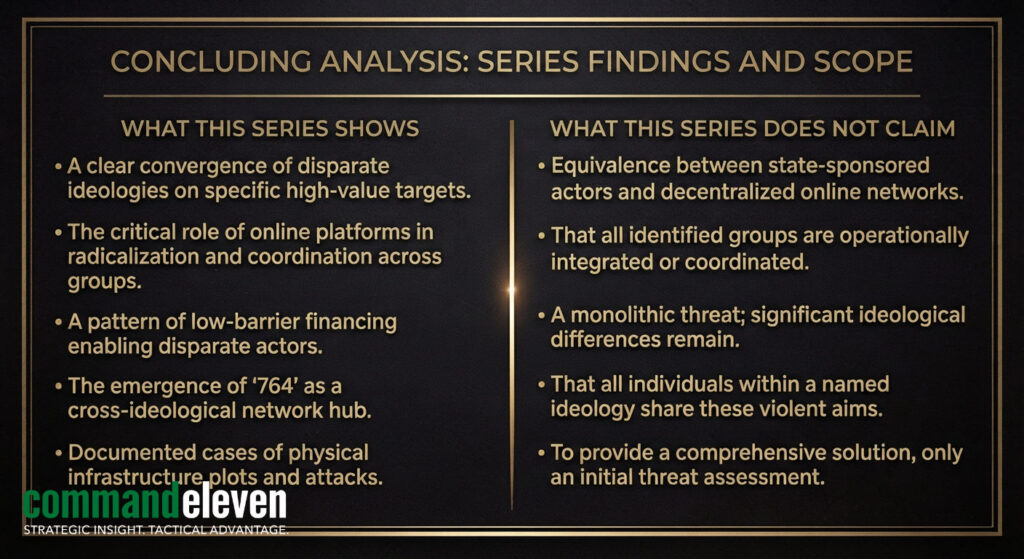
Consistent with the standard CommandEleven Intelligence applied throughout its Muslim Brotherhood series, it is worth stating plainly what four parts of evidence do not establish:
- This series does not claim right-wing accelerationist, left-wing violent extremist, and Islamist/Iran-proxy networks are operationally connected to one another. The convergence documented in Sections I and II is infrastructural and financial-mechanism-based, not organizational.
- This series does not claim Part IV’s European leading-indicator thesis is a validated predictive model. It remains, as stated there, one confirmed case following a documented pattern – worth continued monitoring, not treated as settled.
- This series does not resolve the open legal question, examined in Part II, of whether the current Antifa designation and NSPM-7 framework will survive legal challenge. That remains pending in the courts.
- This series does not claim equivalent scale of threat across all four categories. The FBI’s 640 disrupted plots in 2025, the specific incident counts documented in Parts I through IV, and the financing figures above vary considerably by category, and this dossier has presented those differences rather than flattening them into a single threat-level assessment.
Closing Assessment
The throughline across this series – and its companion Muslim Brotherhood series before it – is that the domestic and homeland-adjacent threat environment in 2026 is simultaneously more diffuse and more analytically tractable than the “domestic extremism” label suggests. More diffuse, because right-wing accelerationism, left-wing violent extremism, Islamist-inspired lone-actor violence, and Iran-proxy operations targeting the US homeland are genuinely distinct phenomena requiring distinct law enforcement, platform-policy, and financial-countermeasure responses. More analytically tractable, because – as this series has attempted to demonstrate across five parts – each of these categories is documentable with primary sourcing, sworn testimony, and confidence-tiered analysis, without requiring either the reflexive dismissal or the reflexive alarm that has characterized too much public discussion of domestic threats on all sides of the ideological spectrum. That is the standard this series, like its predecessor, has tried to hold itself to throughout.
Sourcing Base (Confidence-Tiered, with Links)
CONFIRMED – Primary Record & Direct Reporting:
- Chainalysis, “Cryptocurrency donations to extremist groups dip globally, but white supremacism, nationalism, and anti-Semitism grow across Europe“
- Chainalysis, “Assessing Terrorism Financing On-chain is Crucial and Complex” (Hezbollah/Quds Force $1.7M seizure detail)
- Congressional Research Service, “Terrorist Financing: Hamas and Cryptocurrency Fundraising,” Congress.gov
- HDIAC, “Financing Terrorism Through Cryptocurrencies” (Hamas USDT shift, $130M figure)
- Rep. Ritchie Torres, House press release citing ADL crowdfunding data (320 campaigns, $6.2M, 2016-mid 2022)
ASSESSED – Credible Secondary/Academic Reporting:
Maria Jofre et al., “Cryptocurrency and the Financing of Right-Wing Extremism,” March 2026
Excluded from this dossier: Any claim of direct organizational or financial coordination between right-wing accelerationist, left-wing violent extremist, and Islamist/Iran-proxy networks. The convergence documented here is in shared low-barrier infrastructure and mechanism, not shared membership, leadership, or coordinated planning.
The US Domestic Threat Landscape Series
- Right-Wing Accelerationism and “764” – The Ideology That Wants Collapse
- Left-Wing Violent Extremism – A New Designation, Tested in Court
- Radical and Extremist Islam – The Reactivated Lone-Actor Threat
- Europe as the Leading Indicator – Testing the Transatlantic Terror Thesis
- Synthesis – Mobilization, Financing, and the Shape of the Domestic Threat