Key Judgments
- [CONFIRMED] – Across the four preceding parts of this series, a consistent pattern emerges from primary documentary and trial evidence spanning 1988 to 2026: a small, durable network of individuals and organizations – traceable through seized internal Brotherhood documents, FBI wiretaps, sworn testimony, and court findings – has maintained organizational continuity across four decades despite repeated rebranding, legal challenges, and public disavowals.
- [CONFIRMED] – That continuity is now intersecting with a materially changed federal posture: the January 2026 designation of Lebanese, Egyptian, and Jordanian Muslim Brotherhood chapters as terrorist entities represents the first concrete US government action against the movement, following a 2025 congressional letter requesting a CAIR-specific Treasury investigation and two state-level terrorist designations of CAIR itself.
- [ASSESSED] – The evidentiary record supports confident conclusions about historical organizational conspiracy (Part I), documented institutional affiliation and personnel continuity (Part II), and continued financial and legal irregularity through the present day (Part III). It supports more limited, carefully bounded conclusions about the network’s current political and educational reach (Part IV), where influence is real and documented but should not be overstated as centrally coordinated.
- [ASSESSED] – CommandEleven Intelligence assesses the most significant open question this series leaves unresolved is whether the current wave of federal and state scrutiny – designations, grant investigations, legislative proposals – will produce the kind of enforcement action last seen in the 2008 HLF prosecution, or whether it will follow the pattern of the 2009 FBI liaison cutoff: a real policy shift that nonetheless left the underlying financial and organizational network intact for another seventeen years.
The Throughline
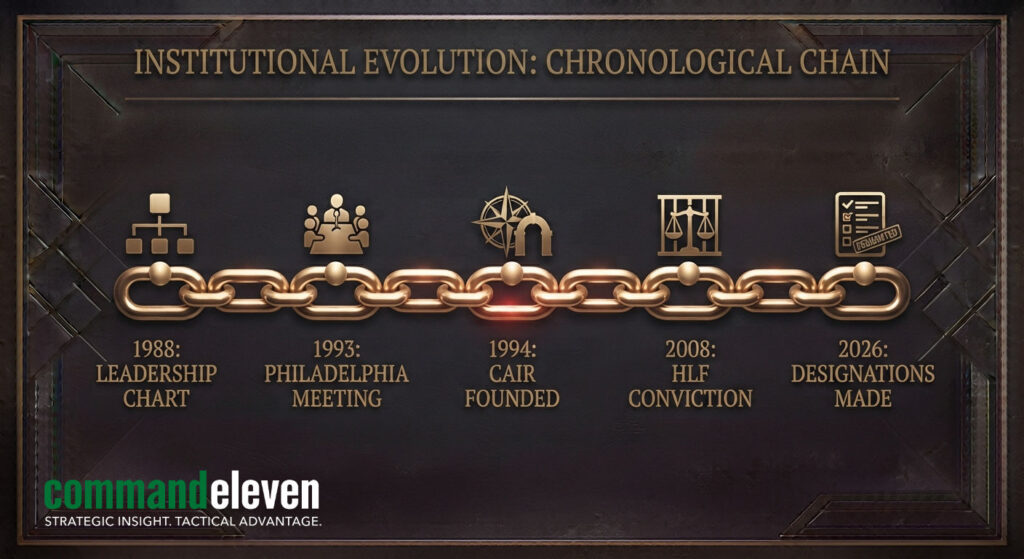
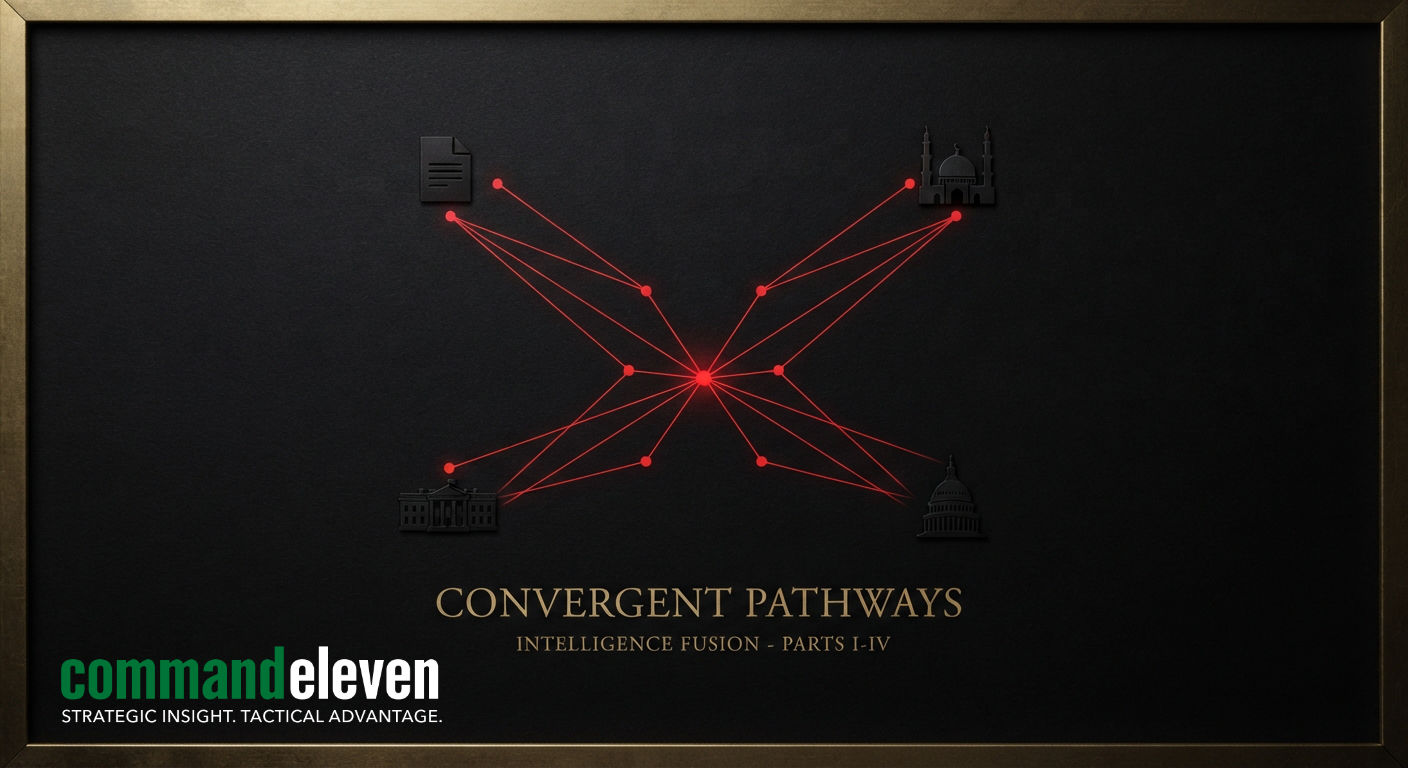
This series’ four parts trace a single continuous story rather than four separate ones. Part I established that CAIR was not merely “linked to” a Hamas-support network but was, per FBI wiretap evidence and sworn testimony from the lead investigator on the case, deliberately created by that network’s own leadership as a public-facing shield. Part II showed that the organizations surrounding CAIR – MAS, ICNA, NAIT, AMP, and the Dar al-Hijrah nexus – share the same personnel roots documented in the 1988 Chart and 1991 Explanatory Memorandum, with the Anwar al-Awlaki case illustrating how consequential a single institutional connection can become. Part III demonstrated that the financial infrastructure sustaining this network has continued operating largely unimpeded by the 2009 FBI cutoff, drawing tens of millions in federal and state funds even as oversight bodies documented specific instances of misuse. Part IV showed the same network’s reach into K-12 curriculum, university activism financing, and – in at least one sworn-testimony-documented case – direct state government appointment.
No single part of this series, standing alone, would justify the conclusions the whole supports. It is the documented continuity across all four – the same names, the same organizational lineages, the same patterns of public denial followed by private-record contradiction – that makes this series’ central claim different from a loosely connected set of grievances: this is one network, adapting its public presentation across four decades while its underlying structure and strategic goals, as stated in its own internal 1991 memorandum, have not required formal renunciation to remain operative.
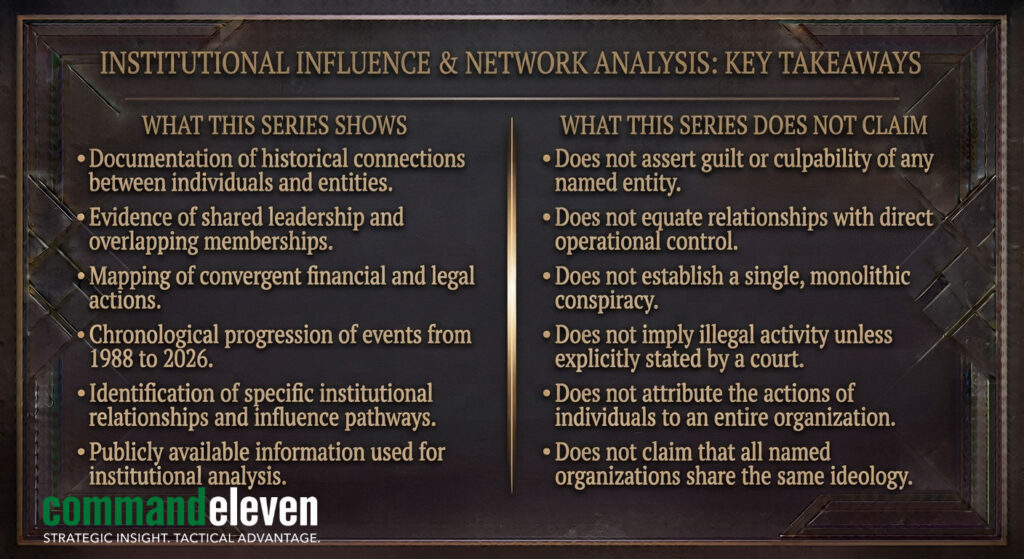
What This Series Does Not Claim
In the interest of the credibility this series was built to protect, it is worth stating plainly what has not been established:
- This series does not claim every individual named across these four parts had personal knowledge of or involvement in Hamas fundraising or violent extremism. Organizational affiliation and documented statements are not, on their own, proof of individual criminal intent, and courts have not found otherwise for individuals beyond those actually convicted at the 2008 HLF trial.
- This series does not claim the January 2026 EO 14362 designations extend to any U.S.-based organization. They do not, as a matter of law, as of this writing.
- This series does not claim SJP/NSJP campus activity is centrally directed chapter-by-chapter by national Muslim Brotherhood leadership. Founding and financial-sponsorship connections are documented; day-to-day chapter conduct varies and was not independently verified case by case.
- This series does not resolve the Houston mosque question raised in Part II. It remains an open, flagged pattern, not a finding.
Policy Considerations
Sworn testimony examined across this series has proposed a range of policy responses relevant to readers assessing what should happen next, independent of CommandEleven Intelligence’s own editorial position:
- Criminal investigation focus areas raised in testimony include potential Foreign Agents Registration Act (FARA) violations, 18 U.S.C. §2339B material support violations, tax fraud, and RICO exposure for organizations and individuals with documented continuing financial ties to the network examined in this series.
- Civil and administrative recommendations include 501(c)(3) compliance review, enhanced foreign-donor transparency requirements for tax-exempt organizations, and K-12 foreign-funding disclosure requirements at the state level.
- Separately, the debate this series’ Part IV documents – whether to expand terrorist designation beyond the three chapters named in January 2026 to other national Brotherhood chapters – remains contested among the sources reviewed for this series, with legitimate arguments on both the sequencing and the scope of any further designation.
- [ASSESSED] – CommandEleven Intelligence does not take an institutional position on which of these specific legislative or enforcement measures should be adopted. This series’ function is to establish the evidentiary record; the policy response is properly a matter for elected officials, law enforcement, and the public debate this series aims to inform rather than foreclose.
Series Connection: The Domestic Threat Landscape
This series was conceived, in part, as the Islamist-extremism component of CommandEleven Intelligence’s broader US Domestic Threat Landscape coverage, alongside our existing and forthcoming work on right-wing accelerationism, left-wing violent extremism, and lone-actor mobilization. Read against that broader series, the Muslim Brotherhood’s American network represents a distinct threat category from the others: not a movement oriented toward direct violence in the way lone-actor or accelerationist threats are, but an institutional-influence network whose documented history includes direct terrorism financing, and whose current activity – per Parts III and IV of this series – continues to draw scrutiny across financial, legal, and political domains simultaneously.
Closing Assessment
Four decades after the Muslim Students Association’s founding, and eighteen years after the Holy Land Foundation convictions, the organizations this series has examined remain active, well-funded, and institutionally embedded in American civic life. That is not, on its own, evidence of ongoing criminal conduct – the law has not found it to be. But it is a record any serious observer of American counterterrorism policy should be able to discuss plainly, sourced to primary documents and sworn testimony rather than rumor, and without either the reflexive dismissal or the reflexive overstatement that has defined too much of the public conversation on this subject for too long. That is what this series has attempted to provide.
Sourcing Base
This closing dossier draws on the full sourcing base established across Parts I-IV of this series; no new primary sourcing is introduced in this synthesis beyond the policy-recommendation citations below.
- Lara L. Burns, Written Testimony, US Senate Committee on the Judiciary, Aug. 5, 2026 (Policy Considerations section)
- M. Zuhdi Jasser, Written Testimony, House Committee on Oversight and Government Reform, Subcommittee on National Security, July 11, 2018 (Conclusions and Recommendations section)
The Muslim Brotherhood Series
- The Conspiracy Documented – Origins of the Muslim Brotherhood’s American Front
- The Affiliate Network – Dar al-Hijrah, CAIR, and the American Brotherhood’s Web
- Financial Infrastructure & Legal Obstruction – How the Network Funds and Defends Itself
- Institutional Capture – Mosques, Classrooms, Campuses, and Congress
- What Four Decades of Evidence Adds Up To