Key Judgments
- [CONFIRMED] – A 1988 internal US Muslim Brotherhood document, seized by the FBI in a 2004 search of Hamas operative Ismail Elbarasse’s home and entered as evidence at the 2008 Holy Land Foundation (HLF) terrorism-financing trial, names the leadership structure of the US Muslim Brotherhood by role and organization – including the Islamic Society of North America (ISNA), the North American Islamic Trust (NAIT), and the Muslim Students Association (MSA) – under a section explicitly labeled “The Palestine Committee.”
- [CONFIRMED] – A 1991 internal memorandum titled “An Explanatory Memorandum on the General Strategic Goal for the Group in North America,” written by senior US Muslim Brotherhood leader Mohamed Akram and entered as a government trial exhibit, describes the Brotherhood’s American project as a “kind of grand Jihad in eliminating and destroying the Western civilization from within.” Attached to it is a list of 29 US-based organizations captioned “A list of our organizations and the organizations of our friends,” with the handwritten aside: “Imagine if they all march according to one plan!!!”
- [CONFIRMED] – The Council on American-Islamic Relations (CAIR) was founded in 1994 by two senior leaders of the Muslim Brotherhood’s US-based “Palestine Committee” – Omar Ahmad and Nihad Awad – months after both men participated in an FBI-wiretapped October 1993 meeting in Philadelphia at which participants explicitly discussed creating a new organization with no visible ties to Hamas, capable of operating as a public-facing shield for the network. Awad remains CAIR’s Executive Director today.
- [CONFIRMED] – In November 2008, a federal jury convicted the Holy Land Foundation and five of its officers on all counts of providing material support to Hamas – the largest successful terrorism-financing prosecution in American history. The convictions were affirmed by the Fifth Circuit Court of Appeals; the Supreme Court denied certiorari. CAIR was named, and remains, an unindicted co-conspirator and joint venturer in that case.
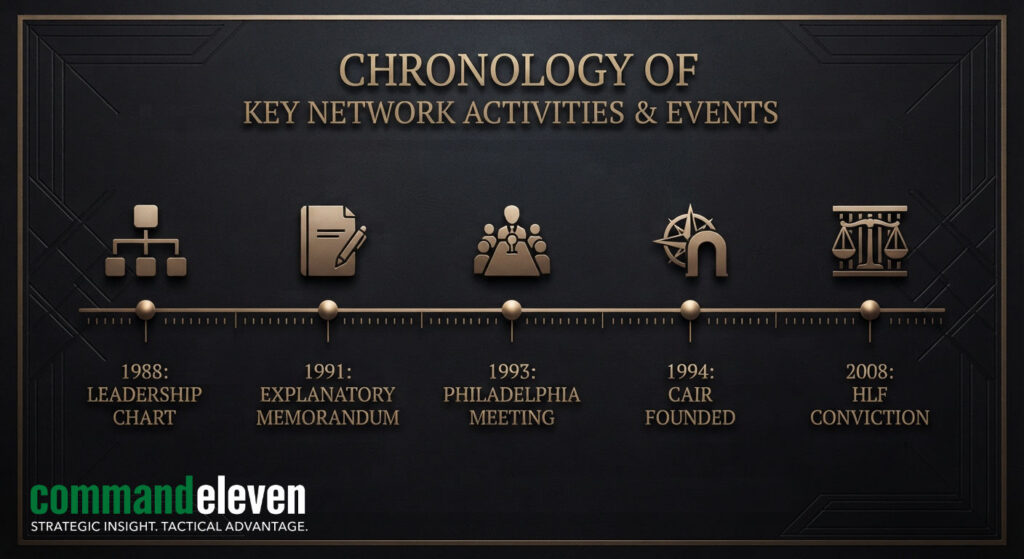
- [ASSESSED] – The organizational and personnel continuity documented from the 1988 Chart through the 1991 Explanatory Memorandum, the 1993 Philadelphia Meeting, and CAIR’s 1994 founding constitutes one of the most thoroughly evidenced trails in American counterterrorism history – grounded in seized internal documents, FBI wiretap transcripts, and sworn trial testimony rather than inference.
Building the American Structure (1960s-1988)
The Muslim Brotherhood’s US presence traces to the early 1960s, when members and sympathizers active on American college campuses founded the Muslim Students Association (MSA) – formally established in 1963 at the University of Illinois, Urbana. MSA was not, by every account, a “pure” Brotherhood organization, but Brotherhood members and sympathizers held key positions from its inception and used it as both an ideological platform and a recruiting pipeline. From MSA’s base, a growing web of affiliated entities emerged through the 1970s and 1980s: the North American Islamic Trust (NAIT, 1973, MSA’s financial holding arm), the International Institute of Islamic Thought (IIIT, 1980), and eventually the Islamic Society of North America (ISNA), created as an “adult” umbrella organization once Brotherhood leadership concluded that a student group alone could not sustain a permanent American movement.
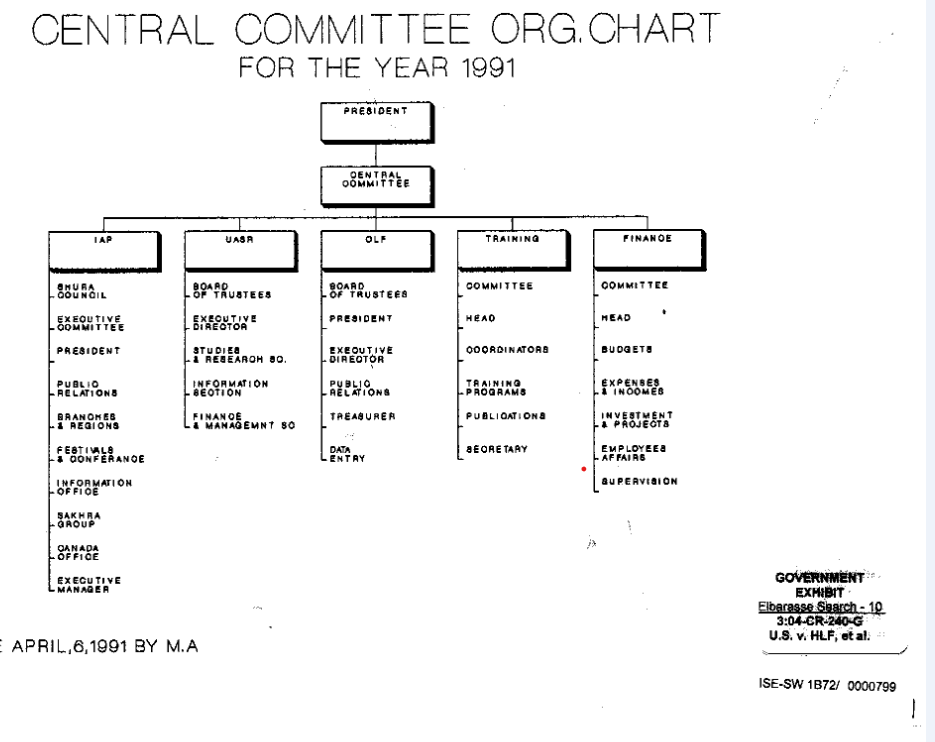
By 1988, this network had developed a formal, documented leadership hierarchy. A chart seized in the 2004 Elbarasse search – captioned “Chart of the capability of the present leadership and the size of task distribution” – lists named individuals against numbered “Apparatuses”: the Shura council, financial, political, legal, security, and regional divisions, alongside direct lines to ISNA, the Muslim Arab Youth Association (MAYA), MSA, and NAIT. The same 1988 period saw the formation of a distinct internal body: the Palestine Committee, tasked by the international Muslim Brotherhood with organizing US-based support for the newly formed Hamas.
The Explanatory Memorandum: The Strategy in the Brotherhood’s Own Words
If the 1988 Chart establishes structure, the 1991 Explanatory Memorandum establishes intent. Written by Mohamed Akram – a named leader on the 1988 Chart – and addressed to the US Brotherhood’s Shura Council, the memorandum states the movement’s goal without euphemism:
“The process of settlement is a ‘Civilization-Jihadist Process’… The Ikhwan must understand that their work in America is a kind of grand Jihad in eliminating and destroying the Western civilization from within and ‘sabotaging’ its miserable house by their hands and the hands of the believers so that it is eliminated and God’s religion is made victorious over all other religions.”
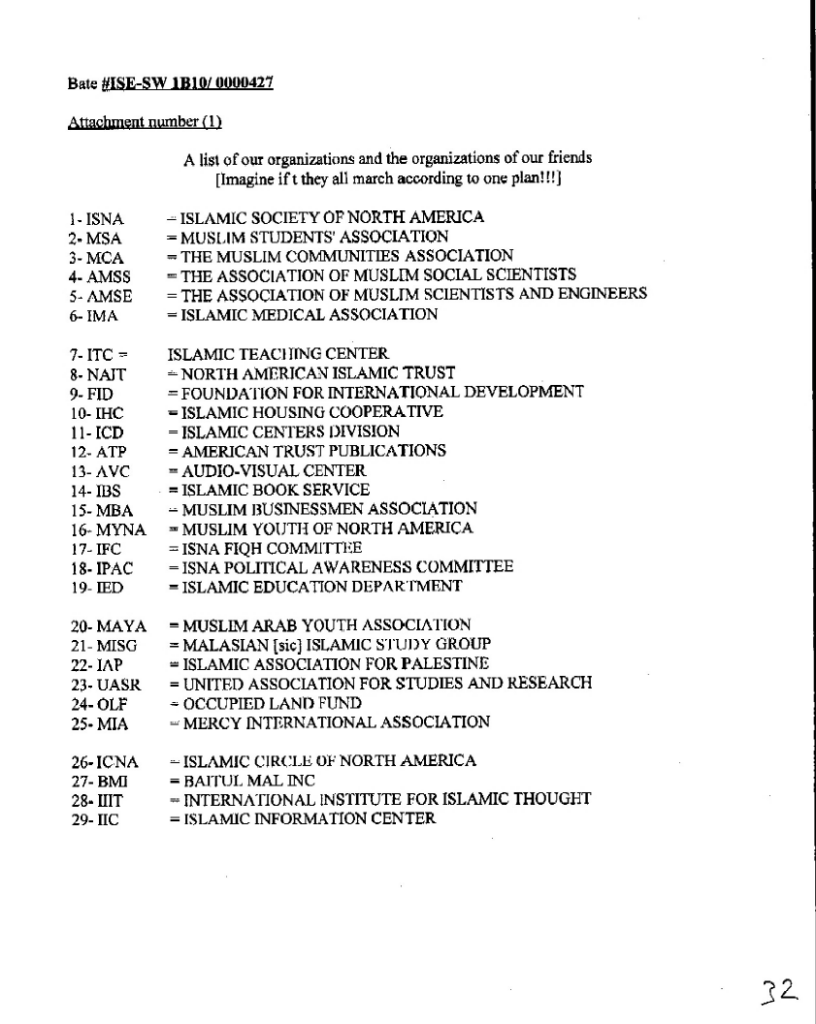
Attached to the memorandum is a list titled “A list of our organizations and the organizations of our friends” – 29 named US entities, including ISNA, MSA, NAIT, the Muslim Communities Association, the Islamic Association for Palestine (IAP), the United Association for Studies and Research (UASR), and the Islamic Circle of North America (ICNA), among others. The list’s own caption – “Imagine if they all march according to one plan!!!” – makes the coordinating intent explicit.
- [DATA DEFICIT] – No evidence introduced at any trial establishes that the Explanatory Memorandum’s plan was ever formally ratified as binding Shura Council policy. What can be established with confidence is authorship, the document’s admission as evidence without successful legal challenge to its authenticity across multiple proceedings, and clear personnel overlap between its author, the 1988 Chart, and the organizations discussed in the sections that follow. This dossier treats the document as a documented statement of strategic intent by a named senior leader, not as proof that every listed organization executed that intent identically or with equal awareness.
The Palestine Committee: Building Hamas’s American Infrastructure
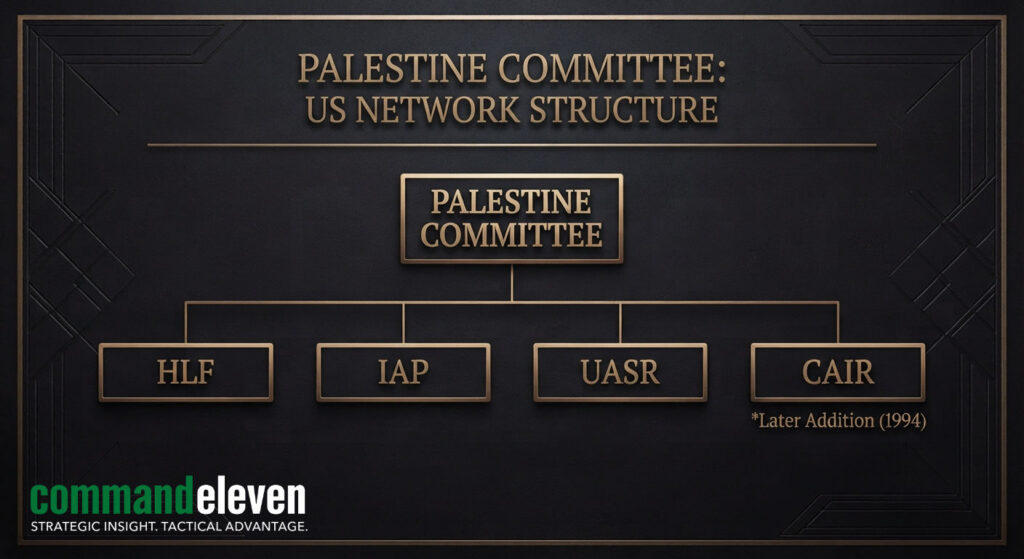
In 1988, the same year as the leadership chart above, the international Muslim Brotherhood tasked its US chapter with forming a Palestine Committee to support the newly declared Hamas. Led in its early years by Mousa Abu Marzook – then a Louisiana-based engineering doctoral student, later chief of Hamas’s Political Bureau – the Committee operated through three organizations: the Islamic Association for Palestine (IAP, propaganda), the Occupied Land Fund (soon renamed the Holy Land Foundation, fundraising), and the United Association for Studies and Research (UASR, the network’s think tank). A 1991 internal roster – recovered in a separate 1994 FBI search of Committee member Abdel Haleem Ashqar’s home – names 28 leaders of the US Palestine Committee as of that year, cross-referencing directly against names on the 1988 Chart.
During the First Intifada (1987-1993), the HLF and IAP raised funds at US festivals that, according to trial evidence, praised Hamas and encouraged violent jihad; proceeds funded Hamas-linked social infrastructure in Gaza, including institutions that trial evidence showed taught children that violence was “the only solution.” In 1993, Hamas was designated a Specially Designated Terrorist entity by the US government; the formal Foreign Terrorist Organization designation followed in 1997.
The Philadelphia Meeting: Planning the Deception
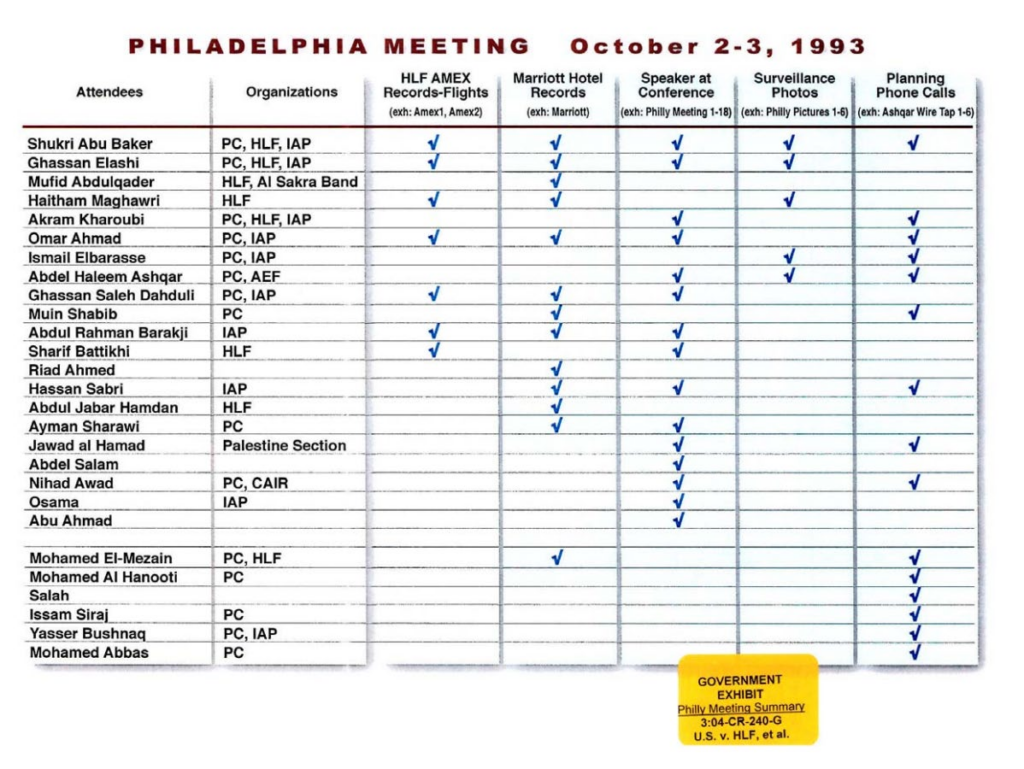
The 1993 Oslo Accords – which Hamas violently opposed – triggered a crisis inside the Palestine Committee, captured in extraordinary detail because the FBI had wiretapped the hotel conference room where the Committee’s leadership convened in Philadelphia that October. The transcripts, entered as trial exhibits, record a leadership explicitly plotting how to sustain support for Hamas domestically while avoiding the label of terrorism supporters publicly. One unidentified speaker articulated the core operating principle: “War is deception.” Participants discussed, in the same session, developing curricula to prevent Muslim children in America from “growing up surrendering to the issue of peace with Jews,” and the value of “infiltrating the American media outlets, universities and research centers” – a statement made specifically by Omar Ahmad, who would co-found CAIR within months.
- [DATA DEFICIT] – This dossier presents these statements as documented, wiretap-recorded speech admitted at federal trial – not as evidence of continuing personal intent by any individual decades later. Readers should apply the same distinction the courts themselves have applied: speech alone is protected; what matters legally and analytically is the pattern of subsequent organizational conduct, addressed in later parts of this series.
The Birth of CAIR
The most consequential outcome of the Philadelphia Meeting was organizational. Participants discussed forming a new entity – described in the transcripts as needing to be “neutral,” with an “Islamic hue” that was “not very conspicuous” – that could defend the rest of the network if government or media scrutiny intensified. Months later, CAIR was incorporated in Washington, D.C. Its two founders, Omar Ahmad and Nihad Awad, were both senior IAP leaders who had attended the Philadelphia Meeting; both appear on a 1994 FBI-recovered document titled “Palestine Section/America,” alongside Marzook, Akram, and other named Palestine Committee leadership. A July 1994 Palestine Committee memorandum explicitly lists CAIR alongside HLF, IAP, and UASR as one of the network’s four constituent organizations.
The relationship was not merely originary. Wiretapped 1999 telephone calls, played for the HLF trial jury, captured Ahmad – despite holding no official HLF position – directing HLF officers on the organization’s expenditures. Awad, for his part, told a 1994 Barry University audience he supported “the Hamas movement more than the PLO,” a statement he later said under oath he made without awareness Hamas had claimed credit for violent acts.
Adjudication
The 2008 HLF trial ended with convictions on all counts against the Foundation and five officers – the largest successful terrorism-financing prosecution in US history, per the Department of Justice’s own characterization. The Fifth Circuit affirmed; the Supreme Court denied certiorari. CAIR, ISNA, and NAIT were named unindicted co-conspirators and joint venturers in the case – a designation CAIR disputes publicly, incorrectly characterizing it in past public statements as a ruling the Fifth Circuit found “unconstitutional,” which the appellate record does not show. The FBI formally suspended liaison relationships with CAIR in 2009, a policy that, per later Senate testimony, has been inconsistently enforced at the federal grant-funding level in subsequent years.
Series Roadmap
This dossier establishes the documented origin and founding conspiracy. Subsequent installments in this series will examine: the wider US affiliate network and Dar al-Hijrah’s role as an operational nexus (Part II); CAIR’s financial infrastructure and the 2026 headquarters asset transfer to NAIT amid state FTO designations (Part III); mosque networks, education infiltration, and political influence, including Executive Order 14362’s January 2026 designation of the Lebanese, Egyptian, and Jordanian Muslim Brotherhood chapters as terrorist entities (Part IV); and a closing synthesis tying this series to CommandEleven Intelligence’s US Domestic Threat Landscape coverage (Part V).
Sourcing Base (Confidence-Tiered, with Links)
CONFIRMED – Primary Trial Record & Sworn Testimony:
- Lara L. Burns, Written Testimony, “Hidden in Plain Sight: Confronting the Muslim Brotherhood Network in America,” US Senate Committee on the Judiciary, Aug. 5, 2026 (author is a retired FBI Special Agent who led the HLF investigation, 2001-2008) [Note: filename references a differently-named witness; content and signature block confirm authorship by Lara L. Burns]
- Government Exhibit Elbarasse Search-4 (the 1988 Chart), United States v. Holy Land Foundation et al., 3:04-cr-240-G (N.D. Tex. 2008)
- Government Exhibit Elbarasse Search-3 (the 1991 Explanatory Memorandum)
- Government Exhibit Elbarasse Search-10 (the 1991 Palestine Committee List)
- Government Exhibits, Philadelphia Meeting 1-16 (Oct. 1993 FBI wiretap transcripts)
- Government Exhibit Ashqar Search-1 (“Palestine Section/America” list)
- United States v. El-Mezain, 664 F.3d 467 (5th Cir. 2011) (affirming HLF convictions)
- El-Mezain v. United States, 568 US 977 (2012) (certiorari denied)
- Letter from Richard C. Powers, FBI Assistant Director, Office of Congressional Affairs, to Sen. Jon Kyl, April 28, 2009 (confirming FBI’s 2009 suspension of CAIR liaison)
ASSESSED – Credible Secondary/Academic Sourcing:
- Lorenzo Vidino, “The Muslim Brotherhood in America: A Brief History,” George Washington University Program on Extremism, July 2025
- M. Zuhdi Jasser, Written Testimony, “The Muslim Brotherhood’s Global Threat,” House Committee on Oversight and Government Reform, Subcommittee on National Security, July 11, 2018
- Institute for the Study of Global Antisemitism and Policy (ISGAP), “The Muslim Brotherhood’s Strategic Entryism Into the United States: A Systemic Analysis,” Nov. 17, 2025
- Noreen S. Ahmed-Ullah, Sam Roe, and Laurie Cohen, “The New Face of the Muslim Brotherhood – The Muslim American Society,” Chicago Tribune, Sept. 19, 2004
Excluded from this dossier: Any characterization implying that every individual named in the 1988 Chart, the 1991 organization list, or the Philadelphia Meeting transcripts personally directed or had knowledge of Hamas fundraising activity. Trial evidence establishes organizational and documentary linkage; this dossier does not extend individual criminal culpability findings beyond what courts have actually adjudicated.
The Muslim Brotherhood Series
- The Conspiracy Documented – Origins of the Muslim Brotherhood’s American Front
- The Affiliate Network – Dar al-Hijrah, CAIR, and the American Brotherhood’s Web
- Financial Infrastructure & Legal Obstruction – How the Network Funds and Defends Itself
- Institutional Capture – Mosques, Classrooms, Campuses, and Congress
- What Four Decades of Evidence Adds Up To