
Key Judgments
- [CONFIRMED] – On September 22, 2025, President Trump signed an executive order designating “Antifa” a domestic terrorist organization – the first time any US administration has applied that label to a domestic ideological movement, including historically violent groups such as the Ku Klux Klan. Days later, National Security Presidential Memorandum 7 (NSPM-7) directed federal agencies to prioritize investigation of a broadly defined set of “anti-fascism”-linked activity; a December 4, 2025 Attorney General memorandum further operationalized this, characterizing organized doxing of law enforcement, mass rioting, and efforts to obstruct immigration enforcement as domestic terrorism conduct.
- [CONFIRMED] – No federal statute authorizes the president to formally designate a domestic group as a terrorist organization – a legal gap multiple legal scholars and civil liberties organizations, including the Brennan Center for Justice, have specifically identified as distinguishing this action from the well-established Foreign Terrorist Organization designation process. Antifa itself has no formal leadership, membership, or organizational structure, a fact legal experts note complicates the government’s ability to apply the designation as if to a conventional organization.
- [CONFIRMED] – The July 4, 2025 attack on the Prairieland ICE Detention Facility in Alvarado, Texas – in which prosecutors allege an organized cell used fireworks and gunfire in a coordinated ambush that wounded a police officer – produced the first-ever federal indictment charging alleged Antifa-linked defendants with domestic terrorism. In March 2026, a federal jury convicted eight of nine defendants on terrorism-related charges while acquitting some defendants of attempted murder counts, a mixed verdict both prosecutors and defense attorneys have characterized as significant for how future cases will be charged.
- [CONFIRMED] – The Center for Strategic and International Studies reported that left-wing political violence outpaced right-wing political violence in the United States during the first half of 2025 for the first time in three decades – though CSIS’s own reported figures (five left-wing attacks versus one right-wing attack) reflect small absolute numbers, a scale distinction this dossier treats as analytically significant.
- [ASSESSED] – CommandEleven Intelligence assesses that the current prosecutorial and policy environment represents a genuine and significant shift in how the federal government treats left-wing political violence, but also that this shift remains legally and politically contested in ways the right-wing accelerationism and 764 material examined in Part I is not – this series treats that contestation as part of the record rather than resolving it.
The Designation and Its Legal Basis
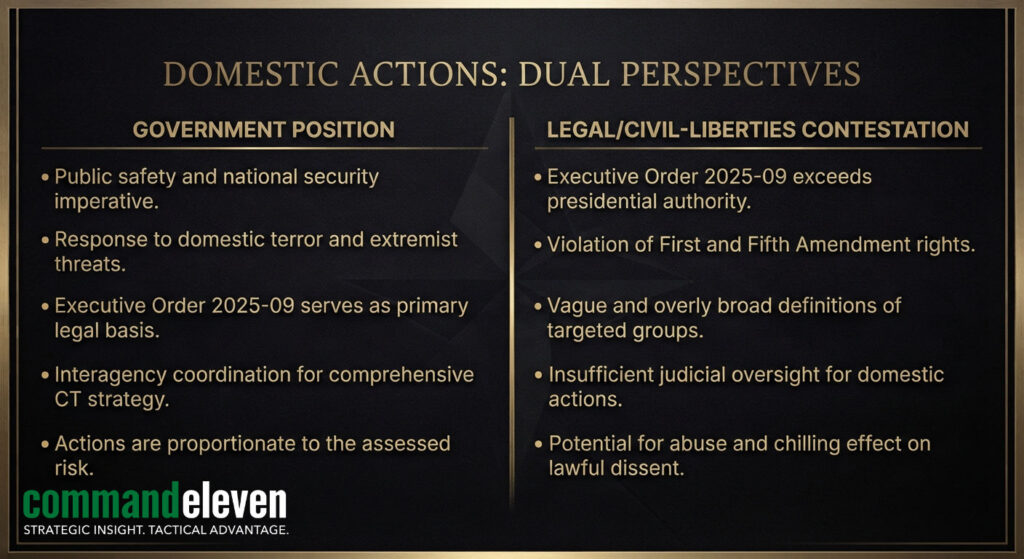
The September 2025 executive order characterizes Antifa as a “militarist, anarchist enterprise that explicitly calls for the overthrow of the United States Government,” citing a pattern of armed standoffs with law enforcement, organized rioting, assaults on ICE personnel, and doxing of political figures. NSPM-7, issued days later, broadened the operative definition considerably, directing federal prioritization of investigation into activity associated with what it terms the “umbrella of self-described ‘anti-fascism'” – a category the memorandum explicitly extends to include opposition to capitalism, opposition to “traditional American views on family, religion, and morality,” and support for “radical gender ideology.” A December 4, 2025 Attorney General memorandum operationalized this further, directing the FBI and Joint Terrorism Task Forces to treat “Antifa-aligned extremists” – defined by adherence to a described set of viewpoints rather than solely by violent conduct – as a domestic terrorism priority.
[Legal context, not CommandEleven Intelligence’s editorial position] Multiple legal scholars, including analysts at the Brennan Center for Justice, have stated plainly that no federal statute grants the executive branch authority to designate a domestic group a “terrorist organization” in the manner used for foreign entities under the Foreign Terrorist Organization framework. They further note that Antifa’s decentralized, leaderless structure – a point acknowledged even in reporting sympathetic to the administration’s broader approach – makes formal organizational designation analytically difficult to apply in the way it would to a hierarchical group. This dossier presents this legal contestation as part of the documented record surrounding the designation, not as CommandEleven Intelligence’s own judgment on its validity.
The Prairieland Case: A Test Case in Real Time
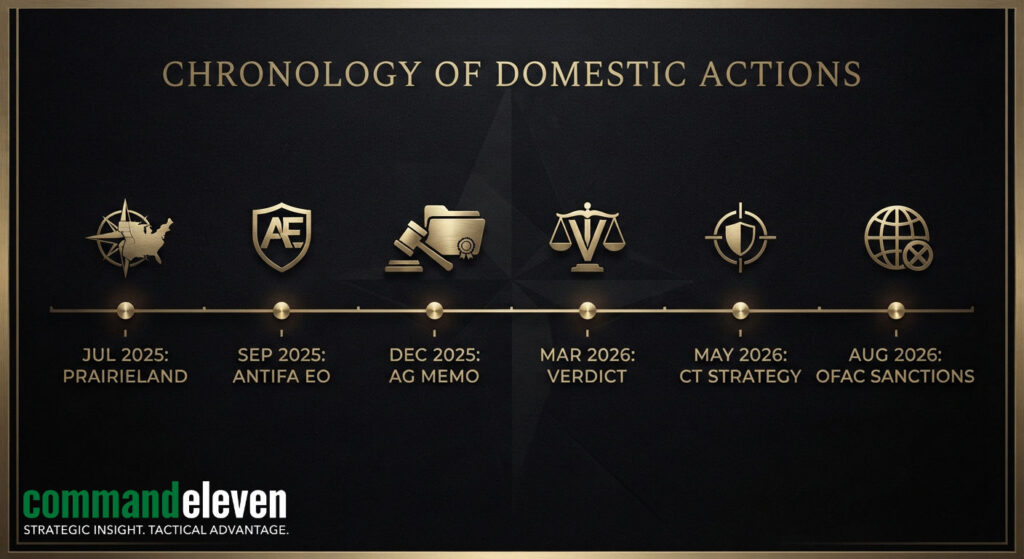
On the night of July 4, 2025, a demonstration outside the Prairieland ICE Detention Facility in Alvarado, Texas escalated into gunfire. Prosecutors allege fireworks and vandalism were used to draw officers outside, at which point gunfire – from what the indictment describes as an organized cell of at least eleven operatives coordinating via encrypted messaging – wounded a responding police officer, who survived and later returned to duty. Nine defendants were indicted; the government’s case relied in part on Signal messages it obtained showing the group had specifically discussed the perceived ineffectiveness of less confrontational prior protests at the same facility.
In March 2026, following a trial delayed once by a mistrial over a defense team member’s courtroom attire, a federal jury delivered a mixed verdict: eight of nine defendants were convicted on terrorism-related charges, while the jury acquitted on some attempted-murder counts. FBI Director Kash Patel and Attorney General Pam Bondi both publicly characterized the verdict as validating the administration’s approach and signaled it as a template for future prosecutions; defense-aligned commentary and some independent legal observers have described the case as testing the outer boundary of what conduct can be charged as terrorism, drawing explicit comparisons to the 2017 “J20” Inauguration Day prosecutions and the Atlanta “Stop Cop City” domestic terrorism and racketeering cases, both of which substantially collapsed at trial.
- [DATA DEFICIT] – This dossier does not take a position on whether the Prairieland verdict reflects appropriate application of domestic terrorism statutes or prosecutorial overreach – both characterizations appear in credible reporting reviewed for this dossier, and the case remains subject to appeal. What is established at CONFIRMED tier is the sequence of events, the indictment’s specific allegations, and the verdict itself.
Formalization at the Federal and International Level
By May 2026, the White House’s own Counterterrorism Strategy had elevated “violent far-left terrorist groups” to one of three primary national security threat categories, alongside cartels/transnational gangs and Iran-linked threats – placing left-wing domestic violence in a policy category it had never previously occupied. In August 2026, Treasury’s Office of Foreign Assets Control extended this internationally, sanctioning Autistici/Inventati (an Italy-based group providing digital infrastructure to Antifa-linked cells), Palestine Action (proscribed as a terrorist organization by the UK government in July 2025), and Masar Badil (characterized by Treasury as a front for the Popular Front for the Liberation of Palestine, a long-designated FTO). Secretary of State Rubio has characterized the shift as correcting what he called a longstanding “blind spot” in US counterterrorism doctrine regarding left-wing violence.
Assessment
- [ASSESSED] – Read against Part I, this dossier’s central comparative observation is that right-wing accelerationism and 764 occupy a settled analytical and legal space – their violent conduct, ideology, and (in 764’s case) prosecutorial framework are documented without significant contestation over whether the underlying legal theory is valid. Left-wing violent extremism, as currently treated by federal policy, occupies a much less settled space: the underlying conduct in cases like Prairieland is serious and, per the jury’s verdict, criminal – but the broader designation framework applied to it (Antifa as a formally “designated” domestic terrorist organization, NSPM-7’s ideological-category approach) remains actively contested on legal and constitutional grounds in a way that right-wing accelerationism prosecutions, built on decades of settled domestic terrorism statute application, are not. CommandEleven Intelligence treats this distinction as analytically important rather than politically inconvenient to note.
Series Continuity
Part III turns to radical and extremist Islam, building directly on CommandEleven Intelligence’s five-part Muslim Brotherhood in America series and examining that material specifically through the domestic mobilization and threat lens.
Sourcing Base (Confidence-Tiered, with Links)
CONFIRMED – Primary/Official Record:
- The White House, “Designating Antifa as a Domestic Terrorist Organization,” Executive Order, Sept. 22, 2025
- Arnold & Porter, “DOJ Issues Sweeping New Domestic Terrorism Directive” (Dec. 4, 2025 AG memorandum analysis)
- The White House, “Trump Administration Unleashes Global Campaign to Crush Radical Left Terrorism,” July 2026
- US Department of the Treasury, “Treasury Takes Action Against Violent Far-Left Terrorist Networks,” Aug. 2026
- US Department of State, “Imposing Sanctions on Violent Far-Left Terrorist Groups“
- Fox News, “Nine convicted North Texas ICE attack; Kash Patel issues warning” (March 2026 verdict)
- Fox News, “Antifa members indicted [in] Texas ICE facility riot, attempted murder [of] officer” (indictment/AG Bondi statement)
ASSESSED – Credible Secondary Reporting (Multiple Perspectives):
- Brennan Center for Justice, “Trump’s Orders Targeting Anti-Fascism Aim to Criminalize Opposition“
- The Washington Post, “Government argues ICE facility protest was actually left-wing terrorist plot,” March 2026
- KERA News, “How will Trump’s DOJ prosecute ‘antifa?’ The Prairieland ICE shooting trial could be the playbook” (CSIS left/right-wing violence data)
- The Intercept, “Anti-ICE Protesters Convicted on Terrorism Charges for Wearing All Black” (defense/civil-liberties perspective)
- Democracy Docket, “DOJ Brings First Terror Charges Under Trump’s Antifa Order“
Excluded from this dossier: Any CommandEleven Intelligence institutional position on whether the Antifa designation or the Prairieland prosecution’s legal theory is constitutionally valid. This dossier reports the government’s action, the documented conduct at issue, and the legal contestation surrounding both, without adjudicating that contestation – an outcome properly left to the courts, where it remains pending.
The US Domestic Threat Landscape Series
- Right-Wing Accelerationism and “764” – The Ideology That Wants Collapse
- Left-Wing Violent Extremism – A New Designation, Tested in Court
- Radical and Extremist Islam – The Reactivated Lone-Actor Threat
- Europe as the Leading Indicator – Testing the Transatlantic Terror Thesis
- Synthesis – Mobilization, Financing, and the Shape of the Domestic Threat