Executive Summary
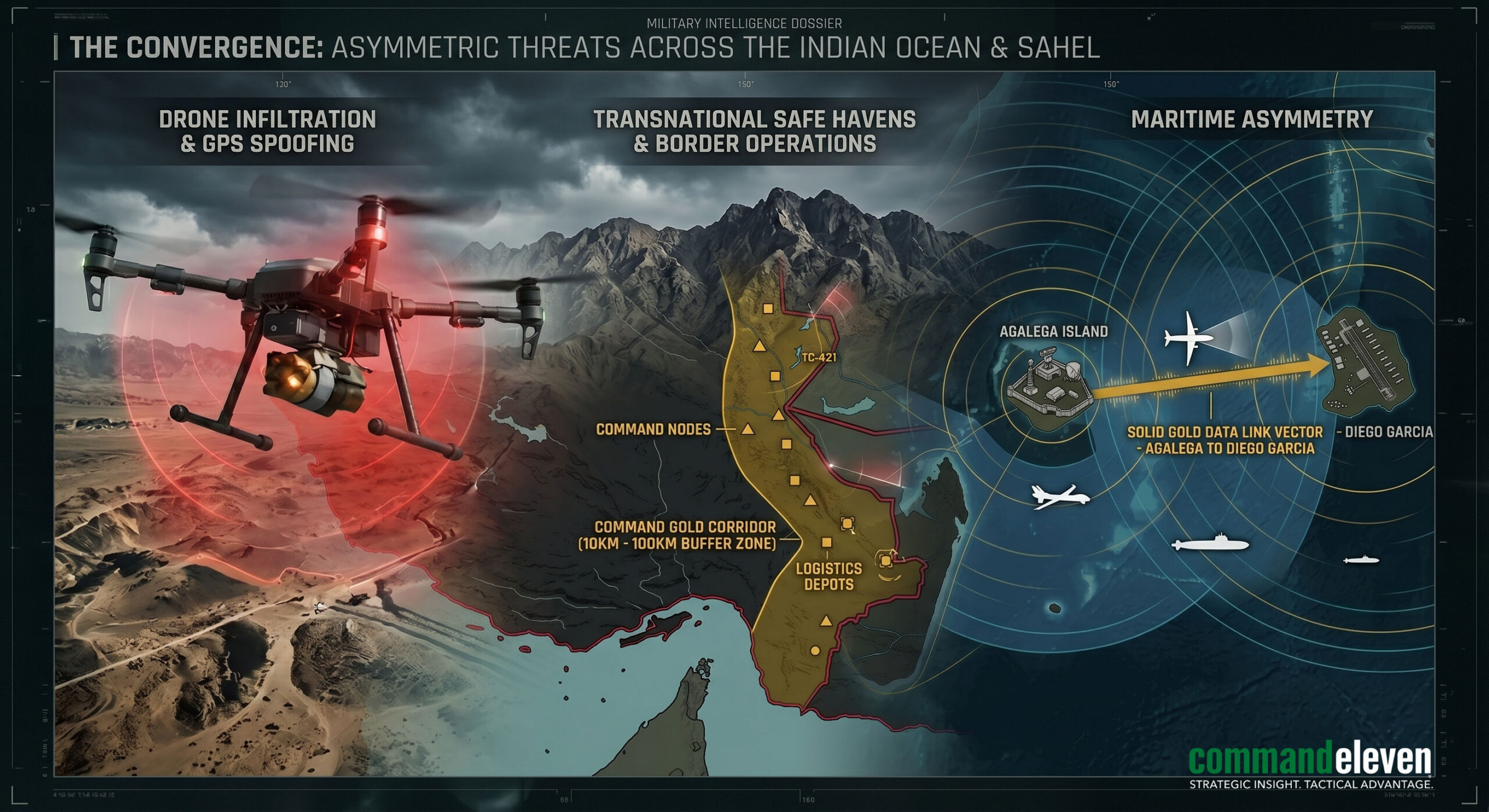
The current convergence of asymmetric threats across the Middle East and East Africa demands a fundamental recalibration of regional security frameworks. State and non-state actors are exploiting localized governance vacuums, porous maritime boundaries, and rugged land frontiers to build resilient logistics networks. These networks bypass traditional defensive grids by integrating commercial technologies into their weapon systems. Militant syndicates no longer operate in isolation. They form strategic alliances with transnational criminal organizations to secure funding, acquire weapons, and move personnel across continents. The security environment is highly volatile. Electronic warfare arrays face declining interception rates as adversaries deploy hybrid navigation architectures on unmanned aerial vehicles. These platforms now use internal dead reckoning and visual terrain-matching to defeat standard global positioning system spoofing. Kinetic risks have amplified. Weapon payloads have transitioned from basic drop-rigs to impact-fused, high-explosive fragmentation and thermite mixtures.
Technical Takeaways
- Navigation Architecture Resiliency: Conventional global positioning system spoofing arrays are increasingly ineffective against modern asymmetric aerial threats. Security forces must shift from radio-frequency denial to physical interception and multi-band telemetry disruption to counter drones utilizing internal dead reckoning and real-time visual terrain-matching software.
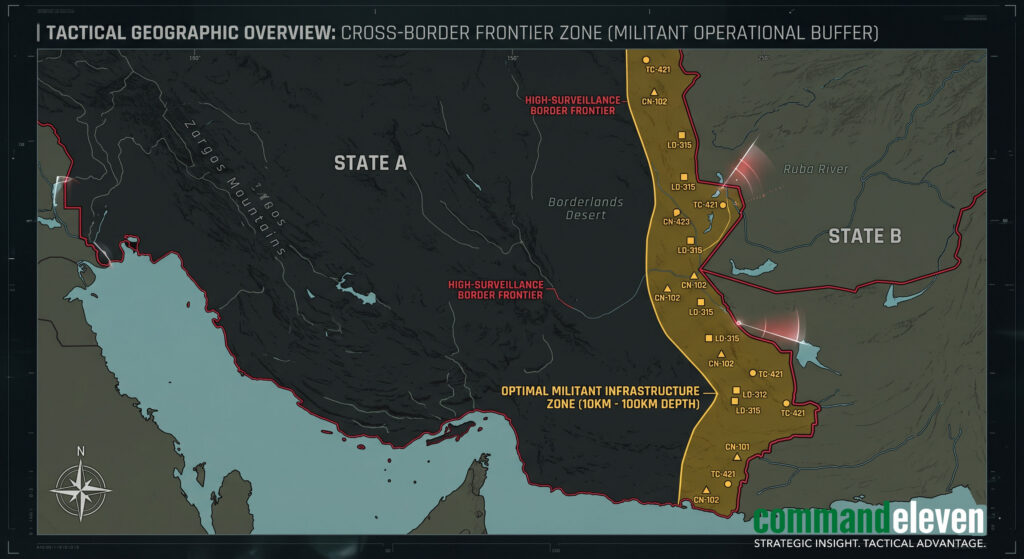
- Logistical Buffer Exploitation: Militant networks have decentralized their physical presence away from immediate borderlines to mitigate the risk of tactical raids and cross-border hot-pursuit operations. Effective interdiction requires target acquisition frameworks to focus on the ten to one hundred kilometer deep border corridor where permanent supply depots and command nodes are established.
- Trans-Regional Procurement Loops: Asymmetric networks in primary conflict zones rely on highly stable, dual-use commercial supply chains rooted in Southeast Asian manufacturing hubs. Counter-terrorism strategies must integrate international export controls with maritime transshipment data analysis to disrupt front companies acquiring drone components and explosive precursors.
Regional Players
The Middle East and East Africa kinetic axes comprise highly institutionalized asymmetric networks, ideological vanguards, and entrenched insurgent forces capable of projecting state-level disruption. The primary entities tracked within this segment are:
- Hezbullah (Lebanon Core & External Action Cells)
- Ansar Allah (Houthi Movement – Yemen)
- Harakat al-Shabaab al-Mujahideen (East Africa Core)
- Al-Qaeda in the Arabian Peninsula (AQAP)
- Kata’ib Hezbollah (Iraqi PMF Faction)
- Asa’ib Ahl al-Haq (Iraqi PMF Faction)
- Islamic State in Iraq and Syria (ISIS-Core remnants)
- Syrian Salvation Government (SSO / HTS administrative wing)
- Palestinian Islamic Jihad (PIJ)
Regional Ecosystem
The primary engine of stability degradation across this segment is the exploitation of governance vacuums and fractured state sovereignty across the Bab-el-Mandeb, the Red Sea corridor, and the Levant. The intersection of weak state control, state-sponsored proxy funding, and geographic maritime chokepoints allows these networks to build parallel administrative structures, secure deep logistical depth, and project asymmetric kinetic capabilities far beyond their immediate territorial strongholds.
Middle East and East Africa Kinetic Axes
The kinetic axes connecting the Middle East and East Africa represent a highly synchronized threat network that operates across the Red Sea, the Gulf of Aden, and the Bab al-Mandeb strait. This maritime choke point serves as the primary conduit for the transfer of advanced weaponry, financial resources, and trained personnel between Iranian-backed networks in Yemen and militant factions in Somalia, Sudan, and the broader Horn of Africa. The primary actor driving this instability is the Houthi movement in Yemen, which has established robust logistical lines with Al-Shabaab in Somalia and various armed factions in the Sudanese civil war.
Operational intelligence confirms that the transfer of hardware occurs via decentralized maritime smuggling rings utilizing low-signature wooden dhows. These vessels originate from ports along the southern coast of Yemen, such as Ash Shihr and Nishtun, and navigate south-west toward the northern coast of Somalia, specifically the Puntland region. The primary offloading zones are located around Caluula, Qandala, and Bosaso. Once the cargo reaches these shores, Al-Shabaab logisticians secure the shipments and distribute the material throughout central and southern Somalia, while a portion is re-routed overland toward western borders.
The inventory of smuggled hardware has transitioned from basic small arms to sophisticated dual-use components and precision weaponry. Shipments seized by maritime interdiction forces include components for unmanned aerial vehicles, such as small gasoline engines, servomotors, and guidance microchips. Additionally, anti-tank guided missiles, specifically the Dehlavieh variant, and man-portable air-defense systems have been intercepted. These weapon systems significantly upgrade the kinetic capabilities of East African militant groups, allowing them to challenge state security forces and African Union transition missions effectively.
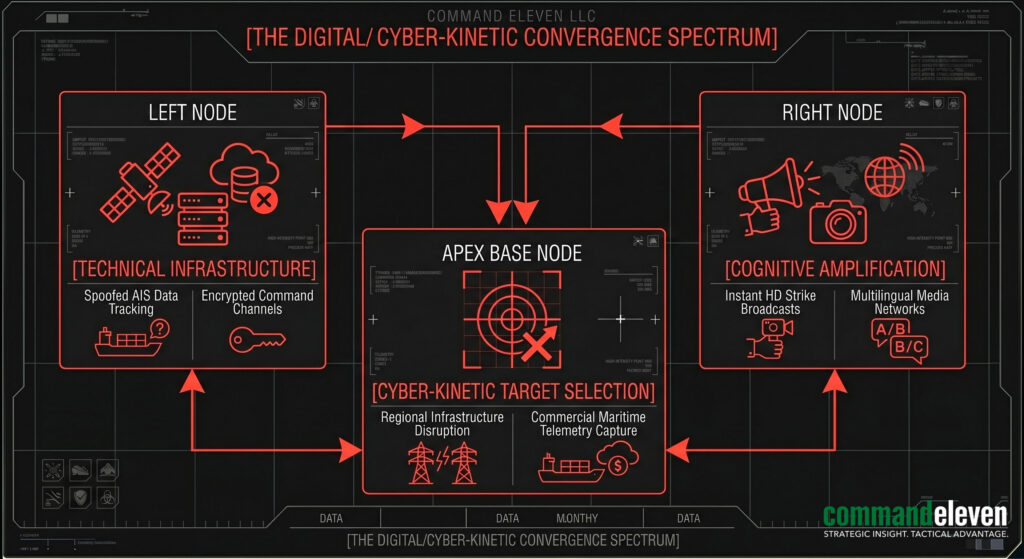
The financial architecture supporting this axis relies on a hybrid system of traditional hawala networks, trade-based money laundering, and illicit charcoal and narcotics smuggling. Al-Shabaab funds its operations by taxing local businesses and agricultural outputs, generating an estimated one hundred million dollars annually. A significant portion of these funds is laundered through legitimate commercial enterprises in the Gulf region, where it is converted into consumer goods and shipped back to East Africa. This trade-based laundering mechanism provides a self-sustaining financial loop that remains immune to international banking sanctions.
Furthermore, the kinetic axis exploits the ongoing conflict in Sudan to expand its operational footprint. The breakdown of state authority in Port Sudan and the surrounding Red Sea coast has created new opportunities for weapons proliferation. Armed factions in Sudan are actively trading gold and agricultural commodities for small arms and ammunition sourced from Yemeni black markets. This illicit exchange exacerbates the humanitarian crisis and destabilizes the regional border security frameworks of neighboring states, including Egypt, Ethiopia, and Eritrea. The convergence of these conflicts creates a continuous zone of instability that threatens international shipping lanes and regional security.
TCO to Terrorist Network Matrix
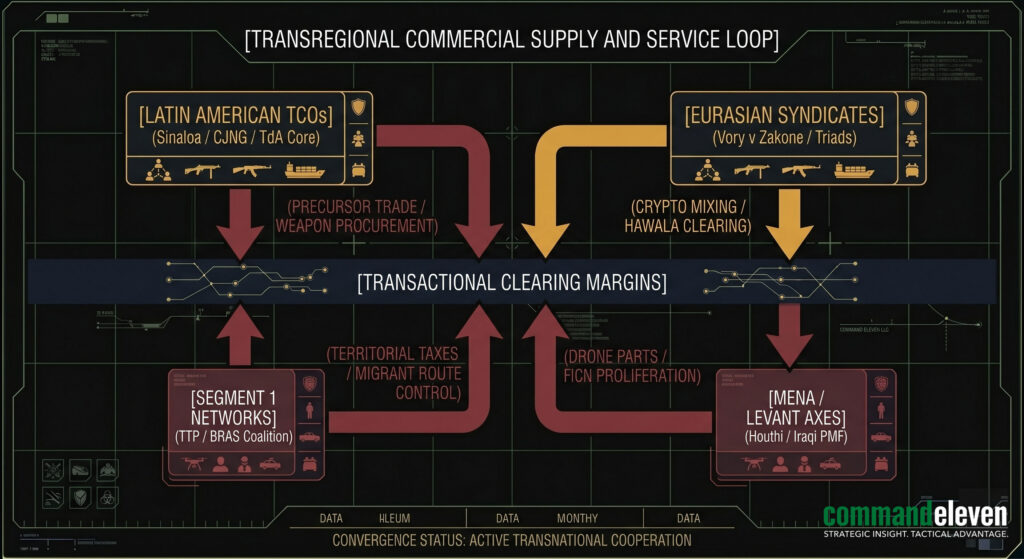
The operational integration between Transnational Criminal Organizations (TCOs) and terrorist networks across the Middle East and East Africa has created a highly resilient, market-driven threat ecosystem. This symbiotic relationship bypasses ideological differences, focusing entirely on transactional efficiency, logistical optimization, and risk mitigation. Terrorist groups require constant flows of funding, specialized hardware, and forged documentation, while criminal syndicates seek secure transit corridors, protection from state law enforcement, and access to corrupted border officials.
In East Africa, the primary criminal-terrorist nexus involves Al-Shabaab and transnational smuggling syndicates operating out of the Dadaab refugee camp complex near the Kenya-Somalia border and the port cities of the Indian Ocean. These syndicates manage the illicit trade of sugar, charcoal, and counterfeit pharmaceuticals. Al-Shabaab does not directly run the smuggling operations. Instead, the group establishes checkpoint taxation systems along key transit routes, charging fixed fees per vehicle based on cargo volume and value. This extortion matrix generates millions of dollars in predictable revenue without requiring the group to manage complex international distribution logistics.
In the Middle East, the convergence centers on the production and trafficking of synthetic narcotics, specifically Captagon. Production facilities located in government-controlled areas of Syria and parts of Lebanon produce billions of tablets annually. These narcotics are smuggled through Jordan and Iraq into the Gulf Cooperation Council states, utilizing highly sophisticated concealment methods within legitimate agricultural exports. The funding generated from this multi-billion dollar trade is directly channeled into financing paramilitary operations, procuring drone components from East Asian markets, and maintaining localized patronage networks that undermine state authority.
- Financial Facilitation: Criminal syndicates utilize gold-smuggling routes from the Democratic Republic of the Congo through Uganda to Dubai to launder the proceeds of terrorist extortion schemes. The gold is melted down and integrated into the global market, providing untraceable cash reserves for militant buyers.
- Weapons Procurement: Eastern European and Balkan criminal networks supply small arms, rocket-propelled grenades, and explosives to Middle Eastern brokers, who then route the hardware through the Red Sea to East African insurgent buyers.
- Human Smuggling: Transnational networks move migrants from the Horn of Africa across the Gulf of Aden into Yemen. Terrorist factions tax these smuggling rings and actively recruit vulnerable individuals from the migrant streams into their combat units.
The logistical nodes of this matrix are highly adaptive. When state forces increase interdiction efforts along specific land routes, the TCO-terrorist networks rapidly shift to maritime coastal routes, utilizing small fishing vessels that blend into local traffic. This operational fluidity renders static border security measures ineffective and requires a dynamic, intelligence-led approach to map and disrupt the underlying financial and logistical connective tissue.
| Transnational Criminal Node | Terrorist/Asymmetric Recipient | Primary Commodity/Pipe | Operational Clearing Mechanism |
| West African Drug Syndicates | Hizbullah (Unit 910 Logistics) | Bulk Cocaine Transshipment | Laundering via Lebanese diaspora-owned commercial networks and used-car import export lines in Cotonou and Abidjan. |
| Gulf of Aden Smuggling Guilds | Al-Shabaab / Ansar Allah | Maritime Transit Corridors | Reciprocal trade loops where Somali small arms are exchanged for Iranian-origin technical components and loitering munition parts. |
| Levantine Captagon Networks | Regional Armed Formations / PMFs | Synthetic Stimulants (Captagon) | Structured taxation of production facilities and transit highways, generating liquid cash reserves independent of international banking systems. |
| Eurasian Precursor Brokers | South Asian Affiliates (ISKP / AQIS) | Chemical Precursors | Diverting industrial chemicals from Southwest Asian ports into regional processing centers to refine illicit synthetic narcotics. |
Intra-Theater Axis – Sahel & MENA
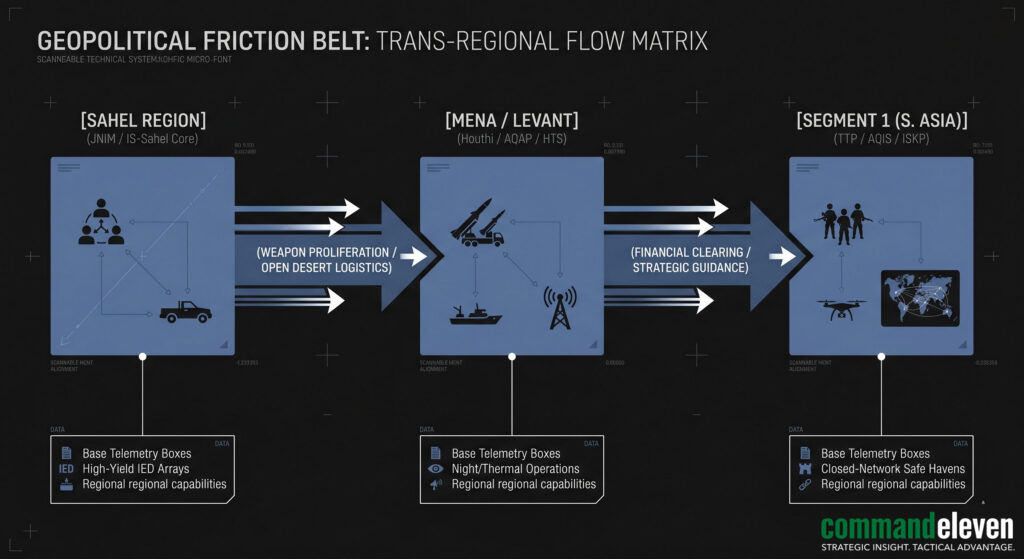
The intra-theater axis connecting the Sahel with the Middle East and North Africa (MENA) region functions as a strategic super-highway for militant groups, weapons, and extremist ideology. The collapse of state authority in Libya following the conflict of 2011 established a massive, unmonitored weapons bazaar that continues to fuel insurgencies across Niger, Mali, Burkina Faso, and Chad. This northern kinetic pipeline is dominated by Al-Qaeda in the Islamic Maghreb and its regional affiliate, the Jama’at Nusrat al-Islam wal-Muslimin, alongside competing factions aligned with the Islamic State.
The primary geographical conduit for this axis is the Salvador Pass, a remote desert frontier intersection connecting southern Libya, northern Niger, and eastern Algeria. This rugged terrain is outside the effective control of any central government, allowing militant convoys to transport heavy weaponry, including heavy machine guns, mortar systems, and industrial-grade explosives, deep into the Sahelian theater. These weapons are used to execute complex, multi-directional assaults against isolated military outposts and critical mining infrastructure in the tri-border region of Burkina Faso, Mali, and Niger.
Financial sustainability along the Sahel-MENA axis is maintained through the exploitation of artisanal gold mining sectors. Over the past decade, hundreds of informal gold mines have opened across the Sahara and the Sahel. Militant groups have systematically seized control of these mining sites, enforcing strict taxation regimes on independent miners and smuggling the raw gold northward into North African markets or eastward through Sudan. This gold-based economy bypasses the international financial system entirely, providing militants with a liquid asset that can be readily exchanged for vehicles, satellite communications equipment, and weapons components.
The operational tactics of Sahelian militant groups have evolved through direct knowledge transfer from Middle Eastern theaters. Foreign fighters who gained combat experience in Iraq, Syria, and Libya have migrated southward, bringing advanced tactical expertise. This includes the manufacturing of complex, vehicle-borne improvised explosive devices with dual-stage detonation mechanisms, the integration of commercial off-the-shelf drones for tactical reconnaissance and artillery spotting, and the implementation of decentralized command-and-control structures that utilize end-to-end encrypted messaging applications.
State responses to this intra-theater threat have been severely degraded by recent political instability within the Sahel. The expulsion of European counter-terrorism missions and the breakdown of regional security frameworks, such as the G5 Sahel, have left a security vacuum that militant groups are aggressively exploiting. The lack of coordinated cross-border intelligence sharing allows insurgent cells to launch kinetic operations in one jurisdiction and then retreat into neighboring territory to rest, refit, and resupply, creating a cycle of violence that threatens to spill over into the coastal states of West Africa.
Tactical Innovation Matrix
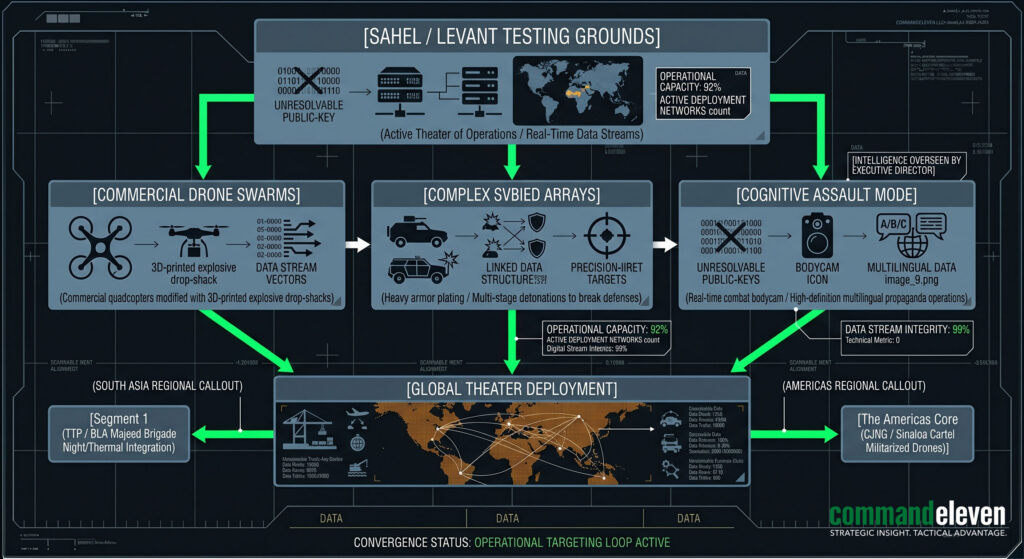
Adversaries across the Middle East and East Africa are demonstrating rapid tactical innovation by modifying commercial technologies to match or exceed the capabilities of conventional state security forces. This democratization of technology allows asymmetric actors to project power, gather intelligence, and conduct precision strikes at a fraction of the cost of traditional military hardware. The primary areas of innovation center on unmanned aerial systems, improvised naval capabilities, and decentralized operational security protocols.
In the aerial domain, militant groups have bypassed GPS spoofing defenses by upgrading the guidance packages of their tactical drones. Standard commercial unmanned aerial vehicles are highly vulnerable to electronic warfare arrays that jam or manipulate satellite signals. To counter this, technicians are integrating secondary optical flow sensors and edge-computing processors running visual odometry software. These algorithms allow the drone to analyze terrain features in real-time, matching the visual input against pre-loaded satellite maps to maintain its flight path without relying on external radio signals or satellite links.
- Kinetic Fallback Routines: Drones are programmed to detect terminal signal loss or coordinate discrepancies. If electronic jamming is detected, the platform automatically accelerates along its last known heading, transforming from a reconnaissance asset into a blind kinetic missile directed at stationary targets.
- Improvised Naval Threats: In the Red Sea and Gulf of Aden maritime theaters, adversaries are utilizing unmanned surface vessels packed with industrial-grade explosives. These remote-controlled or pre-programmed boats are designed with low radar cross-sections, making detection difficult for conventional naval vessels until they enter the terminal engagement zone.
- Decentralized Financial Systems: Insurgent financial networks are migrating away from traditional hawala brokers toward privacy-focused digital currencies and decentralized finance protocols. These digital assets are used to purchase specialized electronic components from international markets, hiding the identity of both buyer and seller.
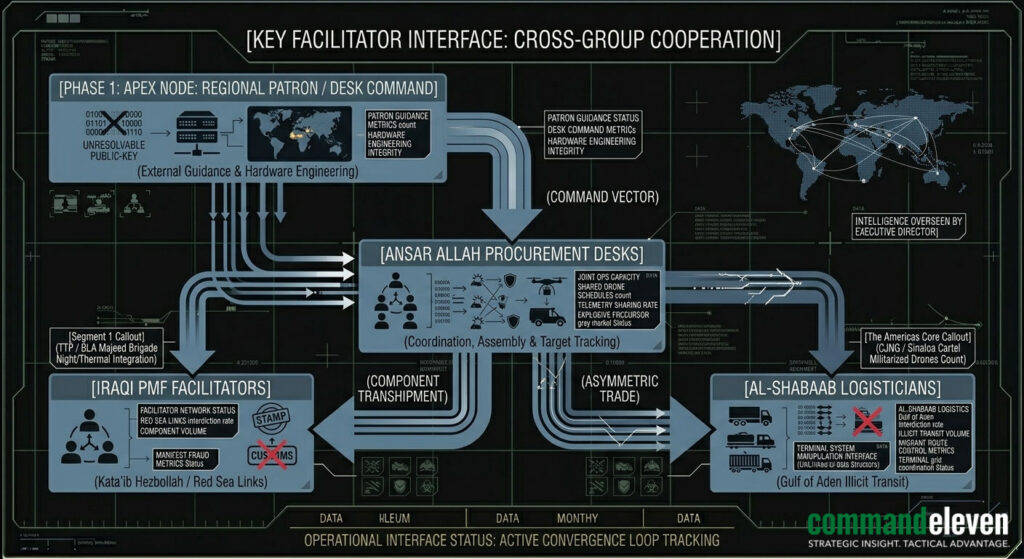
Operational security has also been enhanced through the systematic deployment of encrypted communication platforms that utilize peer-to-peer mesh networking. These systems do not require cellular infrastructure or internet access, allowing militant units to maintain tactical coordination within a local radius of several kilometers even during complete electronic blackouts or active state jamming operations.
The payload kinetics of these improvised systems have become significantly more destructive. Militants are moving away from basic military-grade ordnance toward custom chemical formulations, including thermite mixtures capable of burning through armored plating and reinforced concrete structures. The combination of increased precision, autonomous navigation, and enhanced payload lethality has compressed the decision cycle for defensive forces, requiring automated, hard-kill countermeasure systems at the tactical level.
Trans-Regional Axis – Southeast Asia Linkage Loops
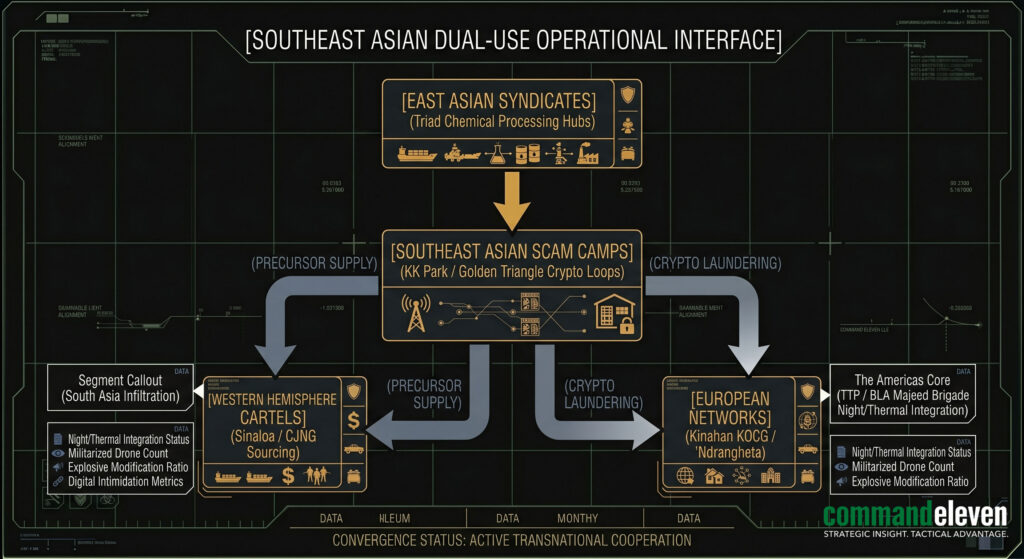
The trans-regional axis connecting Middle Eastern and East African conflict zones to Southeast Asia represents a highly covert procurement and financial network. This axis operates through complex maritime shipping lanes, international banking hubs, and dual-use technology markets in countries such as Malaysia, Indonesia, and the Philippines. Rather than transferring large numbers of combatants, this linkage loop focuses primarily on the acquisition of specialized hardware, the generation of capital through shell companies, and the transfer of technical expertise.
The primary logistical function of the Southeast Asian loop is the procurement of dual-use electronics necessary for the assembly of advanced improvised explosive devices and unmanned aerial systems. Procurement cells operating in regional electronics manufacturing hubs acquire commercial components such as microcontrollers, high-frequency radio transceivers, brushless electric motors, and lithium-polymer batteries. These items are purchased through front companies registered as legitimate agricultural or consumer electronics distribution businesses, masking the ultimate end-user in the Middle East or East Africa.
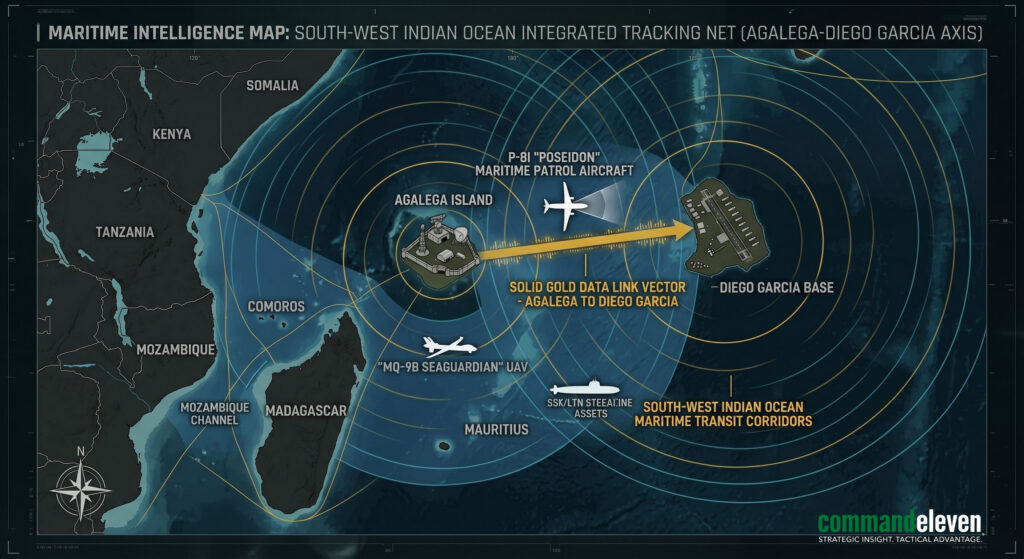
The maritime routing of these supply lines relies on the exploitation of transshipment hubs. Cargo containers containing illicit electronic components are shipped from ports in Southeast Asia, such as Port Klang or Singapore, to intermediate destinations in the borderlands of South Asia before reaching their final destinations in the Gulf or East Africa. Manifests are systematically falsified at each transshipment point, changing the description of the cargo from specialized electronics to generic consumer goods or machine parts to evade customs inspections and international export controls.
Financial networks within this trans-regional axis utilize the highly integrated banking sectors of Southeast Asian financial capitals to launder money and distribute funds to operational cells worldwide. Non-profit organizations, religious charities, and educational foundations are frequently exploited as front operations. Legitimate donations are comingled with illicit funds generated from kidnapping-for-ransom schemes, extortion, and cybercrime operations conducted by regional militant affiliates like the Abu Sayyaf Group or Jemaah Islamiyah, then transferred to Middle Eastern financial institutions via wire transfers.
Furthermore, the transfer of technical expertise is a critical component of the Southeast Asian linkage loop. Digital networks allow bomb-makers and drone technicians in the Middle East to share instructional manuals, software code, and tactical lessons learned with their counterparts in Southeast Asia. This digital exchange has led to a standardization of tactics, with regional groups adopting the precise manufacturing techniques for suicide vests and remote-controlled explosive devices developed in the Syrian and Iraqi theaters, thereby increasing the lethality of localized insurgencies in the Pacific.
Conclusion
The convergence of kinetic axes across the Middle East, East Africa, and their trans-regional extensions in the Sahel and Southeast Asia presents a complex challenge to international security. Asymmetric actors have demonstrated a high degree of operational flexibility, adapting to conventional military pressure by building resilient, multi-layered networks that exploit geographic borderlands and technological vulnerabilities.
The traditional approach to security, which relies on static border lines, siloed intelligence structures, and defensive electronic warfare capabilities, is no longer sufficient to disrupt these highly adaptive adversaries. The integration of commercial technologies, such as visual navigation algorithms on unmanned aerial vehicles and privacy-focused digital financial systems, allows militant groups to operate with minimal signatures and high precision, reducing the effectiveness of state interdiction efforts.
On a strategic level, international partners must enhance cross-border intelligence sharing, synchronize export controls on dual-use electronic components, and dismantle the transshipment networks and financial front companies operating within international trade hubs. The maritime security architecture must be reinforced by expanding real-time tracking links between key installations, ensuring complete surveillance coverage over critical choke points and illicit shipping corridors. Only by executing a coordinated, trans-regional strategy that targets the funding, procurement, and logistics of these groups simultaneously can the international community hope to stabilize these vital regions, secure global trade routes, and permanently neutralize the evolving threat networks.
Part I of this series – The Regime-Structure Evolution Blueprint
Part II – Indian Subcontinent Regional Security Seams
Part III – Western Weapons Proliferation – TTP & BLA
Part IV – Middle East & East Africa Kinetic Axes: Asymmetric Threat Dossier