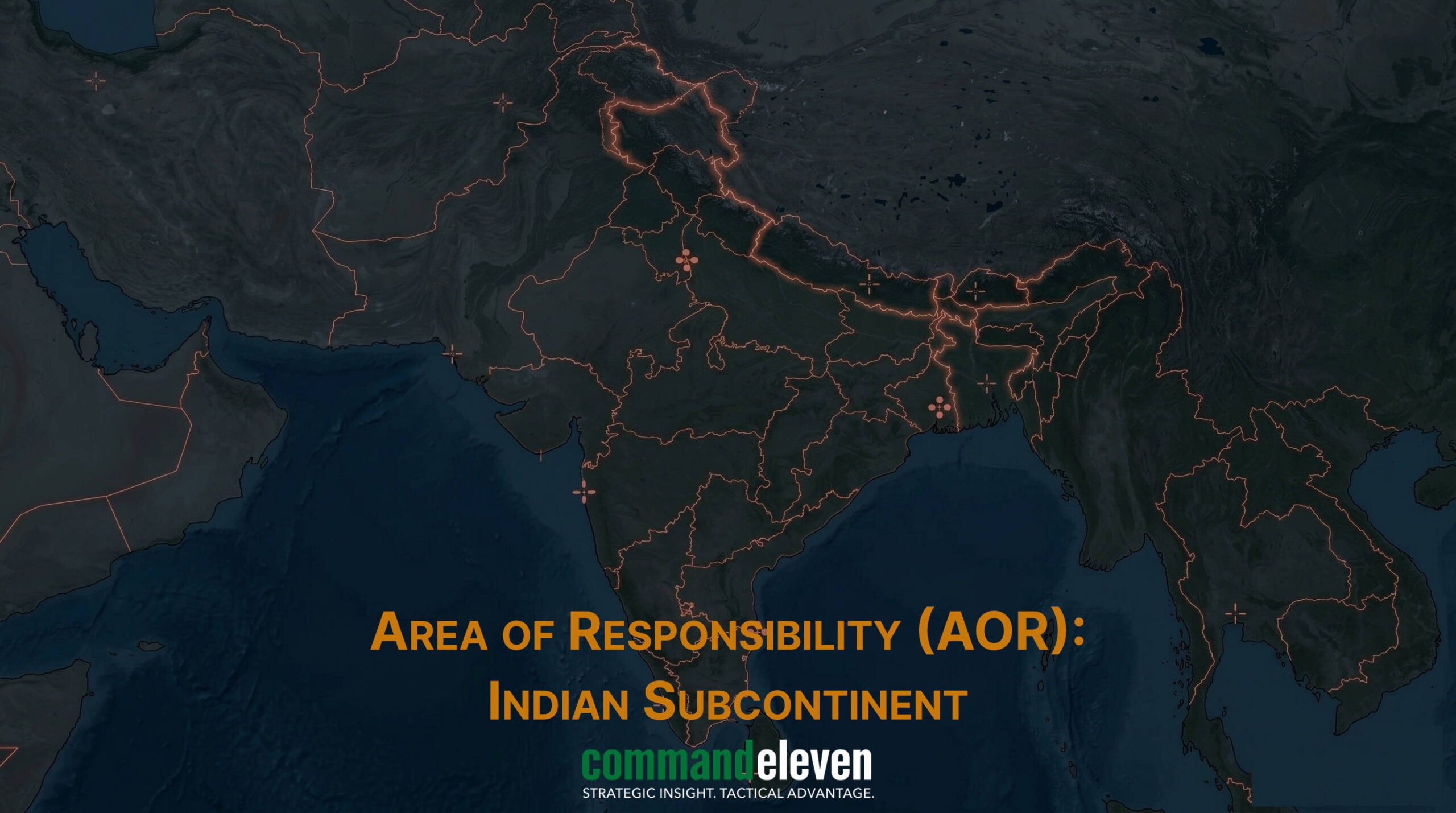
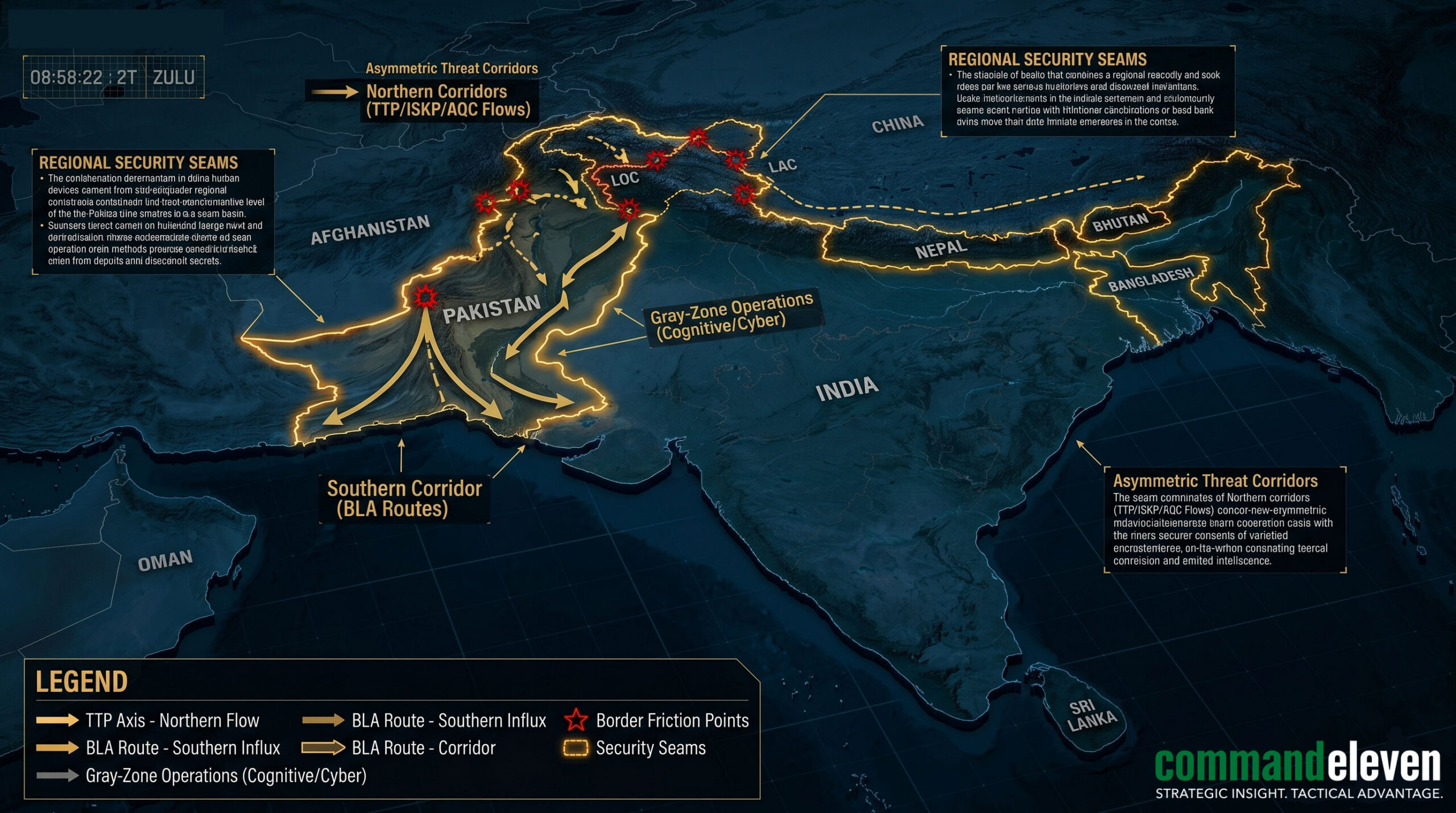
This technical intelligence dossier details the operational mechanics, structural topology, and trans-regional convergence pipelines defining the South Asia Regional Security Seams.
The complete assessment is structured into exactly four distinct, deeply technical sections:
- Section 1 outlines the operational profiles and command frameworks of localized actors
- Section 2 itemizes the hardware, weapons procurement networks, and kinetic tracking vectors active along the Afghanistan-Pakistan border
- Section 3 deconstructs the financial liquidation and precursor chemical diversion networks
- Section 4 details trans-regional synchronization and external sanctuary vectors.
Core Entity Profiles and Institutionalized Command Frameworks
Tehreek-e-Taliban Pakistan (TTP) Core
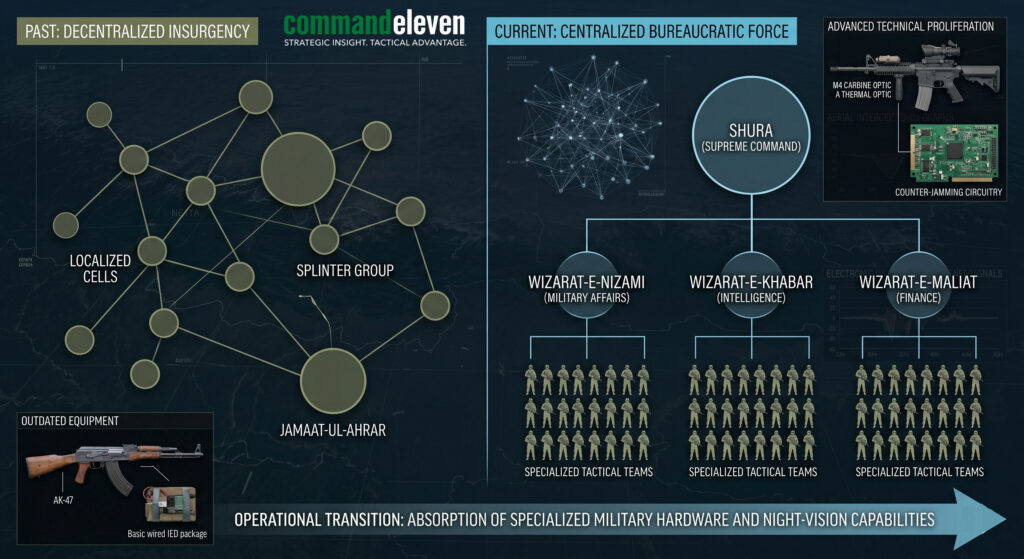
The Tehreek-e-Taliban Pakistan (TTP) Core operates under a highly corporate, centralized administrative matrix overseen by the Rahbari Shura (Supreme Leadership Council), with primary command directives structured by Amir Mufti Noor Wali Mehsud. Moving away from the highly fractionated tribal coalition model that characterized its operational profile prior to 2020, the TTP has enforced strict organizational discipline modeled directly after the administrative architecture of the Afghan Taliban. The group enforces centralized fiscal oversight through a dedicated finance commission and orchestrates kinetic campaigns via regional shadow ministries (comissions).
Kinetic operations are heavily decentralized at the execution layer through specialized territorial commands, with primary strategic weight concentrated within the Malakand Regional Command and the Peshawar Regional Command. The Malakand Regional Command specializes in subterranean recruitment pipelines, intelligence collection, and targeted execution sweeps across Swat, Dir, and Chitral. The Peshawar Regional Command coordinates high-impact urban destabilization campaigns, specialized targeted actions within the provincial capital perimeter, and automated improvised explosive device (IED) placement along state transport routes. The group maintains strategic depth by anchoring its primary command elements, training facilities, and family sanctuaries inside eastern and southern Afghanistan, enabling units to absorb domestic kinetic pressure, conduct weapons maintenance, and redeploy tactical assets into municipal centers with high flexibility.
Islamic State Khorasan Province (ISKP)
In direct structural opposition to the rural insurgent-holding strategy of the TTP, the Islamic State Khorasan Province (ISKP) functions through a highly compartmentalized, clandestine network of urban sabotage cells. These cells operate with high autonomy inside major regional municipal centers to maximize state delegitimization. Recruitment methodologies have shifted away from a reliance on local Taliban defectors toward an aggressive trans-regional pipeline targeting radicalized, highly educated individuals across Central Asia,specifically Uzbekistan, Tajikistan, and Kyrgyzstan,and urban South Asia.
Operational execution is heavily reliant on technical skillsets for encrypted communication management and strict operational security (OPSEC). The group’s media wing, the Al-Azaim Foundation for Media Production, runs a sophisticated decentralized information warfare operation. Al-Azaim simultaneously distributes high-definition content in Pashto, Dari, Urdu, Tajik, Uzbek, English, Russian, and Arabic. This multi-language apparatus functions to activate localized lone-wolf operators and systematically undermine the governing legitimacy of both the Pakistani state and the Afghan Taliban through ideological targeting mandates.
Al-Qaeda in the Indian Subcontinent (AQIS)
Al-Qaeda in the Indian Subcontinent (AQIS) has deliberately minimized its visible kinetic signature to evade international electronic intelligence (ELINT) and signature detection tracking. Operating primarily as a high-tier advisory, technical, and logistics node, AQIS personnel embed within localized insurgent formations rather than claiming independent kinetic strikes. The group functions as a force multiplier by providing specialized media strategy support, advanced tactical instruction, bomb-making optimization tradecraft, and digital operational security protocols. AQIS maintains deep, generational ties with senior logistics elements of both the TTP and the Afghan Taliban, acting as an ideological and technical advisory vanguard along the Afghanistan-Pakistan border.
Balochistan Liberation Army (BLA) – Majeed Brigade
The Majeed Brigade represents the elite, highly specialized asymmetric wing of the Balochistan Liberation Army (BLA). This unit selects, indoctrinates, and trains highly ideologically driven operatives, including an increasing sub-set of educated female operatives, for complex multi-stage martyrdom operations. Moving away from traditional low-intensity guerrilla ambushes, the Majeed Brigade specializes in high-impact urban penetration and the sabotage of fortified installations.
Kinetic profiles are marked by extensive pre-operational reconnaissance, the deployment of tactical security uniforms, and forged state credentials. Their targeting matrix is explicitly anti-state and directed against foreign economic investments, specifically focusing on Special Economic Zone (SEZ) infrastructure, deep-sea port logistics pipelines across the Makran coast, and Chinese diplomatic missions and engineering personnel.
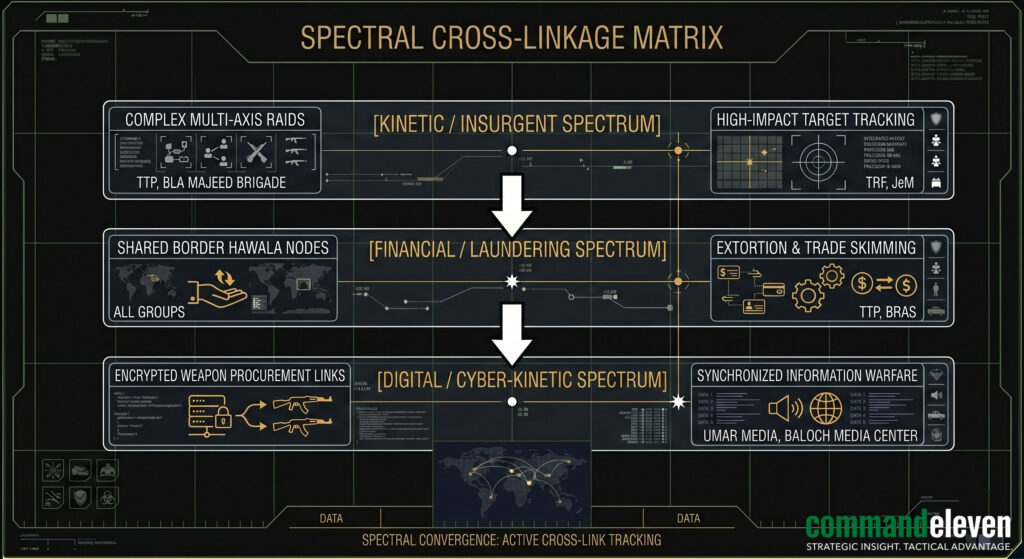
Kinetic Tracking Vectors and Hardware Proliferation Mechanics
The tactical capabilities of actors operating across the South Asia Regional Security Seams experienced a profound structural upgrade following the international military withdrawal from the Afghan theater. This section itemizes the specific hardware variants, supply lines, and operational procurement networks currently deployed by the TTP and BLA/BRAS coalitions.
Primary Proliferation Corridors and Border Infiltration Nodes
The movement of military-grade hardware relies on a decentralized network of smugglers utilizing cross-border tribal smuggling syndicates who operate on a profit-margin basis.
- The Northern Influx Route: Sourced from legacy caches and active black-market repositories in Jalalabad and Nangarhar province, high-value optical gear, modular assault rifles, and specialized ammunition are routed through the mountain passes of Torkham and Landi Kotal to directly supply the TTP’s Peshawar and Malakand commands.
- The Waziristan Supply Axis: Medium and heavy ordnance, including anti-armor systems and heavy machine guns, move through the Khost-Paktia-Paktika triangle, dropping directly into North and South Waziristan.
- The Southern Influx Route: Sourced from primary storage depots in Helmand and Kandahar, weapons pass through the Spin Boldak-Chaman border interface.
- The Balochistan Desert Corridor: Once across the Chaman interface, hardware is distributed through the arid expanses of Nushki and Chaghi, moving deep into southern Balochistan to supply BLA Majeed Brigade cells operating along the Makran coast.
Hardware Classification and Tactical Application Matrix
The black-market valuation and operational integration of Western-pattern materiel left behind from the inventories of the dissolved Afghan National Defense and Security Forces (ANDSF) have altered traditional engagement rules:
- Colt M4 / FN M16A4 Carbines: These 5.56x45mm NATO assault rifles feature flat-top receiver rails configured for modular tactical attachments. Sourced at black-market valuations ranging from $1,500 to $2,500 per unit depending on barrel wear, these platforms have systematically replaced legacy smooth-bore Soviet AK-47 variants among front-line TTP and BLA strike cells, providing tighter grouping capabilities and standardized ammunition configurations.
- M24 Sniper Systems / M110 Semi-Automatic Sniper Systems (SASS): These precision 7.62mm platforms command premium market pricing between $3,500 and $5,000. They are deployed by specialized sniper units for long-range targeted assassinations of border security personnel, boundary customs officers, and conventional command structures.
- AN/PVS-14 Night Vision Devices & Thermal Sights: Tactical infrared monoculars and advanced thermal imaging weapon scopes command market values between $2,500 and $4,000. The integration of these optoelectronic assets has completely neutralized the historical night-operations advantage held by conventional state security forces, allowing insurgent cells to execute complex, zero-light ambushes against exposed frontier outposts.
- 9M113 Konkurs / Milan Anti-Tank Guided Missiles (ATGMs): Wire-guided anti-armor systems sourced from old ANDSF strategic reserves command values between $8,000 and $12,000 per launch unit and missile configuration. These heavy assets are used selectively by elite anti-infrastructure cells to neutralize fortified security checkposts and armored personnel carriers.
Closed-Loop Digital Clearing Houses
The physical arms marketplaces of the frontier districts have transitioned into closed, invitation-only digital clearing houses to avoid physical interdiction and signal intelligence tracking. Weapons brokers utilize end-to-end encrypted messaging applications to manage digital showrooms. Serial numbers, barrel rifling integrity, and optical functionality are verified exclusively via encrypted video feeds. Payment processing is separated from the physical logistics chain, utilizing traditional Hawala escrow layers or privacy-centric cryptocurrency transfers, ensuring total anonymity prior to physical collection at designated border drops.
Financial Liquidation Infrastructure and Precursor Chemical Diversion Networks
Alternative Value Transfer Systems (AVTS) and Cryptographic Settlement Layers
The operational continuity of asymmetric networks across the South Asia Regional Security Seams relies on a dual-layered financial liquidation model that bridges traditional Hawala networks with decentralized cryptographic ledgers. The primary financial hubs for these operations are anchored within the wholesale markets of major regional commercial zones, operating under the guise of legitimate import-export trading companies dealing in bulk commodities such as textiles, agricultural machinery, and electronics.
To clear high-volume transactional flows without triggering conventional anti-money laundering (AML) detection flags, syndicates utilize trade-based money laundering (TBML). Under this mechanism, cash assets generated from illicit activities are integrated directly into commercial supply chains by over-invoicing and under-invoicing bulk commodities moving through the region.
This traditional structure is stabilized by an increasingly sophisticated cryptographic settlement layer, predominantly utilizing Tether ($USDT$) over the TRON ($TRC-20$) network due to its negligible transaction fees and high throughput speeds.
When international or extra-regional capital drops are initiated, funds are funneled through nested, unhosted digital wallets. These digital assets are subsequently liquidated into physical currency via localized over-the-counter (OTC) crypto-to-cash brokers operating within the informal border markets.
To prevent tracking by blockchain analytics platforms, funds are routinely routed through decentralized privacy-centric asset mixers and cross-chain swap protocols before hitting terminal liquidation points. This workflow completely obscures the audit trail prior to final disbursement to tactical procurement commanders on the ground.
Narco-Extractors and Transit Tariffs
For localized actors like the TTP and the BLA/BRAS coalition, primary internal revenue generation is derived from the systematic exploitation of the transit economy passing through their respective areas of tactical dominance.
- The TTP Extraction Model: The TTP enforces a structured, institutionalized taxation code known as Chanda across the transport and corporate sectors of northwestern Pakistan. In the industrial and mining belts of the frontier, the group levies a standardized percentage tax on all commercial extraction activities, specifically targeting marble, emerald, and coal mining operations. Transport companies moving commercial cargo across border entry points are forced to purchase transit passes from TTP financial agents. Failure to comply results in automated IED strikes against logistical assets or targeted abductions of corporate management personnel.
- The BLA/BRAS Extraction Model: In southern and western Balochistan, the BLA and broader BRAS coalition systematically extract revenues from the transit of illicit narcotics moving from southern Afghanistan toward the deep-sea access points of the Makran coast. The group operates toll gates along primary transit tracks, charging a fixed percentage tariff on every kilogram of raw opium and refined methamphetamine passing through their sectors. Additionally, these groups demand protection fees from corporate infrastructure projects, telecommunications providers, and mineral extraction syndicates operating inside their self-proclaimed operational perimeters.
Precursor Chemical Diversion Networks
The production of highly refined synthetic narcotics, specifically crystalline methamphetamine, has emerged as a primary financial pillar within the regional threat landscape, requiring a complex supply line for precursor chemicals. Because key precursor chemicals,primarily ephedrine, pseudoephedrine, and acetic anhydride,are strictly regulated under international conventions, specialized procurement syndicates orchestrate the systematic diversion of these compounds from legitimate pharmaceutical and industrial manufacturing sectors within South and Central Asia.
Bulk ephedrine shipments are routinely mislabeled as commercial chemical solvents, industrial cleaning agents, or cosmetic components, and are transported via commercial freight networks through major transit lines. Once these shipments arrive at border distribution centers, they are broken down into smaller, low-signature packages and transported by mule caravans and off-road vehicles through uncontrolled mountain passes into eastern and southern Afghanistan.
At terminal destinations, these precursor inputs are fed into decentralized, mobile refining laboratories equipped with industrial-grade glass distillation apparatus and chemical processing equipment, allowing syndicates to produce high-purity methamphetamine at a massive scale for global distribution.
Trans-Regional Synchronization and External Sanctuary Vectors
Strategic Depth and Spatial Sanctuary Dynamics
The primary operational resilience of the insurgent landscape across this segment is derived from the exploitation of the Pakistan-Afghanistan border as a geopolitical barrier. The rugged, non-demarcated terrain of the border zone,characterized by deep mountain passes, cave networks, and dense alpine forests,presents an environment that restricts conventional military movement while providing natural defensive positions for asymmetric actors.
By establishing primary command nodes, logistical staging facilities, and training camps within eastern Afghan provinces like Kunar, Nangarhar, Khost, and Paktika, organizations like the TTP maintain a secure rear guard. When state counter-insurgency operations intensify within the border districts, tactical units execute disciplined, cross-border retreats into sovereign Afghan territory to evade capture.
Once inside these sanctuaries, units undergo rest, medical rehabilitation, and organizational reconstitution under the protection of localized tribal arrangements and sympathetic regional actors. This spatial depth makes it impossible for conventional state security forces to decisively neutralize the threat architecture without causing international border incidents.
Pragmatic Tactical Convergence and Operational Cross-Pollination
Despite maintaining distinct, and often diametric, long-term ideological frameworks, a highly pragmatic operational alliance has solidified between ethno-nationalist secessionist groups and religious vanguard actors along shared geographic interfaces. This tactical convergence is driven by shared logistical vulnerabilities and a mutual interest in undermining the security framework of the central state.
- The TTP-Baloch Insurgent (BRAS/BLA) Interface: In northern and western Balochistan, where TTP territorial commands overlap with BLA/BRAS operational corridors, specialized logistics facilitators have set up joint coordinating hubs. These facilitators manage the mutual exchange of tactical intelligence, safe-house networks, and border infiltration routes.
- Weapons-for-Access Exchanges: The TTP regularly leverages its superior access to Western-pattern military hardware,sourced from legacy ANDSF stockpiles,to supply BLA Majeed Brigade cells with high-end optical equipment, thermal imagery scopes, and modular carbines. In exchange, Baloch insurgent elements provide the TTP with deep maritime smuggling connections and access to established southern transit routes moving toward the coast.
- Tactical Tradecraft Sharing: This operational cross-pollination has led to a noticeable alignment in tactical methodologies. The Majeed Brigade has integrated highly sophisticated, multi-stage martyrdom tactics and advanced IED circuit-design methodologies that were historically perfected by religious vanguard networks in the tribal areas, thereby exponentially increasing the lethality of their urban penetration operations.
Electronic Warfare, Encrypted Communications, and Counter-ELINT Protocols
To survive within an environment increasingly monitored by state electronic intelligence (ELINT), signals intelligence (SIGINT), and unmanned aerial reconnaissance platforms, trans-regional actors have updated their operational communications security (COMSEC) protocols. Traditional cellular and standard satellite communication platforms have been banned across all front-line command elements due to their vulnerability to voice-print tracking and geolocation mapping.
Field detachment commanders now communicate via specialized, end-to-end encrypted messaging applications running on hardened, open-source operating systems that are stripped of cellular baseband functionality. These devices connect exclusively via localized, mobile Wi-Fi routers or encrypted satellite data terminals that utilize dynamic, multi-layered virtual private networks (VPNs) and privacy-focused routing protocols.
To counter state aerial surveillance and drone-based targeting systems, units enforce strict counter-ELINT protocols during field movements. These measures include:
- The total enforcement of radio silence within operational sectors.
- The deployment of specialized thermal-imaging suppression blankets to mask thermal signatures from overhead sensors.
- The utilization of highly complex, pre-arranged time-window schedules for physical courier movements.
- The systematic shifting of electronic signatures through spoofed MAC addresses and rotating digital profiles.
This technical discipline ensures that tactical movements remain undetected by state intelligence collection apparatus until the moment of kinetic impact.
Part I of this series – The Regime-Structure Evolution Blueprint
Part II – Indian Subcontinent Regional Security Seams
Part III – Western Weapons Proliferation – TTP & BLA
Part IV – Middle East & East Africa Kinetic Axes: Asymmetric Threat Dossier