Executive Summary
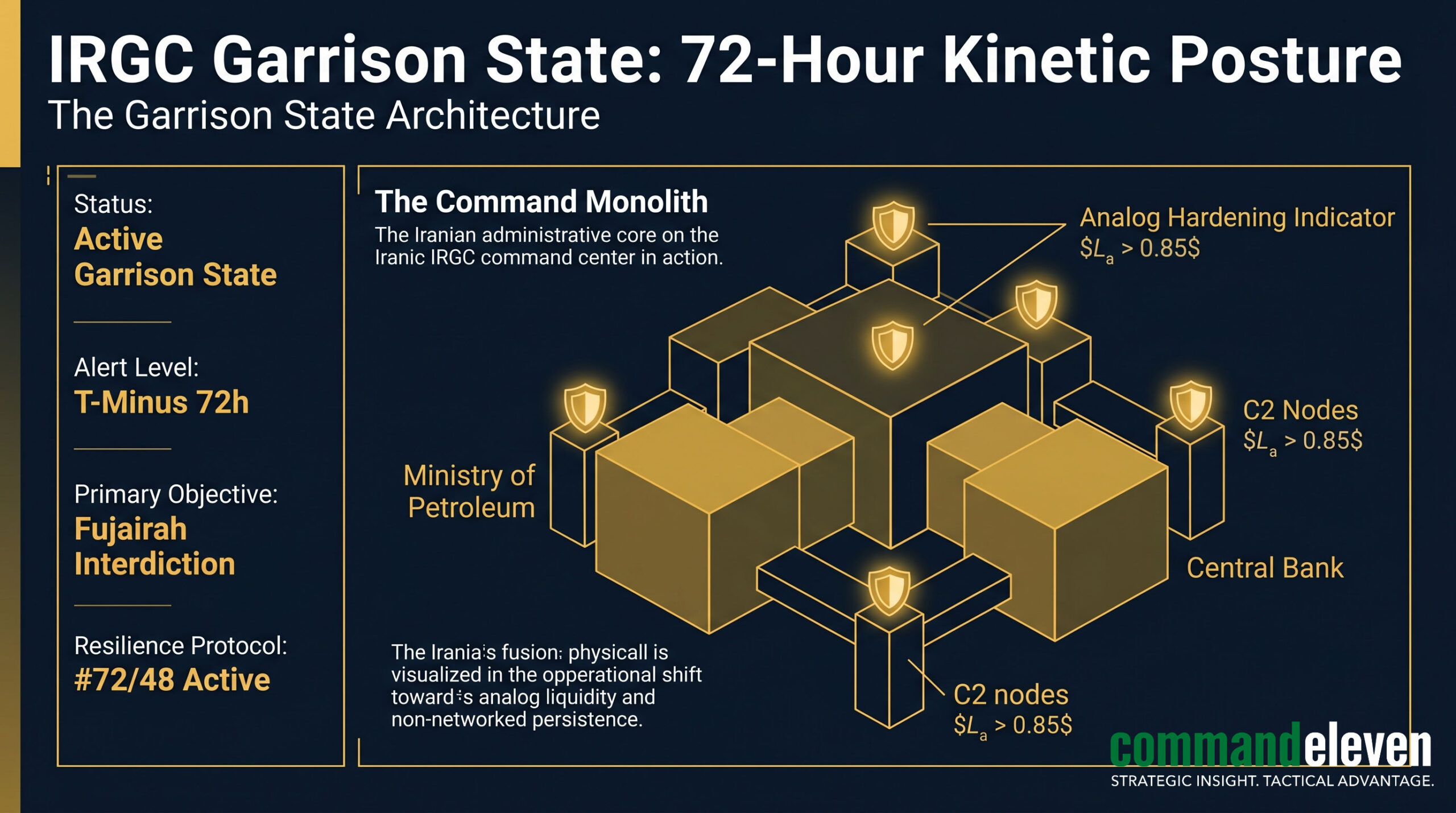
The formalization of the “Garrison State” represents the terminal consolidation of the IRGC over the Iranian administrative and economic core. By dissolving civilian cabinet oversight and seizing the Ministry of Petroleum and the Central Bank, the IRGC has transitioned to a “Siege Economy” posture optimized for kinetic persistence. This assessment audits the 72-hour escalation matrix triggered by the UAE’s exit from OPEC and its deep strategic alignment with the US-Israeli axis.
The Garrison State’s primary objective is the neutralization of the Habshan-Fujairah pipeline to restore the Strait of Hormuz as a non-negotiable global choke point. Through cyber-kinetic “HMI Ghosting” and maritime interdiction, the IRGC seeks to impose a “Western Alignment Penalty” on Abu Dhabi, exploiting regional diplomatic fissures with Saudi Arabia to isolate the UAE during the projected kinetic window.
3 Key Takeaways
- The Single-Trigger Threat: The IRGC is pivoting from administrative consolidation to offensive interdiction, with the Fujairah Pipeline bypass identified as the primary target for a “Single-Trigger” kinetic or cyber-sabotage event.
- Infrastructure Asymmetry: Utilizing Analog Liquidity (La > 0.85) and the #72/48 Protocol, the Garrison State has hardened its own command nodes to survive anticipated US-Israeli SEAD operations while maintaining maritime denial capabilities.
- The OPEC Exit Penalty: The UAE’s US-backed exit from OPEC has transformed it into a front-line adversary for the IRGC, triggering a multi-domain offensive vector that includes subsea cable interdiction and “Synthetic Panic” market manipulation.
The Single-Trigger Threat
The formal transition of the Islamic Republic of Iran to a “Garrison State” represents the terminal consolidation of military authority over the nation’s strategic and economic architecture. By dissolving civilian cabinet oversight and centralizing control of the Ministry of Petroleum and the Central Bank under the IRGC, Tehran has moved to a monolithic command structure optimized for kinetic persistence.
The Shift to a Siege Economy
This administrative seizure is not merely internal restructuring; it is a defensive pivot designed to insulate the state from external geofinancial shocks while projecting offensive capabilities. The Garrison State prioritizes “Siege Economy” metrics – specifically Analog Liquidity (La > 0.85) – over international trade participation. This ensures that domestic military funding and proxy support remain operational even during a total “Flash-Dark” event or severed subsea data links.
The 72-Hour Escalation Window
The convergence of the UAE’s exit from OPEC, synchronized US-Israeli kinetic pressure, and the internal IRGC takeover has created a 72-hour flashpoint window. Intelligence indicators suggest that the IRGC is moving from a posture of consolidation to one of active maritime and infrastructure denial.
The primary risk is no longer a prolonged diplomatic stalemate, but a “Single-Trigger” kinetic event – such as the interdiction of the Habshan-Fujairah pipeline or a high-value vessel seizure – designed to force an immediate and catastrophic shock to global energy markets.
Strategic Objectives – Infrastructure Denial & The Fujairah Gap
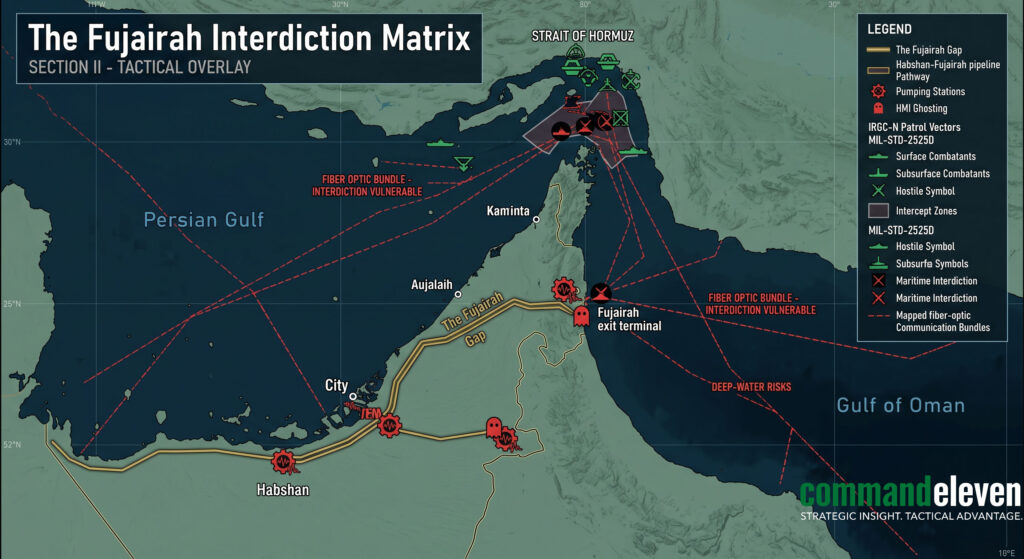
The “Garrison State” view of the Persian Gulf centers on the neutralization of energy bypasses, specifically targeting the Habshan-Fujairah pipeline. The IRGC’s intent is to restore the Strait of Hormuz as a singular, non-negotiable choke point. This objective has been accelerated by the UAE’s withdrawal from OPEC, a move catalyzed by direct US-Israeli strategic intervention.
The US-Israeli Catalyst: Fragmenting OPEC
The UAE’s exit from OPEC is not a localized economic decision but a coordinated geofinancial maneuver backed by the United States and Israel.
- The Oval Office Mandate: Former President Trump’s statement from the Oval Office provided the necessary diplomatic cover and security guarantees for Abu Dhabi to break from the cartel. This signaled a definitive US pivot toward a “post-OPEC” energy architecture in the Middle East, aimed at stripping Tehran and its allies of market-control leverage.
- Intelligence & Kinetic Integration: Israel’s heightened military and intelligence cooperation with the UAE,particularly in subsea surveillance and missile defense – serves as the defensive backbone for this exit. However, this deep integration has fundamentally altered the IRGC’s target prioritization; the UAE is no longer viewed as a peripheral trade partner but as a primary front-line adversary and an extension of the Israeli security apparatus.
The Fujairah Gap: Tactical Intent
The 1.5 million bpd Habshan-Fujairah pipeline represents the primary threat to the IRGC’s “Garrison State” leverage.
- The Sabotage Objective: To maintain “Single-Trigger” control over global energy prices, the IRGC must render the Fujairah bypass inoperable. By neutralizing this link, Tehran ensures that any kinetic closure of the Strait of Hormuz is total and immediate.
- Cyber-Kinetic “HMI Ghosting”: Intelligence suggests the IRGC has deployed specialized cyber-units to execute HMI (Human-Machine Interface) Ghosting against the UAE’s energy infrastructure. This involves the injection of malicious code into SCADA systems at pumping stations to induce over-pressurization or manual override failure, simulating a catastrophic “accidental” rupture.
Target Prioritization and Vulnerability
The IRGC’s 72-hour window focuses on the high-visibility failure of the UAE’s new strategic posture.
- Coordinated Interdiction: We project synchronized probes targeting both the physical pipeline infrastructure and the subsea data cables that facilitate the UAE’s analog-digital bridge.
- The Retaliation Metric: Any IRGC kinetic response is now calibrated to inflict maximum “Administrative Shame” on the UAE, demonstrating that US-Israeli security guarantees cannot prevent localized, high-impact sabotage within the #72/48 Protocol window.
Offensive Vectors – Multi-Domain Interdiction & The Western Alignment Penalty
The IRGC’s offensive strategy for the 72-hour window is designed to impose a “Western Alignment Penalty” on the UAE. This posture moves beyond localized maritime harassment to a systemic punishment of the UAE’s economic and diplomatic standing, framing Abu Dhabi’s exit from OPEC and its US-Israeli alliance as a betrayal of regional and “Arab community” solidarity.
Western Economic Targets & Global Market Sabotage
The IRGC views the UAE’s economy as a proxy for Western interests. Consequently, targets are selected based on their ability to trigger Western capital flight.
- Logistics & Re-export Hubs: Coordinated “Grey Zone” interdictions targeting the Jebel Ali port infrastructure and Western-owned shipping assets. The goal is to induce a “Synthetic Panic” that spikes insurance premiums (Hull and Machinery) to unsustainable levels, effectively blockading the UAE through financial pressure.
- Subsea Digital Interdiction: Intelligence points to the mapping of fiber-optic bundles in the Gulf. Severing these links would not only isolate the UAE’s financial markets but also disrupt Western data flows between Europe and Asia, demonstrating the “Garrison State’s” ability to inflict global pain in response to regional alignment shifts.
Exploiting the Riyadh-Abu Dhabi Fissure
The IRGC’s kinetic calculus incorporates the frayed diplomatic relations between Saudi Arabia and the UAE.
- Strategic Neutralization of Saudi Response: Tehran anticipates that the current friction between Riyadh and Abu Dhabi regarding OPEC quotas and regional leadership will delay or complicate a unified GCC military response.
- The Saudi Proxy Vector: We monitor for IRGC-backed narratives – and potentially kinetic “False Flag” operations – designed to further alienate the UAE from its Saudi neighbors. By framing the UAE’s US-Israeli defense pact as a direct threat to Saudi regional hegemony, the IRGC seeks to ensure that a 72-hour interdiction of the Fujairah Pipeline does not trigger immediate Saudi intervention.
IRGC-N Maritime Intercept Zones
Offensive maritime operations will be characterized by a high degree of distribution, utilizing the Mosaic Defense model to operate without a centralized command signature.
- Kinetic Swarm Zones: Deployment of fast-attack craft (FAC) and unmanned surface vessels (USV) near the Habshan-Fujairah exit terminal.
- The “Single-Trigger” Interdiction: We project a high probability of a vessel seizure involving a Western-flagged tanker within the next 72 hours, intended to test the limits of the UAE’s US-Israeli security umbrella.
Asymmetric Escalation: Desalination & Power
To maximize domestic pressure within the UAE, the IRGC’s asymmetric wing is expected to target the nation’s survival infrastructure.
- Water-Kinetic Convergence: Probes against desalination plants using underwater drones (UUVs) to disrupt intake systems, causing a “Civilian Shock” event that forces the UAE government to prioritize domestic stability over its “Western Alliance” commitments.
Defensive Hardening & The IRGC Counter-Strike Protocol
The “Garrison State” has moved beyond purely offensive posture to a state of Active Defensive Hardening. The IRGC is currently implementing the #72/48 Protocol across its command-and-control (C2) nodes to ensure operational continuity during the anticipated US-Israeli kinetic response, while simultaneously preparing for an escalatory UAE retaliation.
Internalizing the #72/48 Protocol
To survive the high-intensity electronic warfare and SEAD (Suppression of Enemy Air Defenses) operations characteristic of the Western alliance, the IRGC has hardened its strategic nodes.
- Physics-Based Redundancy: All primary C2 nodes have been equipped with manual, analog overrides for energy and communication systems. This “Post-Digital Engineering” baseline ensures that even if digital networks are neutralized by a US-led “Flash-Dark” event, the IRGC can maintain localized kinetic persistence.
- Mosaic Defense Integration: The IRGC-N and aerospace divisions have transitioned to a “Mosaic” model, where decentralized “tiles” (localized units) are empowered with autonomous Rules of Engagement (ROE). This prevents a decapitation strike on Tehran from paralyzing regional maritime interdiction efforts.
Analysis of the UAE Missile Exchange
The limited missile exchange on Sunday/Monday, while characterized by the UAE as a strategic show of force, has been audited by the IRGC as a precursor to more substantive kinetic action.
- The “Show” vs. The “Strike”: Tehran views the previous UAE launch as a calibrated signal of intent rather than a terminal military operation. However, with the UAE’s total alignment with the US-Israeli axis following the OPEC exit, the IRGC anticipates that a second UAE response will be far more lethal and targeted.
- UAE Retaliatory Indicators: We are monitoring for the deployment of UAE-owned long-range precision-guided munitions (PGMs) targeting IRGC-N assets in the Gulf. The UAE’s intent would likely be to demonstrate that it can project power independently of its Western backers, challenging the “Garrison State’s” maritime dominance.
The IRGC Counter-Response Strategy
In the event of a substantive UAE kinetic strike, the IRGC is prepared to move from “Garrison” to “Asymmetric Surge”.
- Proportionality Inversion: The IRGC’s ROE dictates that any UAE strike on Iranian soil or assets will be met with a disproportionate asymmetric response targeting the UAE’s “Economic Survival Nodes” – specifically desalination plants and the Habshan-Fujairah pipeline exit points.
- The “Siege” Escalation: If the UAE initiates a second round of missile strikes, the IRGC will move to finalize the “Single-Trigger” event, attempting a permanent maritime interdiction of all UAE-bound shipping to force a domestic collapse of the Emirati state within the 72-hour window.
The Restoration Threshold – Maintaining the Fujairah Bypass
The “Garrison State” kinetic posture aims to render the Fujairah Pipeline irrelevant by demonstrating its vulnerability. Restoring strategic equilibrium in the Gulf necessitates a shift from reactive defense to a doctrine of Deterrence by Denial. This threshold for reversal is contingent on the ability of the UAE and its Western allies to neutralize IRGC sabotage before it induces a global market shock.
Kinetic Deterrence: Protecting the Bypass
The integrity of the Habshan-Fujairah corridor is now the primary metric of regional stability.
- CMF Integration: The United States and Combined Maritime Forces (CMF) must establish a permanent “Protective Envelope” around the Fujairah export terminals. This requires high-intensity subsea surveillance to counter IRGC-N UUV (unmanned underwater vehicle) probes and the deployment of rapid-response maritime interceptors to prevent “Grey Zone” vessel seizures.
- Countering the “Single-Trigger”: Deterrence is only achieved if the IRGC perceives that any attempt to interdict the pipeline will result in a disproportionate kinetic strike on their own energy infrastructure, specifically the terminals at Kharg Island.
Implementing the Mosaic Defense
To turn the tide, the UAE must move beyond centralized “Fortress” engineering and adopt the Mosaic Defense model.
- Decentralized Resilience: Hardening the pipeline infrastructure requires the implementation of localized, autonomous “tiles”. Each pumping station and sensor node must be capable of independent persistence during an HMI Ghosting attack, utilizing the #72/48 Protocol to maintain flow through physics-based mechanical overrides.
- Analog Hardening: By decoupling critical SCADA systems from the global network during high-threat windows, the UAE can render the IRGC’s cyber-kinetic protocols ineffective, ensuring that “Hardware Truth” remains the final arbiter of operational status.
Neutralizing Cognitive Warfare
A significant component of the IRGC’s strategy is the induction of “Synthetic Panic” in Western markets.
- Narrative Counter-Infrastructure: The UAE and its allies must establish a real-time “Fact-Validation” loop to debunk IRGC-led disinformation regarding pipeline ruptures or maritime “accidents”.
- Market Transparency: By providing audited, real-time data on energy flows through the Fujairah bypass, the Western alliance can prevent the IRGC from leveraging asymmetric “Grey Zone” events to manipulate global oil prices.
The Threshold for Escalation Control
Reversing the IRGC’s momentum requires a clear definition of “Red Lines”. If the IRGC transitions from administrative consolidation to offensive interdiction, the restoration threshold must include the total neutralized capability of the IRGC-N’s fast-attack fleet. This demonstrates that the “Western Alignment” of the UAE is not a liability, but a superior security architecture that the Garrison State cannot breach.
72-Hour Forward Projection – Escalation Matrix
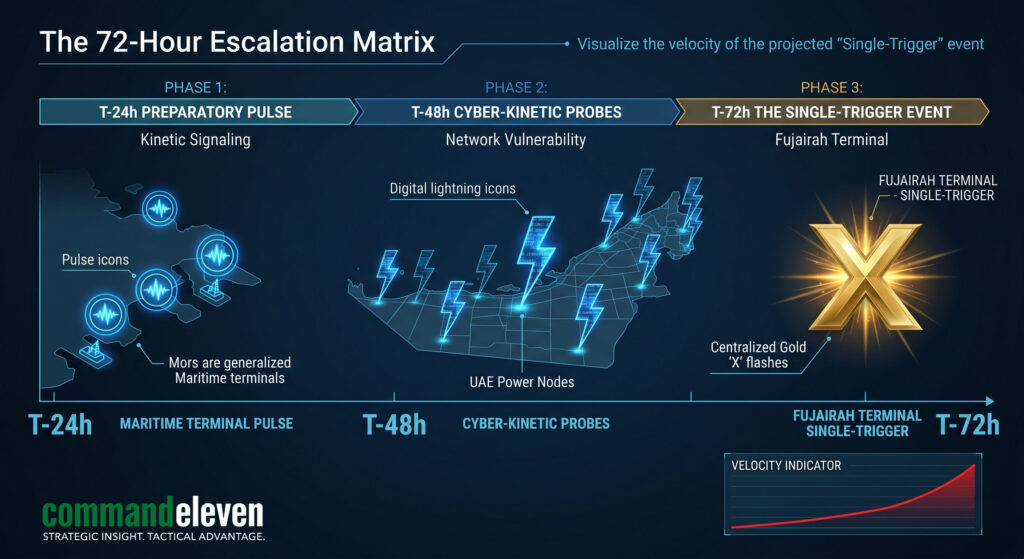
The current posture of the Garrison State indicates a transition from administrative consolidation to active infrastructure denial. We project a “Single-Trigger” kinetic event designed to punish the UAE for its OPEC exit and Western alliance.
T-Minus 24h: Kinetic Signaling and “Swarm” Drills
- Maritime Probes: Expected surge in IRGC-N fast-attack craft (FAC) activity near the Habshan-Fujairah exit terminals. These are not merely drills but “Calibration Runs” to test the response times of the UAE and Combined Maritime Forces (CMF).
- Cognitive Warfare: Initiation of a “Synthetic Panic” narrative across regional media, focusing on alleged “technical failures” within the UAE’s energy grid to drive up global oil insurance premiums.
T-Minus 48h: Cyber-Kinetic Probes and Asymmetric Sabotage
- HMI Ghosting Initiation: Projected deployment of cyber-kinetic protocols against the UAE’s secondary desalination and power nodes. The objective is to induce localized utility failures, testing the UAE’s #72/48 Protocol resilience and domestic stability.
- The Saudi Neutralization: Strategic deployment of diplomatic and “Grey Zone” narratives intended to widen the fissure between Riyadh and Abu Dhabi, ensuring the UAE remains isolated during the initial kinetic exchange.
T-Minus 72h: The “Single-Trigger” Kinetic Event
- Pipeline Interdiction: We project a high-probability attempt to sabotage the Fujairah Pipeline via an underwater drone (UUV) strike or an “accidental” vessel collision at the export terminal.
- Maritime Seizure: Concurrent seizure of a Western-flagged or UAE-bound tanker in the Strait of Hormuz to demonstrate the IRGC’s total maritime denial capability.
- The Threshold of Escalation: By the 72-hour mark, the IRGC anticipates that the global market shock will force a Western diplomatic retreat or, conversely, trigger a full-scale US-Israeli kinetic “SEAD” operation against Iranian coastal infrastructure.