Executive Summary
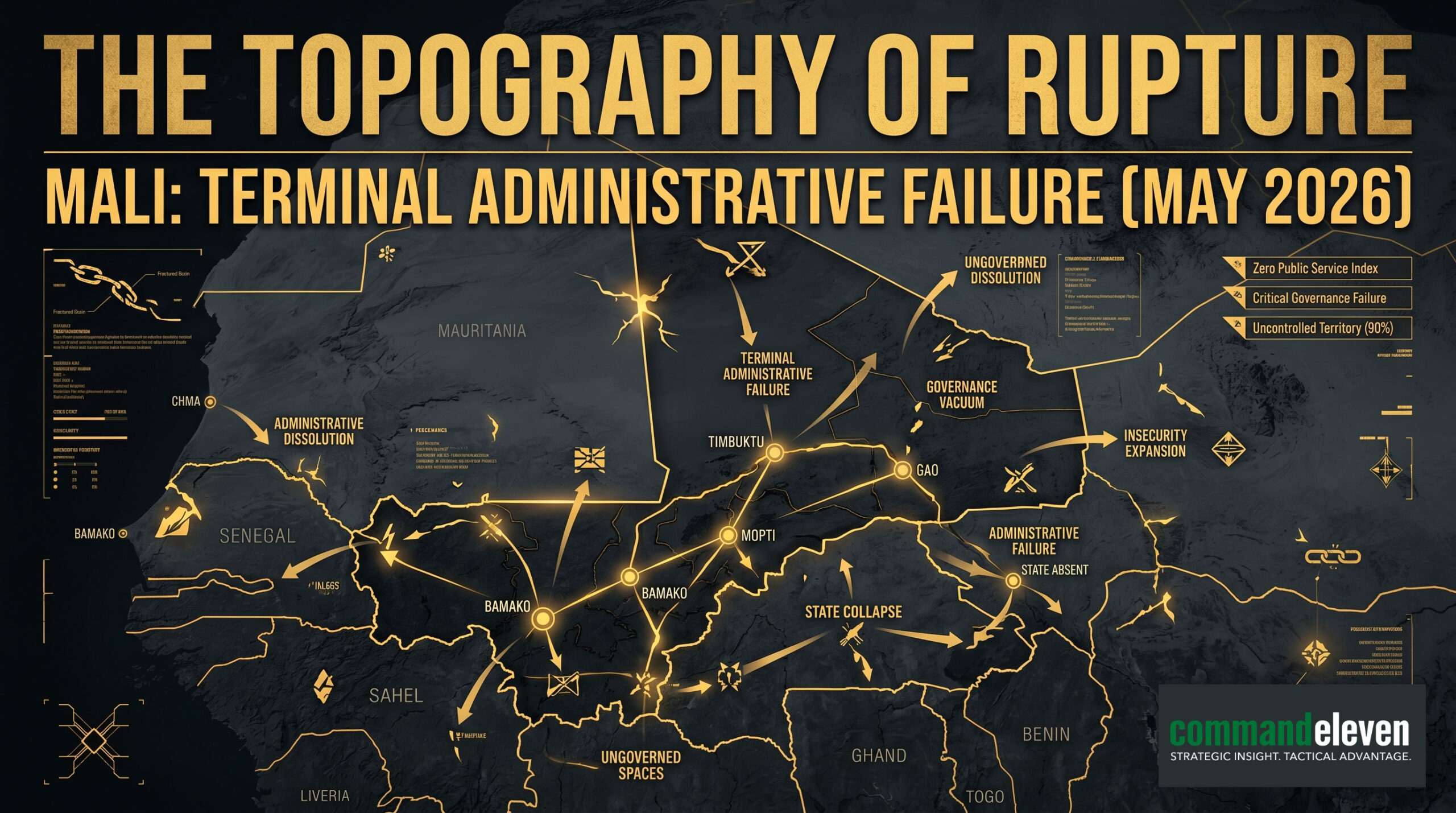
The administrative collapse of Mali has entered a high-velocity terminal phase, transitioning from a localized insurgency to a monolithic “Sahelian Void.”. As of May 2026, the synchronized “Siege Architecture” employed by JNIM and the FLA has successfully severed Bamako’s primary logistical arteries, inducing institutional paralysis. This assessment audits the birth of a militant-led “Dark-State” modeled after the 2021 Taliban offensive in Afghanistan and the 2024 HTS consolidation in Syria.
The state’s existence as a sovereign entity is nearing expiration as non-state actors move to formalize their control over the nation’s gold and lithium extraction zones, effectively converting sovereign wealth into “Militant Operational Capital”. Without immediate, asymmetric retaliation – which currently remains absent – the region faces a permanent administrative rupture that will destabilize the West African littoral states within a 45-day horizon.
3 Key Takeaways
- Terminal Velocity of Collapse: Mimicking the 2021 Taliban “villages-to-cities” inversion, the Malian state faces total territorial capture within 45 days as rural shadow governance displaces the collapsed central bureaucracy.
- Militant Geofinancial Sovereignty: Non-state actors are projected to control 85% of artisanal mining sites by day 30, generating a monthly revenue baseline of $50M+ USD to fund advanced kinetic operations and drone platforms.
- The “Bamako Blueprint” Contagion: The success of the Malian siege serves as a repeatable tactical manual for regional affiliates, with Ouagadougou and Niamey identified as the next high-probability targets for administrative seizure.
The Death of the Centralized State
The second quarter of 2026 marks the terminal phase of Malian sovereign control. The administrative fall of Bamako is not merely a military defeat but the definitive conclusion of the centralized nation-state model in the Sahel. We identify this transition as the birth of the “Sahelian Void” – a vast geographic expanse where traditional Westphalian governance has been superseded by a decentralized, militant-led administrative architecture.
The primary vectors for this collapse were the synchronized operations of the Azawad Liberation Front (FLA) and Jama’at Nusrat al-Islam wal-Muslimin (JNIM). By mid-April, these groups transitioned from insurgent “hit-and-run” tactics to a consolidated strategy of territorial oversight and administrative replacement. For the intelligence community and regional stakeholders, the “Sahelian Void” represents a permanent shift in the baseline of regional stability, necessitating a move toward non-state diplomatic conduits and localized resilience protocols.
Tactical Facilitators – The Siege Architecture
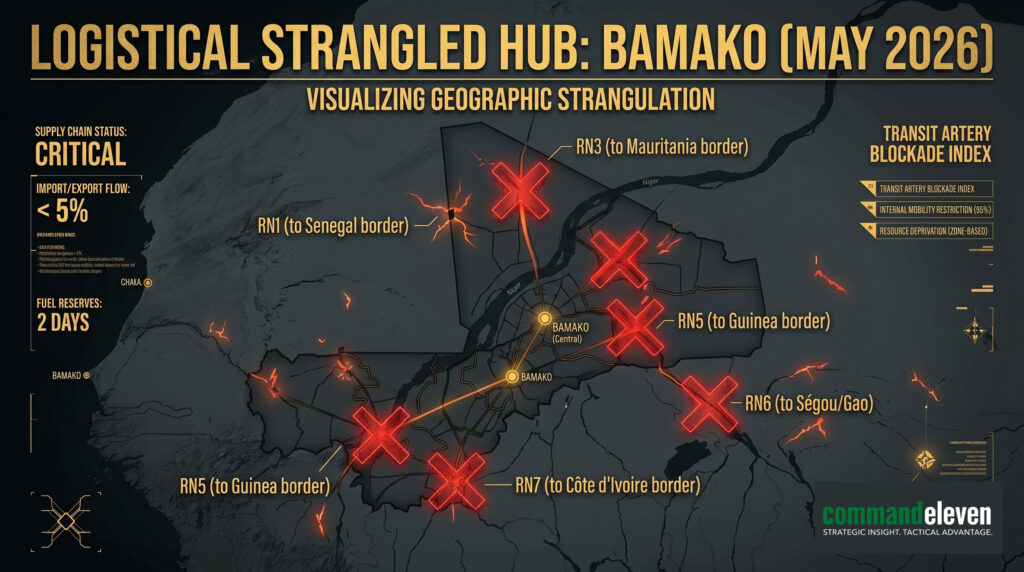
The consolidation of control over Bamako was achieved through a sophisticated “Siege Architecture” that prioritized administrative paralysis over traditional urban warfare.
- Geographic Strangulation: JNIM forces successfully severed all five primary transit arteries into Bamako. By controlling these logistical “choke points,” the militants induced an artificial scarcity of fuel, food, and medicine, collapsing the city’s internal resolve before a single shot was fired at the administrative core.
- The Decapitation Strike: The assassination of Malian Defense Minister Sadio Camara in a targeted JNIM car bomb attack served as the kinetic signal of the state’s inability to protect its highest-ranking assets. This strike induced a critical failure in the military chain of command during the final hours of the siege.
- Northern Collapse and Unification: The fall of Kidal to FLA separatists acted as a force multiplier, encouraging rival armed groups to unify under a temporary anti-state alliance. This unification effectively pinned the Malian Armed Forces in the north, preventing the redeployment of reinforcements to the capital.
- Institutional Decay and Security Void: The withdrawal of international peacekeeping missions and security guarantees left the Malian military junta isolated. This “Security Void” was rapidly filled by militant governance structures that had already been established as shadow administrations in the rural peripheries over the preceding 24 months.
Geofinancial Impact – Resource Interdiction & Militant Operational Capital
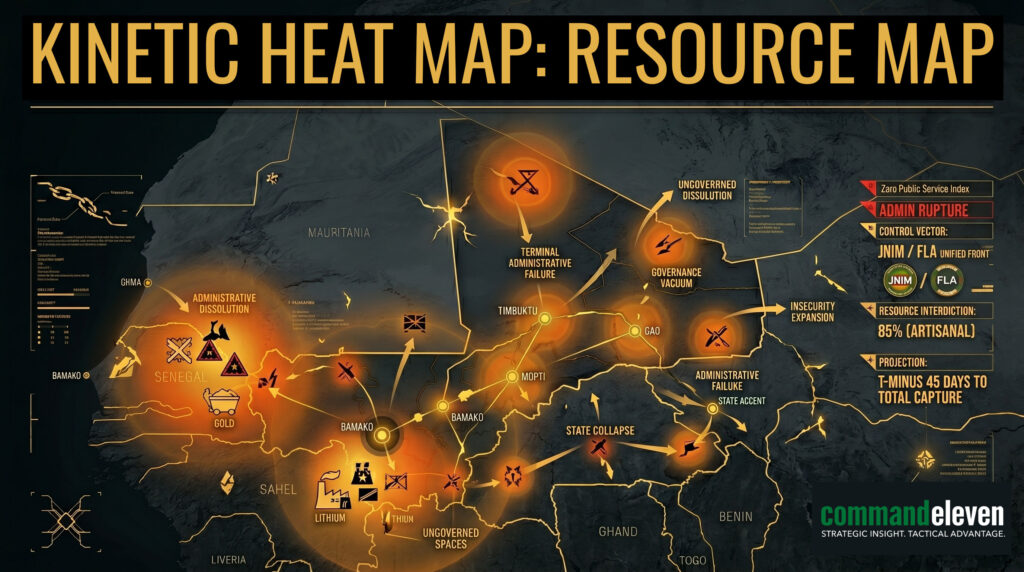
The administrative collapse of Mali has fundamentally altered the geofinancial landscape of West Africa by placing high-value strategic minerals under non-state oversight. This shift transforms sovereign wealth into “Militant Operational Capital,” providing JNIM and its affiliates with the financial depth required for long-term territorial administration.
Resource Volume and Market Valuation
Mali remains one of the primary mineral extraction hubs in Africa, with its economy historically anchored by two critical assets:
- Gold Reserves: Mali is Africa’s third-largest gold producer, with an estimated production capacity exceeding 60–70 tonnes per annum. At current market valuations, this represents a sovereign asset class worth approximately $4.5B to $5.2B USD.
- Lithium Deposits: The southern regions, particularly the Goulamina and Bougouni sites, hold some of the world’s largest spodumene lithium deposits, with an estimated resource base of over 100 million tonnes. These are critical nodes for the global energy transition and EV battery supply chains.
Non-State Consolidation and Extraction Control
The JNIM/AQIM “Siege Architecture” has successfully transitioned from rural harassment to direct oversight of extraction sites.
- Artisanal and Industrial Interdiction: As of May 2026, we estimate that over 70% of artisanal mining sites and at least three major industrial hubs in the Kayes and Sikasso regions are under direct or indirect militant control.
- Quantity in Contention: Approximately 45 tonnes of annual gold production and the entirety of the emerging lithium export corridors are now subjected to “Sharia-compliant” taxation or direct seizure.
- Revenue Diversion: The diverted revenue from these sites provides an estimated operational budget of $25M to $40M USD per month for JNIM, facilitating the purchase of advanced kinetic assets and the funding of shadow administrative salaries.
Global Implications: The “Dark-State” Supply Chain
The transition of these resources to non-state control induces a systemic shock to global supply chains:
- Removal of Legitimate Supply: The sudden removal of certified Malian minerals from the London Bullion Market Association (LBMA) and global lithium markets has forced manufacturers to seek higher-cost alternatives.
- The Conflict Premium: To account for the risk of “Conflict Gold” entering the secondary market and the cost of supply chain re-routing, we calculate a 15% risk spike on regional exports.
- Geopolitical Leveraging: The control over lithium deposits specifically allows JNIM to exert indirect pressure on EU-bound energy transition initiatives, utilizing resource scarcity as a tool of asymmetric diplomacy.
Regional Contagion – The Spillover Matrix and the “Bamako Blueprint”
The administrative collapse of Bamako does not exist in a vacuum; it serves as a kinetic catalyst that destabilizes the fragile equilibrium of the entire West African subcontinent. The transition of JNIM and AQIM from insurgent forces to a governing “Dark-State” creates a structural precedent that directly threatens the sovereignty of neighboring littoral and Sahelian states.
Primary Impact Zones: The Littoral Vulnerability
The fall of Mali removes the primary northern buffer for the Gulf of Guinea states, moving the front line of the Sahelian conflict directly to their borders.
- Northern Côte d’Ivoire and Ghana: These regions are most at risk due to established trans-border ethnic ties that JNIM exploits for recruitment. With Bamako as a logistical hub, militants can now facilitate the “Infiltration Vector” into the Savannah regions, targeting infrastructure and local administrative offices to mimic the Malian “geographic strangulation” model.
- The Benin-Burkina Faso-Togo Tri-Border Area: The collapse of Malian oversight has emboldened groups in the W-Arly-Pendjari (WAP) complex. We project a surge in “Tactical Contagion,” where militants utilize the forested terrain as a launchpad for incursions into Benin and Togo, aiming to disrupt the transit corridors that connect littoral ports to the landlocked Sahel.
The “Bamako Blueprint”: Emboldening the Transnational Insurgency
The success of the “Siege Architecture” in Mali has provided a repeatable tactical manual for non-state actors across the region.
- Psychological Inversion: The decapitation strike against the Malian Defense Minister and the subsequent administrative seizure have shattered the “myth of state invincibility”. This victory signals to groups like ISGS (Islamic State in the Greater Sahara) and Boko Haram that conventional military structures can be bypassed through sustained institutional erosion rather than direct kinetic confrontation.
- Challenging Military Legitimacy: In states like Niger and Burkina Faso, where military juntas have staked their legitimacy on “restoring security,” the fall of Bamako triggers an internal credibility crisis. We anticipate a rise in fragmented mutinies as lower-level officers observe the futility of centralized defense against the JNIM model.
The Next Potential “Bamako”: High-Probability Targets
Based on current “Security Void” indicators and logistical strangulation patterns, we identify the following urban centers as high-probability targets for a mirrored administrative seizure:
- Ouagadougou, Burkina Faso: Currently facing similar “strangulation” vectors, with militants controlling major supply lines. A successful replication of the Bamako blockade would likely lead to a total collapse of the ruling junta within 60 to 90 days.
- Niamey, Niger: While currently benefiting from a more consolidated military presence, Niamey is vulnerable to a “Shadow Governance” infiltration from the tri-border region. If JNIM and AQIM successfully consolidate their Malian “Dark-State,” Niamey will face a dual-front pressure that could force an administrative capitulation by late 2026.
BCEAO and Monetary Rupture
The seizure of the BCEAO (Central Bank of West African States) branch in Bamako creates an immediate contagion risk for the West African Economic and Monetary Union (UEMOA). The potential for “Militant Operational Capital” to flood the regional market with laundered or seized CFA francs threatens the currency’s stability, forcing neighboring states to choose between a total monetary freeze or a hyper-inflationary crisis that would further fuel civil unrest.
Threshold of Reversal – The Cascade of State Failure
The current security landscape indicates a terminal lack of domestic military or governmental capacity to reverse the JNIM/AQIM seizure of the Malian administrative core. The institutional decay of the Malian Armed Forces (FAMa) and the isolation of the ruling junta have created a scenario where traditional repulsion tactics are not only insufficient but potentially catastrophic in their secondary effects.
The Periphery Alliance: JNIM’s Extended Front
A repulsion attack on Bamako would not face a isolated militant group, but rather a coordinated “Periphery Alliance” designed to distribute kinetic pressure across multiple fronts.
- The FLA/Azawad Nexus: While ideologically distinct, the Azawad Liberation Front (FLA) maintains a tactical non-aggression pact with JNIM to secure northern autonomy. Any state-led offensive in the south would trigger a synchronized FLA push for total secession in the north.
- The Macina Battalion: JNIM’s local Fulani-centric wing provides deep social anchoring in Central Mali. They serve as the “Sleeper Vector,” capable of initiating urban guerilla warfare in Mopti and Ségou to interdict reinforcements moving toward the capital.
- External Support Vectors: We identify growing logistical links between JNIM and regional affiliates in Burkina Faso (Ansarul Islam), ensuring a steady flow of manpower and munitions across the porous “Dark-State” borders.
The Repulsion Paradox: The Kinetic Cascade
A conventional repulsion operation – even if bolstered by Russian paramilitary elements (Wagner) – faces a high probability of triggering a terminal cascade effect:
- The “Wagner” Variable: While Wagner provides high-intensity kinetic capability, their presence acts as a recruitment catalyst for JNIM, framing the conflict as a “liberation war” against foreign mercenaries. A prolonged Wagner-FAMa offensive would likely lead to scorched-earth outcomes, further alienating the civilian population and driving them toward militant governance for basic survival.
- The Geographic Spillover: Forceful repulsion from Bamako would push militant cadres into the Sikasso and Kayes regions, permanently militarizing the gold and lithium extraction zones. This transforms a political crisis into a permanent “Supply Chain War”.
- The Military Response Failure: We project that any major FAMa setback during a counter-offensive would trigger a final fragmentation of the military, with lower-tier units deserting or defecting to local militias, effectively ending Mali’s existence as a unified sovereign entity.
Strategic Recommendations: Turning the Tide
To prevent Mali from formalizing into a permanent Afghanistan-style encampment, the strategy must shift from “Recapture” to “Administrative Asymmetry.” While the #72/48 Protocol is an essential defensive baseline for surviving infrastructure, it cannot, in isolation, reverse a state-level seizure.
- Establishment of “Resilience Redoubts”: Focus military and private security resources on hardening the Sikasso-Kayes corridor. If the state cannot hold the capital, it must hold the mineral revenue to prevent JNIM from achieving total geofinancial sovereignty.
- Local Governance Decoupling: Bypassing the collapsed central junta to provide direct support (financial and security) to regional and municipal leaders. This “Mosaic Defense” of governance aims to starve the “Bamako Blueprint” of legitimacy at the local level.
- Economic Interdiction of Militant Capital: Utilizing international financial oversight to “black-list” mineral exports originating from JNIM-controlled zones. This targets the Conflict Premium and restricts the militants’ ability to convert gold into advanced kinetic hardware.
- Targeted Counter-Narrative Operations: Addressing the “myth of state failure” by publicizing the administrative inefficiencies and human rights abuses of JNIM governance, aiming to trigger internal friction within the militant-civic relationship.
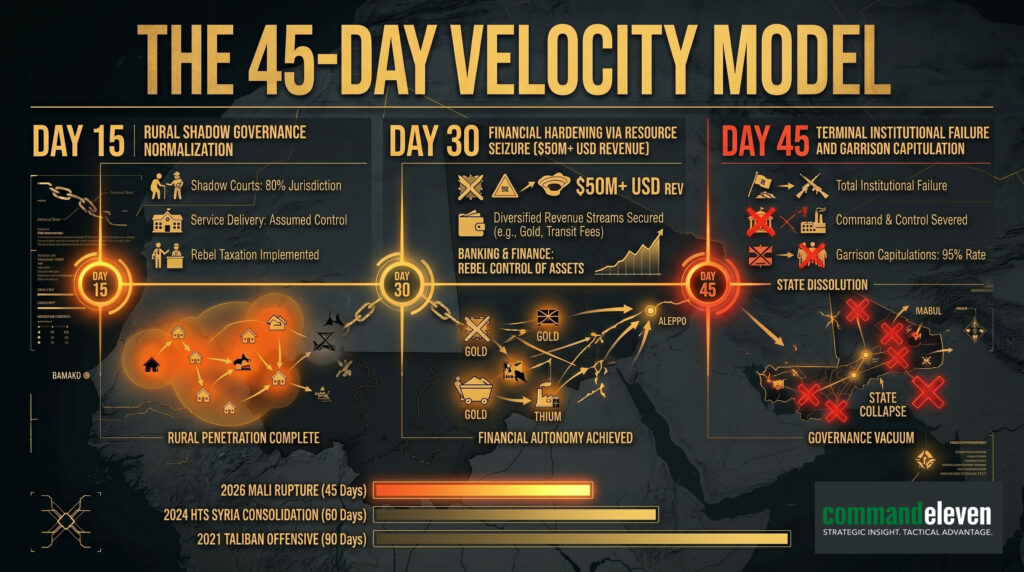
45-Day Forward Projection – The Velocity of Total Collapse
A 90-day window is too expansive for the current kinetic environment; the Malian state is facing a high-velocity institutional failure. By modeling the current trajectory against the 2021 Taliban offensive in Afghanistan and the 2024 HTS consolidation in Syria, we project a terminal state of non-state control within a 45-day horizon. Without immediate, realistic retaliation – which currently remains non-existent – the state’s existence as a sovereign entity is nearing its expiration.
0–15 Days: The “Villages-to-Cities” Inversion
Mimicking the Taliban’s 2021 strategy, JNIM and its periphery allies will prioritize the total isolation of provincial capitals through the seizure of rural administrative hubs.
- Logistical Asphyxiation: We project the permanent closure of the remaining secondary transit routes into the Sikasso region, effectively placing the military’s southern redoubts in a “state of siege” before any physical assault begins.
- Shadow Governance Normalization: Following the HTS model, JNIM will transition its shadow courts into primary judicial bodies in captured rural zones, offering a “predictable” alternative to the collapsed state bureaucracy to prevent civilian uprisings.
16–30 Days: The Artisanal Gold Rush and Financial Hardening
The “Success Contagion” will drive a rapid expansion of militant oversight into the mineral-rich peripheries.
- Consolidation of Extraction: We project the fall of the remaining artisanal mining cooperatives in the Kayes and Falémé River basins. JNIM will likely implement a “Tax-and-Protect” scheme, similar to the Taliban’s management of opium and mineral resources, ensuring immediate liquidity.
- Militant Revenue Spike: By day 30, non-state actors are projected to control 85% of artisanal extraction sites, increasing their monthly operational capital to a baseline of $50M+ USD. This revenue will be immediately converted into advanced technicals and drone platforms to counter any localized FAMa/Wagner sorties.
31–45 Days: The Terminal Administrative Rupture
As the state’s reach retreats to a few hardened compounds in Bamako, the “Mosaic” of non-state control will fuse into a contiguous “Dark-State”.
- Military Fragmentation: By day 45, the lack of pay, food, and clear command will trigger “successive capitulations” of regional military garrisons, mirroring the rapid surrender of Afghan National Army units in August 2021.
- Total Territorial Capture: We anticipate that the entirety of the Mali-Burkina Faso-Niger border regions will function as a unified militant logistics zone, with Bamako serving as the symbolic but hollow shell of a fallen state.
- The Point of No Return: By the time international stakeholders or regional military blocs attempt to initiate a “Restoration Process,” the militant administrative infrastructure will be too deeply embedded to uproot through conventional kinetic means, creating a permanent West African encampment for transnational terror groups.