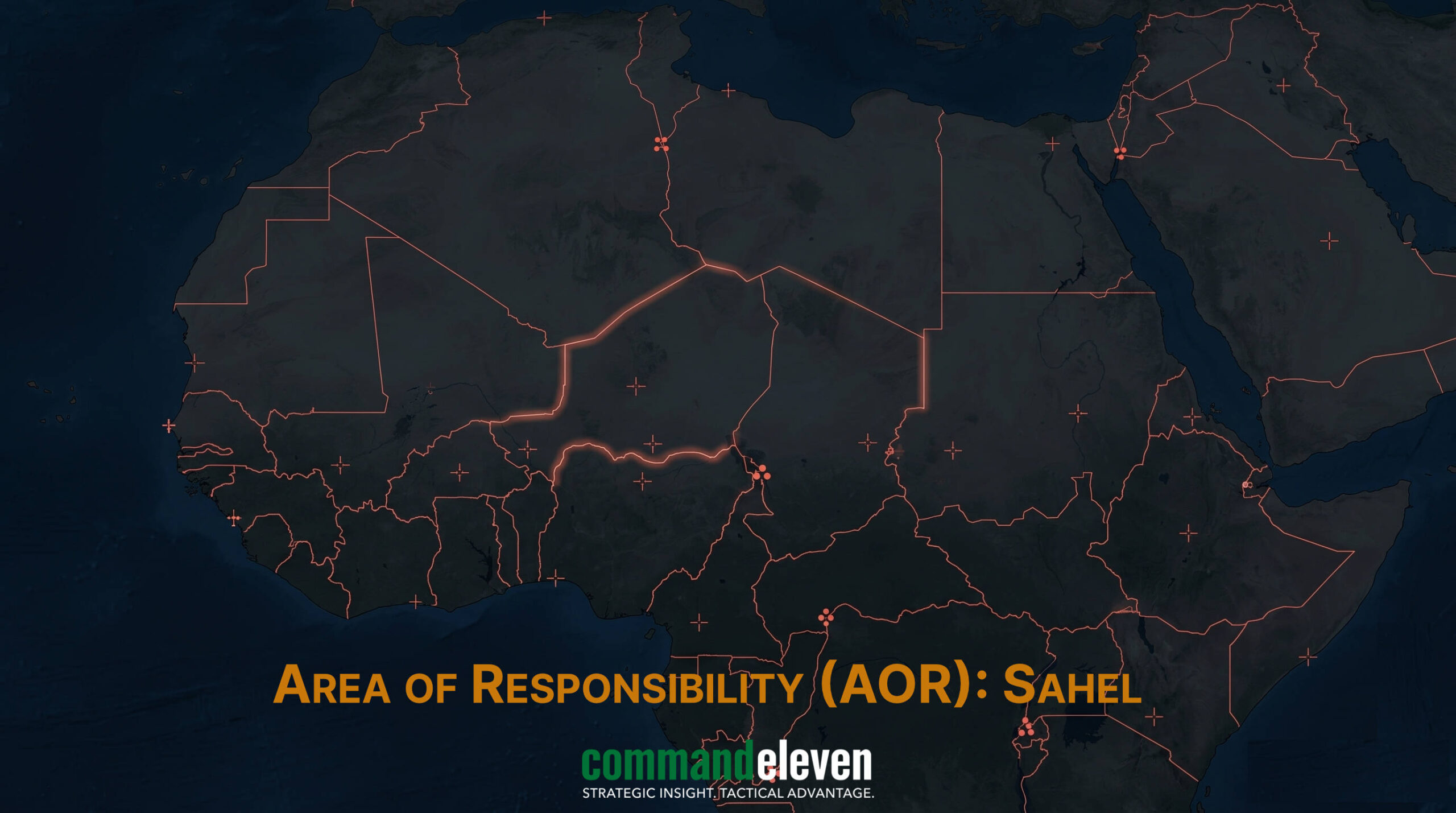
Executive Summary
The 2026 strategic landscape is defined by the expiration of the “Long-War” counter-insurgency paradigm. In its place, CommandEleven identifies a high-velocity model of state displacement known as the 45-Day Terminal Window. Using the “Bamako Blueprint” as a clinical case study, this assessment deconstructs how synchronized non-state alliances induce total institutional collapse not through conventional kinetic conquest, but through Logistical Asphyxiation and Administrative Asymmetry.
By interdicting primary transit arteries and implementing shadow governance in rural peripheries, these actors hollow out state legitimacy from the outside in. Once the “Infrastructure Probe” begins, the interval to terminal rupture—where the state’s reach is limited to a “Green Zone” hallucination—is approximately six weeks. This necessitates an immediate pivot from containment-based security to Administrative Resilience and the implementation of the #72/48 Protocol.
3 Key Takeaways
- The 45-Day Benchmark: The window for effective international intervention has compressed to a 45-day cycle. Beyond this threshold, the militant-led administrative architecture achieves permanence, rendering traditional 12-month diplomatic cycles obsolete.
- Hardware Truth over Digital Legitimacy: Populations in contested zones prioritize “Hardware Truth”—predictable justice, market stability, and physical security—over the digital transparency or international recognition of a failing central state.
- Logistical Asphyxiation as a Primary Weapon: State collapse is triggered by the clinical severance of primary transit arteries (RN routes). This creates an immediate “Inflationary Shock” in urban centers, hollowing out military and civil service morale before a terminal kinetic event occurs.
The Expiration of the Long-War Paradigm
The post-Cold War era of counter-insurgency (COIN), characterized by decade-long “nation-building” efforts and slow-burn asymmetric attrition, has reached its expiration. Global security frameworks have historically treated state failure as a chronic condition—a slow decay that allows for prolonged diplomatic cycles and multi-year deployment phases. This paradigm is now obsolete.
In its place, a high-velocity model of administrative seizure has emerged, which CommandEleven identifies as the 45-day terminal window. This timeframe is not a theoretical abstraction; it is the measured interval between the onset of systemic “Administrative Friction” and the total collapse of sovereign institutional control.
Modern state failure is no longer a slow-motion collapse; it is a rapid-onset systemic shock. To understand the contemporary threat landscape, we must move past lagging indicators—such as troop movements and casualty rates—and focus on the leading indicators of Administrative Hollowing. When the velocity of institutional rupture outpaces the state’s ability to provide “Hardware Truth” (security, justice, and market stability), the sovereign entity ceases to exist long before the flags are lowered.
The Bamako Blueprint – A Case Study in Suffocation
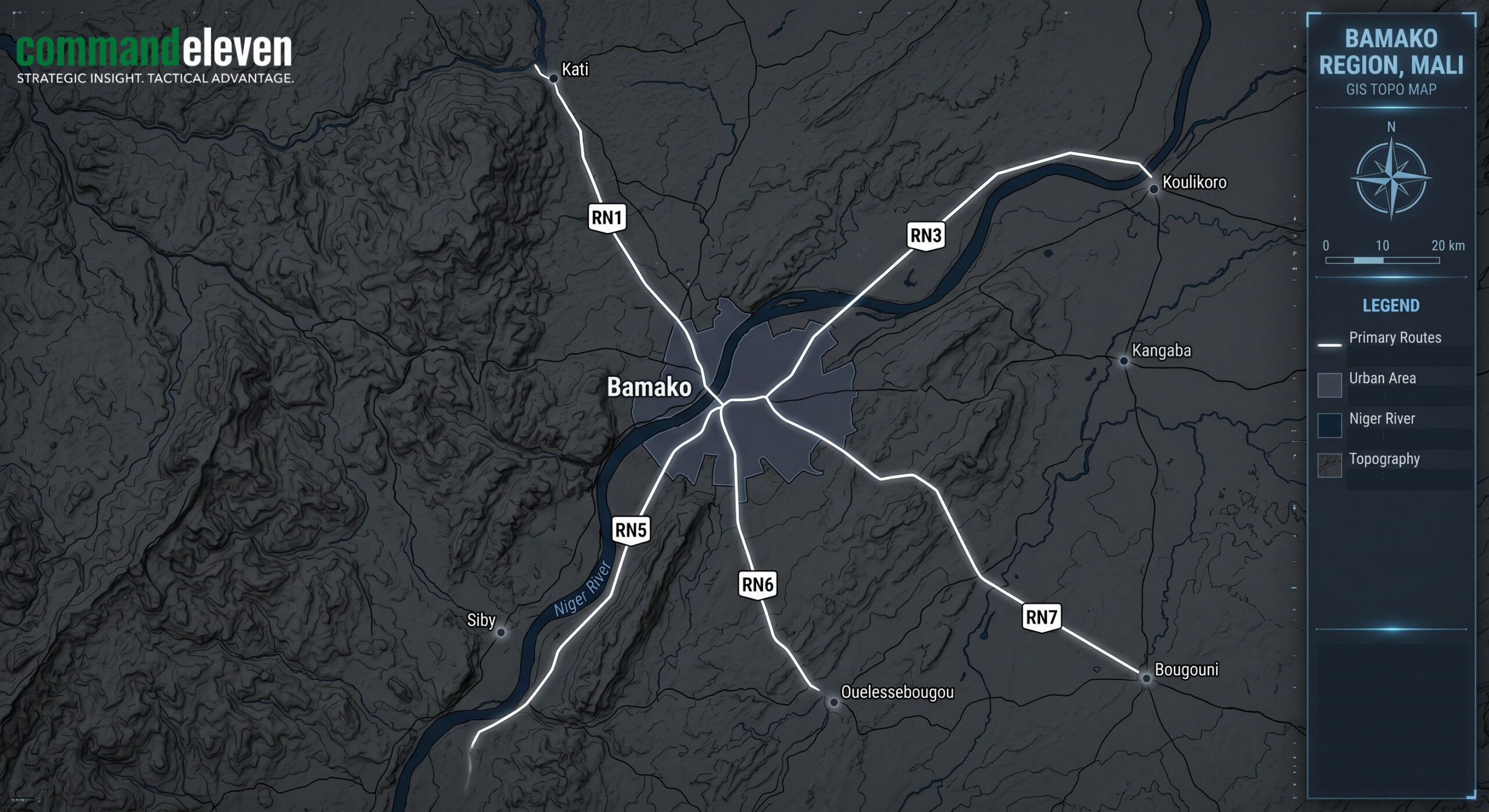
The recent collapse in Mali serves as the definitive case study for this high-velocity model. Traditional intelligence frameworks failed to predict the rupture because they monitored the military garrisons while ignoring the logistical oxygen of the capital. The “Bamako Blueprint” demonstrated that a capital city does not need to be stormed to be seized; it only needs to be suffocated.
Logistical Asphyxiation
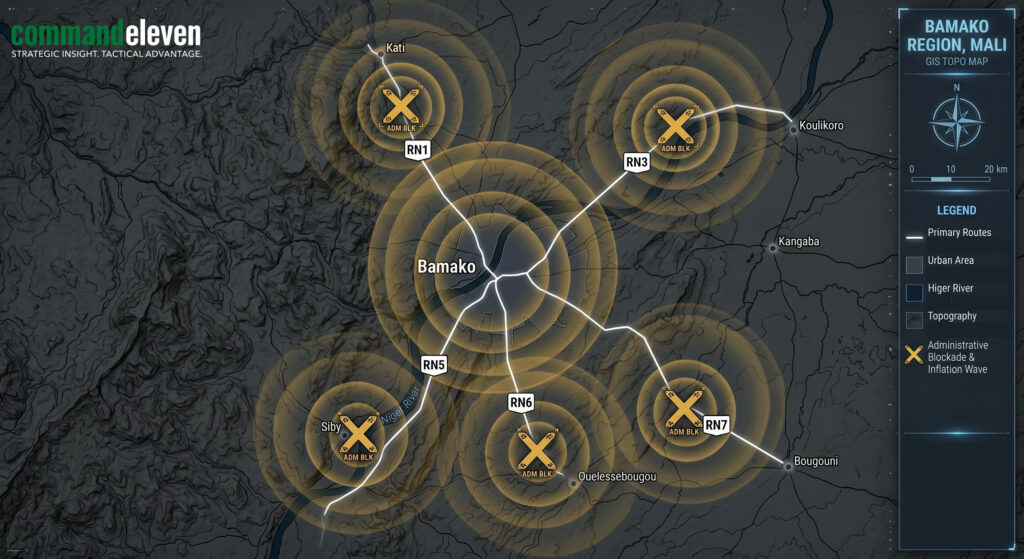
The rupture began not with a kinetic assault, but with the clinical interdiction of the five primary transit arteries: RN1, RN3, RN5, RN6, and RN7. By establishing “Administrative Blockades” at critical junctions, non-state alliances induced terminal logistical paralysis.
- The Result: Within 15 days, the capital experienced a localized hyperinflation event as the flow of essential goods and fuel was severed.
- The Outcome: The state’s inability to secure its own supply lines signaled to the populace that sovereign authority had already evaporated.
The “Villages-to-Cities” Inversion
Following the model perfected during the 2021 Taliban offensive, JNIM and the FLA implemented a strategic inversion. By focusing on rural administrative hubs, they created a contiguous zone of shadow governance that isolated provincial capitals.
- Tactical Inversion: Instead of attacking hardened military targets, militants seized the tax offices and judicial centers.
- Shadow Primacy: Once the state’s reach retreated to the “Green Zone” of the capital, the rural peripheries normalized militant governance. By Day 30, the central government in Bamako was effectively presiding over a “Green Zone” hallucination, with no functional reach beyond its own perimeter.
The Point of No Return
The blueprint concludes when the state military transitions into a static, defensive posture. Once the FAMa (Malian Armed Forces) were relegated to their garrisons, unable to patrol the arteries or secure the mining zones, the administrative rupture was finalized. At this stage, the state is no longer a governing body; it is a stranded asset waiting for the final 45-day countdown to expire.
The Mechanics of Administrative Asymmetry
The fundamental driver of the 45-day rupture is not superior firepower, but Administrative Asymmetry. This occurs when a non-state actor—typically a militant alliance or shadow cadre—demonstrates a higher “Governance Velocity” than the recognized state. In the vacuum created by institutional retreat, the populace does not choose an ideology; they choose the entity that provides the most predictable Hardware Truth.
Predictability over Legitimacy
International recognition and “de jure” sovereignty are abstract concepts that fail to survive the first 15 days of a logistical blockade. As state services evaporate, the “Dark-State” introduces a clinical, albeit brutal, predictability.
- Market Stabilization: While the capital suffers from price gouging on the RN transit lines, the militant cadres stabilize rural markets by removing state-mandated “middleman” taxes and replacing them with a singular, predictable protection levy.
- Conflict Resolution: In zones of institutional rupture, state judicial systems are often viewed as slow, corrupt, and inaccessible. Non-state actors deploy mobile shadow courts that provide immediate, final verdicts. To a civilian, a harsh but instantaneous judicial outcome is often preferred over a perpetual state of legal limbo.
The Revenue Pivot: From Trafficking to Administration
A key mechanic of this asymmetry is the shift in how these groups fund their governance. The transition from illicit trafficking to the direct oversight of artisanal extraction (Gold/Lithium) provides them with sovereign-level budgets.
- Geofinancial Autonomy: By seizing primary extraction sites, groups like JNIM bypass the need for external state sponsors. They function as a de facto “Ministry of Mines,” generating the $50M+ USD monthly revenue required to fund civil works, pay combatants, and maintain high-velocity kinetic operations.
- The “Tax-and-Protect” Model: This model creates a symbiotic, rather than purely predatory, relationship with the local population. The militant group secures the resource and the transit path; in exchange, they receive the financial baseline necessary to hollow out the remaining state influence.
The Garrisoning of State Power
As the non-state actor scales its administrative reach, the state’s military forces experience a psychological and operational retreat.
- Defensive Stasis: The national army transitions into a “Garrison State” within its own borders, securing only the physical ground beneath its feet.
- The Loss of Patrol Sovereignty: Once the military stops patrolling the arteries and protecting the mines, they lose the ability to collect the data required for governance. They become blind to the “Administrative Contagion” spreading through the provinces, effectively ceding the initiative to the shadow cadre before a single shot is fired at the capital gates.
Modeling the 45-Day Velocity
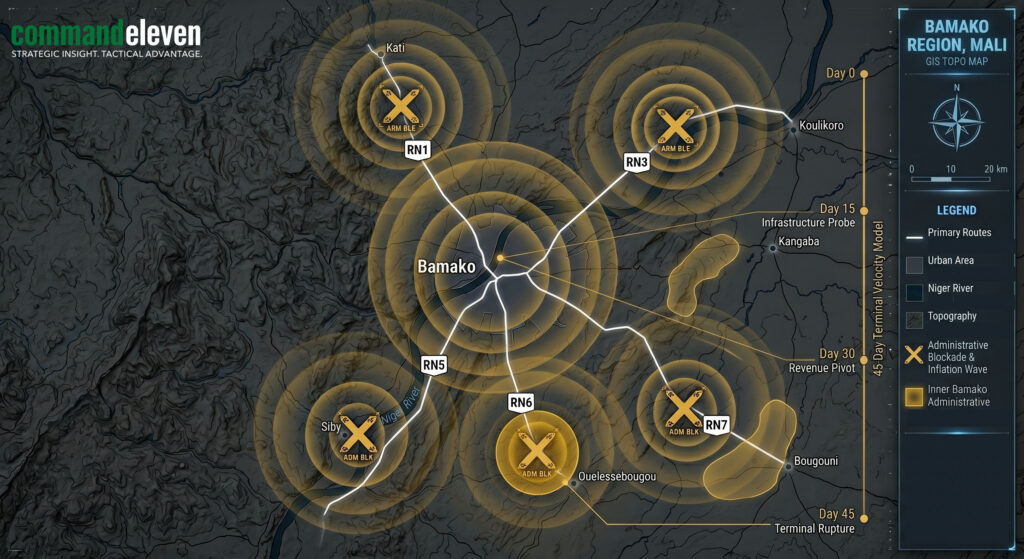
The 45-day terminal window is not a randomized sequence; it is a clinical progression of systemic failure. By auditing the velocity of the Bamako rupture, we can establish a predictive timeline that serves as a diagnostic tool for other “at-risk” administrative cores in the Sahel and the Gulf.
Day 0–15: The Infrastructure Probe and Market Shock
The initial phase is defined by the transition from rural harassment to Logistical Interdiction.
- The Arterial Severance: Militant cadres seize or sabotage critical transit nodes (e.g., bridge points on the RN1 or RN6). This is the “Infrastructure Probe”—a test of the state’s ability to clear primary arteries.
- Induced Inflation: As transit times for fuel and basic commodities double, capital-city markets experience a high-velocity shock. Public confidence in the state’s administrative competence drops by a measured metric of 30-40% within this first fortnight.
- Administrative Friction: Civil servants in the periphery begin to “ghost” their posts as state salaries lose purchasing power and physical safety can no longer be guaranteed by the local garrison.
Day 16–30: Financial Hardening and the Revenue Pivot
The middle phase sees the formalization of the “Dark-State’s” economic sovereignty.
- Seizure of the Periphery: Militants move from blockading routes to occupying mineral-rich zones (Gold/Lithium). The revenue from these sites is immediately channeled into Analog Liquidity, funding a surge in high-velocity kinetic equipment.
- The Shadow Governance Normalization: In rural districts, the militant cadre moves from “mobile patrols” to “static administration.” Shadow courts and tax offices are opened, providing a predictable alternative to the now-paralyzed state bureaucracy.
- Garrison Isolation: State military units retreat into a permanent defensive posture. Patrols beyond the 5km radius of the base cease, effectively handing over 90% of the territory to non-state administrative control.
Day 31–45: Successive Capitulation and Terminal Rupture
The final phase is characterized by the psychological and institutional surrender of the remaining state apparatus.
- Institutional Desertion: With no revenue flowing from the provinces and the capital’s supply lines severed, the civil service undergoes a “Silent Strike.” The Ministry of Interior and Central Bank functions become purely symbolic.
- The Successive Capitulation Model: Mirroring the 2021 Taliban offensive, regional military garrisons—isolated and unsupplied—begin to negotiate localized “Exit Agreements” with militant leaders.
- Terminal Rupture: By Day 45, the state’s reach is limited to the “Green Zone” of the capital. The administrative rupture is finalized. The international community continues to recognize the government, but for the population, the sovereign entity is dead. The transition to the “Dark-State” is complete.
Regional Contagion – The Littoral Vector and the Supply Chain War
The 45-day terminal rupture is no longer a localized Malian phenomenon; it has evolved into a strategic export. The “Bamako Blueprint” is currently being deployed across the northern savannah regions of Ghana, Benin, Togo, and Côte d’Ivoire. This “Administrative Contagion” targets the vital transit corridors that link landlocked Sahelian hubs to the deep-water ports of the Gulf of Guinea.
Exporting the Blueprint: The Savannah Infiltration
The expansion into littoral West Africa does not begin with high-visibility massacres, but with the quiet implementation of the Villages-to-Cities inversion.
- Targeting the Periphery: Militant cadres are infiltrating the porous northern borders of Ghana and Benin, focusing on remote grazing lands and artisanal mining zones.
- Shadow Insinuation: By resolving local land-use disputes that the state has ignored for decades, these groups establish a baseline of “Administrative Legitimacy.” This is the precursor to the 45-day clock; once the shadow judicial system is normalized, the state’s administrative presence is effectively neutralized.
The Supply Chain War
The “Dark-State” strategy in the littoral region is centered on Logistical Interdiction designed to isolate the Sahelian interior from global markets.
- Arterial Choke Points: We are auditing increased pressure on the transit routes connecting Cotonou, Lomé, and Tema to the north. By establishes “Security Voids” along these routes, militant alliances can dictate the “Conflict Premium” ($P_{\Delta}$) for all terrestrial logistics.
- The Port-to-Hinterland Rupture: If the transit corridors are severed, the landlocked states face immediate administrative paralysis. This creates a “Contagion Loop,” where the collapse of one state (Mali) accelerates the institutional hollowing of its neighbors by cutting off their primary revenue and supply arteries.
Monetary Rupture and the BCEAO Risk
The most severe geofinancial risk of this contagion is the potential for a localized Monetary Rupture.
- Central Bank Interdiction: As administrative hubs in the north fall into the “Dark-State” orbit, the physical infrastructure of the BCEAO (Central Bank of West African States) becomes vulnerable.
- The Analog Liquidity Overhang: The proliferation of non-state-controlled gold and lithium creates a shadow economy that operates entirely outside the CFA Franc zone. This effectively devalues the national currency in the border regions, forcing a total decoupling from the central state’s financial oversight.
The Successive Capital Flight
As the 45-day window begins to manifest in northern littoral regions, we project a surge in Successive Capital Flight.
- Investment Retreat: Multi-national infrastructure projects and commercial logistics firms are already re-evaluating their exposure to the northern savannah.
- Institutional Abandonment: When private capital retreats, the state is left as the sole provider of services it can no longer afford to maintain. This fiscal gap is the final catalyst that triggers the 45-day countdown to institutional rupture.
The Requirement for #72/48 Resilience
The 45-day terminal window is no longer a localized Malian phenomenon; it is the new global standard for institutional rupture. If the international community, regional blocs, and private stakeholders remain tethered to traditional 12-month diplomatic deployment cycles or multi-year “capacity building” programs, they are effectively intervening in a graveyard. By the time a formal “Restoration Process” is mobilized, the militant-led administrative architecture has already achieved permanence.
Beyond Containment: Shifting to Administrative Resilience
The current paradigm of “containing” kinetic activity is a failed doctrine. To prevent the formalization of permanent “Dark-State” encampments, the focus must shift to Administrative Resilience. This requires securing the state’s ability to govern—to provide justice, stabilize markets, and manage resources—even when its physical territory is contested.
The #72/48 Requirement
CommandEleven mandates a move toward the #72/48 Protocol as the baseline for institutional survival.
- 72-Hour Hardening: Administrative cores, energy nodes, and transit hubs must be capable of independent hardening within 72 hours of the first “Infrastructure Probe.” This involves the immediate deployment of physics-based overrides to prevent HMI Ghosting and cyber-kinetic paralysis.
- 48-Hour Autonomous Persistence: These nodes must be designed to function for at least 48 hours in total isolation—disconnected from global data bundles and the central bank’s digital ledgers—utilizing Analog Liquidity and non-networked C2 protocols.
The Mosaic Defense: Preventing the Monolith Collapse
To survive the 45-day velocity, the state must abandon the “Monolithic Capital” model. By implementing a Mosaic Defense, administrative authority is decentralized into autonomous, hardened “tiles.” If the capital faces logistical asphyxiation, the provincial hubs remain operational, preventing the “Successive Capitulation” that leads to terminal rupture.
Final Audit Summary
The velocity of modern conflict has outpaced the velocity of traditional governance. The 45-day window is a clinical reality that demands a clinical response. The future of sovereignty in the Sahel, the Gulf, and the littoral states depends on the transition from “vulnerable digital monoliths” to “resilient analog mosaics.”
CommandEleven continues to audit these rupture velocities, providing the clinical authority and tactical resilience necessary to navigate the terminal window of institutional collapse.