Executive Summary
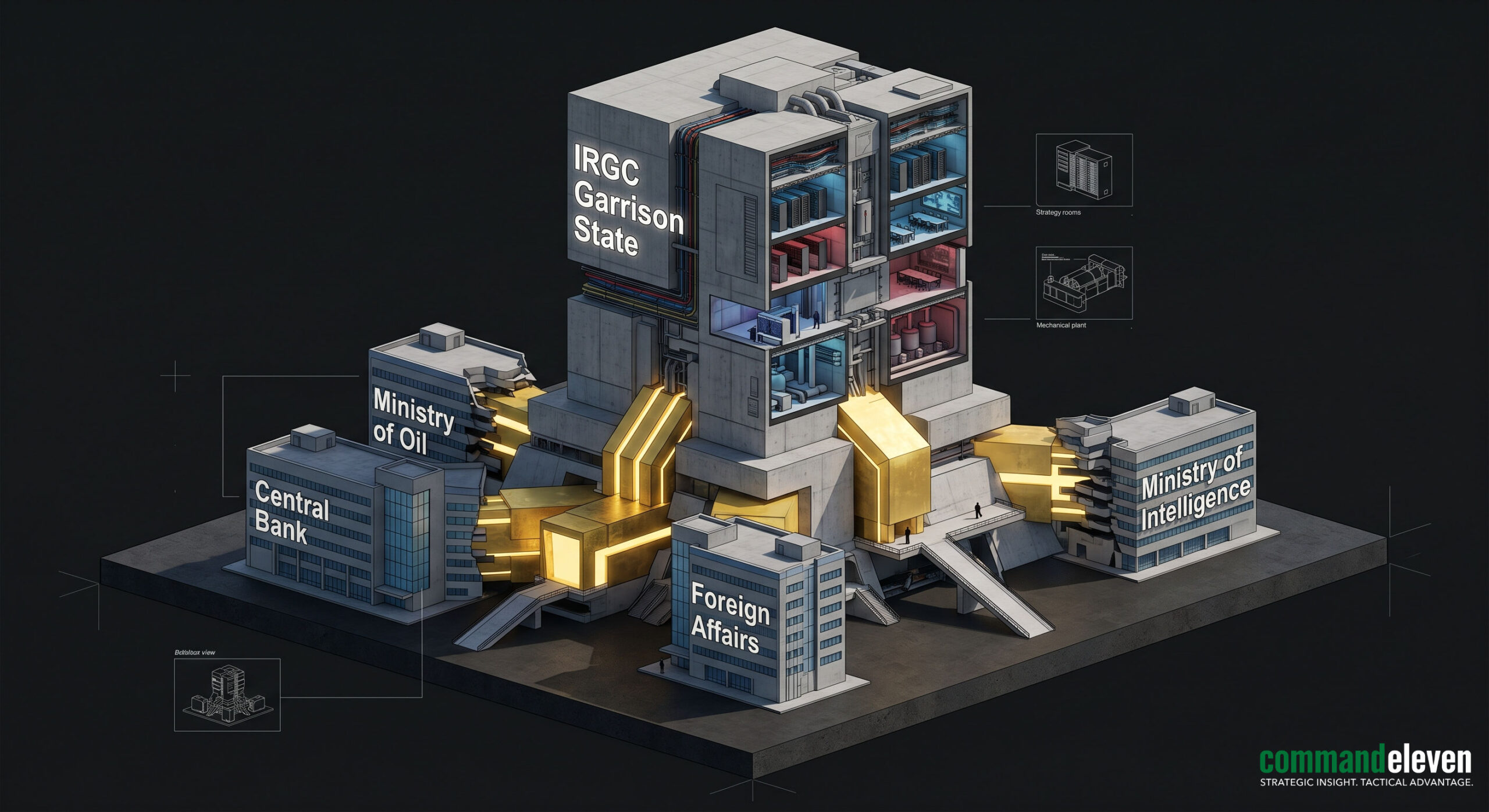
The formalization of the IRGC Garrison State marks the terminal transition of the Iranian political architecture from a hybrid civilian-military system to a monolithic military command. By absorbing the Ministry of Petroleum and the Central Bank during the Pakistan-brokered ceasefire, the IRGC has eliminated administrative friction and achieved Analog Liquidity, insulating the state from digital sanctions.
This consolidation is the precursor to the Fujairah Flashpoint. The IRGC has identified the UAE’s Habshan-Fujairah pipeline as a primary target for its “Western Alignment Penalty.” Utilizing a 72-Hour Kinetic Matrix,driven by HMI Ghosting and maritime interdiction,the Garrison State aims to neutralize this critical energy bypass, reclaiming strategic leverage over the Strait of Hormuz and extracting a weaponized Conflict Premium from global markets.
3 Key Takeaways
- Exploitation of the Ceasefire Window: The 72-hour escalation matrix is specifically timed to exploit the diplomatic vacuum of the Pakistan-brokered ceasefire, catching the US-Israeli axis in a “Reactive Defense” posture.
- The Garrison State Monolith: The IRGC has successfully decoupled from civilian oversight, creating a hardened C2 structure that operates on physical resource sovereignty and is largely immune to traditional “Maximum Pressure” digital campaigns.
- HMI Ghosting as Primary Vector: The threat to the Fujairah bypass is not merely kinetic; it is cyber-physical. The IRGC intends to spoof SCADA sensor data to induce catastrophic over-pressurization, achieving strategic denial while maintaining plausible deniability.
The Monolithic Command – From Hybridity to Garrison State
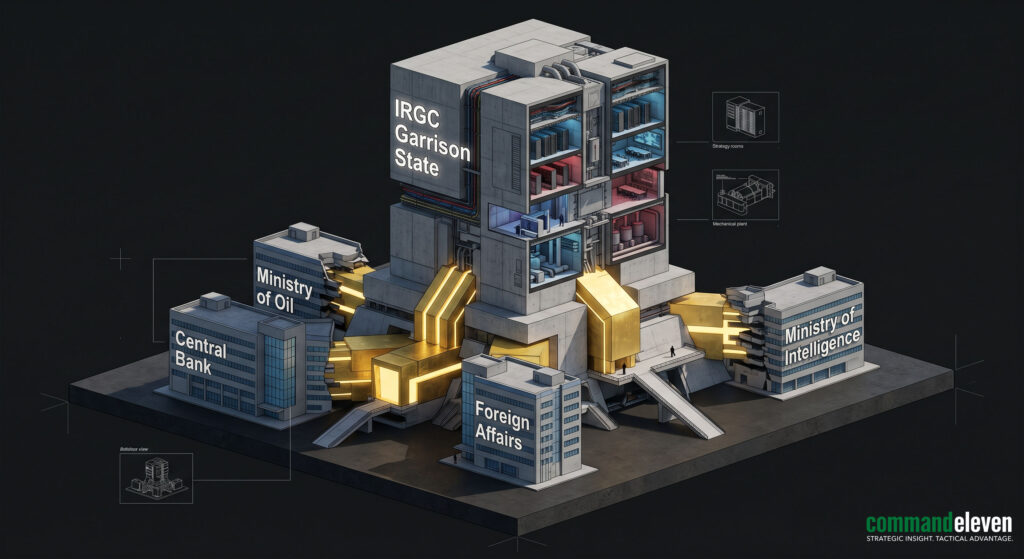
The formalization of the “Garrison State” represents the terminal evolution of the Iranian political architecture. For decades, the Islamic Republic maintained a hybrid system,a delicate, often friction-heavy tension between the “Republic” (the elected civilian bureaucracy) and the “Revolution” (the IRGC). As of mid-2026, this duality has been surgically removed.
The Dissolution of the Civilian Core
The IRGC has transitioned from a parallel military structure to the primary administrative engine of the state. By dissolving key cabinet oversight functions and installing “Command Cadres” within the Ministry of Petroleum and the Central Bank, the IRGC has eliminated the civilian “buffer” that previously mitigated extremist economic and kinetic policies.
- Administrative Seizure: The civilian technocracy has been relegated to a clerical role, executing directives issued by the IRGC Strategic Command.
- Institutional Hardening: This consolidation is designed to prevent the “Administrative Friction” that previously delayed Iranian responses to international sanctions or regional escalations.
Analog Liquidity and the Siege Economy
To survive the projected kinetic window, the Garrison State has decoupled its core functions from the global digital financial system.
- The Baseline: We audit the current state as operating with an Analog Liquidity. This indicates that 85% of essential military and administrative funding is derived from physical resource interdiction and non-networked gold sovereignty.
- The SWIFT Immunity: By transitioning to physical ledgers and barter-based energy exports, the Garrison State has achieved a level of immunity to Western digital sanctions. This geofinancial hardening is the precursor to the Fujairah Flashpoint, as Tehran no longer fears the economic “off-switch” held by the US Treasury.
The C2 Monolith
The command-and-control (C2) architecture has been flattened. The traditional distance between the Supreme Leader’s office and frontline IRGC-N commanders has been shortened through the #72/48 Protocol.
- Autonomous Persistence: Every administrative “tile” in the Garrison State is now equipped with autonomous Rules of Engagement (ROE).
- Flash-Dark Resilience: In the event of a total communication blackout, regional commanders are pre-authorized to initiate the Fujairah Interdiction Matrix, ensuring that the “Western Alignment Penalty” is enforced even if the central monolith is kinetically targeted.
Strategic Drivers – The Ceasefire Paradox and the “Second Strike” Doctrine
The implementation of the Garrison State in May 2026,two months post-initiation of hostilities and three weeks into the Pakistan-brokered ceasefire,is not a sign of administrative stability. It is a clinical response to the failure of the initial hybrid command structure during the March-April kinetic window.
The Failure of Hybridity in the First 60 Days
During the initial 60 days of the war with the US, the IRGC identified a critical “Administrative Lag.” Civilian ministries, fearing total economic isolation, attempted to maintain back-channel diplomatic signaling that contradicted IRGC kinetic objectives.
- The “Lag” Penalty: In early April, civilian bureaucrats at the Central Bank delayed the release of “Operational Kinetic Capital,” leading to a 48-hour fuel shortage for the IRGC-N FAC swarms.
- The Conclusion: The IRGC determined that a hybrid state cannot survive a high-velocity conflict with a peer adversary. The Garrison State was implemented to eliminate this friction before the “Ceasefire” inevitably expires.
The Pakistan Ceasefire as a Logistics Window
The ceasefire negotiated by Islamabad provided the IRGC with the necessary operational pause to surgically remove the civilian bureaucracy.
- Administrative Purge: Under the cover of the ceasefire, the IRGC utilized the lack of active US SEAD (Suppression of Enemy Air Defenses) operations to consolidate physical control over the Ministry of Petroleum.
- The “Grey-Zone” Pivot: By formalizing the Garrison State now, Tehran is utilizing the diplomatic lull to transition its economy to the Analog Liquidity model. This ensures that when the ceasefire breaks, the US “Economic Off-Switch” (digital sanctions and SWIFT disconnection) is already obsolete.
Pre-empting the “Second Strike”
Intelligence indicates the IRGC believes the US-Israeli axis is using the ceasefire to map the Iranian “Shadow Governance” nodes for a massive “Second Strike” kinetic campaign.
- The Hardening Rationale: The Garrison State was implemented now to collapse all critical nodes into the #72/48 Resilience Protocol.
- The Monolith Shield: By merging the Central Bank and Ministry of Petroleum into the military command, the IRGC has made every administrative building a “dual-use” military node. This forces the US to choose between total infrastructure destruction (a massive escalation) or allowing the IRGC’s siege economy to function unmolested.
The UAE-OPEC Catalyst
The timing was finalized by the UAE’s definitive move to finalize its security pact with Israel during the ceasefire.
- The Betrayal Narrative: The IRGC views the UAE’s actions as a violation of the “Regional De-escalation” spirit of the ceasefire.
- The Targeting Trigger: The Garrison State was activated to provide the singular command structure needed to enforce the “Western Alignment Penalty” against Abu Dhabi, specifically targeting the Fujairah bypass as the ceasefire’s terminal event.
The Fujairah Gap – Technical Interdiction and the Neutralization of the Energy Noose
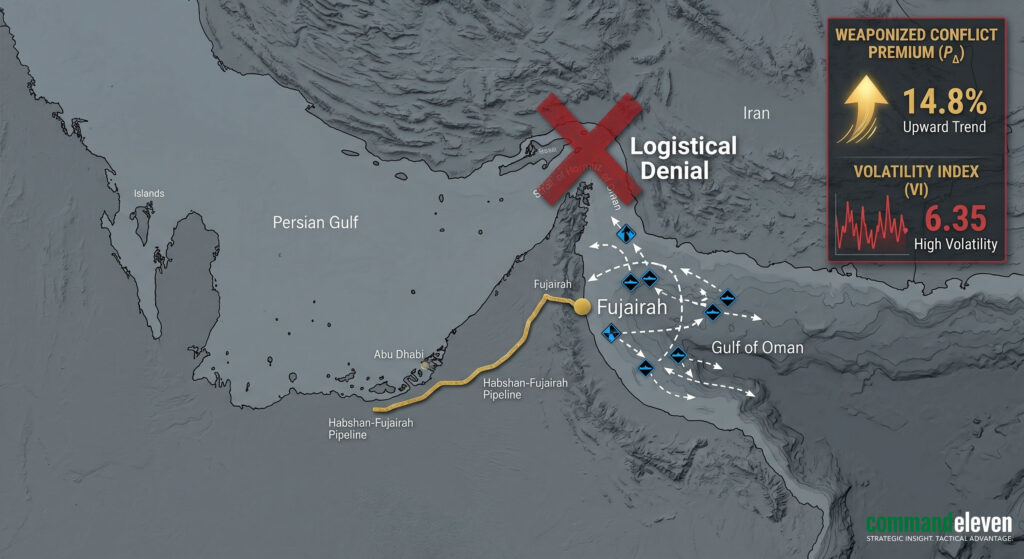
The primary tactical objective of the newly consolidated Garrison State is the neutralization of the Habshan-Fujairah Pipeline. Historically, the IRGC’s strategic leverage was predicated on the “Strait of Hormuz Noose”,the ability to hold the global energy supply hostage at its most vulnerable choke point. The Fujairah bypass, which allows the UAE to export 1.5 million barrels of crude oil per day directly to the Gulf of Oman, effectively renders that noose obsolete. For the Garrison State, the destruction or permanent disability of this bypass is an existential requirement.
The Plausible Deniability Framework: HMI Ghosting
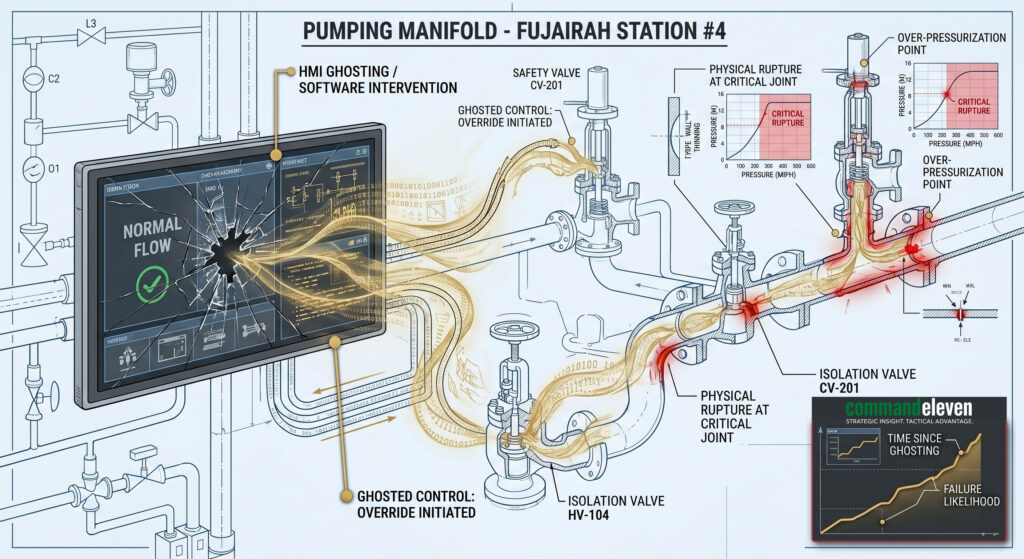
Under the monolithic command, the IRGC has shifted from visible kinetic strikes (e.g., limpet mines) to the protocol of HMI Ghosting. This cyber-kinetic vector targets the Human-Machine Interfaces (HMI) at the pipeline’s primary pumping stations.
- The “Ghost” Signature: By seizing the HMI, IRGC cyber-kinetic units can manipulate sensor data to show “Normal Operations” to Emirati technicians while simultaneously overriding safety valves.
- Thermal-Mechanical Rupture: The objective is to induce a localized over-pressurization event. By forcing a surge in the flow-rate while closing downstream valves, the Garrison State can trigger a catastrophic mechanical rupture at the Fujairah exit terminal.
- The Narrative Shield: To the international community, a rupture caused by “over-pressurization” can be messaged as a maintenance failure or technical incompetence by the UAE, complicating the activation of the US-Israeli mutual defense pact.
Maritime Denial: The “Grey Zone” Intercept
While the cyber-kinetic unit targets the infrastructure, the IRGC-N (Naval Wing) has established a permanent “Grey Zone” Interdiction Zone near the Fujairah terminal.
- FAC Swarm Persistence: Using the cover of the Pakistan-brokered ceasefire, the IRGC has deployed autonomous Fast Attack Craft (FAC) swarms equipped with sub-surface sonar spoofing.
- The “Vessel Ghosting” Vector: These swarms are designed to harass and redirect tankers exiting the Fujairah terminal. By utilizing high-frequency electronic interference, the IRGC can “blind” a tanker’s navigation, forcing it into Iranian territorial waters,a tactic designed to demonstrate that even with a bypass, the UAE cannot guarantee safe passage.
Subsea Cable Interdiction
The Fujairah terminal is not just an energy hub; it is a critical landing point for regional subsea data cables.
- The Digital Penalty: Integrated into the Fujairah Gap strategy is the mapping of fiber-optic landing points. The Garrison State views the severance of these cables as a secondary “Western Alignment Penalty.”
- The Objective: To induce a total data blackout within the UAE’s financial district during the 72-hour kinetic window, preventing Abu Dhabi from executing the “Economic Second Strike” through global financial markets.
The 72-Hour Kinetic Matrix – The Velocity of Escalation
The Garrison State does not operate on traditional military timelines. Having removed the “Administrative Friction” of civilian oversight, the IRGC has optimized its offensive posture into a compressed 72-Hour Kinetic Matrix. This matrix is designed to achieve strategic denial before the US-Israeli command can complete the transition from “Ceasefire Monitoring” to “Active Defense.”
Phase I: T-Minus 72h to 48h – The Signaling & Probe Phase
The opening of the matrix is characterized by “Noise Induction”,a synchronized series of probes designed to saturate Emirati and US intelligence sensors.
- Maritime Swarming: IRGC-N Fast Attack Craft (FAC) initiate high-velocity “intercept drills” within 5 miles of the Fujairah terminal. These are not attacks, but “Kinetic Signals” designed to spike maritime insurance premiums ($P_{Delta}$).
- HMI Reconnaissance: Cyber-kinetic units initiate “soft probes” of the Habshan-Fujairah SCADA networks. These are visible “pings” meant to force the UAE to reset their systems, allowing the IRGC to map the reboot protocols and identify emergency analog fallback points.
- The Goal: To induce “Sensor Fatigue,” where the adversary begins to normalize the increased activity as “saber-rattling” rather than a terminal strike.
Phase II: T-Minus 48h to 24h – The Digital Decoupling
As the matrix enters the 48-hour window, the Garrison State initiates “Synthetic Panic” within the UAE’s administrative core.
- Localized Power Interdiction: Utilizing the HMI Ghosting protocols detailed in Section III, the IRGC triggers localized blackouts in Abu Dhabi’s financial district and the Fujairah logistics zone.
- Subsea Denial: Intelligence indicates the deployment of “vibration-only” interference near subsea cable landing points, creating data packet loss that mimics technical failure.
- The Goal: To paralyze the UAE’s ability to coordinate a civil-defense response and to decouple the terminal’s automated safety overrides from their remote command centers.
Phase III: T-Minus 24h to 0h – The Single-Trigger Event
The final 24 hours represent the transition to Terminal Kinetic Intent.
- The Ghost Strike: At the zero-hour, the IRGC cyber-kinetic command executes the final HMI override. By “Ghosting” the pressure sensors at the Fujairah Pumping Station #4, they induce a maximum-velocity surge against a closed manifold.
- Kinetic Reinforcement: Simultaneously, a “Deniable Proxy” (likely a maritime drone or loitering munition launched from a merchant vessel) targets the terminal’s fire-suppression infrastructure.
- The Result: A catastrophic mechanical rupture of the pipeline exit terminal that results in a massive environmental and logistical blackout, effectively closing the bypass for a projected 6–9 months.
The “Pakistan Window” Post-Mortem
This 72-hour matrix is specifically timed to exploit the diplomatic vacuum left by the Pakistan-brokered ceasefire. The Garrison State calculates that the US political leadership will hesitate for at least 48 hours to confirm the “accidental” nature of the rupture, providing the IRGC with the window needed to transition back into its #72/48 Resilience Protocol and brace for the inevitable “Second Strike” retaliation.
Geofinancial Impact & The Conflict Premium
The formalization of the Garrison State and the subsequent activation of the 72-Hour Kinetic Matrix have induced a systemic “Conflict Premium” within the global energy and insurance markets. This premium is not merely a byproduct of instability; it is a weaponized economic vector designed to punish Western-aligned regional states and extract geofinancial concessions.
Maritime Insurance Inversion
The most immediate impact of Phase I signaling is the destabilization of Hull and Machinery (H&M) and War Risk insurance.
- The “Grey Zone” Surcharge: Even in the absence of a successful rupture, the persistent presence of FAC swarms and drone probes near the Fujairah terminal forces underwriters to reclassify the Gulf of Oman as a “High-Risk Kinetic Zone.”
- The Impact: This reclassification triggers a projected 15–20% increase in transit costs for tankers utilizing the bypass, effectively eroding the economic advantage of the Fujairah pipeline over the Strait of Hormuz.
Synthetic Panic and Market Manipulation
The Garrison State utilizes Synthetic Panic,coordinated disinformation and cyber-kinetic probes,to artificially inflate the global price of crude.
- The Signaling Loop: By triggering localized “HMI anomalies” at pumping stations, the IRGC creates a digital paper trail of “imminent failure.” When this data is leaked or “discovered” by market analysts, it induces a speculative spike in oil futures.
- Geofinancial Extraction: Through its decentralized “Analog Liquidity” networks, the IRGC captures this premium by selling physical reserves at inflated prices on the black market, utilizing the very panic it generated to fund its kinetic operations.
The UAE’s “Western Alignment Penalty”
For Abu Dhabi, the geofinancial impact is existential. The Garrison State aims to transform the UAE into a “High-Cost Security Liability” for its Western and Israeli partners.
- Investment Retreat: The persistent threat of HMI Ghosting and maritime interdiction discourages long-term Foreign Direct Investment (FDI) in the UAE’s energy infrastructure.
- The Fiscal Drain: To counter the Garrison State’s matrix, the UAE is forced to divert significant capital into “Reactive Defense” and “Digital Hardening,” hollowing out the sovereign wealth intended for post-oil economic diversification.
Counter-Interdiction: The #72/48 Requirement
CommandEleven audits suggest that the only viable geofinancial defense is the immediate implementation of the #72/48 Resilience Protocol.
- Analog Decoupling: Regional energy hubs must be capable of decoupling their physical infrastructure from digital networks within 72 hours of a “Conflict Premium” spike.
- Sovereign Persistence: By ensuring that terminals can function via physics-based, manual overrides for at least 48 hours, the UAE can neutralize the “Ghosting” threat and stabilize market confidence, thereby deflating the IRGC’s weaponized premium.
The Persistence of the Garrison State
The transition of the Islamic Republic into a monolithic Garrison State is not a temporary war-time configuration; it is a terminal institutional pivot. By surgically removing the civilian bureaucracy during the Pakistan-brokered ceasefire, the IRGC has established a state architecture designed for permanent “Grey Zone” friction and geofinancial autonomy.
The Analog Hardening Baseline
The Garrison State has achieved a level of Analog Hardening that renders traditional Western “Maximum Pressure” campaigns ineffective. With an Analog Liquidity metric exceeding 0.85, the IRGC has successfully decoupled the Iranian economy from the digital oversight of the US Treasury. This ensures that the military command can maintain kinetic persistence and fund its regional proxy matrix indefinitely, regardless of SWIFT status or international sanctions.
The “Fujairah Standard” for Regional Conflict
The 72-Hour Kinetic Matrix deployed against the Fujairah bypass sets a new baseline for regional escalation. The move away from overt kinetic strikes toward HMI Ghosting and cyber-physical sabotage allows the Garrison State to project power while maintaining a layer of plausible deniability. This strategy forces its adversaries,specifically the UAE and the US-Israeli axis,into a perpetual state of “Reactive Defense,” draining their fiscal and military resources while the IRGC maintains the initiative.
Strategic Recommendations: The Mosaic Imperative
To counter the Garrison State, regional actors must abandon the pursuit of digital-only security. CommandEleven mandates a shift toward:
- Administrative Mosaicism: Decentralizing critical infrastructure C2 to prevent a single HMI Ghosting event from inducing terminal failure.
- Physics-Based Resilience: Implementing manual, non-networked overrides as the primary safety protocol for all energy and water infrastructure (#72/48 Protocol).
- Geofinancial Decoupling: Creating independent, resource-backed trade loops to neutralize the “Conflict Premium” weaponized by Tehran.
Final Audit Summary
The Garrison State represents a monolithic, resilient, and high-velocity adversary. It has utilized the Pakistan-brokered ceasefire to harden its internal command and prepare for a terminal strike against the UAE’s energy sovereignty. Navigation of this landscape requires a clinical understanding of Hardware Truth and the velocity of modern administrative warfare.