This is Part 4 of Running to Disaster, CommandEleven’s eight-part study of how Pakistan’s radicalization and terrorism problem was built, from the Soviet-Afghan war to today.
Active (Subversion) Measures – USSR
Active measures, also known as subversion measures, is a catch-all expression for a “variety of influence activities,” a range of activities limited only by the imagination and creativity of the officer, and could include:
- Funding front groups
- Covert broadcasting
- Media manipulation
- Disinformation and forgeries
- Buying agents of influence (politicians, media personalities, celebrities, athletes, etc.)
- Supporting pro-democracy, political, and cultural change movements
- Overt and covert influence operations to manipulate perception
- Installing and undermining governments
- Assassination
- Insurgencies
- Terrorism
They are included in our analysis because we believe two things happened pre-1979, 1979-1989, and post-1989. The Soviet Union:
- Enriched their drive to affect change in the West, specifically the United States, in response to their defeat in Afghanistan
- Entrenched itself further with India to use these active measures against Pakistan for supporting the US against the Soviet Union
Developing an understanding of these active measures is essential to understanding how the global jihad reached milestones more quickly than were previously thought or projected.
KGB archivist Vasili Mitrokhin smuggled numerous documents from the Soviet Union, but one significant document was “KGB Active Measures in Southwest Asia (1980–82),” which details how in February 1980, Yuri Andropov, then chairman of the KGB, detailed extensive retaliatory tactics to punish Pakistan:
“Through KGB Second Chief Directorate (SCD) assets, a warning is to be conveyed to the Pakistan Mission in Moscow to the effect that if a sensible line does not prevail in [Pakistani leader] Zia-ul Haq’s political course, and Pakistan agrees under pressure from the US and China to turn its territory into a base for permanent armed struggle against Afghanistan…”
General Yuri Andropov was also the founder of the Red Banner Institute, now the Academy of Foreign Intelligence (SVR Academy), one of the primary espionage academies of Russia, and the former Soviet Union, serving the KGB and Foreign Intelligence Service (FSB), attended by President Vladimir Putin in the 1980s.
These Soviet Union Active Measures also attempted to push Pakistan and India to war to benefit the Babrak Kamal regime in Afghanistan.
When you read the KGB document as a student, the clarity of how intelligence agencies took the opportunity to settle scores became very evident. The sheer number of “active measures” can easily be identified in today’s radicalization or insurrections in Pakistan.
Are These Active Measures Unfamiliar to Pakistanis?
The entire Bhutto political family was assassinated without any real investigation, even though the United Nations investigated the assassination of Benazir Bhutto, 2-time former Prime Minister of Pakistan and leader of the Pakistan People’s Party, Pakistan’s largest political party at the time, which also brought no result or justice.
Since the end of martial law in 1988, Pakistani politics has never seen stability.
The 90s were plagued by the Pakistan Army, dismissing elected democratic governments due to accusations of massive corruption. Benazir Bhutto and Muhammad Nawaz Sharif could not spend more than 36 months in power. The 1996 Nawaz Sharif government was brought down by a military coup led by General Pervez Musharraf in 1998.
Pakistan’s trouble with sectarian violence, starting during General Zia-ul-Haq’s martial law from 1977 to 1988, between the Shia and Sunni groups, uncontrolled escalated to full terror camps funneling fighters to conflict zones around the Middle East.
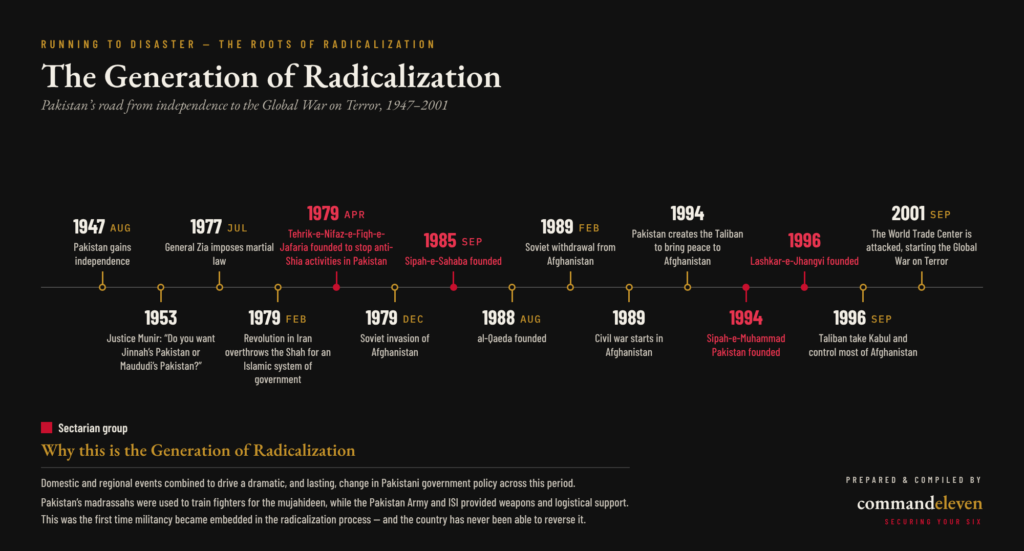
Pakistan has seen pro-democracy movements organized, run, and attended by the same political parties who have failed the country repeatedly.
Pakistan has seen social and cultural change movements from Aurat March to the Pashtun Tahafuz Movement, which has amazingly launched its own political party, the National Democratic Movement, under the leadership of the current member of the National Assembly, Mohsin Dawar.
When one can plunge an entire nation into political, social, economic, and financial unrest caused by its own people, it effectively neutralizes the nation’s ability to grow or progress.
Cicero once said:
“A nation can survive its fools, and even the ambitious. But it cannot survive treason from within.”
Pakistan has been able to survive the fools and is ambitious, but it has now reached a point where treason is not an impossible thought, concept, or possibility.
The Great Bear Hug: Mrs. Indira Gandhi with Leonid Brezhnev in Delhi, by Christopher Andrew, focused on KGB penetration into other parts of the world, including India. The thesis of the research was the Soviet Union’s decision that the Third World was the arena in which it could win the Cold War by proxy.
Andrew claims that the KGB’s maximum effort in a Third World country was India, where the number of KGB agents during the 1970s was the largest outside the Soviet Union.
Some of the exploits detailed in the book are as follows:
- Indira Gandhi was sent suitcases of money meant for the Congress coffers.
- On one occasion, a secret gift of Rs 2 million from the Politburo to Congress Party was personally delivered by Leonid Shebarshin, head of the KGB in India.
- Another million rupees were given on the same occasion to a newspaper that supported Mrs. Gandhi.
- In 1977, the KGB files identified 21 non-communist politicians (four union ministers) whose election campaigns were subsidized by the KGB.
- In 1978, the KGB ran over 30 agents in India, 10 of whom were Indian intelligence officers.
- CPI was funded in many ways, including the transfer of money through car windows on Delhi roads.
- In 1959, CPI General Secretary Ajoy Ghosh agreed on a plan to found an import-export business for trade with the Soviet bloc. Over the past decade, its annual profits have grown to over Rs 3 million.
- In 1975, a total of 10.6 million rubles were spent on active measures in India designed to strengthen support for Mrs. Gandhi and undermine her political opponents.
- V. Krishna Menon, as defense minister, was persuaded to buy Soviet MiGs and not British Lightnings. His 1962 and 1967 election campaigns were funded by the KGB.
- By 1973, the KGB had ten Indian newspapers on its payroll and a press agency. In 1975, the KGB planted 5,510 articles in the Indian newspapers.
- Promode Dasgupta, the communist stalwart, was identified by the KGB as an Intelligence Bureau (IB) informant in the Indian communist movement.
In the first volume of this series, CommandEleven detailed the US government’s role in the radicalization of Pakistanis and Afghans during the Soviet invasion of Afghanistan with a religiously motivated agenda.
In this volume, CommandEleven details the punitive measures taken by the Soviet Union against Pakistan for its support of the Afghan people and the United States.
The Pawns, the Knights, and the Kings
For any war chessboard to translate to victory, it relies on the effective and efficient use of the pieces. In this case, it was on the chessboard of Afghanistan, where the pawns and knights could be sacrificed, the kings are protected until the very end.
In the end, however, one king must fall.
In the Soviet invasion of Afghanistan, the pawns were the first in play.
Strategically moved around the chessboard until they could achieve maximum damage before sacrifice. And, unlike the normal chessboard, where the number of pieces is limited, on the global warfare chessboard, the pieces are endless and can be bought for more effective results. The pawns are sacrificed, which is what happened with Afghanistan and Pakistan.
Next came the knights, riding in from behind the smoke. The knights are the foreign governments and intelligence agencies. Their job to survey the board and re-position pieces to make another assault on the king. The knights are rarely sacrificed, as they never emerge from the smoke screen.
Lastly, and most importantly, are the kings, as this battle is a showcase of their knowledge and strategic ability to conquer their enemy. The kings are continuously moving around the board with security close by to defend in case of attack. The kings are Russia, who invaded Afghanistan, and the United States, who was fighting by proxy through Pakistan and the Afghan mujahideen.
In the research process, it became clear that significant work on active measures was done well-before the invasion by the KGB in Afghanistan, and Pakistan.
Most of the work against Pakistan was to rebuke them for supporting the Afghan mujahideen, with the United States, against the Soviet Union.
We will give a broad-stroke understanding of the active measures used in each country that would later be involved in the Soviet occupation, with specific focus on Afghanistan and Pakistan. Those are detailed in the next parts of this series and in the KGB document on its active measures in Southwest Asia.
Sources
- Christopher Andrew and Vasili Mitrokhin, The World Was Going Our Way: The KGB and the Battle for the Third World, Basic Books, 2005
- KGB Active Measures in Southwest Asia in 1980-82, Mitrokhin Archive, Wilson Center Digital Archive
Next: Part 5: Afghanistan, 1978–1979
Download the original report: Running to Disaster, Volume II: Operation Dinner Out (PDF). The 2024 report this part is drawn from, which covers Parts 3 to 8 of this series.