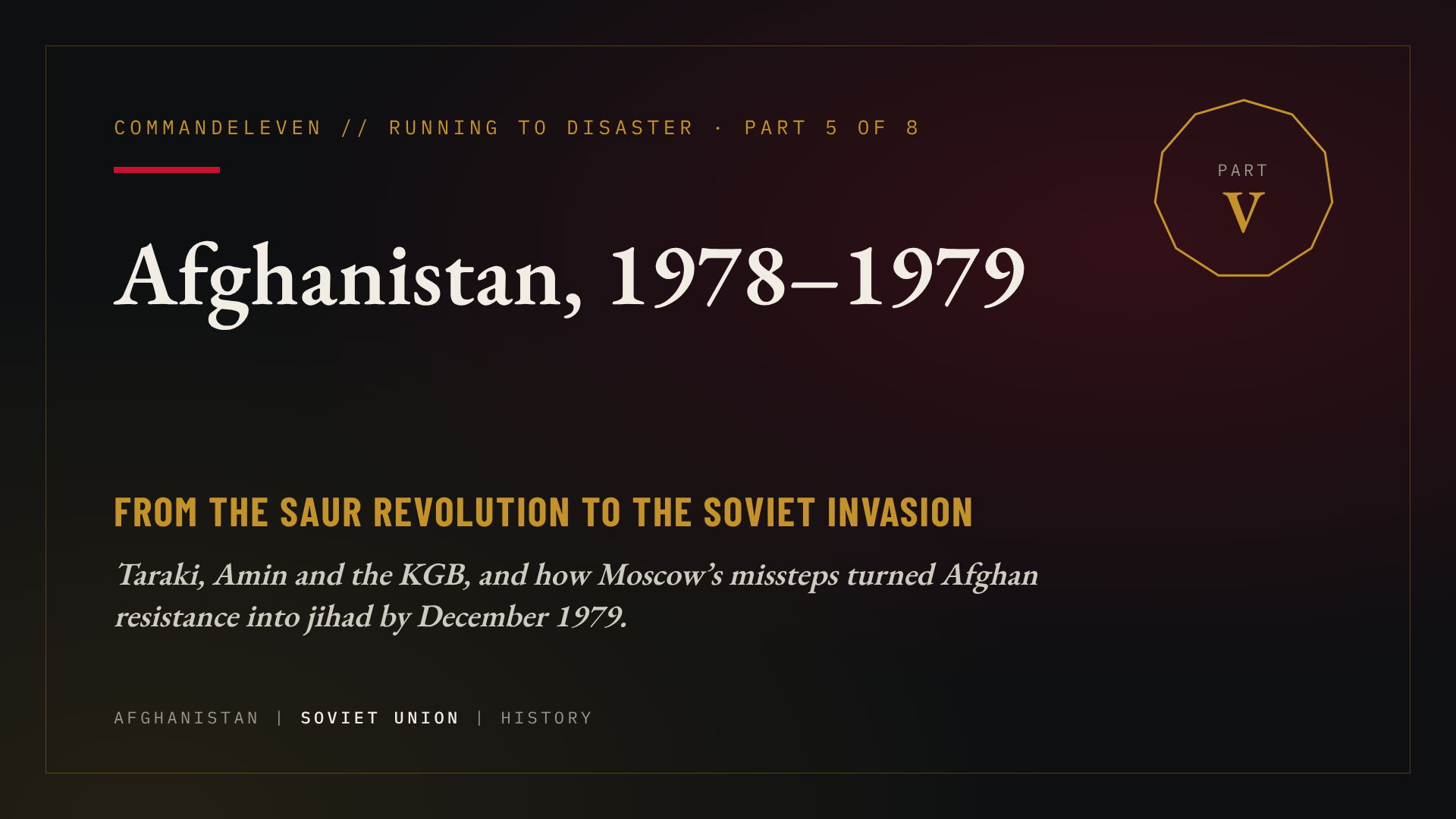
This is Part 5 of Running to Disaster, CommandEleven’s eight-part study of how Pakistan’s radicalization and terrorism problem was built, from the Soviet-Afghan war to today.
Afghanistan (1978-1979)
While Afghanistan was the battlefield for the military conflict, there was a significant amount of work completed prior to Soviet invasion to establish a pro-communism government. It could be believed that the Soviets manufactured Afghanistan’s political instability, but it’s also clear that Soviet decisions, in terms of leadership, pushed Afghanistan closer to an Islamic revolution much faster than expected.
Known as “The Great Saur Revolution,” communism began in Afghanistan on April 27, 1978 with a bloody military coup led by KGB assets, Major General Sayed Muhammad Gulbazoy and Lieutenant Colonel Muhammad Rafi, Major Muhammad Aslam Watanjar, and Major Sherjan Mazduryar, with the support of the People’s Democratic Party of Afghanistan (PDPA) party leader, Nur Muhammad Taraki, seized control of the Presidential Palace and executed President Muhammad Daoud Khan and his entire family.
Taraki had been a KGB asset for almost 30 years. Taraki, while President, was removed from the agent network, but continued to maintain close contact directly with the KGB, assisting with intelligence gathering, talent-spotting, and assisted in operations against the US and Chinese embassies in Kabul and other targets. When the KGB began to have disagreements with a “painfully vain” Taraki, a full vetting was ordered by the KGB Station in Kabul.
The vetting revealed he was responsible for a growing split within the PDPA between his own Pashtun-speaking Khalq (masses) and the predominantly urban Persian-speaking Parcham (banner), led by Babrak Karmal.
The KGB believed a working relationship with Karmal would be significantly better than Taraki. Karmal was better educated, naturally sociable, and more flexible.
There was no love lost between Taraki and Karmal, each having made numerous complaints to the KGB against the other. The accusations reached such a tenor the KGB instructed Kabul in 1974:
“In the course of regular meetings with Karmal and Taraki, you must carefully, in the form of friendly advice and without referring to instructions from Moscow, tell them not to take any steps, without prior agreement by us, which could be used by their enemies as a pretext for striking a blow at their groups, or compromising them. Karmal and Taraki should also be warned that they must desist from attacking each other and accusing each other of anti-republican activities, as this plays into the hands of the reactionary forces and will lead to the collapse of the democratic (Communist) movement in Afghanistan.”
On April 30, 1978, Taraki became both President and Prime Minister of a government that included Babrak Karmal and Hafizullah Amin, a leading member of Taraki’s Khalq faction, as Vice-President and Deputy Prime Minister, respectively. After the signing of the Treaty of Friendship and Cooperation on December 5, 1978, between Leonid Brezhnev and Taraki, the friction between the two leaders began to emerge.
When asked to release KGB agents and confidential contacts who had been jailed during Daoud’s regime, Taraki, who had taken personal charge of the Afghan security apparatus, responded:
“Some Soviet specialists, particularly those who worked for many years in Afghanistan under the old regime and have now returned, often have a dated view of the country and do not see, in an objective light, what is happening in the country.”
Taraki also showed he had little understanding of the problems establishing Communist rule over a staunchly Muslim country.
Taraki also began an assault on traditional Islamic authority, disguised as an attempt to “clean Islam… of the ballast and dirt of bad traditions, superstition, and erroneous belief.”
The 320,000 traditionally minded mullahs were treated as an obstacle to “the progressive movement of our homeland.”
Those religious leaders who resisted the “cleansing” process were tortured and shot, or buried alive. Taraki also gave orders for members of the Muslim Brotherhood and followers of Khomeini to be immediately eliminated wherever they were found.
Islam became the unifying bond of opposition to the PDPA and its Soviet backers.
Afghan resistance to the regime was transformed into a jihad in defense of Islam, whose significance was grossly underestimated by the KGB, as there were no reports from the Kabul Station of the threat of an Afghan jihad.
The KGB was more concerned with the massive power struggle that had emerged between the Khalq and Parcham factions within the PDPA. Taraki, in his arrogance, turned a deaf ear to the pleas from the Soviet embassy, the Kabul Station, and the KGB Liaison Mission, which had arrived in May 1979, to help reorganize the Afghan security services, which led to the Kabul Station sending this communication to the KGB in July:
“Only the leadership of the CPSU can influence wild (Khalq) opportunists and force them to change their attitude towards the Parcham group.”
The “opportunists” didn’t listen, sending large numbers of Parcham followers to jail, and sending their leader, Babrak Karmal, into exile as the Ambassador to Czechoslovakia.
Taraki had uncovered twenty-seven supposed conspiracies to topple his regime in the four months since the April Revolution, most of the theories were probably based on his and his inner circles’ paranoid tendencies.
Among the supposed ringleaders arrested in August of a plot to assassinate Taraki and Amin were Major General Abdul Qadir, Armed Forces Minister, and Major General Shapur Ahmadzai, Chief of the General Staff. He claimed the plot also implicated China, the United States, Iran, Pakistan, Saudi Arabia, and the Federal Republic of Germany.
Taraki understood, having purged most of the senior officials of the Daoud administration, as well as other “anti-revolutionary, anti-democratic elements,” real and imagined, his regime was now completely dependent on Soviet advisers.
The advice of the advisers did create one deeply embarrassing debacle in Kabul.
On February 14, 1979, US Ambassador Adolph Dubs was kidnapped in broad daylight by four Maoist ‘guerrillas’ and taken at gunpoint to the Hotel Kabul, where they demanded the release of some of their imprisoned comrades. On the advice of KGB advisers, Amin ordered an Afghan assault group to storm the hotel. In the shootout that followed, Ambassador Dubs and two of his kidnappers were killed, one kidnapper injured and the fourth escaped.
The KGB covered up their role in the operation and refused to allow American embassy security personnel access to evidence and bullet casings. Though the guerrillas had only been armed with a total of three pistols, a gun of unknown origin, like a Kalashnikov, was planted in the room to suggest it was the murder weapon. To keep the Americans from speaking to any of the guerrillas, the KGB produced the bodies of 3 guerrillas and a bogus one. Pictures were published in Afghan newspapers to further the cover-up.
The Taraki regime was also very critical of the Soviet military advisers during the initial months of operations against the mujahideen. After Afghan security forces were defeated in Kamdesh gorge in 1978, the following was communicated from Kabul:
“The Afghan troops led by Adviser Bryaskin have long since shown themselves incapable of eliminating the anti-government bands. We gave your advisers wide powers in the leadership of Afghan troops. We punish (our) troops severely for any failure to accept the advice of your commanders. This suggests to us that not all your advisers are sufficiently competent. We need experienced generals of whom we know there are many in the USSR. They must increase the fighting capability of the Afghan army and teach it to fight and use the experience of the Soviet army during the war.”
Kabul’s tone changed after a major rebellion in Herat on March 15, 1979, which was joined by the 17th Division of the Afghan army. Frenzied, vengeful mobs hunted down Afghan government officials, Soviet advisers, and their families, and skinned some of them alive. Body parts of Soviet advisers, their wives and their children were triumphantly paraded through the streets. A panicked Taraki phoned Prime Minister Aleksei Kosygin to appeal for Soviet troops to be sent to Afghanistan to save the revolution. He flew to Moscow to again appeal, only to be sent back empty-handed.
On April 1, 1979, the Soviet Politburo decided the Taraki regime’s political inflexibility and inexperience was compounded by its reluctance to take Soviet advice, made it impossible to use Soviet troops to repress an Afghan counter-revolution because it would reveal the weaknesses of the Taraki government and widen the scope of counter-revolution both domestic and internationally, as well as seriously damage the international authority of the USSR.
The Politburo also formed a commission to formulate proposals and coordinate action on Afghanistan (Afghanistan Commission) comprised of Yuri Andropov, Andrei Gromyko, Defense Minister Dmitry Ustinov, and Boris Ponomarev, the head of the Central Committee’s International Department. It was this commission that made all policy decisions for Afghanistan during the months prior to the Soviet invasion.
The Afghanistan Commission, like the Politburo, did not believe that a Soviet military intervention was the solution, but it did increase the number of military advisers and aid to help stabilize the Afghan regime. It also sent six generals for an inspection of the Afghan army, who reported back the low morale, low level of political training, extreme religiousness, and downtrodden nature of the masses of soldiers.
Over the next two months, as rebel attacks escalated, mutinies and desertions began within government forces. After violent demonstrations in the center of Kabul, the Afghanistan Commission reported to the Politburo that measures taken by the Afghan government have not been effective and recommended to send the parachute battalion disguised as aircraft maintenance personnel to protect Soviet air squadrons at Bagram Air Base, and a KGB detachment of 125-150 men to defend the Soviet embassy.
Neither the Politburo, nor the Communist Party of the Soviet Union (CPSU), understood the real nature of the Afghan problem – the impossibility of imposing, on a staunchly Muslim and fiercely patriotic country, the rule of a Communist regime with little popular support and unreliable armed forces.
Instead, the Commission placed all the blame on the inadequacies of the Taraki government.
“In the Party and the government… all power in fact is concentrated in the hands of N. M. Taraki and H. Amin, who none too rarely make mistakes and commit violations of legality.”
On March 27, 1979, profiting from Taraki’s loss of nerve after the defeat in Herat, Amin replaced him as Prime Minister, with Taraki maintaining his title of President. While taking over as Prime Minister, Amin also announced himself as Defense Minister, gaining direct control of the Afghan armed forces.
While the KGB believed Taraki to be vain and incompetent, it had significantly graver doubts about Amin, who unlike Taraki and Karmal, was never recruited as a KGB agent. The Kabul Station reported to the KGB in July that Amin had asked his Soviet financial adviser, P. Y. Dragulis, to find a way in which he could access the US$ 400 million of Afghan government funds in foreign banks. Amin complained that withdrawals from these accounts require three Afghan official signatures, and asked Dragulis to arrange some way so that he could sign and get the money. Dragulis also told the KGB that if Amin was successful in getting the money, he would eliminate all those who had evidence of his embezzlement.
Far more worrying for the KGB were the rumors that Amin had sympathies for the United States. Though fluent in English, he never learned Russian, and as a teacher in Kabul, 20 years earlier, he had won a scholarship to study his Master’s Degree in Educational Administration from Columbia University.
- A KGB investigation also determined that Amin was friends with Nemattula Pazhwak, later Afghanistan Minister of Education, and anti-Communist. On his return from New York, Amin stayed in Bonn with the Afghan ambassador, Ali Ahmad Popal, who the KGB believed was a Western agent.
- Early in his political career, Amin received financial backing from the chairman of the Spinzer joint-stock company, Sarwari Nasher, who was believed to maintain contacts with the exiled King of Afghanistan and the Americans.
- After the April Revolution, Amin released Nasher from prison and supplied him with a car and driver. The KGB’s belief was that Amin was a smooth-talking fascist, who was secretly pro-West.
On September 1, 1979, a memorandum from Moscow to the Politburo declared Amin personally responsible for the general failure of Afghan government policy and unjustified mass repression. The Politburo looked for ways to remove Amin from power, persuade Taraki to form a more broad-based government, including the Parcham faction, “patriotically inclined” clergy, tribal leaders, and intellectuals.
On September 16, 1979, Kabul Radio announced that the PDPA Central Committee had granted a request from Taraki that he “be relieved of his party and government positions due to health reasons and physical incapacity, which makes it unable to continue work, and had elected Amin to succeed him as Party leader.”
The Central Committee also circulated a secret resolution to party members denouncing the ‘terrorist actions and unprincipled behavior’ of Taraki and his chief supporters from the PDPA, and announced their expulsion from the party.
From September to December 1979, tensions between the Amin government and the Soviet Union grew exponentially, as reports of Amin meeting with US diplomats and a supposed meeting with the extreme Muslim opposition, where the KGB believed the possibility of the complete expulsion of Soviet officials, release of imprisoned Muslim rebels and ending the civil war were discussed.
This raised a concern that Afghanistan could potentially come under an Islamic government and the only way to keep Afghanistan in the Soviet sphere of influence was with a full military invasion.
On December 12, 1979, gathering in Brezhnev’s office before a Politburo meeting, the members of the Afghanistan Commission obtained the General Secretary’s support for Soviet military intervention in Afghanistan. The Politburo authorized the Commission to oversee the implementation of the decision.
On December 13, 1979, Babrak Karmal and members of his future government were secretly flown to Bagram Air Base, ready to take over once Amin was neutralized.
On the 17th, Amin’s nephew fell very ill from food-poisoning, possibly a plate prepared for Hafizullah Amin himself. With the food poisoning incident, Amin was very careful with changing his food and drink, as if he expected to be poisoned. The Soviets decided, after the failed poisoning, shooting Amin at the beginning of the Soviet military intervention was the only option.
On December 23, 1979, the KGB Station in Kabul reported that Amin’s suspicions had been aroused by both Western reports of Soviet troop movements and frequent flights into Bagram Air Base.
The invasion began at 3 pm, Kabul time on December 25, 1979.
Two days later, 700 members of the KGB Alpha and Zenith special forces, dressed in Afghan uniforms and traveling in military vehicles with Afghan markings, stormed Darulaman Palace. As the sound of gunfire echoed from the outskirts of Kabul, frightened PDPA members at Kabul Radio hid their party cards or flushed them down the toilets believing that Amin’s government was under attack from anti-Communist mujahideen.
That evening, a Red Army radio station in Termez, using the callsign Kabul Radio, announced that Babrak Karmal had assumed power and requested Soviet military assistance. Fifteen minutes later, Soviet paratroopers arrived at the actual Kabul Radio station and told the staff – they had come to save the revolution.
Sources
- Henry St. Amant Bradsher, Afghan Communism and Soviet Intervention, Oxford University Press, 1999
- Vasili Mitrokhin, The KGB in Afghanistan, Vol. 1, Chapters 2 and 4
Next: Part 6: Pakistan in the KGB’s Crosshairs
Download the original report: Running to Disaster, Volume II: Operation Dinner Out (PDF). The 2024 report this part is drawn from, which covers Parts 3 to 8 of this series.