This is Part 2 of Running to Disaster, CommandEleven’s eight-part study of how Pakistan’s radicalization and terrorism problem was built, from the Soviet-Afghan war to today.
Those Who Fostered the Culture Burning Pakistan
The international community has, and does, play a significant role in the radicalization of the Muslim world.
While the West continues to pass the blame of radicalization to the Muslim countries and the radical imams that preach extremism, we still remember the “J for Jihad.”
The Soviet invasion into Afghanistan in 1979 began the involvement of foreign governments and intelligence agencies to significantly increase radicalization.
To most observers, Pakistan’s radicalization originated through the madrassa system that was leveraged during the time of the mujahideen, which today is the feeder pond for all terror groups operating globally.
After the Soviet Union invaded Afghanistan in 1979, the United States, in coordination with regional partners, such as Saudi Arabia and Pakistan launched Operation Cyclone, to support the Afghan mujahideen resistance to the Soviet occupation.
That would be partially correct.
This was the public face that was fed to the world, while a more sinister covert operation was initiated.
The military operation was well known but most are still unaware of the significant expenditures by the American government through the United States Agency for International Development (USAID) to provide educational materials and textbooks to mujahideen parties and Afghan children from 1986 to 1994.
These books were developed and published by the University of Nebraska – Omaha (UNO) with the specific intent to encourage violent resistance to Soviet forces in Afghanistan by shaping the educational program of Afghan youth.
USAID invested US$50 million on “The Alphabet of Jihad Literacy” between 1986 and 1994:
- to develop and publish the educational materials and textbooks to mujahideen parties and Afghan children
- to fund the establishment of the Education Sector Support Project (ESSP)
- the ESSP would coordinate with the mujahideen parties to form the Education Council of the Seven Party Alliance (ECSPA), comprised of the education presidents of each party
- the ECSPA would also set up the Educational Center of Afghanistan (ECA).
ESSP documents, produced by UNO, describe the American intervention in the Afghan education system as a direct counter to the “Sovietization” of Afghan education. The stated goal was to replace Marxist and secular educational materials.
Through the same networks used to funnel weapons to mujahideen, UNO oversaw the distribution of educational kits of textbooks and other materials, funded by the USAID grant to schools across Afghanistan and the refugee camps on the Pakistan border.
However, the content of these textbooks blatantly promoted jihad, militancy, and violence through language and imagery. The textbooks included clear messages aimed at evoking hostility and promoting violent retribution against occupiers of Afghanistan, designed to teach children to read and basic mathematics simultaneously emphasizing weapons, killings, jihad, and Islamism.
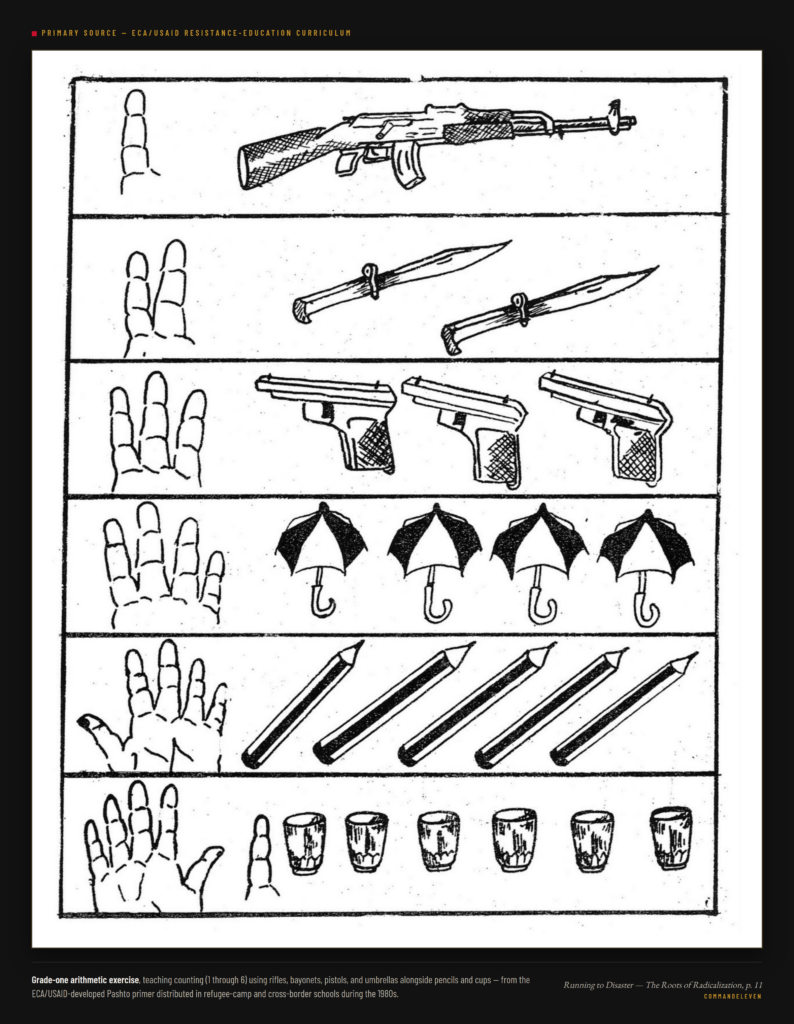
The distribution and management of the educational materials was the sole discretion of the ECA. USAID documents detail where ESSP school materials were distributed, their mujahideen party affiliation and the total number of students. The schools the ECA supplied were both within Afghanistan and “cross-border schools” in the refugee camps on the Pakistan border.
Many of these “schools” were madrassas, religious schools often funded by Saudi Arabia or wealthy Arab families, that provided a direct pipeline of radicalized fighters to the mujahideen.
The US’s policy was geared to strengthening the mujahideen, and these textbooks secured an endless pipeline of followers.
At that point, the US was not looking at the long-term effects of this program, which is globally felt today in the forms of the Afghan Taliban, the Islamic State (IS), Hezbollah, al-Qaeda (AQ) and the numerous terror groups that take their inspiration and direction from these groups.
In 2007, the Taliban spent US$1 million to set up schools in Southern Afghanistan with the 1980s mujahideen curriculum.
How widespread was the reach of the USAID’s “The Alphabet of Jihad Literacy” program?
In the 1992 UNO/ESSP Annual Report to USAID, Thomas Gouttierre, the head of the Center of Afghanistan Studies at UNO, explained that the program covered
“some 1180 schools inside Afghanistan, 1031 refugee schools in Pakistan, logistical and professional support for curriculum development, teacher training, and monitoring through the ECA.”
As per the same report, for grades 1-6, 2.3 million textbooks were distributed to ECA schools and another 6.7 million textbooks were distributed to non-ECA and refugee schools.
These textbooks have been reprinted by various foreign aid and terrorist organizations, including the Taliban and Islamic State to reinforce their violent beliefs.
American taxpayer dollars paid for the Taliban, al-Qaeda, the Islamic State, and every other terrorist group that originated or is inspired by any of these three groups.
Dana Burde, professor of international education at New York University, in her book Schools for Conflict or for Peace in Afghanistan, described the educational content as
“teaching bias or hatred toward a particular group, fosters discriminatory and exclusionary attitudes and behaviors, which contribute to the underlying conditions for conflict… curriculum content that glorifies war, militancy, and the use of force is likely to increase normative support for violence and militancy more generally.”
She continues,
“By propagandizing Afghan children with themes for violence Islamism for anti-Soviet objectives, American policymakers put their military and foreign policy goals over the well-being of Afghan youth by laying the groundwork for future conflict through shaping the psychology of an entire generation of Afghans toward violence.”
In his “‘A’ is for Allah, ‘J’ is for Jihad” article in World Policy Journal, Craig Davis translated some of the textbooks.
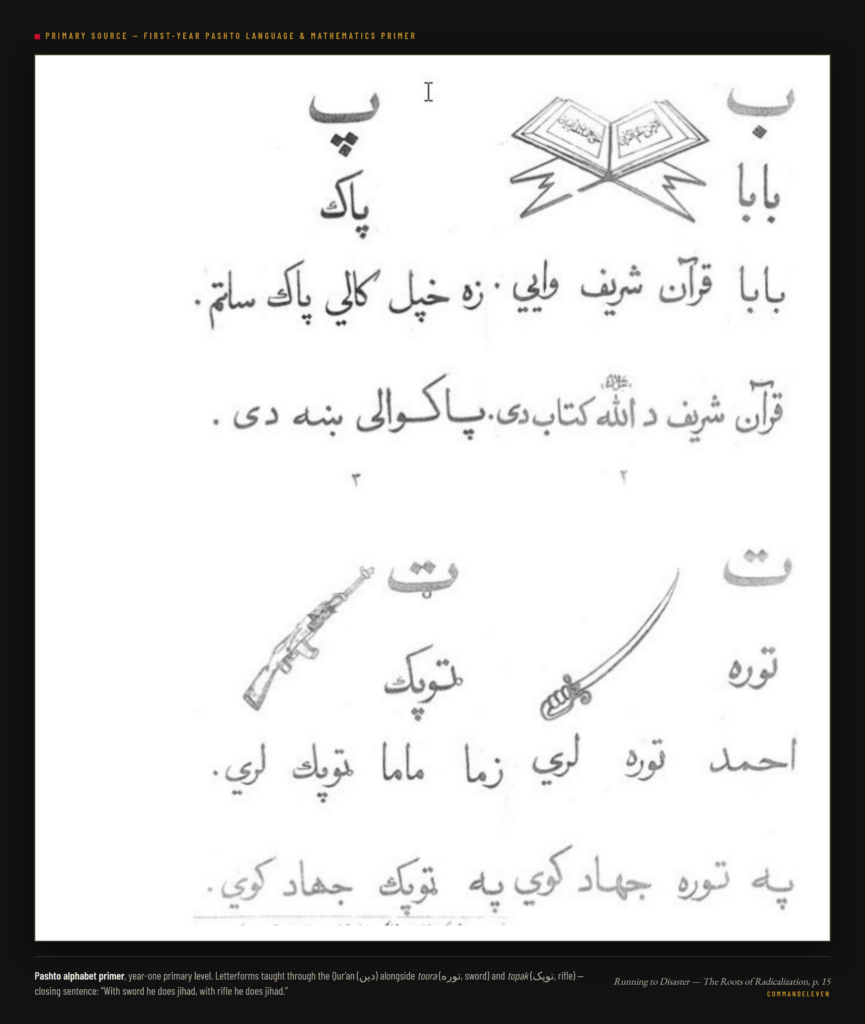
In the first-grade language arts textbooks, the alphabet was taught with the following:
- Ti is for topak (rifle) – Javed obtains rifles for the Mujahideen
- Jin is for Jihad – Jihad is an obligation. My uncle went to the jihad. Our brother gave water to the mujahid.
- Dal is for din (religion) – Our religion is Islam. The Russians are the enemies of the religion of Islam.
- Zhi is for muzhdih (good news) – The mujahideen missiles rain down dew on the Russians. My brother gave me good news that the Russians in our country taste defeat.
- Shin is for Shakir – Shakir conduct jihad with the sword. God become happy with the defeat of the Russians.
- Zal is for zulim (oppression) – Oppression is forbidden. The Russians are oppressors. We perform jihad against the oppressors.
This textbook was used to teach first-graders Pashto. In the primer, eight of the 41 letters of the alphabet contained references to guns, swords, and defending the homeland against infidels.
Primary school math textbooks had the same message. A third-grade math textbook teaches subtraction with the following problem:
“One group of mujahideen attacks a group of 50 Russian soldiers. 20 Russians were killed. How many Russians fled?”
A fourth-grade math textbook has this problem:
“The speed of the Kalashnikov bullet travels at 800 meters per second. If a Russian is at a distance of 3200 meters from the mujahid, and that mujahid aims at the Russian’s head, calculate how many seconds it will take to strike the Russian in the forehead.”
Joe Stephens, in his March 2002 Washington Post article, “From U.S., the ABC’s of Jihad,” describes:
“In the twilight of the Cold War, the United States spent millions of dollars to supply Afghan schoolchildren with textbooks filled with violent images and militant Islamic teachings, part of covert attempts to spur the resistance to the Soviet occupation. These primers, which were filled with talk of jihad and featured drawings of guns, bullets, soldiers, and mines, have served since then as the Afghan school system’s core curriculum. Even the Taliban used American-produced books.”
Yahia Baiza, in his 2013 book Education in Afghanistan, stated the following:
“The primary objective behind the war curriculum for resistance education was to habituate and bring up children right from class one of the primary level with anti-Soviet, anti-communist hatred, love for violence, war, killing in the name of ‘jihad’, ‘patriotism’ and ‘love for mother land’. Perhaps the most shocking of all was the fact that the United States Agency for International Development (USAID) and its implementing partner the University of Nebraska at Omaha developed the curriculum for the refugee children and those outside the state’s control inside Afghanistan. They did it in consultation with the resistance leaders. It was a clear violation of human rights and children’s rights for sound and non-violent education. As an example, the Pashto language and mathematics textbook for Pashto, speaking children of year one of primary level, starts with a message of hatred against the Soviet Union and the ruling PDPA. It describes the Soviet Union as aimless communists who commit inhuman and savage deeds, such as mass killing, looting, burning of houses, farmers’ harvests, and destruction of holy mosques and other places of [religious] respect, using of poisonous gases, etc.”
He shared the following examples:
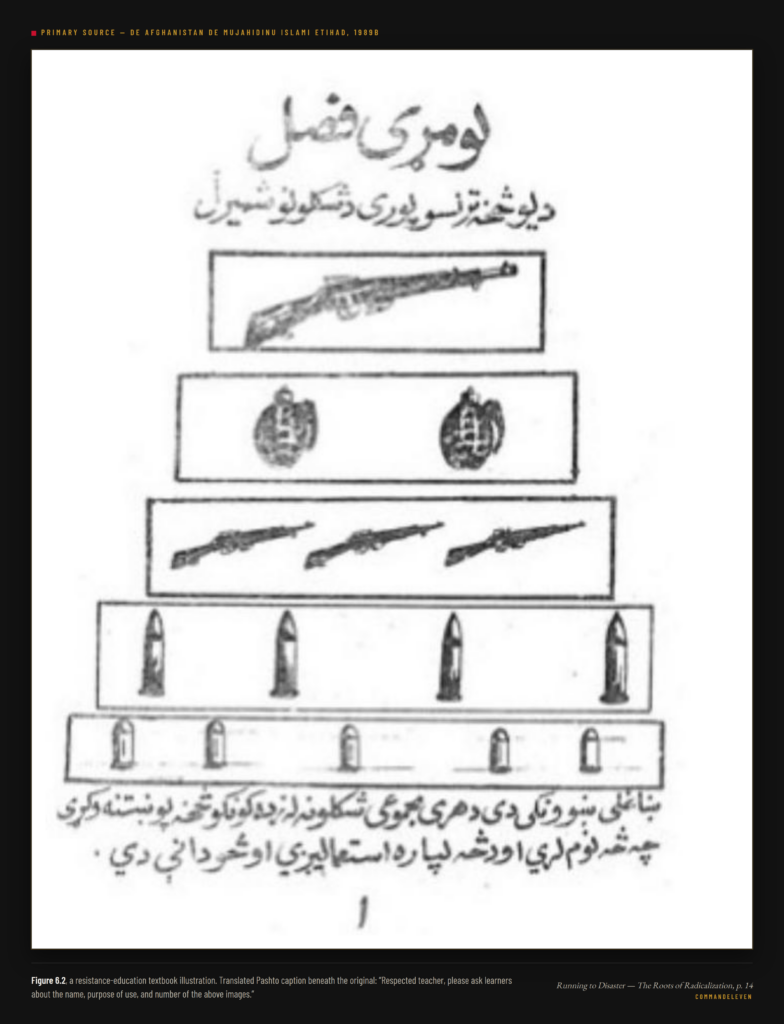
And another example from his book:
After reaping the successes of creating, inspiring and educating the global jihadi, in February 2002, United States foreign aid workers launched a “scrubbing” operation in neighboring Pakistan to purge all references to rifles and killing from the books.
Doug Pritchard, a representative of a Canadian Christian non-profit group, who visited Pakistan as part of the operation to review and scrub the primers, said
“We were quite shocked. The constant image of Afghans being natural warriors is wrong. Warriors are created. If you want a different kind of society, you have to create it.”
Another aid worker, who reviewed an unrevised 100-page textbook, counted 43 pages containing violent images and passages.
After the 2001 invasion of Afghanistan, the United Nations’ education agency, UNICEF, began preparing to reopen Afghanistan’s schools, using new books, developed with the assistance of 70 Afghan educators and 24 private aid groups. In January 2002, UNICEF started printing the new textbooks for many subjects, but also arranged copies of the old, unrevised USAID books for other subjects, including Islamic instruction.
Within days, the Afghan interim government announced it would continue to use the old USAID-produced textbooks for the core school curriculum, with the UNICEF books only used as supplements.
In 2002, the US used part of the US$ 296 million Rebuilding Afghanistan aid package to reprint the old books, purging the violent references.
Of the 200 titles originally created by UNO and USAID, only 18 were reprinted, which were mostly Islamic instruction books.
At the end of 2002, UNICEF claimed they had only 500,000 copies, of the millions in circulation, of the “militarized” version.
In 2002, the nearly four million textbooks entering Afghanistan, and millions more en route, taught verses from the Holy Quran and tenets of Islam. President George W. Bush even had the outright audacity to state in one of his weekly radio addresses:
“…the books being trucked to Afghan schools would teach ‘respect for human dignity, instead of indoctrinating students with fanaticism and bigotry.’”
It is a great thing when the man who is solely responsible for the prison in Guantanamo Bay, the enhanced interrogation techniques employed to “gather intelligence,” the invasion of Afghanistan and Iraq, should be lecturing others about the “respect for human dignity.”
It was also no surprise the university responsible for radicalizing the region was again given the contract to provide “revised textbooks and teacher training kits,” with interim President Hamid Karzai and first lady Laura Bush present at the announcement.
USAID showed their “good intentions” for the Afghan people by removing their logos and any mention of the US government, said USAID spokeswoman Kathryn Stratos. She continued
“It’s not USAID’s policy to support religious instruction, but we went ahead with this project because the primary purpose is to educate children, which is predominantly a secular activity.”
In an interview with National Public Radio (NPR), Burde said:
“Picture yourself in the mid-80s. Preventing and countering Soviet expansion was a single-minded focus in the United States and across the West. After the balance of power shifted and the Shah of Iran was overthrown, there was an enormous amount of suffering among the Afghan people, and an exodus of epic proportions, like the Syrian refugee crisis. There was a lot of outpouring of support on both the right and the left for Afghans struggling against the Soviet occupation. As part of this war effort and consistent with the spirit and goals of the time, the alphabet of jihad literacy tried to solidify the links between violence and religious obligation.”
She further said:
“When you look at really intolerant, biased content, whether the books, or those in Germany pre-World War II, or in Rwanda before the genocide, all of these things condition people toward ideas, stereotypes, biases, and I think that’s clear that it has some influence on underlying conditions for conflict.”
Mia Bloom, a terrorism expert at Georgia State University, said
“It exposes children to violence in a routine and daily fashion so it ceases to be shocking and normalizes violence.”
Bloom is part of the Georgia State University Minerva research project on children and extremism to track apps, textbooks, and other macabre Islamic State learning tools. She stated that her team had already found 35 Islamic State textbooks easily downloadable and ready to use in the dark corners of the Internet.
Through American taxpayer dollars, United States foreign policy, the Pentagon, and the Central Intelligence Agency (CIA), the mujahideen were created, children’s minds were poisoned toward war instead of peace, and an endless war was set in motion, as radical and violent textbooks became core staples of Afghan and Pakistani madrassa education, despite the consequences for childhood development and the future stability of Afghanistan and Pakistan as countries.
Understanding the Mistakes
Islam was the principal element behind the mobilization of masses during the Pakistan Movement under Quaid-e-Azam Muhammad Ali Jinnah. The Two Nation Theory was the indicator of Muslim nationalism in India while the Islamic ideology was the motivational force behind it.
Pakistan’s journey clearly demonstrates the shift from the Two Nation Theory and nationalism to the Islamic ideology and theology.
Jinnah’s Muslim League provided a political party for the integration of Islamic ideology with political interests. This mixture was never acceptable to the fundamentalists of India, although they later joined the Pakistan Movement as a pressure group.
Jinnah in his inaugural speech on 11th August, 1947, clearly stated that religion would be the private affair of the individual and stressed equality and freedom of religion in Pakistan.
While this was the original spirit for the creation of Pakistan, the religious groups that partnered with the Muslim League dedicated themselves to declaring Pakistan an Islamic state.
This debate shaped the Objectives Resolution of March 1949 to draft an Islamic Constitution.
It was Justice Muhammad Munir’s commission in 1953 that clearly identified the struggle within the nation’s fabric – “That the object (of the agitators) was to establish a religious state. It was neither in Quaid-e-Azam’s mind nor in that of Allama Iqbal’s.” Leading many people to state that the father of Islam in Pakistan was not Quaid-e-Azam, but Maulana Sayyid Abul A’la Maududi, the founder of Jamaat-e-Islami (JI).
This was the foundational brick placed in the radicalization of Pakistan.
After the Constitution of 1956, which was considered the first compromise between the liberals and the conservatives, the fundamentalists created political parties to attain positions in the State.
General Zia’s era is considered as the most crucial phase for the study of extremism.
In his totalitarian regime, the fanatics and fundamentalist groups acquired power and resources they never had access to, to thrust their agenda and challenge the power of the state in future.
The nexus between extremists and the State ended with the effectiveness of the former. The undue support to the religious groups and parties gradually undermined the role of State and emerged as the driving and principal actors in all decisions and policies of the State.
As a matter of fact, the tussle between the people and the fundamentalists was going on since independence, but Zia’s era is held solely responsible for Islamization of Pakistan. He used Islam as a tool for the legitimization of his autocratic military rule. He had accomplished the task that he became responsible of strengthening Jihadi elements. The fundamentalists and their elements had nothing to do with the golden teachings of Islam, instead they used Islamic injunctions to legitimize their aggressive moves of controlling different segments of society and components of power.
The Islamic agenda of Zia administration was entrusted with political expediency.
Zia’s administration brought an alliance with the military actively supporting politicians and political parties. The Ameer-e-Jamaat-e-Islami (JI), Mian Muhammad Tufail was General Zia’s uncle; Jamaat-e-Islami became more vocal and effective in this era. While the religious parties were gaining more control in Pakistan, the Soviet invasion of Afghanistan provided the institutional, financial, and tactical support from Arab nations, wealthy Arab families, and global superpowers.
Prior to the invasion, these parties and groups were vocal but there was no trend of militancy in them. However, with the alliance against the Soviet invasion, the doorway to militancy was permanently opened.
These groups were given agendas and resources with the financial incentives.
The amalgamation of money, politics, power, and religion brought havoc in the region. Both Pakistan’s Inter-Services Intelligence (ISI) and CIA trained thousands of Pakistanis and Arab volunteers to become part of the Mujahideen, who would later become diehard Jihadis. This training induced both homicidal and suicidal tendencies within the structure of Jihadis.
Madrasahs and religious institutions in Pakistan were used as nurseries for breeding fighters for the Jihad.
The engineers of this strategy probably were unaware of the fact that once this trend was established, it would become fatal for generations for decades and decades.
While repeating General Zia-ul-Haq’s name as the driving force, it should also be clear that many of Pakistan’s pundits and politicians also locked arms with the General, including Muhammad Nawaz Sharif, the deposed 3-time Prime Minister of Pakistan and leader of his own faction of the Pakistan Muslim League.
It was Muhammad Nawaz Sharif, speaking at a death anniversary rally for General Zia, where he said –
“I will carry on General Zia’s vision for Pakistan.”
As a nation, Pakistan has suffered at every level for mistakes in managing national issues, which became international issues.
The possibility that these same Mujahideen and their violent ideology could one day turn against Pakistan was never considered, nor was any strategy developed for reviewing and reversing the potential fallout.
Since the last Soviet soldier left Afghanistan, Pakistan has been overtaken by the violent ideology that continues to be taught in its madrassahs. The ideology that takes an underprivileged child and uses their shortcomings to motivate them towards violence continues to drive militants and jihadis to self-proclaimed jihads in Pakistan, in the region, and around the world.
The disenfranchised Pakistani diaspora, armed militant groups, radicalized madrassas and mullahs, networks of donors and deep-pockets, and relationships with intelligence, both foreign and domestic, became a significant part of Pakistan’s continued, and deepening, radicalization.
The militants that were created during the Soviet invasion grew into two groups, which have inspired thousands of like-minded groups around the world – al-Qaeda, the international terrorist group founded by Osama bin Laden and the Taliban, based in Afghanistan, the realized result of what violent religious radicalization could achieve.
This was while there were only newspapers and TV.
Now, there is the Internet to facilitate terrorist groups spreading their message of violence without ever meeting a single person, distributing videos that recruit individuals, training and educating their believers with materials on bomb-making, attack methods, and lone-wolf attacks, taking terrorism to a dramatically more brutal and individualized level.
The Internet successfully reached the individual, who shared the ideology, but didn’t have access to the terrorist groups. The Internet expanded the audience and increased recruitment beyond anyone’s expectations, while motivating them to act where they were. They didn’t need to come to Afghanistan, Iraq, or Syria.
Today’s terrorist is no longer waiting for approval from some commander. No, today’s terrorist is an individualized weapon, with a fuse burning and the detonation location, capacity, and carnage unknown. An active sleeper cell unknown to even their own family.
While the war in Afghanistan against the Soviet Union achieved its goal of pushing back the Red Army, neither the United States, Pakistan, Saudi Arabia, nor the thousands of individuals, organizations, universities, and countries that were party to the creation of this havoc, have any realistic plan to reverse the plague that has spread across the globe, without using weapons, which further radicalizes the population.
Radicalization cannot be stopped by military force alone.
Rather, military force further emboldens it against the State, when there is nothing offered in return. Most of those being recruited as fighters come from poor backgrounds, where families could not meet their daily requirements. If the State is unable to offer immediate economic and developmental incentives, the problem of radicalization grows exponentially and belief in the State disappears.
Conclusion
Terrorism is the organic by-product of the radicalization of the Muslim world that started with the Soviet invasion of Afghanistan. When a massive group of people is motivated, mobilized and armed for a specific objective, the global diaspora cannot blame the victims, it must place the blame on those who designed the blueprint for this cancer.
But this cancer was not self-inflicted, as the world would like to portray. Pakistan was purposely infected, along with Afghanistan, during the Soviet invasion to fully radicalize society so that it would be easy to instigate conflict, easy to manipulate, and, most of all, easy to control.
Since the withdrawal of the Soviets from Afghanistan, and despite being a frontline partner against the United States’ ultimate Cold War rival, Pakistan was sanctioned, military support was withdrawn, the people were made to feel manipulated and used, further increasing radicalization opportunities, and terrorism exploded upon the world.
In the next part of this series, CommandEleven links radicalization with the organic transformation to violent conflict within Pakistan’s borders and the rise of international terrorism.
Sources
- Joe Stephens and David B. Ottaway, From U.S., the ABC’s of Jihad, The Washington Post, March 23, 2002
- Dana Burde, Schools for Conflict or for Peace in Afghanistan, Columbia University Press, 2014
- Q&A: ‘J’ Is for Jihad, interview with Dana Burde, NPR, December 6, 2014
- Craig Davis, “‘A’ is for Allah, ‘J’ is for Jihad,” World Policy Journal, Spring 2002
- Yahia Baiza, Education in Afghanistan: Developments, Influences and Legacies Since 1901, Routledge, 2013
- University of Nebraska at Omaha / ESSP, Annual Report to USAID, 1992
Next: Part 3: Operation: Dinner Out
Download the original report: Running to Disaster, Volume I: The Roots of Radicalization (PDF). The 2024 report this part is drawn from, which covers Parts 1 and 2 of this series.