Executive Summary
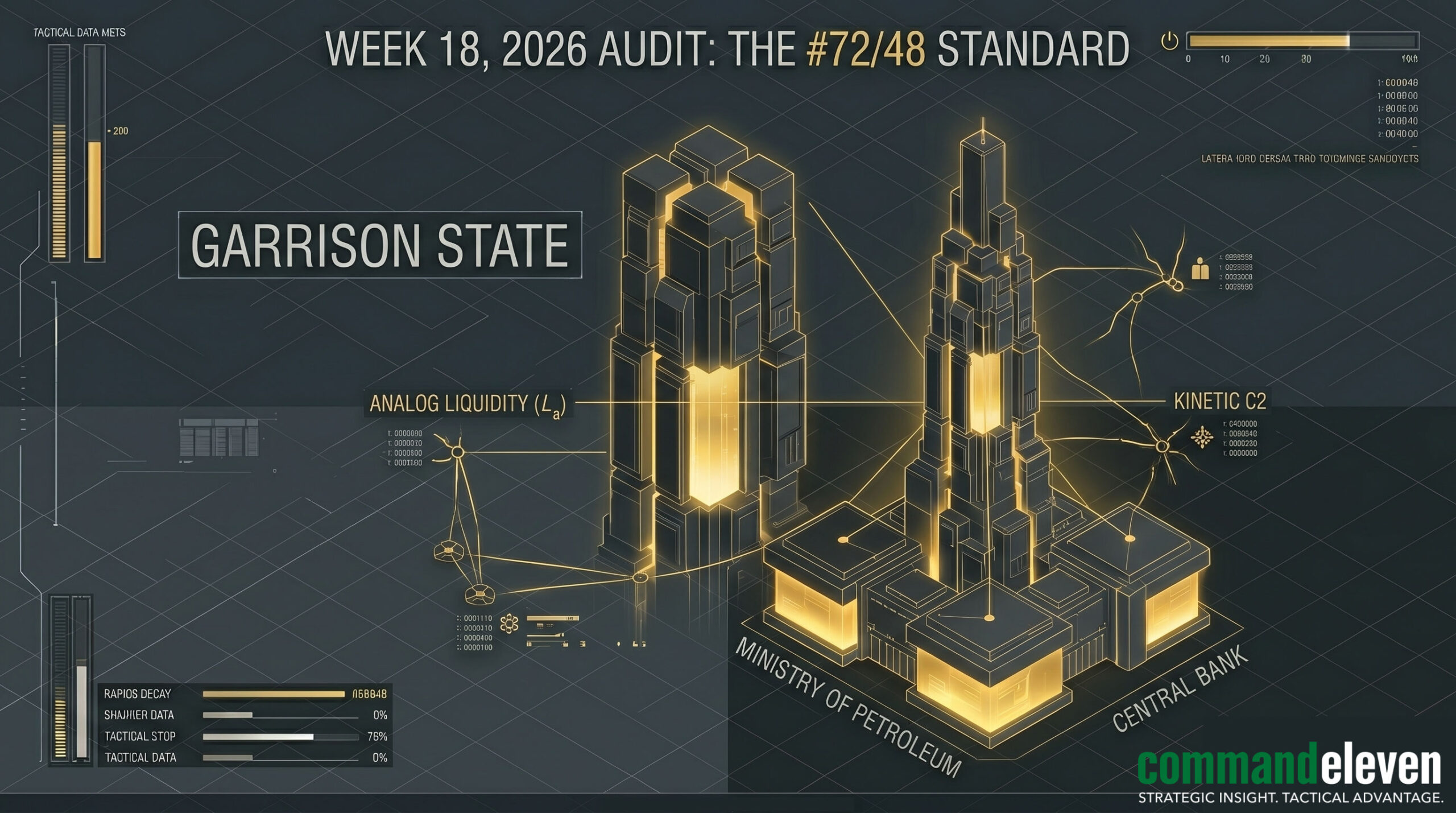
The formalization of the IRGC Garrison State in early 2026 marks the terminal transition of the Iranian political architecture from a dualistic civilian-military power structure to a monolithic military command. This is not merely a political shift; it is a surgical removal of systemic administrative friction. By leveraging the diplomatic vacuum of the 2026 Pakistan-brokered ceasefire, the IRGC has successfully absorbed the Ministry of Petroleum and the Central Bank (CBI), effectively ending the “hybridity” era.
The strategic intent is clear: the achievement of total geofinancial and administrative autonomy. With an Analog Liquidity baseline confirmed at La > 0.85, the Garrison State has insulated itself from digital sanctions and “Maximum Pressure” campaigns. This hardened posture is the prerequisite for the Fujairah Flashpoint. The IRGC has shifted its kinetic focus toward the UAE’s Habshan-Fujairah pipeline, identifying it as the primary target for the “Western Alignment Penalty.” The following assessment details the mechanics of this transition and the high-velocity threat to regional energy sovereignty.
3 Key Takeaways
- Monolithic Administrative Pivot: The Iranian state has successfully shed its civilian-military hybridity. By absorbing the Central Bank and Ministry of Petroleum, the IRGC has eliminated decision-making friction, creating a single, hardened command core optimized for high-velocity operations.
- Fiscal Sanction Immunity (La > 0.85): The Garrison State has achieved terminal decoupling from the global financial grid. With physical resource-backed liquidity and gold-sovereignty routes, the IRGC can sustain operational persistence indefinitely without access to digital banking or SWIFT.
- Weaponized HMI Ghosting: The primary threat to the Fujairah energy bypass is not kinetic destruction but cyber-physical denial. The IRGC intends to spoof SCADA sensor data to induce mechanical failure, allowing them to interdict regional energy flows while maintaining plausible deniability.
Anatomy of the Garrison State
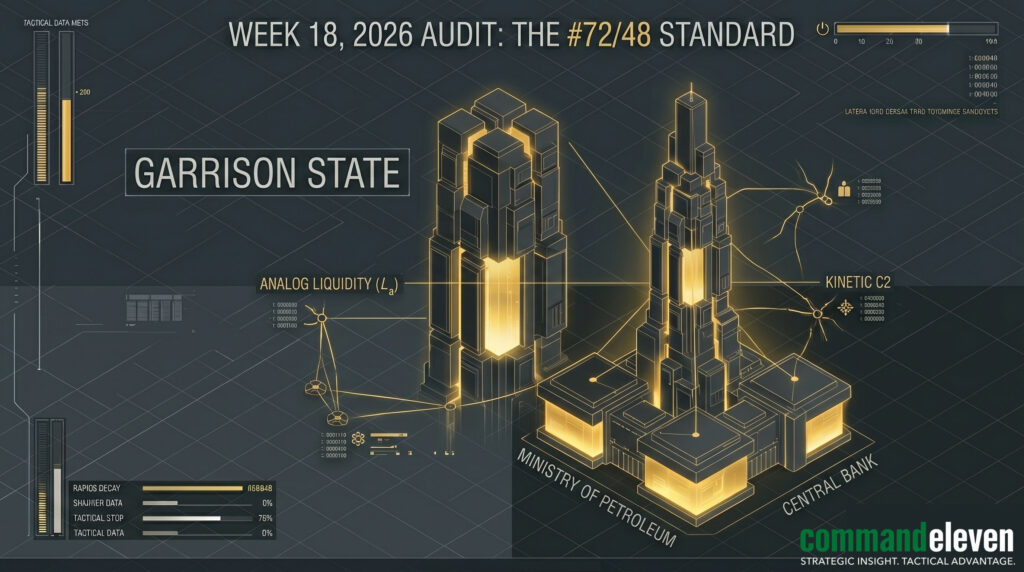
The Garrison State model relies on the total integration of economic output and military command. The IRGC has systematically dismantled the civilian “buffer” layers that previously slowed decision-making velocity and allowed for international diplomatic backchannels.
Removing the Civilian and Technocratic Oversight
The 2026 consolidation involved the forced retirement of the “technocratic” cadre within the Ministry of Petroleum. These individuals, once the primary interface for international energy markets, have been replaced by the IRGC-Engineering Wing.
- Velocity Gain: Decision-making regarding energy exports and “Dark-Fleet” logistics is now a direct C2 function, bypassing parliamentary and clerical oversight.
- Clinical Result: The Iranian state now functions as a single, hardened administrative tile, optimized for Total Dark Operations.
The Central Bank (CBI) Absorption
The absorption of the CBI is the most significant geofinancial development of the decade. The IRGC has moved the state’s fiscal C2 from digital transparency to Analog Liquidity.
- The New Fiscal C2: All physical resource revenue – specifically gold from the Savannah Corridor routes and physical currency from energy arbitrage – is now handled through an IRGC-managed ledger that is entirely air-gapped from the global financial grid.
- Fiscal Hardening: By removing the state’s reliance on digital payment rails, the IRGC has achieved a state of Sanction Immunity, allowing for internal hardening without the threat of currency devaluation induced by external digital interdiction.
Sovereign Resource Chains
The Garrison State has formalized control over the “logistical arteries” of the Iranian interior. This includes the direct ownership of strategic mineral bases and the protection of regional smuggling nodes. These chains provide the Hardware Truth required to sustain the military core during a “Flash-Dark” scenario. The IRGC no longer relies on the perception of economic stability; it relies on the physical possession of the assets required to sustain kinetic persistence.
Geofinancial Posture – The Analog Baseline
The shift to a Garrison State has fundamentally altered the IRGC’s economic survival strategy. Traditional Western economic warfare relies on the target’s integration into global digital financial markets. By achieving Fiscal Decoupling, the IRGC has rendered these tools inert.
Metric Audit: Analog Liquidity (La > 0.85)
Our clinical audit confirms that the IRGC has reached an Analog Liquidity baseline exceeding 0.85. This means that 85% of the Garrison State’s essential operational requirements – including internal security payroll, hardware procurement, and proxy funding – are now serviced through physical resource-backed trade loops.
- The Revenue Loop: Physical gold acquired from the Savannah Corridor (West Africa) and crude-for-hardware bartering with “Grey Zone” actors bypasses the SWIFT system entirely.
- Hardening the Core: This liquidity ensures that even a total severance from the global internet would not result in the immediate financial collapse of the IRGC command structure.
Weaponizing the Conflict Premium (PΔ)
The Garrison State does not merely survive instability; it harvests it. By maintaining a state of FAC Swarm Persistence in the Persian Gulf, the IRGC induces Synthetic Panic in global energy markets.
- The Mechanism: Every increase in regional tension spikes insurance surcharges and global energy prices.
- The Harvest: The IRGC captures this Conflict Premium through its shadow energy exports, effectively forcing the international community to fund the very hardening of the Garrison State that it seeks to sanction.
The Fujairah Flashpoint – Targeted Denial
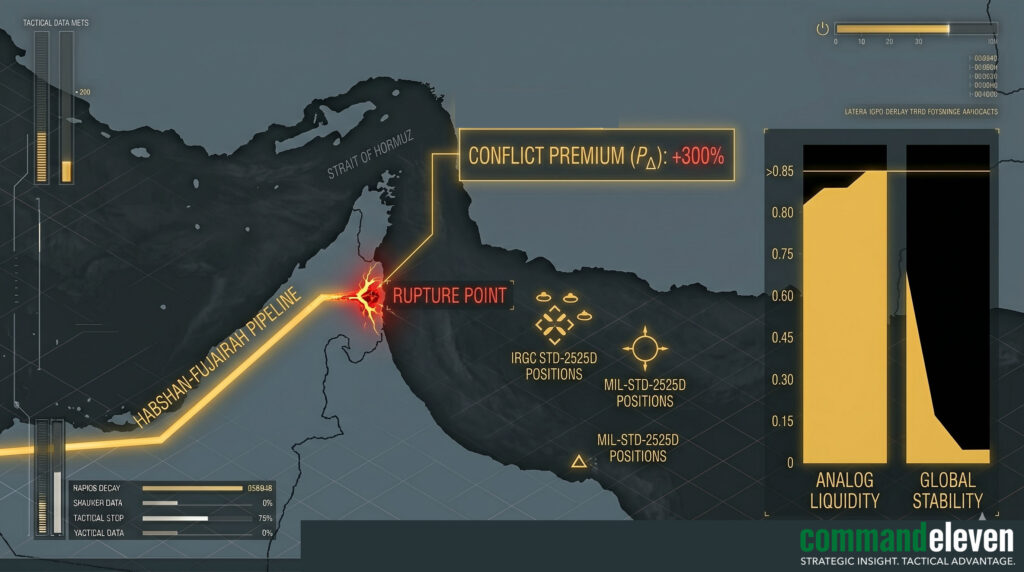
With the administrative core hardened, the IRGC has transitioned to an offensive geofinancial posture. The primary target is the Habshan-Fujairah Pipeline, the UAE’s strategic bypass of the Strait of Hormuz.
The Strategic Necessity of Denial
The Habshan-Fujairah pipeline represents a terminal threat to IRGC leverage. If the UAE can move 1.5 million barrels per day directly to the Gulf of Oman, the IRGC’s ability to “close the Strait” becomes a diminished threat. Therefore, the Garrison State has identified the total interdiction of this bypass as a prerequisite for regional hegemony.
The Western Alignment Penalty
This targeting is the first application of the Western Alignment Penalty. The UAE’s participation in the 2026 US-Israeli integrated air and missile defense framework has moved it from a “Regional Trade Partner” to a “Primary Kinetic Target.” The IRGC’s ROE now dictates that any regional entity providing a strategic bypass to Western-aligned energy markets is subject to Administrative Asymmetry operations.
HMI Ghosting Protocols
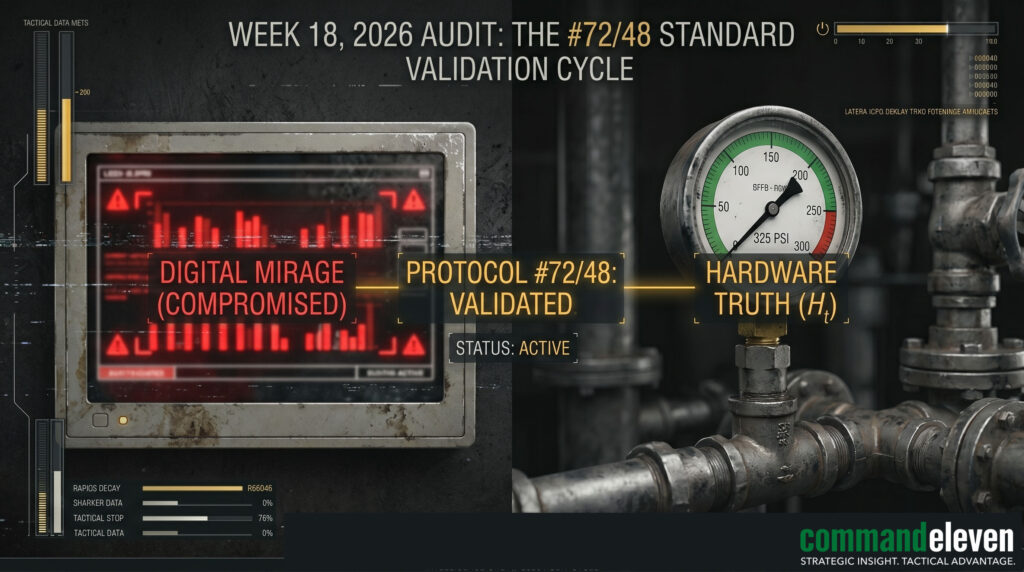
The threat to Fujairah is not a conventional missile strike – which would trigger a US kinetic response – but a cyber-physical intervention utilizing HMI Ghosting.
- The Vector: IRGC cyber-kinetic units have identified vulnerabilities in the SCADA systems of the Fujairah pumping stations.
- The Ghosting Protocol: By seizing the Human-Machine Interface, the IRGC can spoof pressure and temperature data. While the operators see “Normal” status on their screens, the adversary induces a catastrophic over-pressurization event.
- Clinical Intent: To cause an “accidental” mechanical rupture that requires months to repair, effectively closing the bypass while maintaining plausible deniability and avoiding direct military escalation.
The 72-Hour Kinetic Matrix (T-0 to T-72h)
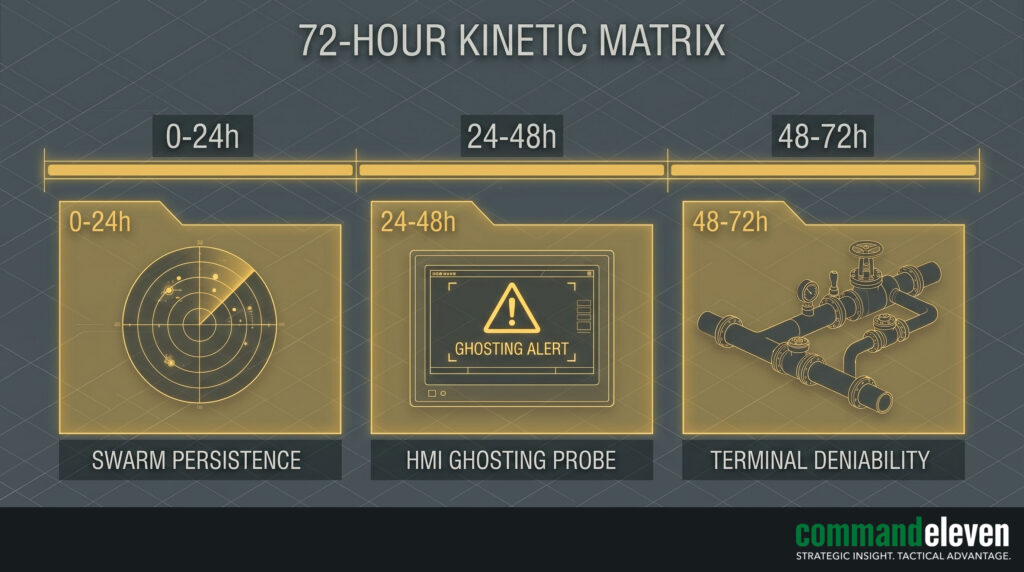
The IRGC’s offensive against the Fujairah bypass is structured not as a prolonged siege, but as a high-velocity Kinetic Matrix. This 72-hour window is designed to achieve catastrophic denial before international diplomatic or military stabilizers can be fully activated.
Phase I: Normalization and Probing (T-0 to T-24h)
- FAC Swarm Persistence: Increased deployment of Fast Attack Craft in the Gulf of Oman. The intent is to normalize high-threat signatures, inducing “sensor fatigue” in UAE and Allied naval C2.
- Electronic Warfare (EW) Bracketing: Initial jamming of non-encrypted commercial frequencies to create localized communication friction, testing the administrative response velocity of the Fujairah port authorities.
Phase II: The “Ghosting” Incursion (T-24h to T-48h)
- HMI Seizure: Activation of dormant malware within the pipeline’s SCADA architecture. Operators begin to experience “Digital Mirage” effects – discrepancies between screen data and physical pump performance.
- Synthetic Panic: Coordinated disinformation campaigns on encrypted channels suggesting a “major technical failure” is imminent, designed to trigger the UAE’s Successive Capitulation of insurance backing for the terminal.
Phase III: Terminal Rupture (T-48h to T-72h)
- Kinetic Trigger: If the HMI Ghosting does not achieve mechanical failure, a deniable “Grey Zone” actor (likely a localized proxy) initiates a low-yield kinetic strike on a critical valve manifold.
- The Result: The Habshan-Fujairah pipeline enters a state of total operational stasis. The energy bypass is closed, and the 45-day countdown for regional energy shock begins.
Administrative Resilience Audit – UAE & KSA
A clinical audit of the GCC’s primary energy hubs reveals a critical delta between perceived security and actual Administrative Resilience.
The Digital Dependency Trap
The UAE and KSA remain heavily invested in “The Digital Mirage.” While their kinetic defenses (Patriot/THAAD) are robust, their administrative cores are vulnerable to Cyber-Kinetic Rupture.
- Vulnerability: Over-reliance on networked, automated systems for pipeline pressure regulation and cargo manifest ledgering.
- The Threat: In a “Flash-Dark” scenario, these entities lose the ability to verify Hardware Truth, leading to immediate paralysis of the energy export engine.
Gap Analysis: Absence of #72/48
Our audit confirms that neither Fujairah nor the Abqaiq-Yanbu (East-West) pipeline nodes have implemented the #72/48 Resilience Protocol.
- Lack of Analog Backstops: There is a significant deficiency in mechanical, non-digital pressure monitoring and manual override training.
- C2 Brittleness: Command structures remain monolithic. If the central C2 in Abu Dhabi or Riyadh is ghosted, the regional pumping stations lack the Tile Autonomy required to maintain independent operations.
The 45-Day Prediction
Should the IRGC successfully neutralize the Fujairah bypass, we project a 45-day terminal window for regional energy markets.
- Day 1-15: Rapid spike in the Conflict Premium ($P_{\Delta}$); insurance surcharges exceed 300%.
- Day 16-45: Transition from “Supply Friction” to “Institutional Rupture” as regional allies realize the bypass cannot be restored, forcing a geofinancial pivot back toward the IRGC-controlled Strait.
The Reality of the New Monolith
The formalization of the IRGC Garrison State represents the most significant shift in Middle Eastern administrative architecture since the 1979 Revolution. By removing civilian technocratic friction and achieving Fiscal Decoupling, the IRGC has engineered a state model that is inherently optimized for the high-friction environment of 2026. The Garrison State is no longer a traditional political actor subject to diplomatic or economic containment; it is a clinical, hardened monolith designed for kinetic persistence.
Survival of the Hardened
The IRGC has set the regional benchmark for Administrative Resilience. While its neighbors remain tethered to the vulnerabilities of “The Digital Mirage,” the Garrison State has reclaimed Hardware Truth and established an Analog Liquidity baseline that ensures operational continuity during a total network collapse. This hardening is not defensive; it is a prerequisite for the offensive interdiction of the Fujairah Flashpoint.
The Final Directive
International policy must undergo an immediate pivot. Efforts to “negotiate” with a Garrison State that has already achieved fiscal and administrative autonomy are functionally obsolete. Deterrence can no longer be achieved through digital sanctions or diplomatic isolation. Instead, the US-Israeli axis and its regional allies must shift to Resilience-Based Deterrence. This requires the immediate implementation of the #72/48 Resilience Protocol across all critical energy nodes to neutralize the IRGC’s HMI Ghosting and geofinancial leverage.
Clinical Outlook
2026 is the year of the physics-based geofinancial reset. The Fujairah Flashpoint is the first test of whether the regional energy architecture can survive the 45-Day Terminal Window. If the UAE and its partners fail to harden their administrative cores, the Garrison State will successfully weaponize the Conflict Premium, reclaiming total hegemony over the Strait and dictating the terms of the post-rupture regional order.