
Executive Summary
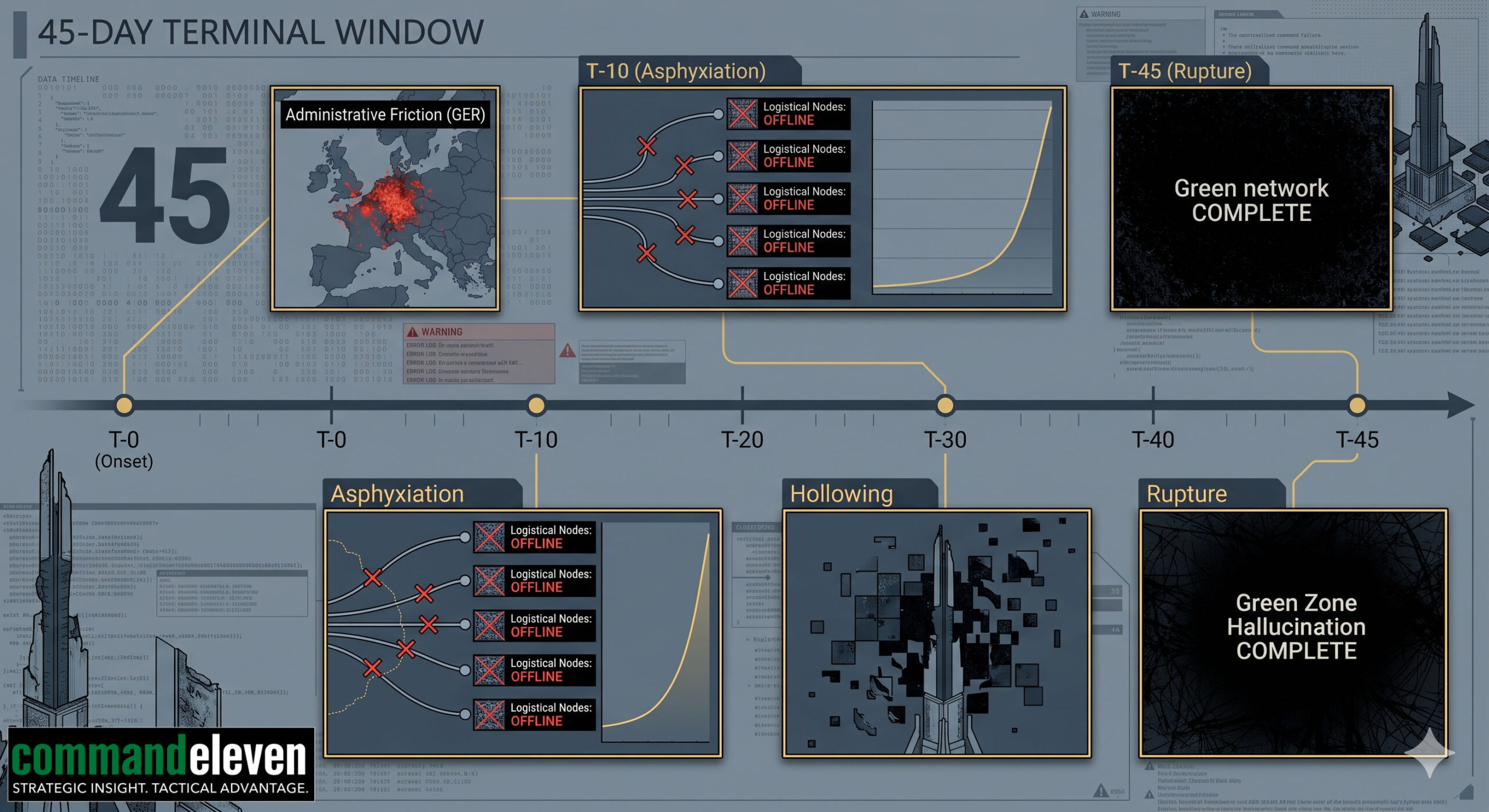
The traditional counter-insurgency (COIN) models of the past two decades have been rendered obsolete by a new paradigm of high-velocity state displacement. This analysis deconstructs the 45-Day Terminal Window – the measured interval between the onset of systemic administrative friction and the total collapse of sovereign institutional control.
By analyzing the Bamako Blueprint, we demonstrate that modern state failure is no longer a slow decay, but a rapid-onset systemic shock triggered by Logistical Asphyxiation and Administrative Asymmetry. When an adversary can provide more predictable, physics-based governance (Hardware Truth) than the recognized state, the institutional core enters a state of Successive Capitulation. The article concludes that in the 2026 theater, sovereignty is not a legal status, but a clinical output of administrative resilience. Entities that fail to harden their cores before the 45-day countdown begins are effectively operating in a graveyard.
3 Key Takeaways
- Velocity is the Primary Weapon: The transition from a “fragile state” to a “ghost state” now occurs within a compressed 45-day window. Strategic survival depends on identifying leading administrative indicators – such as the loss of provincial tax sovereignty – rather than lagging kinetic metrics.
- Logistical Asphyxiation Trumps Siege: The Bamako Blueprint proves that severing primary transit arteries (Logistical Oxygen) is more effective for state displacement than conventional military engagement. Once supply chains fail, the civil service undergoes Successive Capitulation, regardless of the state’s kinetic superiority.
- Hardware Truth as the New Legitimacy: In high-friction environments, rural populations pivot to the entity that provides physical security and predictable local law. To survive, the state must abandon the “Digital Mirage” of centralized databases and reclaim Hardware Truth through analog decoupling and localized Mosaic Defense.
The Expiration of the Long War
The post-Cold War era of counter-insurgency (COIN), characterized by decade-long nation-building efforts and slow-burn asymmetric attrition, has officially reached its expiration. The strategic community must now confront a far more lethal paradigm: high-velocity institutional displacement. We identify this phenomenon as the 45-Day Terminal Window.
Modern state failure is no longer a multi-year decay of civil institutions; it is a rapid-onset systemic shock triggered by the clinical hollowing of administrative legitimacy. In this new landscape, Velocity is the primary weapon. While traditional intelligence frameworks remain tethered to lagging kinetic indicators – such as troop movements and casualty rates – the “Dark-State” actors of 2026 prioritize leading administrative metrics. They do not seek to destroy the state’s military; they seek to render its administrative reach a theoretical concept.
The 45-day window represents the measured interval between the onset of localized administrative friction and the total collapse of sovereign control. Once the velocity of displacement hits this threshold, the state’s survival is no longer a matter of policy, but of physics. If an administrative core is not hardened before the countdown begins, it is effectively operating in a graveyard.
Case Study – The Bamako Blueprint
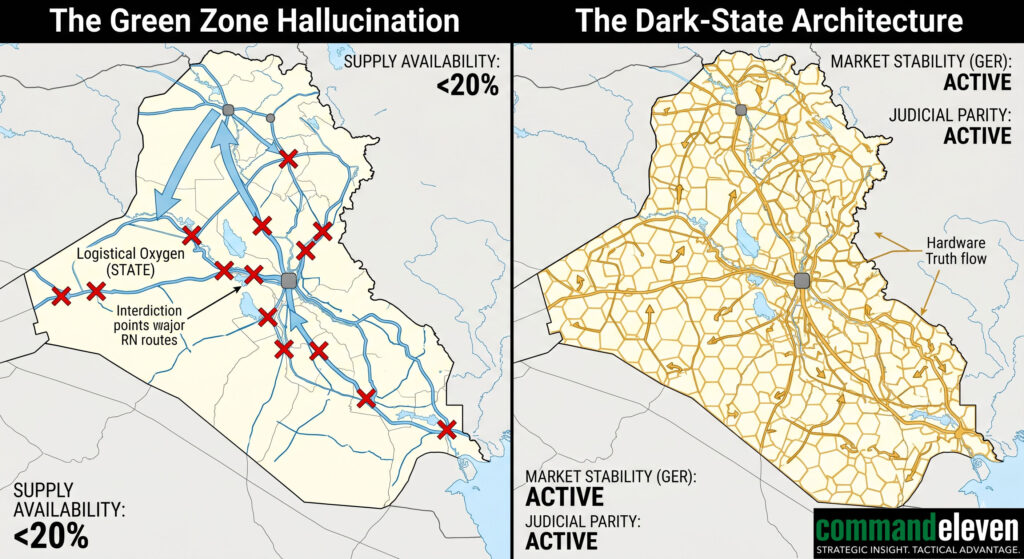
The recent collapse in Mali serves as the definitive case study for this high-velocity paradigm. The “Bamako Blueprint” demonstrated that a capital city does not need to be besieged to be captured. Instead, the adversary utilizes Logistical Asphyxiation.
The Mechanics of Asphyxiation
In the Malian theater, non-state alliances did not engage in a conventional march on the capital. Instead, they identified and severed just five primary transit arteries (RN routes) connecting the interior to the littoral supply chains.
- The Result: An immediate “Inflationary Shock” in urban centers, where the cost of basic staples rose by 400% within 14 days.
- The Administrative Fallout: The state’s civil service, unable to afford the cost of living and perceiving the core’s inability to protect the supply lines, began a process of Successive Capitulation.
Shadow Governance and Hardware Truth
While the central government in Bamako focused on digital transparency and international aid compliance – a “digital mirage” of stability – the militant alliances focused on Hardware Truth. They implemented rural justice systems that, while brutal, were predictable. They secured local markets and enforced tax collection that was actually utilized for local security.
By the time the central government realized the threat, they were already trapped in a Green Zone Hallucination. They controlled the ministerial buildings and the television stations, but their sovereignty ended at the final military checkpoint on the city limits. The Bamako Blueprint proves that when administrative asymmetry favor the non-state actor, the 45-day countdown is irreversible.
The Mechanics of Administrative Asymmetry
The fundamental driver of institutional rupture is Administrative Asymmetry. This occurs when the perceived utility of a non-state actor’s governance exceeds that of the recognized state. In high-friction theaters, legitimacy is not derived from international recognition or democratic mandates; it is derived from Hardware Truth.
Hardware Truth vs. The Digital Mirage
Modern states often fall into the trap of “The Digital Mirage” – relying on centralized databases, biometric systems, and digital payment rails to project sovereignty. However, in the 45-day window, these systems are the first to fail. Non-state actors exploit this by providing physics-based governance:
- Predictable Justice: Implementing localized, face-to-face adjudication that resolves disputes in hours, compared to the state’s multi-year, bureaucratic court systems.
- Market Stability: Securing physical trade routes and enforcing commodity prices at the point of sale, ensuring that “Logistical Oxygen” continues to flow to the local populace.
- Resource Sovereignty: Seizing artisanal and strategic mineral chains to provide immediate, physical liquidity (Analog Liquidity) to their administrative tiles.
When the state’s reach retreats into the digital sphere while the adversary controls the physical sphere, the population pivots. This is not necessarily an ideological choice; it is a survivalist one. Once the adversary achieves administrative parity, the state’s kinetic advantage (airpower, heavy armor) becomes a liability, as any use of force further degrades the infrastructure the state is ostensibly trying to protect.
Identifying the Leading Indicators of Rupture
The transition from a stable state to a hollowed shell is marked by three definitive leading indicators. Identifying these markers early is the only way to activate the #72/48 Resilience Protocol before the terminal window closes.
The Delta of Administrative Friction
Rupture begins when the delta between state-mandated law and actual provincial enforcement hits a critical threshold. Indicators include:
- The rise of illegal “taxation nodes” (unofficial checkpoints) on primary transit arteries.
- The migration of civil service personnel from rural districts to the capital due to “security concerns” – a polite term for administrative surrender.
Successive Capitulation of Logistical Nodes
State failure is a sequence of logistical ruptures. We track the “Logistical Oxygen” of a state. If an administrative hub loses the ability to pay its personnel in physical currency or cannot guarantee the safety of food and fuel shipments for more than 72 hours, that node enters a state of Successive Capitulation. It stops reporting to the core and starts negotiating with the local shadow actor for survival.
The Green Zone Hallucination
The final stage of rupture is the Green Zone Hallucination. This is a psychological state of the central leadership where sovereignty is measured by the security of the ministerial buildings and the broadcast capability of state media.
- The Reality: The state’s actual authority has been compressed into a few city blocks.
- The Signal: When the government begins issuing digital directives to provinces that no longer have electrical or network connectivity, the hallucination is complete. At this point, the 45-day window has usually reached T-Minus 10 days.
The CommandEleven Response – Resilience over Containment
When the 45-day terminal window is activated, traditional “containment” strategies – deploying rapid reaction forces or increasing international aid – are functionally useless. They address the kinetic symptoms rather than the administrative cause. The CommandEleven response is a clinical intervention designed to isolate the core and transition it to a state of Administrative Resilience.
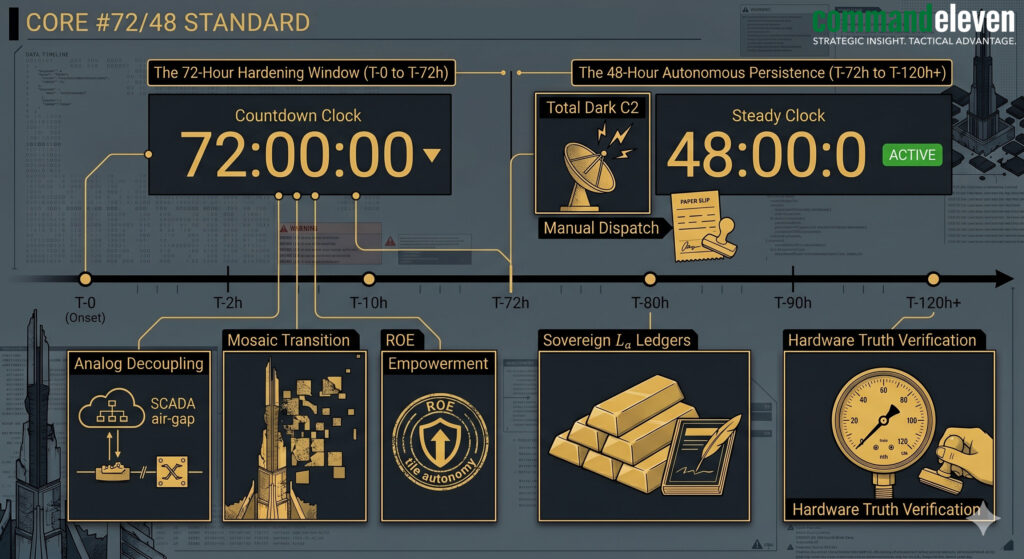
Activation of the #72/48 Resilience Protocol
The moment the Delta of Administrative Friction spikes, the entity must initiate the #72/48 Protocol. This is the only mechanical antidote to high-velocity rupture.
- Analog Decoupling (The 72-Hour Window): Critical infrastructure (power, water, and fuel distribution) is air-gapped from digital networks to prevent HMI Ghosting. Command and control shifts to physics-based verification.
- Autonomous Persistence (The 48-Hour Window): The administrative core proves its sovereignty by operating in “Total Dark” mode. If it can maintain market stability and security for 48 hours without a digital heartbeat, the Green Zone Hallucination is shattered, and the adversary’s momentum is neutralized.
Transition to Mosaic Defense Architecture
To survive the 45-day window, the centralized monolith must be dissolved. We assist clients in implementing a Mosaic Defense.
- Administrative “Tiles”: The territory is divided into autonomous cells. Each tile is pre-authorized with its own Rules of Engagement (ROE) and judicial protocols.
- Localized Sovereignty: By empowering provincial commanders to act as sovereign administrative heads, the state prevents the Successive Capitulation of its logistics. If one tile is interdicted, the others continue to breathe.
Reclaiming Hardware Truth
Resilience is built on the physical. CommandEleven implements a “Hardware Truth” audit for all critical supply chains.
- Analog Liquidity (La) Implementation: Transitioning payroll and procurement to physical resource-backed ledgers to ensure the civil service remains loyal when digital banking fails.
- Physics-Based Monitoring: Replacing vulnerable SCADA sensors with mechanical backups, ensuring that the state’s data reflects the physical reality of the ground, not a spoofed digital signal.
By shifting the focus from “defeating the enemy” to “hardening the administrator,” CommandEleven resets the velocity of the rupture. The goal is to force the adversary out of the administrative shadow and into a protracted kinetic engagement – a theater where they are significantly more vulnerable.
Survival in the Terminal Window
The 45-day terminal window represents a fundamental challenge to global security policy and institutional survival. If an entity remains tethered to a 12-month deployment cycle or a multi-year “reform” plan, it is effectively intervening in a graveyard. Sovereignty in 2026 is no longer about international recognition; it is a clinical output of Administrative Resilience.
The Bamako Blueprint serves as a warning that the velocity of rupture is increasing. As digital dependencies grow, the time required to hollow out a state’s administrative core shrinks. The only antidote is the proactive hardening of the administrative engine – transitioning from a brittle, centralized monolith to a resilient, autonomous mosaic.
For sovereign states and multinational corporations alike, the mandate is clear: master the #72/48 Resilience Protocol or prepare for obsolescence. In the age of high-velocity rupture, you are either hardened by physics, or you are a footnote in the history of the next systemic shock. Preparation is the only factor that determines whether the terminal window leads to collapse or consolidation.