Executive Summary
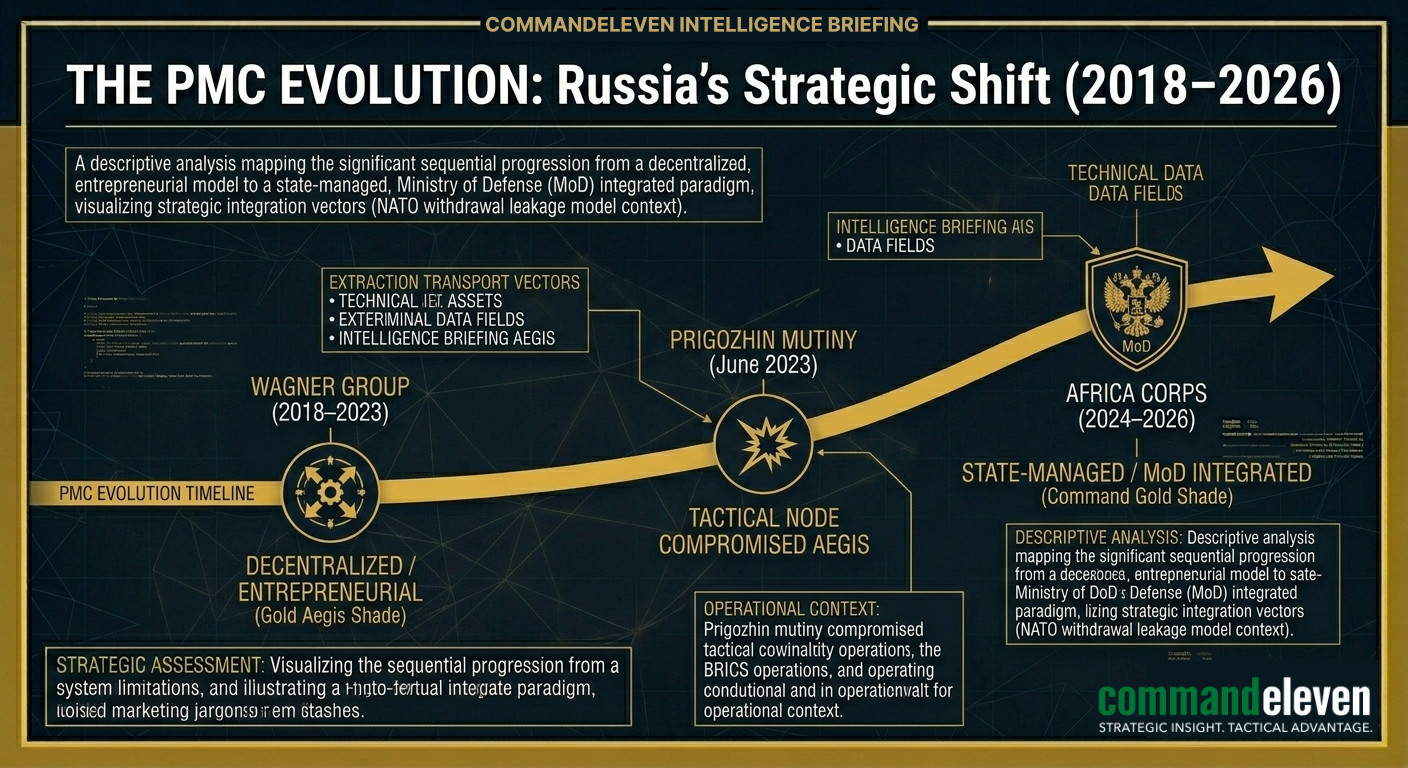
As of May 2026, the Russian paramilitary footprint in the Sahel has successfully transitioned from the decentralized Wagner Group model to the formalized, state-managed structure of the Africa Corps (Afrikanskiy Korpus). Operating under the direct oversight of the Russian Ministry of Defense and the GRU, this entity serves as a “regime survival” instrument for the military juntas within the Alliance of Sahel States (AES). The Africa Corps has institutionalized a self-sustaining geopolitical model: providing advanced electronic warfare, counter-coup intelligence, and high-attrition kinetic support in exchange for sovereign control over strategic mineral concessions, including gold, lithium, and uranium. This shift signifies a permanent Russian military-political presence designed to displace Western influence and secure a non-dollar “hard currency” stream through resource extraction.
3 Key Takeaways
- Institutionalized State Presence: The Africa Corps marks the end of “deniable” mercenary operations; it is a formalized arm of Russian foreign policy, integrated into the Ministry of Defense’s global logistical and intelligence command.
- The Resource-for-Security Swap: Russia has secured a self-financing enterprise in the Sahel, where security services for military juntas are directly compensated with the management of artisanal gold mines and exploration rights for critical minerals.
- Kinetic-Recruitment Loop: While the Africa Corps provides immediate regime security, its high-attrition “clearance” operations in rural areas exacerbate communal grievances, serving as a primary driver for jihadi recruitment among marginalized populations.
Structural Evolution: From Wagner to Africa Corps
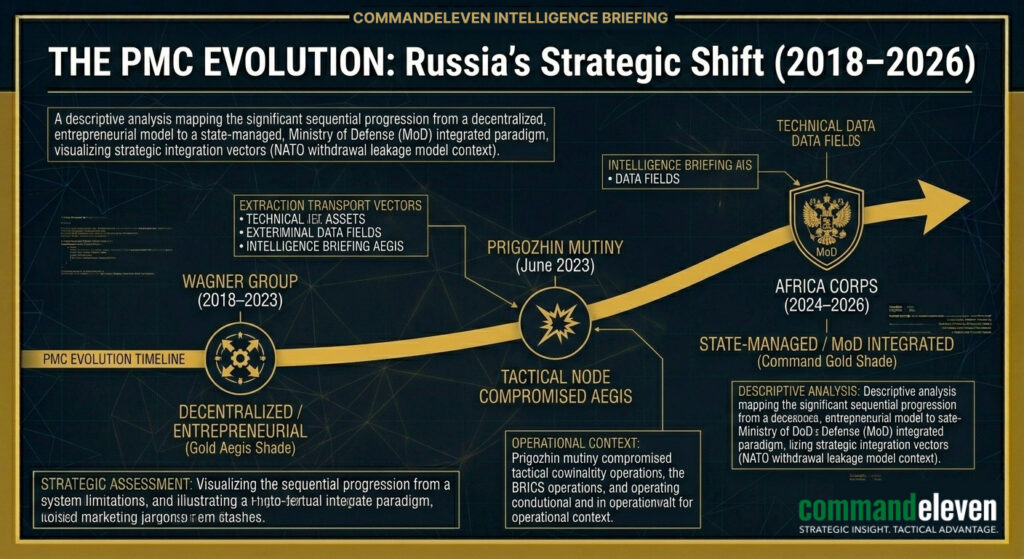
The transition following the 2023 Prigozhin mutiny was completed in early 2026, resulting in a more rigid, disciplined, and politically integrated command structure.
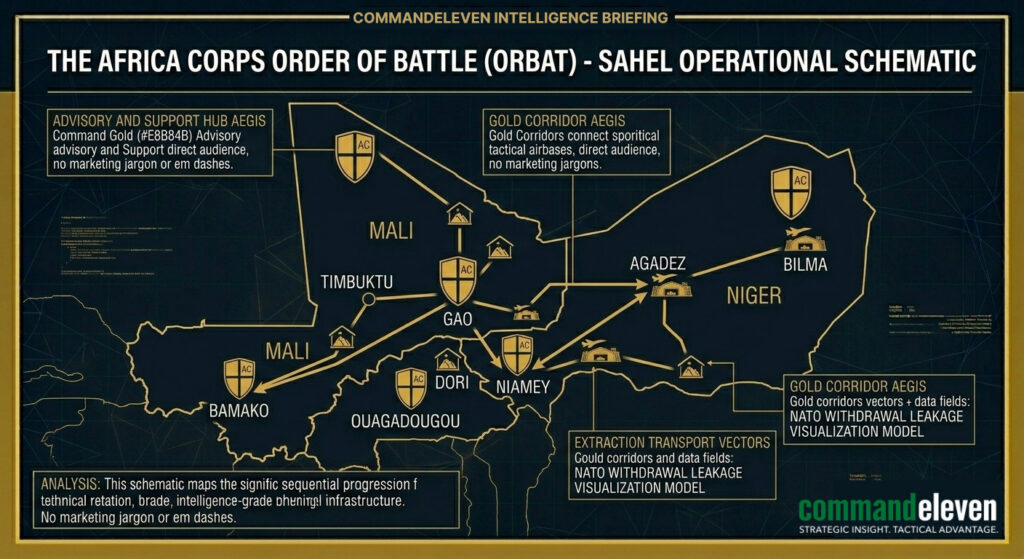
- GRU Oversight: The Africa Corps is now functionally integrated into the Russian MoD’s Special Operations structure. This allows for seamless logistical support via Russian military transport aviation and access to advanced intelligence-sharing that was previously withheld from the Wagner Group.
- The “Vanguard” ORBAT (Order of Battle): The footprint across the Sahel is estimated at 5,000–7,000 personnel. These units are organized into high-mobility “Advisory and Support” teams that embed within national armies (FAMa in Mali, FAN in Niger) rather than operating as independent, standalone units.
- Recruitment and Retention: The Africa Corps has prioritized the recruitment of former Wagner veterans while enforcing a strict “Military Oath” to the Russian state, ensuring that the fragmented loyalties of the previous era are neutralized.
Strategic Objectives and the “Resource Loop”
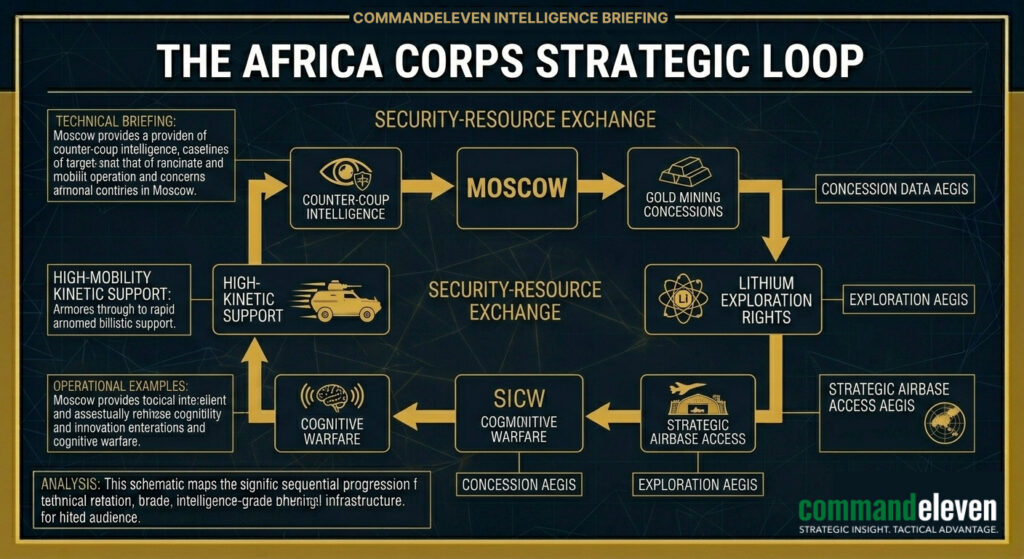
Russia’s engagement in the Sahel is driven by a self-financing model where security services are traded for sovereign control over natural resources.
The Gold-Security Swap
In Mali and Burkina Faso, the Africa Corps has secured direct management or “protection rights” over several high-output artisanal and industrial gold mines.
- Logistical Extraction: Gold is frequently extracted and transported via military channels, bypassing traditional domestic customs and providing the Russian state with a sanctioned-proof “hard currency” stream to fund operations in other theaters.
- The Lithium Frontier: In 2025–2026, Russian interests secured significant exploration rights in Mali’s lithium-rich areas, positioning Moscow as a critical player in the global battery supply chain.
“Regime Survival” Services
The Africa Corps provides a specialized suite of services designed to insulate the AES juntas from both domestic coups and external pressure.
- Intelligence and Counter-Coup Ops: Russian teams provide signal intelligence (SIGINT) and electronic warfare (EW) capabilities to monitor internal communications and detect signs of military unrest.
- Cognitive Warfare: Active support in managing state-aligned disinformation campaigns that frame the Russian presence as “anti-colonial” while discrediting ECOWAS and Western diplomatic initiatives.
Operational Impact and Human Rights Dilemma
While the Africa Corps has provided the AES juntas with increased kinetic “punch,” its operational methodology has exacerbated the regional security crisis.
- The Attrition Model: Russian-led operations in Central and Northern Mali prioritize high-attrition “clearance” sweeps. These operations frequently result in mass civilian casualties and the destruction of pastoralist infrastructure.
- Recruitment Windfall for Jihadi Groups: CommandEleven identifies a direct correlation between Africa Corps “clearance” missions and surges in recruitment for groups like JNIM. Local populations, facing indiscriminate violence from PMC-led state forces, increasingly view jihadi groups as their only viable protection.
- The Ukrainian Factor: Intelligence indicates a presence of Ukrainian special operations units (GUR) conducting asymmetrical “shadow strikes” against Africa Corps personnel in the Sahel to distract and drain Russian resources.