KEY TAKEAWAYS
- A full-scale US ground invasion of Iran is a low-probability contingency at present, constrained by force generation demands, the absence of a willing regional basing partner, and a sustained US preference for stand-off strike over occupation.
- Iran’s mosaic defense doctrine is built to deny any invading force a decisive early victory, favoring dispersed, attritional resistance across mountainous terrain and dense urban centers rather than static conventional defense.
- Any invasion scenario would trigger near-simultaneous escalation across multiple fronts, including missile and drone strikes on US bases, proxy activation in Iraq and Lebanon, Strait of Hormuz disruption, and a global energy price shock.
EXECUTIVE SUMMARY
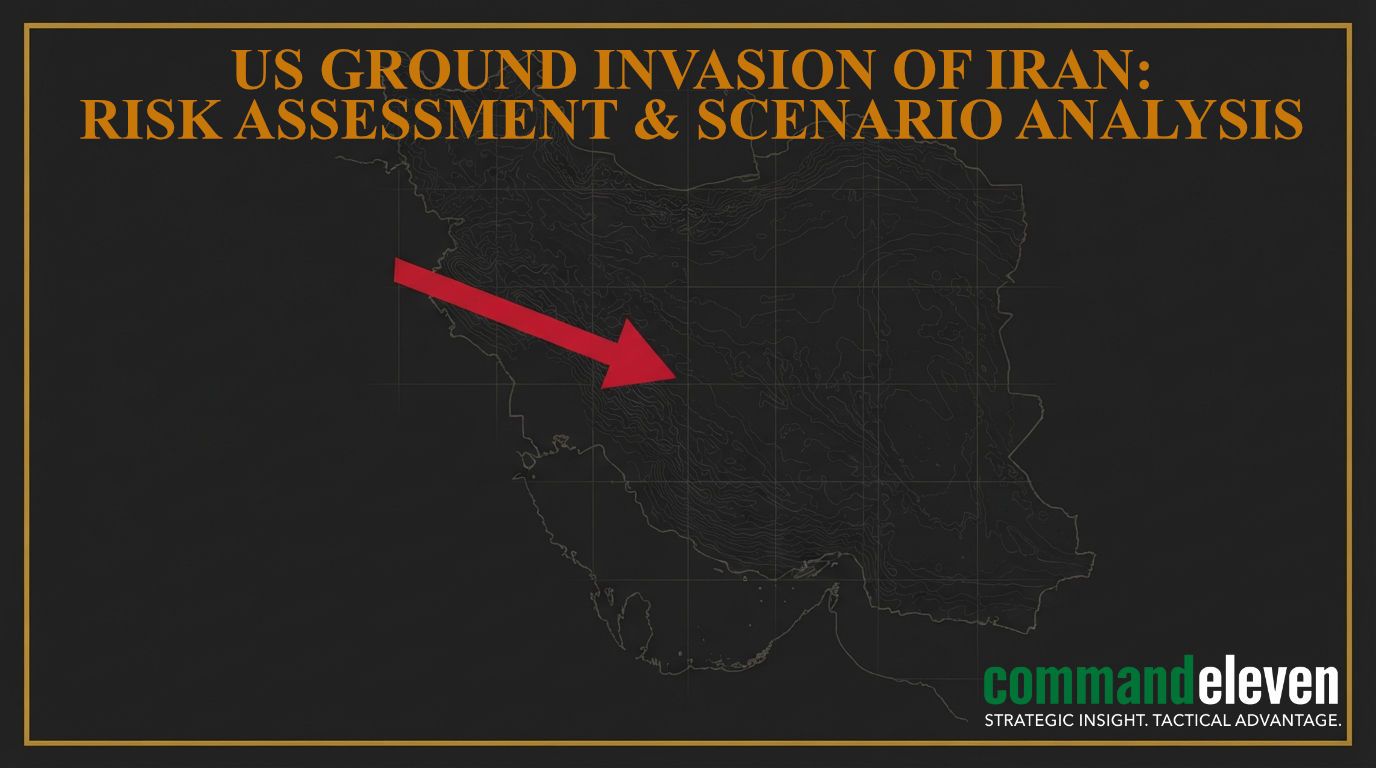
This dossier examines the scenario of a United States ground invasion of Iran, assessing the conditions under which such an operation could be initiated, the doctrinal and logistical constraints facing US planners, and the range of retaliatory options available to Tehran. The core judgment of this assessment is that a full-scale ground invasion remains a low-probability contingency under present strategic conditions, constrained by force generation requirements, regional basing limitations, and the absence of a coalition partner willing to absorb the political cost of hosting an invasion force. Iran’s defensive doctrine, built around dispersed and asymmetric resistance rather than static conventional defense, is assessed to favor a protracted attritional campaign over any decisive early engagement. Should an invasion scenario materialize, Iran’s most probable response would combine immediate missile and drone retaliation against US regional installations, activation of proxy networks across Iraq, Lebanon, and Yemen, and disruption of Gulf shipping through the Strait of Hormuz. The regional and economic spillover from any such campaign would likely exceed the scale of the 2003 Iraq invasion given Iran’s larger population, more mountainous terrain, and denser proxy architecture.
STRATEGIC CONTEXT: DRIVERS OF A US GROUND INVASION OF IRAN
The United States and Iran have remained in a state of managed hostility for more than four decades, punctuated by periods of direct confrontation and extended intervals of proxy competition. The relevant near-term drivers of this dossier’s scenario are threefold in nature but interconnected rather than independent: the status of Iran’s nuclear program, the operational tempo of Iran-aligned militias against US forces in Iraq and Syria, and the domestic political calculus in both Washington and Tehran.
Iran’s nuclear file remains the single most consequential variable. Repeated cycles of negotiation collapse, enrichment escalation, and International Atomic Energy Agency reporting disputes have kept the program at the center of US policy deliberation (ASSESSED, based on the pattern of IAEA reporting over the past several years). Any confirmed move toward weapons-grade enrichment or warhead assembly would represent the most plausible trigger for a shift from air and cyber options toward a ground contingency, given that some hardened enrichment sites are judged to require physical seizure or prolonged occupation to guarantee denial rather than temporary degradation through air strikes alone.
On the militia front, Iran-aligned groups operating under the Islamic Resistance in Iraq umbrella have periodically resumed attacks on US installations following lulls tied to broader regional de-escalation efforts. A mass-casualty attack traceable to direct IRGC-Quds Force direction, rather than to a loosely affiliated militia acting with plausible deniability, would sharply raise domestic US political pressure for a large-scale response.
Domestically, Tehran’s calculus is shaped by internal legitimacy pressures following years of economic strain from sanctions, currency depreciation, and periodic protest movements. The Iranian leadership has historically treated external military pressure as an opportunity to rally nationalist sentiment, a factor Washington’s planners are assessed to weigh heavily when considering whether an invasion would fracture or consolidate the regime’s domestic base.
Regionally, Gulf Cooperation Council states have shown a consistent preference for insulating their own territory from direct involvement in any US-Iran conflict, a posture reinforced by their exposure to Iranian missile and drone retaliation demonstrated in prior strikes against Saudi oil infrastructure. Iraq occupies a uniquely exposed position as both host to US forces and neighbor to Iran, making its territory a likely staging ground and simultaneous target regardless of Baghdad’s official position.
SCENARIO DRIVERS AND TRIGGERS
A US ground invasion of Iran would most plausibly move from standing contingency planning to active execution under one or more of the following conditions.
The first is a confirmed nuclear weapons breakout, meaning verified evidence that Iran has begun assembling a deliverable warhead rather than simply accumulating enriched material. This is judged the single most likely trigger given the extent to which denial of a nuclear-armed Iran has functioned as a bipartisan red line in US policy across successive administrations.
The second is a mass-casualty attack against US forces or diplomatic personnel that intelligence agencies assess with high confidence to have been directed by Iran’s central command structure rather than executed autonomously by an aligned militia. Historical precedent shows that attacks attributed to autonomous proxies tend to generate targeted retaliatory strikes rather than invasion-scale responses, while attacks with confirmed direct state authorship carry substantially higher escalatory potential.
The third driver is the collapse of extended deterrence credibility, meaning a scenario in which repeated air and stand-off strikes fail to alter Iranian behavior and US decision-makers conclude that only ground seizure of key facilities can achieve lasting denial. This pathway is judged less likely in the near term given the political and material cost of ground occupation, but it remains the scenario most closely tied to a protracted air campaign that fails to achieve its objectives.
A fourth, lower-probability driver involves a rapid and destabilizing collapse of regime authority in Tehran, in which internal fragmentation creates conditions under which external actors, including the United States, might consider ground intervention to secure nuclear material or prevent a security vacuum from being filled by hostile non-state actors. This scenario carries substantial uncertainty and is included here primarily for completeness rather than as a near-term probability.
US FORCE POSTURE AND DOCTRINAL CONSIDERATIONS
Any ground campaign against Iran would face force generation requirements substantially larger than those required for the 2003 Iraq invasion. Iran’s population exceeds 90 million against Iraq’s roughly 25 million at the time of the 2003 invasion, and Iran’s territory is nearly four times the size of Iraq with considerably more difficult terrain, particularly the Zagros mountain range along the western approach from Iraq. Historical planning estimates for large-scale stabilization operations generally scale with population and terrain complexity, suggesting that any serious ground campaign would require force levels well beyond what was committed to Iraq at the height of that conflict (ASSESSED, based on comparative terrain and demographic analysis rather than any confirmed current US force planning document).
Basing and access present the most immediate practical constraint. Gulf states hosting US forces, including Qatar, Bahrain, and the UAE, have shown sustained reluctance to serve as staging grounds for offensive operations against Iran given their proximity to Iranian missile and drone range and their economic interdependence with Tehran. Iraq’s government, dependent on both US security cooperation and Iranian economic and political influence, would face an acute sovereignty crisis if its territory were used to launch a ground invasion, regardless of whether Baghdad formally consented.
The maritime and air dimension of any campaign would need to account for Iran’s asymmetric naval capability in the Strait of Hormuz, where IRGC Navy fast-attack craft, coastal anti-ship missile batteries, and naval mine-laying capacity pose a persistent threat to the sustainment shipping any prolonged ground campaign would require. Historical exercises and prior confrontations in the Strait indicate that Iran’s naval doctrine favors swarm tactics and asymmetric harassment over direct fleet engagement, a posture that complicates rather than prevents US naval dominance but significantly raises the cost and duration of establishing secure sea lines of communication.
Sustainment over extended interior lines represents a further structural challenge. Unlike Iraq, where US forces could rely on relatively short supply lines from Kuwait, any advance into the Iranian interior, particularly toward Tehran, would require logistics chains stretching several hundred kilometers through mountainous and hostile terrain, a condition historically associated with sharply rising attrition rates for occupying forces in comparable campaigns.
IRANIAN ORDER OF BATTLE AND DEFENSIVE DOCTRINE
Iran’s ground defense rests on a dual structure combining the conventional Artesh (regular armed forces) with the Islamic Revolutionary Guard Corps Ground Forces, supplemented by the Basij paramilitary mobilization network. Open-source estimates place Iran’s active-duty ground forces at several hundred thousand personnel, with Basij mobilization capacity, while difficult to verify precisely and likely inflated in official Iranian statements, assessed to add a substantially larger pool of reservists and irregular fighters in a national defense scenario (ASSESSED).
Iranian military doctrine since the Iran-Iraq War has emphasized what is often termed a mosaic defense concept, structured around dispersed, semi-autonomous units capable of continuing resistance even after central command and control is degraded. This doctrine reflects lessons drawn directly from the prolonged and costly conventional confrontations of the 1980s, and it is designed specifically to deny an invading force the kind of decisive early battlefield victory that characterized the opening phase of the 2003 Iraq invasion.
Terrain compounds this doctrinal approach considerably. The Zagros mountains form a formidable barrier along the western approach from Iraq, channeling any advance into predictable corridors well suited to ambush and attrition tactics. Tehran itself, a city of more than nine million people set against mountainous terrain, presents urban warfare conditions of a scale and density that would substantially exceed those encountered in Baghdad or Fallujah during the Iraq War.
Iran’s ballistic missile and drone arsenal, developed extensively since the 1980s and demonstrated in strikes against Saudi Arabia and Israel in recent years, gives it a standoff strike capability that regular forces facing invasion in 2003 largely lacked. This capability allows Iran to threaten US regional bases, naval assets, and allied territory without requiring its ground forces to achieve local battlefield success, effectively decoupling its retaliatory capacity from the immediate ground campaign.
IRAN’S LIKELY RESPONSE MATRIX TO A US GROUND INVASION OF IRAN
In the event of a US ground invasion of Iran, Tehran’s response would almost certainly unfold across multiple simultaneous tracks rather than sequentially.
In the immediate term, defined here as the first 24 to 72 hours, Iran is assessed as highly likely to launch coordinated missile and drone strikes against US military installations across the Gulf and Iraq, drawing on the extensive precedent set by its January 2020 strikes on Ain al-Asad airbase following the killing of Qasem Soleimani. Israel would almost certainly be targeted in parallel, given Iran’s consistent framing of the United States and Israel as a joint adversary axis.
Proxy activation would follow closely behind direct strikes. Iraqi militias operating under IRGC-Quds Force coordination would be expected to intensify attacks on US forces and diplomatic facilities within Iraq itself, effectively opening a second front inside the same territory being used to stage the invasion. Lebanese Hezbollah, despite having suffered significant degradation in prior confrontations with Israel, retains residual rocket and missile capability that could be activated to open a northern front against Israel, drawing US and allied attention and resources away from the primary Iranian theater. Yemen’s Houthi movement would likely resume or intensify Red Sea shipping disruption, extending the economic impact of the conflict well beyond the immediate battlespace.
Asymmetric maritime action in the Strait of Hormuz represents Iran’s most economically consequential lever. Even partial interdiction of the Strait, through which a substantial share of global seaborne oil trade transits, would generate immediate and severe global energy price shocks, creating economic pressure on the United States and its allies that operates independently of the ground campaign’s military progress.
Cyber operations against US and Gulf critical infrastructure represent a further asymmetric track. Iran has demonstrated cyber capability against financial, energy, and water infrastructure targets in prior incidents, and a ground invasion scenario would almost certainly see an escalation of such operations aimed at imposing costs on the US domestic population and allied governments without requiring conventional military parity.
On the diplomatic track, Iran would be expected to seek support from China and Russia, both of which have deepened strategic and economic ties with Tehran in recent years, while pursuing parallel efforts at the United Nations Security Council to frame the invasion as an act of unprovoked aggression, seeking to constrain US freedom of action through international political pressure even where binding Security Council action remains unlikely given the US veto.
REGIONAL SPILLOVER ASSESSMENT
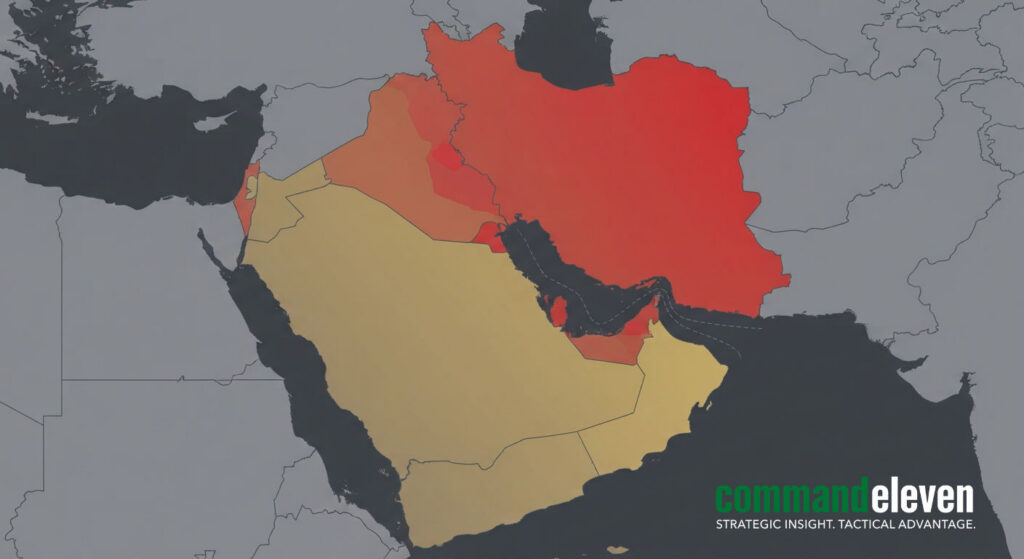
Iraq stands as the actor most immediately exposed to spillover, given its role as both neighbor and likely staging ground. A US ground invasion of Iran launched from or through Iraqi territory would place Baghdad in an acute sovereignty crisis, torn between its security relationship with Washington and its deep economic, religious, and political ties to Tehran. Iraqi political factions aligned with Iran would be expected to demand the expulsion of US forces from Iraqi soil entirely, a demand that has surfaced repeatedly in Iraqi politics following prior US-Iran confrontations.
Gulf states, despite their preference for neutrality, would face direct exposure to Iranian retaliatory strikes against their energy infrastructure and, in some cases, against US forces based on their territory, mirroring the pattern demonstrated in the 2019 attacks on Saudi Aramco facilities. This exposure creates a structural incentive for Gulf governments to distance themselves publicly from any invasion even while facing pressure to provide tacit logistical support.
Israel would almost certainly become a parallel and simultaneous front, given the extensive precedent of direct Iran-Israel exchanges in recent years and the near certainty that Iran would treat Israeli territory as a legitimate retaliatory target regardless of Israel’s formal role in the invasion itself.
Pakistan and Afghanistan present a lower-probability but non-trivial spillover risk along Iran’s eastern border, particularly given existing tensions over Baluch militancy and cross-border security concerns. A prolonged Iranian conflict could reduce Tehran’s capacity to manage its eastern border security commitments, creating opportunities for militant groups operating in that space (ASSESSED, low confidence).
ECONOMIC AND ENERGY MARKET IMPLICATIONS
Any partial or full closure of the Strait of Hormuz would represent the most immediate and consequential economic effect of this scenario, given the substantial share of global seaborne crude oil and liquefied natural gas exports that transit the strait. Historical modeling of comparable disruption scenarios points toward sharp and immediate spikes in global oil prices, with second-order effects on inflation and growth extending well beyond the immediate region.
Global shipping and insurance markets would be expected to react rapidly even to the threat of interdiction rather than requiring an actual closure, as war-risk insurance premiums for Gulf-transiting vessels rose sharply during prior periods of heightened Iran-US tension. This dynamic alone would raise energy transportation costs globally before any physical disruption occurs.
Beyond energy markets, a prolonged ground campaign would impose substantial direct fiscal costs on the United States, echoing the multi-trillion-dollar cumulative cost estimates associated with the Iraq and Afghanistan campaigns, while regional trade and investment flows across the Gulf and broader Middle East would likely contract sharply for the duration of active hostilities.
COMPARATIVE HISTORICAL ANALOGUES
The 2003 Iraq invasion offers the closest available historical comparison, though the differences are as instructive as the similarities. The initial conventional phase of that campaign concluded rapidly against a hollowed-out Iraqi military, but the subsequent insurgency, sustained over the following decade, demonstrated how quickly a rapid conventional victory can give way to prolonged asymmetric conflict once an occupying force attempts to hold territory against a hostile population. Iran’s mosaic defense doctrine appears deliberately designed to compress or eliminate the initial conventional phase entirely, meaning any invading force should expect to face organized resistance from the outset rather than after an interim collapse.
The Afghanistan campaign offers a further relevant lesson regarding the durability of resistance networks operating with cross-border sanctuary and sustained external support, conditions that would likely be replicated or exceeded in an Iran scenario given Tehran’s extensive proxy network across Iraq, Syria, Lebanon, and Yemen, each of which could function as a rear base for sustained resistance even if Iranian territory itself came under partial occupation.
The Iran-Iraq War of the 1980s remains the most direct precedent for Iran’s own institutional memory and doctrinal development, having shaped the mosaic defense concept and the broader Iranian preference for attritional, asymmetric resistance over conventional force-on-force engagement. Iranian planners are assessed to draw heavily on this experience in structuring their anticipated response to any future invasion scenario.
RISK AND PROBABILITY ASSESSMENT: US GROUND INVASION OF IRAN
This assessment assigns a LOW probability to a full-scale US ground invasion of Iran under present strategic conditions, reflecting the scale of force generation required, the absence of reliable regional basing support, and the demonstrated US preference across recent administrations for stand-off strike and containment strategies over ground occupation. This judgment carries MODERATE confidence, reflecting reasonably stable underlying strategic incentives on both sides but acknowledging the potential for rapid shifts driven by a confirmed nuclear breakout or a mass-casualty attack event.
Should the trigger conditions outlined in Section 2 materialize, the probability of at least a limited ground incursion, as distinct from a full invasion and occupation campaign, rises to MODERATE, reflecting the possibility of narrowly scoped operations aimed at seizing or destroying specific nuclear infrastructure rather than full territorial occupation.
The probability of significant regional spillover, including Israeli involvement, proxy activation across Iraq and Lebanon, and at least partial Strait of Hormuz disruption, is assessed as HIGH in any ground invasion scenario, with HIGH confidence, given the consistency of this pattern across multiple prior Iran-related escalation episodes.
INDICATORS AND WARNINGS
CommandEleven’s monitoring framework identifies the following observable indicators as leading signals warranting close tracking. A sustained surge in US strategic airlift and sealift activity toward Gulf and Diego Garcia basing would represent an early logistical indicator of force generation ahead of any ground contingency. Movement of additional US carrier strike groups into the Fifth Fleet area of responsibility, combined with prepositioning of Army or Marine ground equipment stocks, would represent a further material indicator.
On the diplomatic track, a marked shift in Gulf state rhetoric away from public neutrality, or the quiet negotiation of overflight and basing arrangements not previously extended to US forces, would suggest movement toward regional accommodation of a ground option. Conversely, sustained Gulf state public statements opposing any ground campaign would suggest continued reluctance to enable such an operation.
On the Iranian side, indicators would include a confirmed shift in IAEA reporting toward weapons-grade enrichment levels, unusual movement or dispersal of Iranian ballistic missile and drone assets suggesting anticipation of strikes, and any observable acceleration of Basij mobilization exercises beyond routine training cycles.