
This volume examines the operational scaling of expendable autonomous systems and the breakdown of classical tracking frameworks when weapon release authority is decentralized to the tactical edge.
Tactical Reality vs. Doctrinal Friction
The deployment of uncrewed aerial systems (UAS) has shifted from centralized, high-altitude strategic reconnaissance to distributed, low-cost tactical attrition. First-Person View (FPV) loitering munitions and coordinated swarms have commoditized precision strike capabilities, fundamentally altering the density of the modern battlespace.
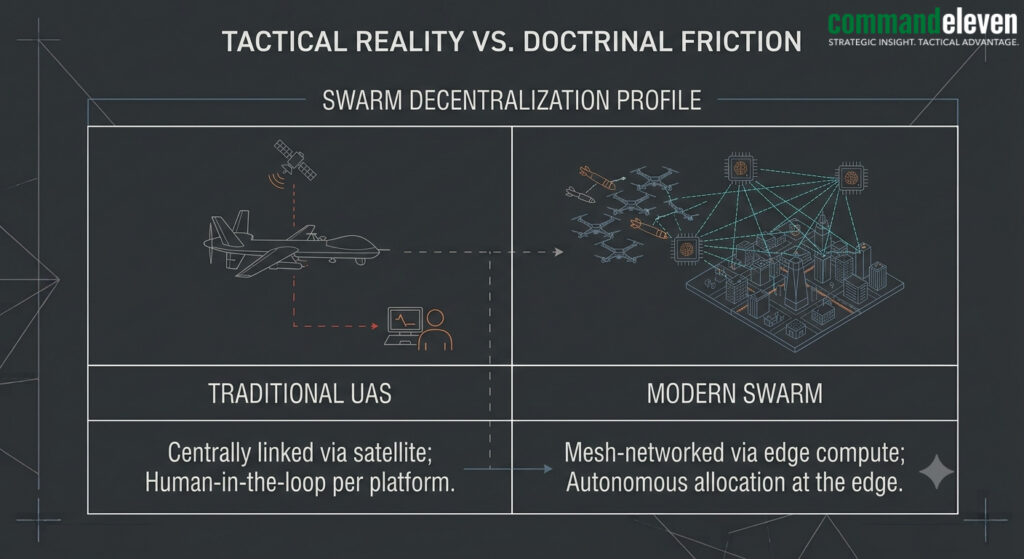
This saturation creates immediate legal and structural strain. International humanitarian law requires that each individual attack be planned and executed with distinct precautions. When a single operational element deploys hundreds of low-altitude assets simultaneously within a compressed geographic sector, the capacity to conduct individualized proportionality reviews collapses.
Autonomous Swarm Allocation Mechanics
Modern swarm doctrine eliminates the one-to-one pilot-to-aircraft architecture. Instead, a swarm operates as a single distributed entity utilizing local mesh networking and edge-computed task assignment.
- Dynamic Target Prioritization: The swarm ingests localized radar, optical, or radio-frequency signatures, distributing engagements across the network based on geometric proximity and payload availability.
- The Veto Window Window: If a human operator manages the swarm through a single terminal, they do not authorize individual strikes. They monitor a macro-level dashboard. The operator’s role is reduced to a time-sensitive veto window,often less than three seconds,before the network assigns an asset to a detected target signature.
The Urban FPV Paradox
Mass expenditure of uncrewed systems in dense urban terrain introduces specific operational hazards that challenge the core principle of precautions in attack.
Blind Spots in Complex Geometry
Low-altitude loitering munitions operate beneath the line of sight of traditional radar, navigating complex urban canyons. This restricted field of view means an FPV drone’s optical sensor often identifies a target only moments before impact, leaving no margins to re-evaluate the immediate presence of non-combatants.
The Problem of UXO and Battery Failures
Mass deployment inevitably yields high failure rates due to active electronic jamming, structural impacts, or battery exhaustion. The resulting accumulation of unexploded ordnance (UXO) and unstable lithium-ion payloads transforms civilian sectors into hazardous, non-permissive zones, creating long-term post-conflict liabilities that intersect with the prohibition against indiscriminate means of warfare.
Swarm Deployment Validation Protocol
To maintain command accountability during mass unmanned operations, planners must implement structural safeguards before initializing network launch sequences.
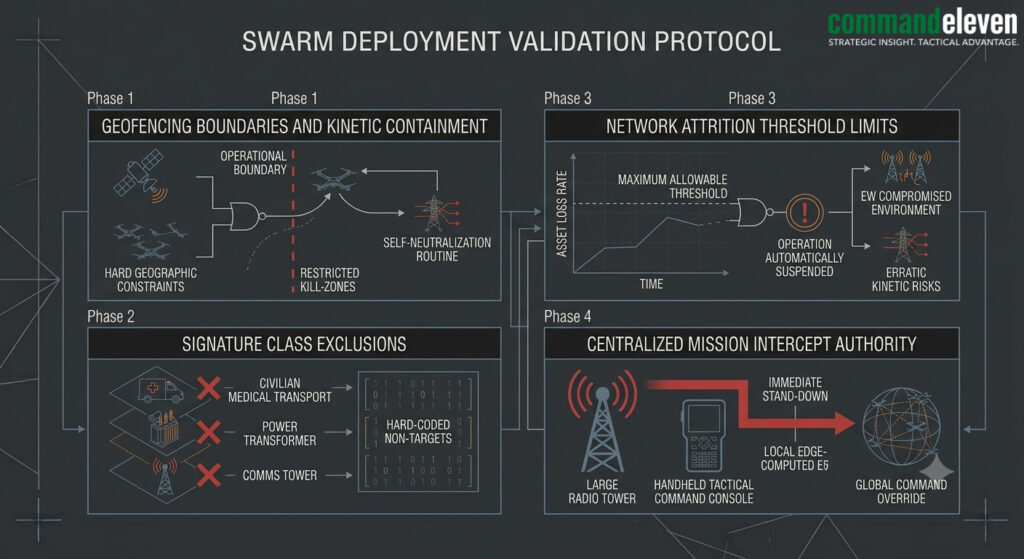
Operational Directive: The volume of assets deployed does not dilute command accountability. If a decentralized system’s operational speed or network complexity prevents a commander from predicting its kinetic outcomes, the deployment violates the structural prohibition against indiscriminate attacks.