Executive Summary
In the 100 days following the launch of Operation Epic Fury, the U.S. Navy has achieved a 95% kinetic intercept rate against one-way attack (OWA) drones. However, this tactical success masks a strategic defeat. The Cost-Exchange Ratio (CER) currently stands at approximately 190:1 in favor of the drone operator. By forcing the expenditure of multi-million dollar interceptors against $20,000 disposable kinetics, the Axis of Resistance has successfully implemented a Magazine Exhaustion Strategy that threatens the sustainability of Western maritime power projection.
Key Takeaways
- The 190:1 CER favors drone swarms over high-end interceptors.
- Saturation occurs when swarm volume exceeds AEGIS fire-control illumination.
- Magazine depletion in the Middle East creates an Indo-Pacific “Window of Vulnerability.”
Mathematical Modeling of Swarm Saturation
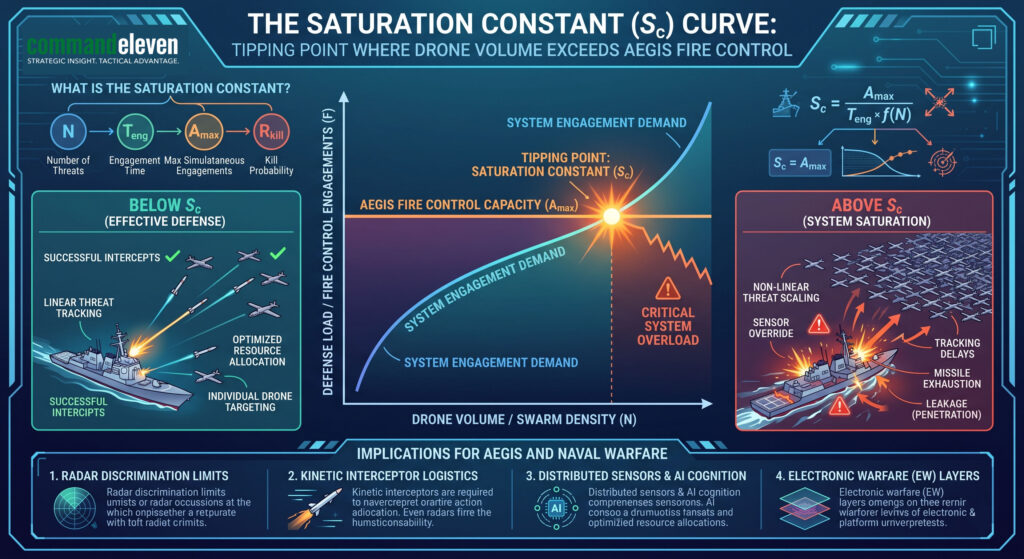
The success of the Mosaic Defense in the maritime domain relies on the mathematical saturation of the AEGIS Combat System.
The Saturation Constant (Sc)
We model the saturation of a ship’s defensive envelope using the following variables:
- T: Number of simultaneous incoming targets.
- C: Maximum number of simultaneous fire-control illuminations available.
- I: Interceptor flight time to target.
Saturation occurs when T > C. In 2026, the Houthi-KH-PMF nexus has shifted from single-drone harassment to Coordinated Swarm Arrivals, utilizing Stigmergic C2 to ensure that drones from multiple launch points arrive at the target vessel within a 30-second window, exceeding the C threshold of most current-generation destroyers.
PD Control and Stigmergy in Swarms
The drones utilize Proportional–Derivative (PD) control and graph-theory-based communication. Each drone acts as a node in a decentralized graph, communicating only with its neighbors to maintain formation and avoid collisions.
- The Laplacian Matrix: This allows the swarm to maintain a coherent “attack shape” even if 50% of the nodes are neutralized.
- Resilience: Unlike a missile salvo, a swarm does not “fail” if the leader is shot down. The remaining nodes automatically redistribute to fill the gap, maintaining the Sc pressure on the defender.
The Economics of Attrition: Forensic Data from Epic Fury
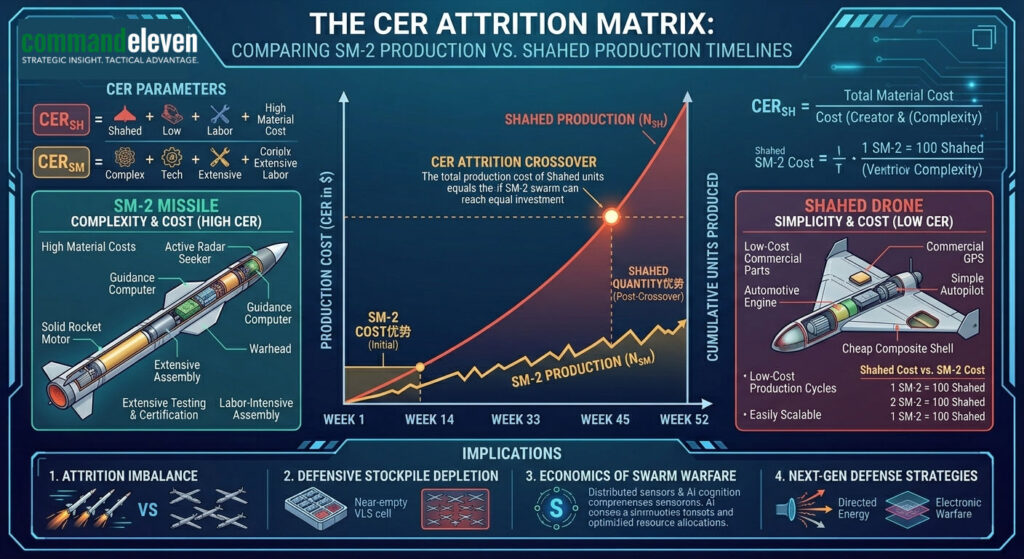
A forensic audit of the first 100 hours of Operation Epic Fury (H+100) reveals a staggering disparity in resource allocation:
| Asset Category | Unit Cost | Units Expended (H+100) | Total Munition Cost |
| US Navy (SM-2/6 Interceptors) | $2,000,000 – $4,000,000 | 96 | ~$508.8 Million |
| Axis (Shahed/OWA Drones) | $20,000 – $50,000 | ~200 (estimated) | ~$4 – $10 Million |
Magazine Attrition vs. Industrial Capacity
The primary threat is not the financial cost, but the Production-to-Expenditure Ratio.
- Replacement Lag: The lead time for a single SM-2 or SM-6 interceptor is currently estimated at 24–36 months.
- Axis Scalability: The “Mosaic” production model—utilizing sharded industrial sites and dual-use components—allows for the production of hundreds of drones per month.
- The “Empty Magazine” Risk: At current expenditure rates, a Carrier Strike Group (CSG) in the Arabian Sea reaches “Critical Magazine Depth” (the point where it can no longer defend against a high-end peer salvo) within 15 days of active swarm defense.
Defensive Doctrine: Shifting the CER
To neutralize the Mosaic maritime threat, CommandEleven proposes a move away from “Exquisite Interception” toward Distributed Layered Defense.
Directed Energy & Interceptor Drones
The U.S. has begun the emergency deployment of Directed Energy Weapons (DEW) and low-cost interceptor drones (e.g., the LUCAS OWA drone) to the theater.
- CER Reversal: By using $3,500 interceptors or $10-per-shot laser pulses, the defender can shift the CER back toward parity.
- The Electronic Operations Room (EOR) Counter: Adversaries are already adapting by adding reflective coatings to drones and shifting to “Silent-Listen” OSINT targeting to avoid DEW tracking.
Conclusion – The Paradigm Shift
Asymmetric attrition has rendered traditional “High-Tech” maritime supremacy brittle. The side that can impose the highest cost while maintaining the lowest production overhead gains the strategic advantage. In 2026, the Mosaic Defense has proven that “Tactical Success” on the high seas is a hollow victory if it results in an empty magazine.
CommandEleven Red Team Assessment: We anticipate that by Q4 2026, Western naval forces will be forced to adopt a “Zone-Based Exclusion” strategy—withdrawing high-value assets from the “Toll” corridors—unless a low-cost, high-volume interceptor capacity is operationalized across the fleet.