
Key Takeaways
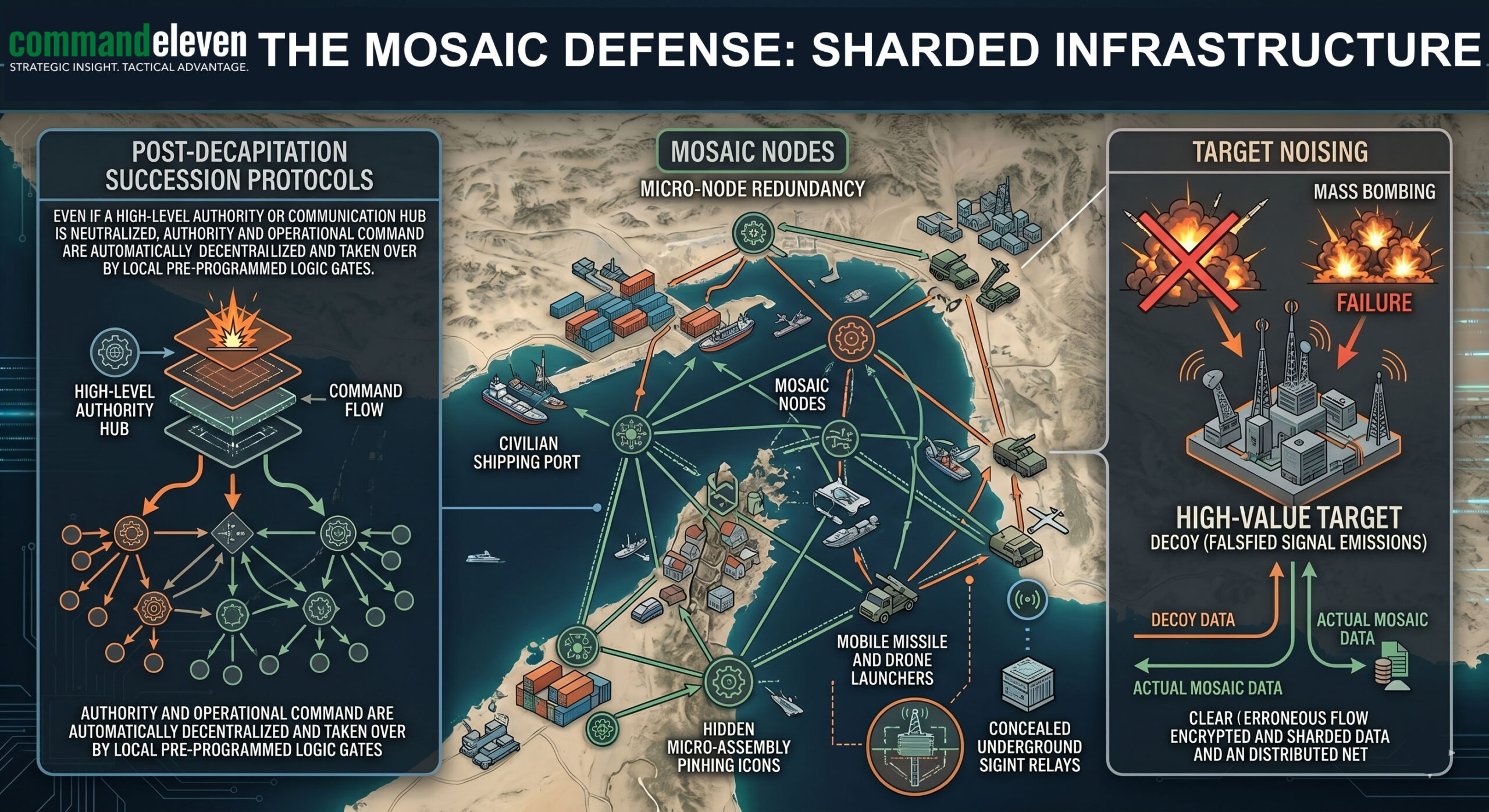
- Decapitation triggers “Succession Protocols” rather than systemic collapse.
- Stigmergic coordination allows for synchronized retaliation without top-down orders.
- Operational “Intelligence” now resides in pre-coded decision trees within the mesh.
The Fallacy of the Center of Gravity
Western kinetic doctrine has historically prioritized the “Decapitation” of adversary leadership as the primary means of achieving systemic collapse. This approach assumes a centralized, hierarchical Command and Control (C2) structure. However, the events of 2025–2026 – culminating in the sustained operations of the Houthi-KH-PMF axis despite the neutralization of Tier-1 commanders – demonstrate that the “Center of Gravity” has shifted from individuals to distributed protocols.
The “Distributed Strike” is not a series of isolated attacks – it is a synchronized, automated response mechanism that functions independently of top-down authorization.
The C2 Evolution: From Hierarchy to Stigmergy
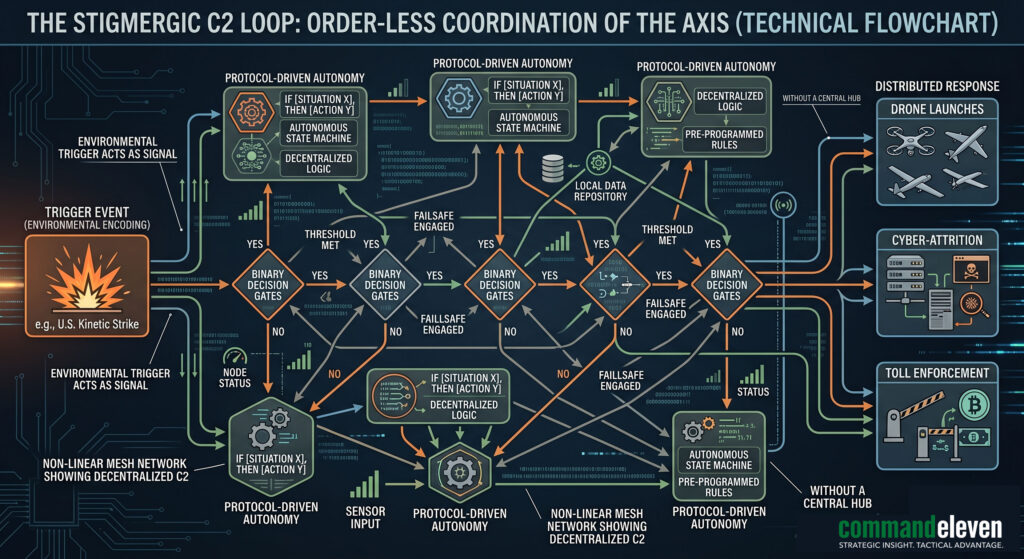
The Axis has transitioned into a Stigmergic Command Structure, a biological model of coordination where the environment serves as the medium for communication. In this framework, centralized “orders” are replaced by “environmental triggers.”
- Environmental Encoding: When a U.S. kinetic strike occurs at Node A, the physical state of that node (the explosion, the heat signature, the cessation of its signal) acts as a stimulus for Nodes B through F. There is no need for a central command to relay a “Retaliate” order; the event itself is the command.
- The Mesh-Logic of Target Selection: Stigmergy allows the Houthi-KH-PMF nexus to function as a self-organizing swarm. If an American carrier group moves into a specific maritime sector, that movement “marks” the environment. Localized cells, pre-programmed with binary decision trees, engage based on that “mark” using whatever assets are locally available.
- Resilience to Decapitation: Because the “Intelligence” resides in the environment and the pre-coded protocols rather than a central brain, the removal of a commander does not result in a loss of direction. The swarm continues to execute its logic based on the last known environmental state.
The Failure of “Epic Fury”: The Fallacy of Immediate Surrender
The primary strategic error of Operation Epic Fury was the Western reliance on the “Top-Down Collapse” theory. The assumption was that the neutralization of Iran’s Supreme Leader would trigger an immediate systemic surrender and a domestic power vacuum. This belief ignored the two-decade evolution of the Mosaic Defense.
- The Decentralization Paradox: The death of the Supreme Leader did not paralyze the state; it triggered the “Autonomous Escalation” phase of the Mosaic Doctrine. Power did not “vacuum” – it devolved.
- From State to Insurgency: The Mosaic Defense, formulated in 2002 precisely to counter a “Shock and Awe” decapitation strike, ensures that every province in Iran, and every proxy node abroad, is capable of independent, sustained warfare for up to two years without contact from Tehran.
- The Escalation Spike: Instead of surrendering, regional commanders initiated the “Hormuz Toll” and the “Arabian Sea Blockade” as a pre-programmed reflexive strike. The lack of a “Head” to negotiate with meant there was no mechanism to stop the escalation, turning a localized decapitation into a global geofinancial crisis.
Kinetic Vector (KT) Analysis: The Mosaic vs. The Machine
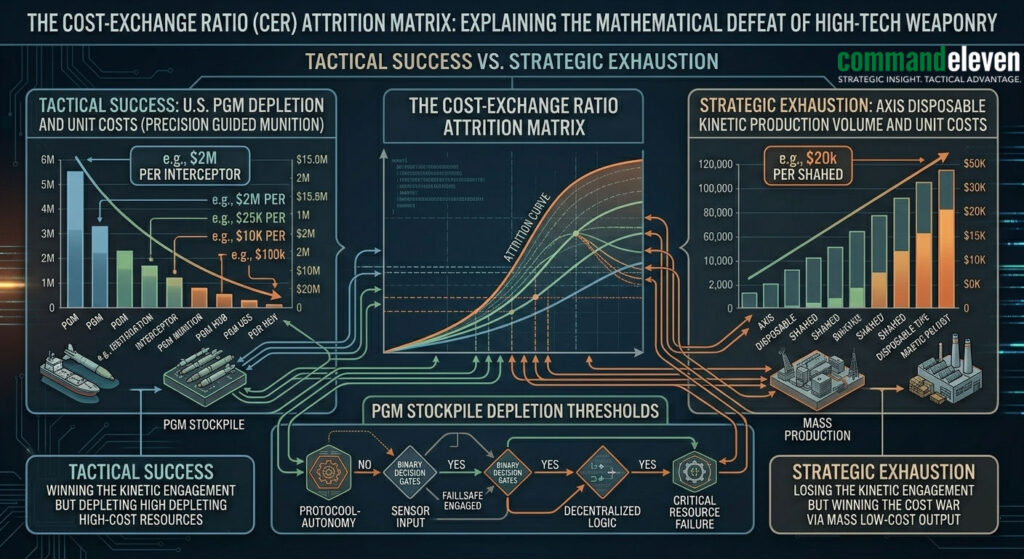
The U.S. massive bombing campaign achieved “Tactical Success” by traditional metrics (targets destroyed, infrastructure degraded), but it was defeated by the Cost-Exchange Ratio (CER) and the Mosaic Defense distribution.
- Depletion via Proliferation: Iran’s 2002 doctrine emphasized the mass production of low-cost, “disposable” kinetic assets (Shahed-series drones and loitering munitions). During Epic Fury, the U.S. was forced to expend $2 million interceptor missiles against $20,000 drones.
- Tactical Success as Strategic Failure: The U.S. successfully hit 90% of its identified targets. However, because the Mosaic Defense sharded its capabilities into thousands of “Micro-Nodes” (civilian basements, mobile launchers, and hidden caves), the 10% of surviving assets were sufficient to maintain the blockade.
- Defeating High-Tech Weaponry: High-tech weaponry relies on clear “target signatures” and centralized logistics. The Mosaic strategy effectively “noised” the battlespace. By the time the U.S. realized it was winning the tactical battle, it had depleted its precision-guided munition (PGM) stockpiles to the point of operational risk, while the Axis drones continued to launch from the rubble.
Moving Toward a Systemic Response
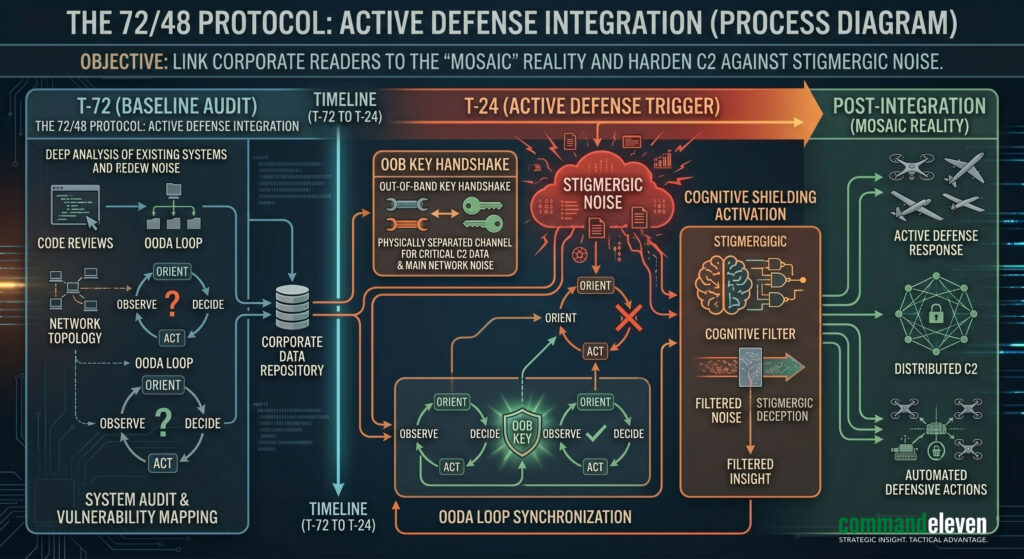
To counter the Distributed Strike, Western doctrine must move beyond the “Kill Chain” and toward “Systemic Attrition.”
CommandEleven Red Team Assessment
Targeting the “Head” of the Axis is a legacy strategy. The 2026 battlespace requires the neutralization of the Connective Tissue,the shared SIGINT loops, the sharded logistics chains, and the automated “Toll” enforcement protocols. Until the U.S. can disrupt the protocol rather than the personnel, the Axis will continue to maintain operational tempo regardless of leadership losses.