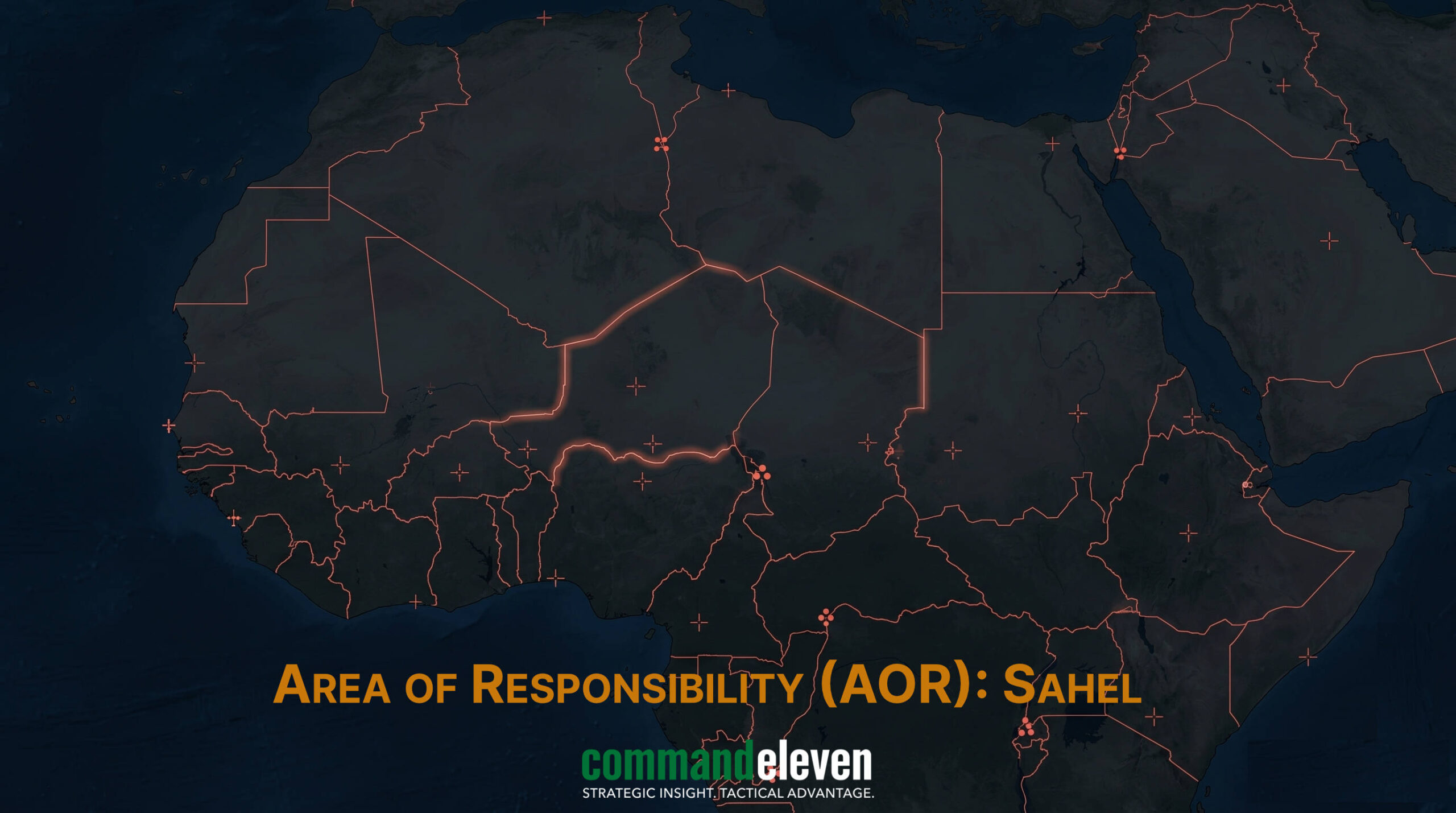
Executive Summary
As of May 2026, the Sahelian theater has undergone a fundamental shift in asymmetric warfare, driven by the proliferation of asymmetric aerial threats. Non-state actors, including JNIM and ISGS, have transitioned from localized guerrilla tactics to the deployment of formalized air wings utilizing long-endurance fixed-wing COTS platforms and satellite-linked navigation. This “democratization” of airpower has neutralized the traditional geographic advantages of regional state forces. Furthermore, the extreme Saharan environment,defined by 50°C+ temperatures and abrasive Harmattan dust,presents critical engineering hurdles for Counter-Unmanned Aerial Systems (C-UAS), causing thermal throttling and sensor degradation. Survival for tactical units now depends on the deployment of “Mobile Jamming Bubbles” and the transition toward AI-driven kinetic “hard-kill” solutions to counter autonomous, non-RF-dependent drones.
3 Key Takeaways
- Fixed-Wing Strategic Reach: The shift from short-range quadcopters to fixed-wing COTS platforms has granted insurgents long-endurance ISR and strike capabilities, extending the kinetic reach of non-state actors deep into previously secure zones.
- Environmental Hardware Failure: Standard C-UAS equipment faces a high failure rate in the Sahel due to “thermal bloom” blinding IR sensors and abrasive silica dust degrading optical lenses and mechanical radar arrays.
- The Autonomy Pivot: The emergence of AI-based visual navigation in insurgent drones renders traditional GPS and RF jamming obsolete, necessitating a move toward programmable airburst munitions and directional hard-kill interception.
Asymmetric UAV Proliferation: The New Air Force
The conflict in the Sahel has transitioned into a “post-permissive” aerial environment. Non-state actors, including JNIM and ISGS, have moved beyond the occasional use of quadcopters to the establishment of formalized, asymmetric air wings. This “democratization” of airpower has stripped regional state forces of their traditional advantage in desert maneuver.
Platform Diversification: The Fixed-Wing Shift
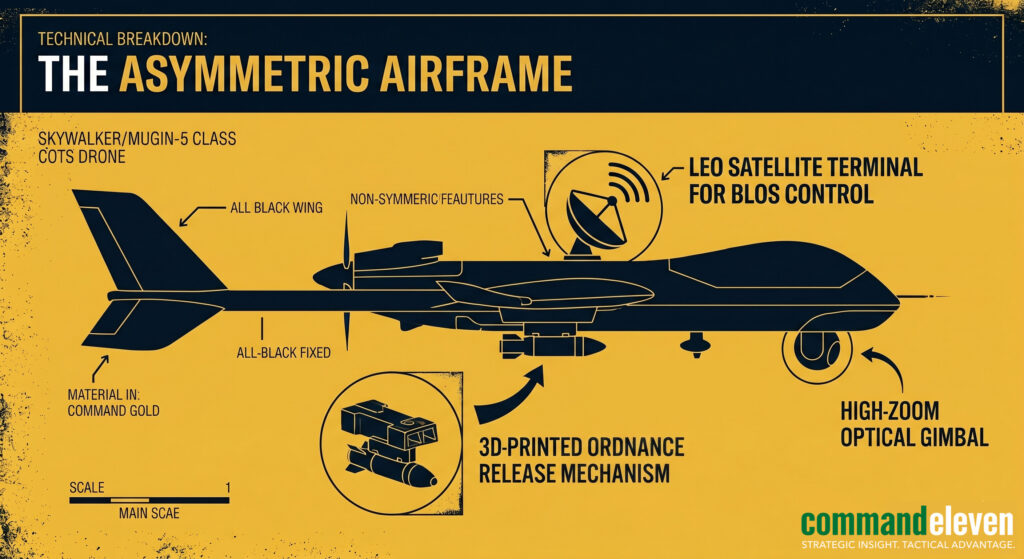
While rotary-wing drones (e.g., DJI Mavic series) remain the standard for localized surveillance, 2026 intelligence indicators show a significant shift toward long-endurance fixed-wing COTS platforms.
- The Mugin-5 and Skywalker Doctrine: These platforms, often constructed from balsa wood or carbon fiber, offer flight endurances of 4 to 7 hours and ranges exceeding 100km. Their small radar cross-section (RCS) and low acoustic signature make them virtually invisible to legacy air defense radars designed for conventional aircraft.
- Satellite Link Integration: The most critical technical evolution is the integration of low-earth orbit (LEO) satellite terminals. By bypassing traditional 2.4 GHz/5.8 GHz radio-frequency (RF) links,which are limited by line-of-sight,insurgents can now control drones from hundreds of kilometers away. This allows a command cell in a safe house in Mali to direct a strike in western Niger with minimal latency.
Engineering “Improvised Aerial Ordnance” (IAO)
Non-state actors have industrialized the conversion of COTS drones into precision-strike assets.
- 3D-Printed Release Mechanisms: Using large-format 3D printers, insurgent technical cells are manufacturing modular “gravity-drop” servos. These are calibrated to carry 60mm mortar shells or modified RKG-3 anti-tank grenades.
- Optical Precision: By utilizing the “First-Person View” (FPV) capability, drone pilots can achieve a degree of accuracy previously reserved for laser-guided munitions. In the flat, open terrain of the Sahel, where traditional cover is scarce, a $500 FPV drone carrying a 1kg shaped charge can successfully neutralize a million-dollar light armored vehicle (LAV).
The Desert Environment: Engineering Hurdles for C-UAS
The Sahel presents one of the most hostile engineering environments for Electronic Warfare (EW) and Counter-Unmanned Aerial Systems (C-UAS). Standard hardware designed for temperate climates frequently fails within weeks of deployment in the Saharan theater.
The Thermal Barrier and Electronic Throttling
- Ambient Heat vs. Operating Temperature: Ambient temperatures in the Sahel regularly exceed 45°C (113°F). High-power jammers generate significant internal heat when broadcasting broadband noise. Without advanced, oversized cooling systems, C-UAS amplifiers undergo “thermal throttling,” reducing their effective jamming radius by up to 60% during peak daylight hours.
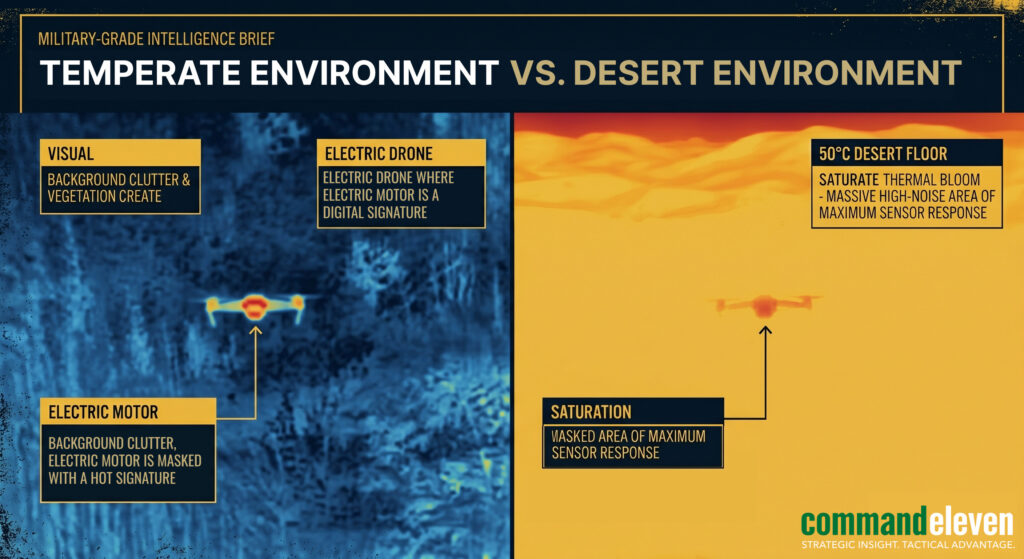
- IR Sensor Saturation: Electro-optical/Infrared (EO/IR) sensors used to track drones are frequently blinded by the “thermal bloom” of the desert floor. The high reflectivity of sand and the extreme heat haze (mirage effects) create a cluttered infrared background, making it difficult for automated algorithms to distinguish a small drone’s heat signature from the ambient environment.
Abrasive Degradation: The Harmattan Factor
- Micro-Abrasions on Optics: The Harmattan winds carry fine, silica-rich dust that acts as a powerful abrasive. Over time, this dust creates micro-scratches on the lenses of thermal cameras and optical sensors, degrading image clarity and significantly reducing the “detection-at-range” capability.
- Mechanical Failure of Radar Arrays: Moving parts in rotating radar systems are prone to seizing as fine dust penetrates sealed bearings and gears. This necessitates the move toward Active Electronically Scanned Array (AESA) systems, which have no moving parts, though these are significantly more expensive and harder to maintain in the field.
The “Signal Shadow” and Topographical Challenges
Despite the apparent flatness of the desert, the Sahel features significant “wadis” (dry riverbeds) and rocky outcroppings (inselbergs) that create “Signal Shadows.”
- Multipath Interference: High-power RF signals can bounce off rocky terrain, creating multipath interference that degrades the precision of C-UAS direction-finding (DF) equipment.
- Ground-Clutter Detection: Tracking low-flying “terrain-hugging” drones is difficult for ground-based radar because the drone’s signature is lost in the “clutter” of the desert surface. This requires the deployment of elevated sensor masts, which themselves become high-visibility targets for insurgent snipers or indirect fire.
Counter-Drone Requirements: The “Mobile Bubble”
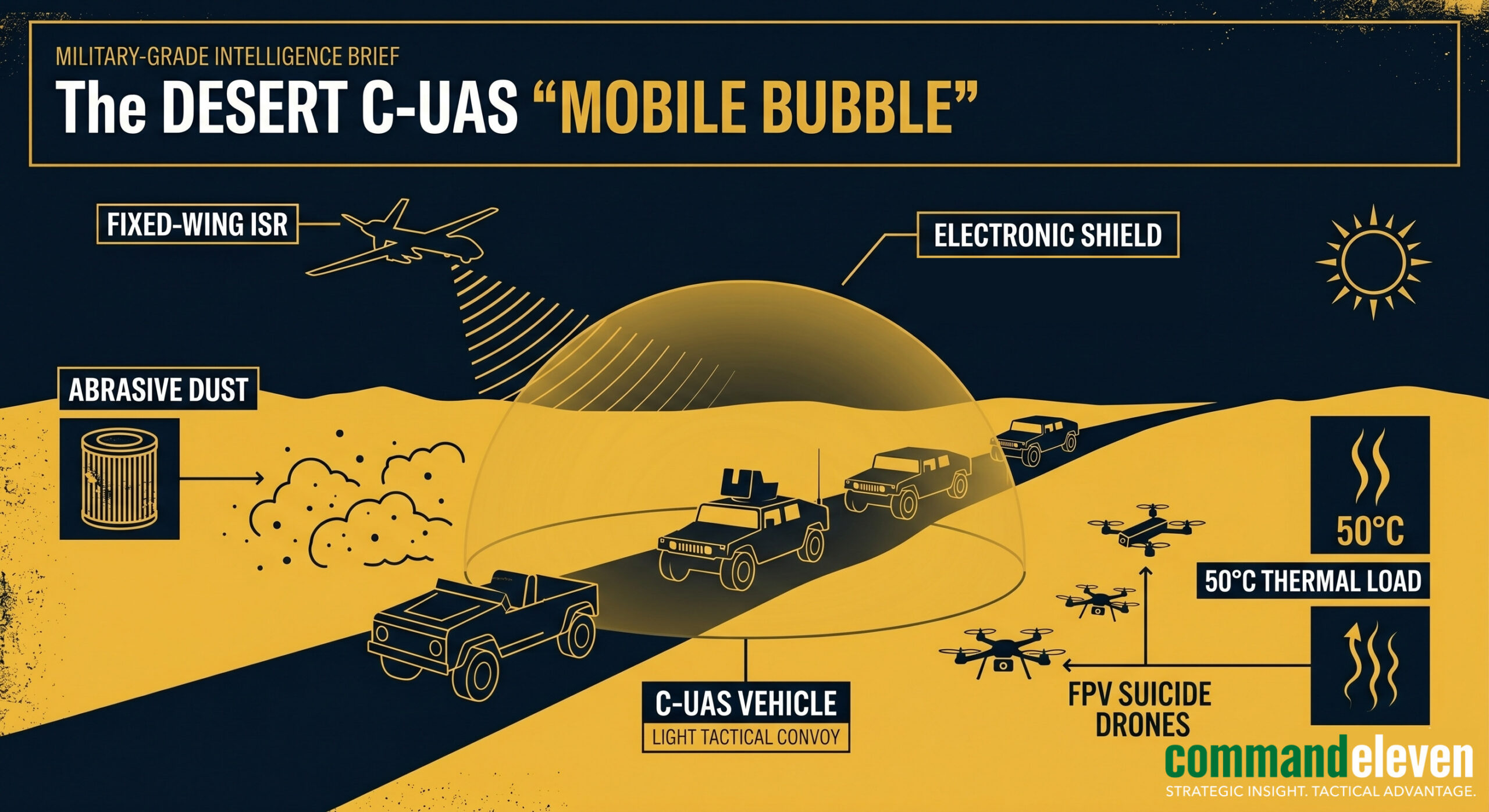
In the vast, non-linear battlefields of the Sahel, static defenses are obsolete. Tactical units and logistics convoys now require a “Mobile Jamming Bubble”,a localized, moving zone of electromagnetic dominance that travels with the unit.
Electronic Warfare (EW) Requirements for Convoys
- Omnidirectional Saturation: Tactical vehicles must be retrofitted with high-gain, omnidirectional antennas capable of simultaneous jamming across the 2.4 GHz, 5.8 GHz, and the primary GNSS bands (GPS L1/L5, GLONASS). This creates a 300–500 meter “dome” of interference that severs the C2 (Command and Control) link between the insurgent pilot and the drone.
- Intelligent Frequency Management: To prevent “electronic fratricide”,where friendly comms are jammed by their own C-UAS,2026 requirements dictate the use of Reactive Jamming. These systems stay passive until a threat signal is detected, then fire a surgical “micro-burst” of noise on that specific frequency, allowing friendly radios to remain operational in the gaps.
Kinetic Interception: The “Hard-Kill” Evolution
The cost-asymmetry of using high-tier missiles against $500 drones is unsustainable. The Sahelian theater requires low-cost, attrition-ready kinetic solutions.
- Electronic “Net-Guns”: For close-in protection of specific high-value assets (HVAs) like mobile command posts, compressed-air net launchers are being deployed. These are integrated with small-form-factor tracking sensors to provide a non-destructive capture of the drone for forensic analysis.
- Programmable Airburst Munitions: Regional state forces are increasingly upgrading their 12.7mm and 14.5mm technical-mounted machine guns with electronic sighting systems that utilize Programmable Time-Fused Ammunition. These shells are designed to explode in front of a drone, creating a localized cloud of shrapnel that neutralizes the platform without requiring a direct hit.
Signature Management in Desert Operations
The best defense against a drone is to avoid detection entirely.
- RF and Thermal Masking: Convoys are utilizing specialized multispectral camouflage nets that reduce both the visual and thermal footprint of parked vehicles. When moving, “EMCON” (Emission Control) protocols are strictly enforced,silencing all non-essential radio and Wi-Fi emitters to prevent insurgent “SIGINT-on-a-Drone” platforms from geolocating the convoy.
- Acoustic Denial: Given how drones are often heard before they are seen, tactical teams are training in “Acoustic Picket” strategies,deploying sensitive ground-based microphones several kilometers ahead of a convoy to detect the unique “whine” of drone propellers before the threat reaches the main body.
Strategic Implications for CommandEleven Operations
As CommandEleven expands its field intelligence and executive protection footprints in the Sahel, the proliferation of asymmetric UAVs introduces a high-risk operational variable.
Mandatory Field Personnel Protocols
- Personal C-UAS Units: All field analysts and observers operating in the Liptako-Gourma or “Three Borders” region must be equipped with portable, wearable drone detection sensors. These devices provide a haptic or silent alert when a drone’s telemetry or video downlink is detected within a 2km radius.
- RF-Shielded Command Nodes: Any temporary field office or mobile command post must utilize RF-shielded tents and directional, low-probability-of-intercept (LPI) communications. Standard Wi-Fi routers and unshielded laptops are strictly prohibited in high-threat kinetic zones.
Digital Forensics and Intelligence Gathering
- Exploitation of Downed Assets: Downed or captured insurgent drones are a primary source of high-grade intelligence. CommandEleven’s technical teams prioritize the extraction of onboard flight logs, GPS waypoints, and unencrypted video data.
- Supply-Chain Attribution: By analyzing the serial numbers of motors, flight controllers, and batteries, we can map the illicit supply chains bringing COTS technology into the Sahel. This “technical HUMINT” allows us to identify assembly nodes and procurements cells operating in regional urban hubs like Bamako and Niamey.
Executive Protection (EP) Adaptations
- The “Shadow” Protocol: During high-profile executive movements, EP teams now deploy their own “Counter-Surveillance Drones.” These friendly assets fly a high-altitude “eye-in-the-sky” orbit to detect and intercept insurgent drones before they can approach the principal’s vehicle.
- GPS-Denied Navigation Training: CommandEleven drivers must be proficient in traditional map-and-compass navigation and the use of high-endurance Inertial Navigation Systems (INS) for scenarios where GNSS jamming renders digital maps useless.
Intelligence Assessment & Forecasting (2026–2030)
The trajectory of asymmetric aerial warfare in the Sahel indicates a rapid transition toward fully autonomous, decentralized airpower. CommandEleven assesses that the next 48 months will be defined by the “Autonomy Pivot,” where the traditional Electronic Warfare (EW) countermeasures of state actors will face diminishing returns against AI-driven insurgent assets.
The “Autonomy Pivot”: Bypassing the Jammer
By 2027, we forecast the widespread deployment of Vision-Based Navigation (VBN) in insurgent drone fleets.
- The End of the GNSS-Dependence: As jamming units become standard on regional convoys, insurgent technical cells are already testing flight controllers that do not rely on GPS. Instead, these drones use on-board AI to compare real-time camera feeds against pre-loaded satellite imagery of the terrain.
- Implications: Because these drones do not “listen” to a satellite signal or a C2 link from a pilot, traditional “noise jamming” and “spoofing” are rendered entirely ineffective. The drone becomes a “fire-and-forget” precision asset that is electronically silent and immune to current soft-kill technologies.
3D-Printed “Expendable” Airframes
The logistics of drone procurement are shifting from international smuggling to localized “Dark Factories.”
- Additive Manufacturing at Scale: CommandEleven has identified the movement of large-scale, industrial 3D printers into the Liptako-Gourma tri-border area. These are being used to print high-strength polymer airframes, allowing insurgent cells to manufacture dozens of “suicide drones” per week within hidden forest camps.
- Supply Chain Resilience: This shift makes the interdiction of drone supply lines nearly impossible. As long as insurgent cells have access to filament, basic motors, and COTS batteries, they can maintain a continuous “air force” regardless of border closures or sanctions.
“Swarm” Logistics in Low-Bandwidth Environments
While true high-tier drone swarms (thousands of units) remain a state-level capability, we anticipate the rise of “Pseudo-Swarms” in the Sahel.
- Saturation Attacks: Insurgent tactics are evolving toward the simultaneous launch of 5–10 drones against a single convoy. Even with a mobile C-UAS bubble, the sheer volume of targets,coming from multiple vectors and altitudes,is designed to overwhelm the operator’s situational awareness and the system’s “cycle time.”
- Coordinated Strikes: We forecast the use of “Mule Drones”,larger, high-altitude fixed-wing assets that act as signal relays and transport for smaller “Striker Drones,” extending the kinetic reach of insurgent cells deep into areas previously considered “safe” behind state lines.
Final Intelligence Forecast
The Sahel has become the world’s most advanced testing ground for asymmetric desert airpower. For CommandEleven assets, the baseline assumption is that the desert floor is no longer a place of concealment. Survival in this theater will depend on the rapid transition from “soft-kill” electronic interference to autonomous “hard-kill” systems,utilizing AI-driven optics and programmable ammunition to physically neutralize silent, non-RF dependent threats before they reach the kinetic threshold.