
Executive Summary & Operational Context
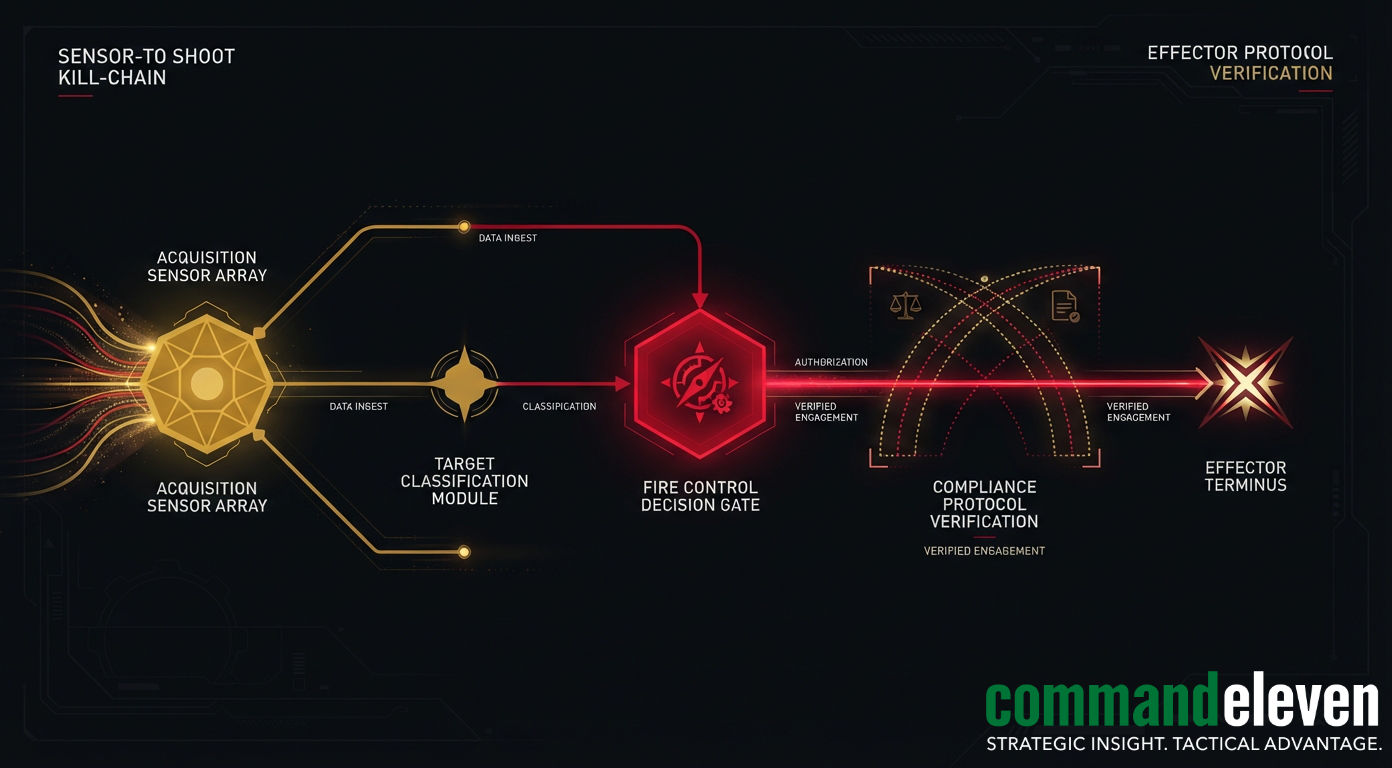
The proliferation of battlefield sensors has generated a data-saturation crisis. Raw telemetry outpaces human cognitive processing limits. Automated target generation systems (ATGS) resolve this latency by compressing the sensor-to-shoot cycle from hours to seconds.
This compression creates immediate legal friction. When operational timelines shrink to milliseconds, human oversight becomes a nominal, rubber-stamp exercise. This structural shift effectively strips legal advisors of the window required to exercise meaningful judgment, pushing the theater of operations toward automated execution.
Technical Architecture of Automated Target Generation
Data Ingestion and Fusion Layers
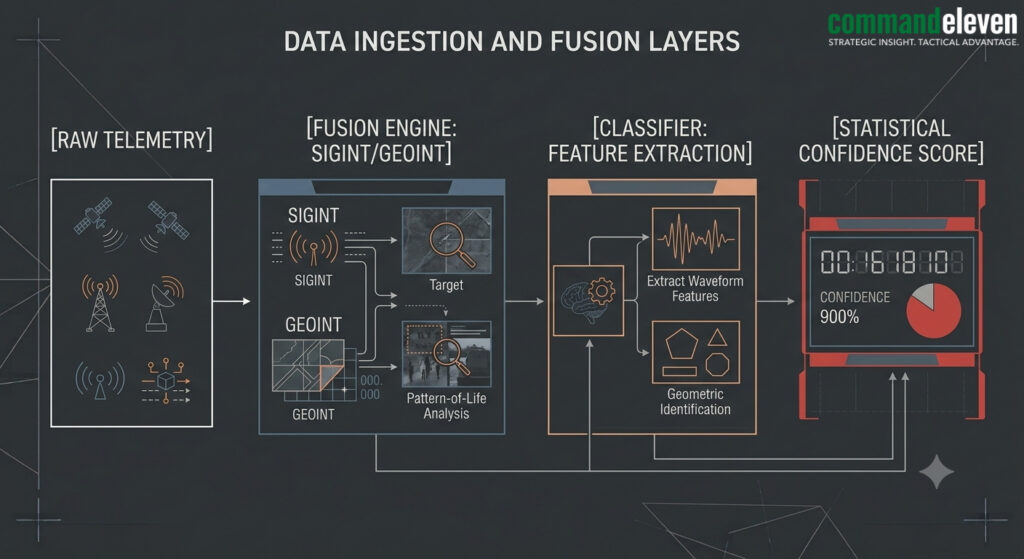
Algorithms ingest multi-spectral inputs across disparate pipelines. Signals intelligence (SIGINT) geolocations, geospatial imagery (GEOINT), and cell tower pattern-of-life telemetry feed into a central fusion engine simultaneously. Deep neural networks then extract distinct signatures—tracking vehicle dimensions, thermal emissions, and movement velocities—to separate military hardware from civilian civilian assets.
The Statistical Output: Confidence Scores
The system outputs a probability metric rather than a definitive identification. A classification of “T-72 Main Battle Tank: 92% Confidence” reflects statistical correlation based on historical training data, not ground-level certainty. Operational law, however, demands the absolute elimination of reasonable doubt before weapon release. This mismatch between probabilistic algorithmic logic and binary legal requirements creates a persistent risk of unlawful targeting.
Legal and Operational Friction Points
Automation Bias and Cognitive Saturation
High-intensity operations induce cognitive fatigue, forcing tactical commanders to default to algorithmic recommendations. This psychological reliance—known as automation bias—converts software outputs into unquestioned facts. During rapid target cycles, analysts routinely skip checking raw imagery or secondary sensor logs, assuming the system’s internal scoring accounts for local anomalies.
Adversarial Countermeasures and Data Poisoning
Adversarial networks exploit these rigid algorithmic parameters through subtle physical and digital manipulation.
- Physical Anharmonic Deception: Deploying low-cost thermal blankets, corner reflectors, and asymmetric camouflage shapes that disrupt the feature-extraction layer of the classifier, causing a false negative.
- Adversarial Data Poisoning: Injecting modified data points into shared open-source or captured networks. Minor alterations to a vehicle’s visible profile can force the targeting model to misclassify a civilian transport asset as an active combat system.
Operational Validation Protocols
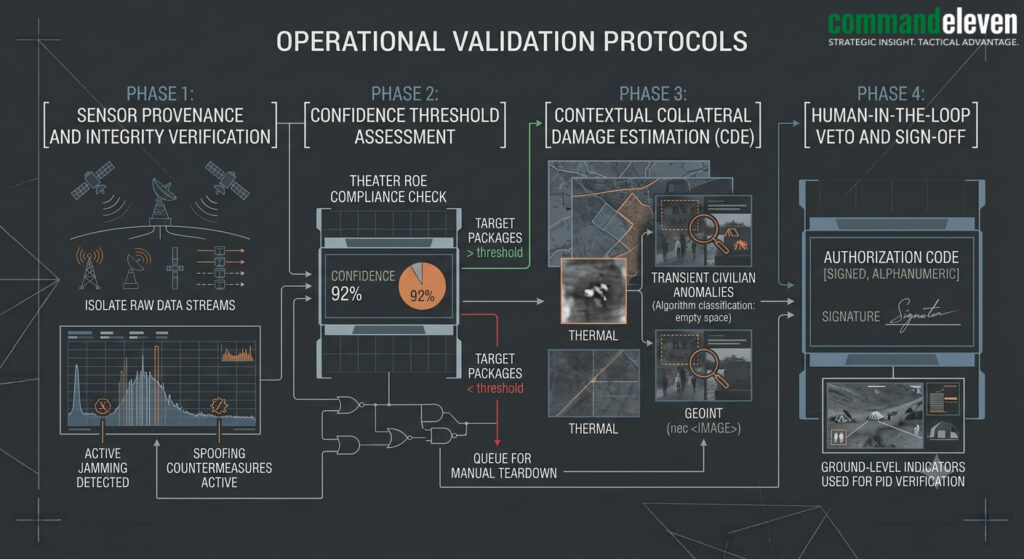
Maintaining positive identification (PID) within an automated loop requires a rigid, non-linear verification sequence executed by human analysts.
The Blind-System Contingency (“LOAC in the Dark”)
When cyber neutralization or electronic warfare operations take the ATGS offline, units must transition instantly to degraded-state operations without lowering compliance standards.
| System State | Operational Impact | Mandatory Tactical Adjustment |
| Degraded Data Fusion | Loss of multi-sensor cross-cuing; single-source reliance. | Immediate suspension of predictive signatures. All targeting reverts to direct visual confirmation. |
| Total Algorithmic Failure | Complete shutdown of automated target generation pipelines. | Reversion to physical, manual targeting boards. Strike approval authority ascends two echelons to senior theater command. |

