

The Virtual-Physical Interface and the Status of Data
The primary legal vulnerability in modern cyber operations stems from the classical definition of an “object.” Traditional frameworks protect physical property from destruction, but they remain ambiguous regarding digital data.
To maintain clear operational parameters, this guide establishes a binary threshold based on functional kinetic consequence:
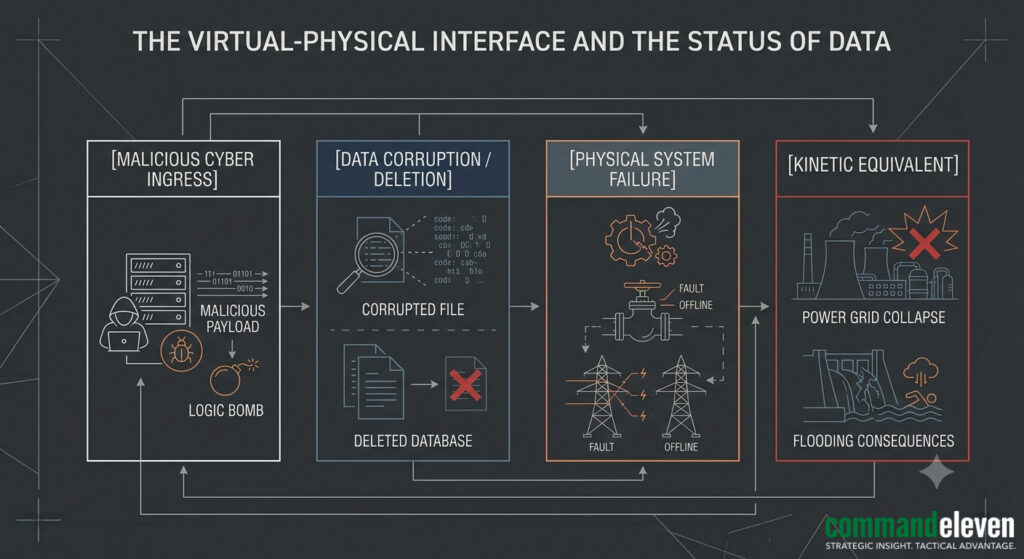
If the manipulation or erasure of data results in tangible physical damage, injury, or the structural collapse of infrastructure (e.g., overriding safety code in a petrochemical plant to induce an explosion), the operation ceases to be a gray-zone action. It crosses the line into a kinetic strike, triggering identical legal obligations under the principles of distinction and proportionality.
Subsea Fiber-Optic and Energy Corridors
Subsea telecommunications cables and undersea energy pipelines represent the most acute dual-use vulnerability on the modern battlefield. These corridors carry over 95% of transcontinental internet traffic, serving civilian commercial banking and military command-and-control loops simultaneously.
- The Military Advantage Test: Under Article 52(2) of Protocol I, a subsea cable utilized by an adversary for military communications becomes a legitimate military objective. However, the physical severing or localized interception of these lines causes systemic, cascading civilian damage.
- The Proportionality Challenge: Interdicting a primary subsea cable can instantly blind regional financial markets, cripple hospital telemetry, and sever emergency services across multiple neutral nations. The expected direct military advantage must be weighted against these global, multi-domain civilian disruptions.
The Sovereign Cloud and Host-Nation Complicity
Modern militaries increasingly store non-tactical logistics, personnel records, and predictive analytics on decentralized commercial cloud architectures. This distribution introduces complex geopolitical friction points when the physical data centers reside outside the immediate theater of operations.
Extraterritorial Storage
If a belligerent’s operational logistics data is hosted on commercial servers located within a neutral third-party state, those servers become part of the adversary’s military infrastructure.
The Co-Belligerency Threshold
Hosting critical operational data can be interpreted as providing active, non-neutral material support. This classification exposes the host nation’s domestic digital architecture to lawful cyber counter-strikes, potentially pulling non-belligerent states into the active conflict zone.
Cyber-Physical Target Validation Protocol
To prevent systemic non-kinetic operations from triggering unmanageable escalatory loops, operational planners must execute a specific validation sequence before deploying offensive cyber or subsea capabilities.
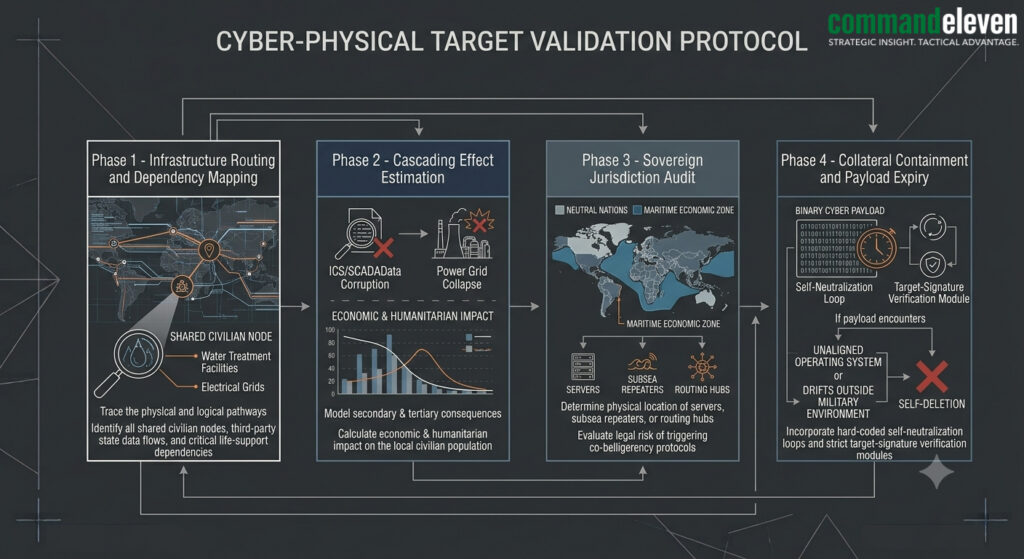
Operational Directive: The invisibility of a cyber operation does not shield the commander from accountability. Any digital action planned with the intent to cause systemic societal collapse rather than a localized, definite military advantage is a violation of customary international law.

