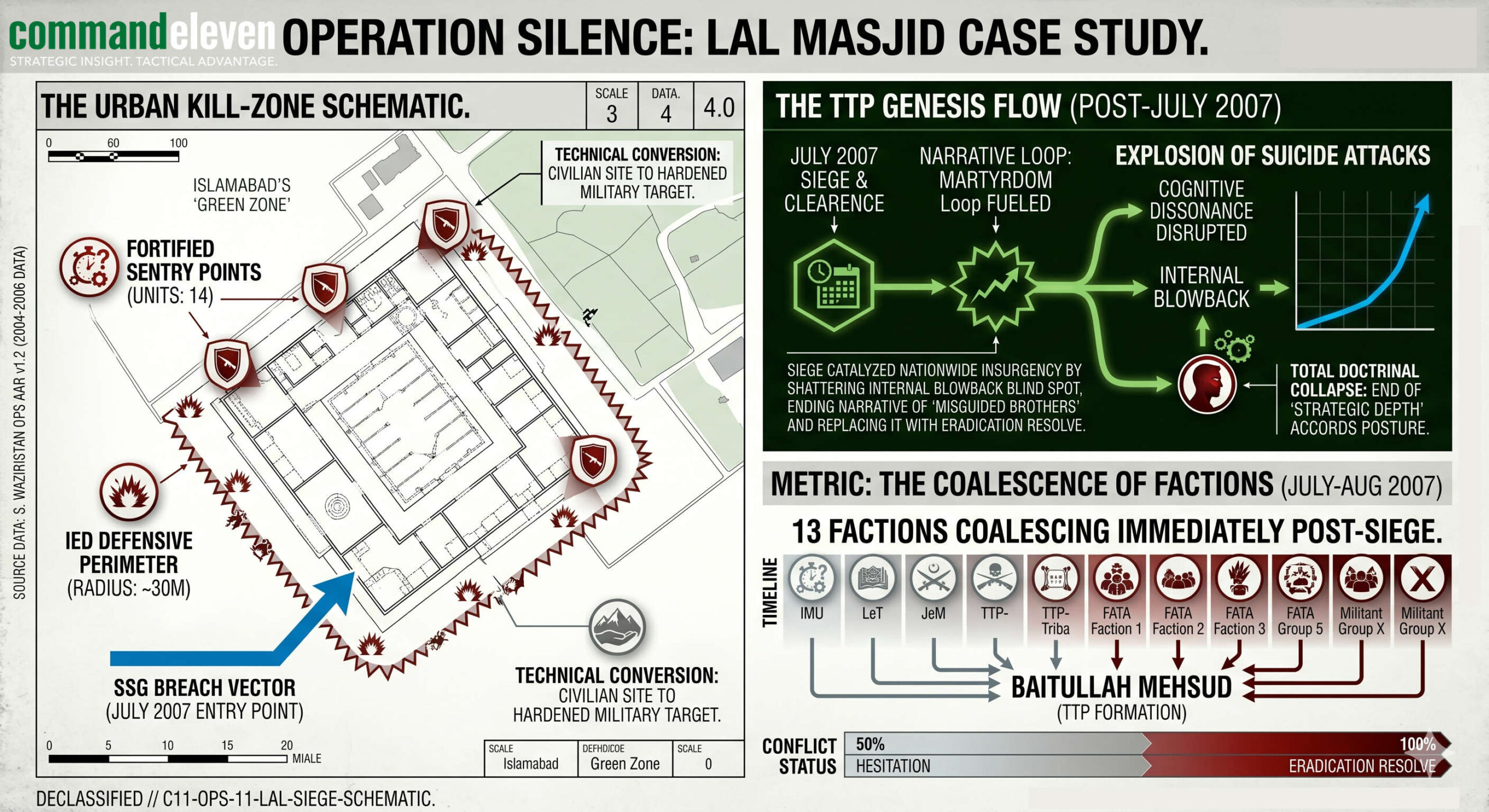
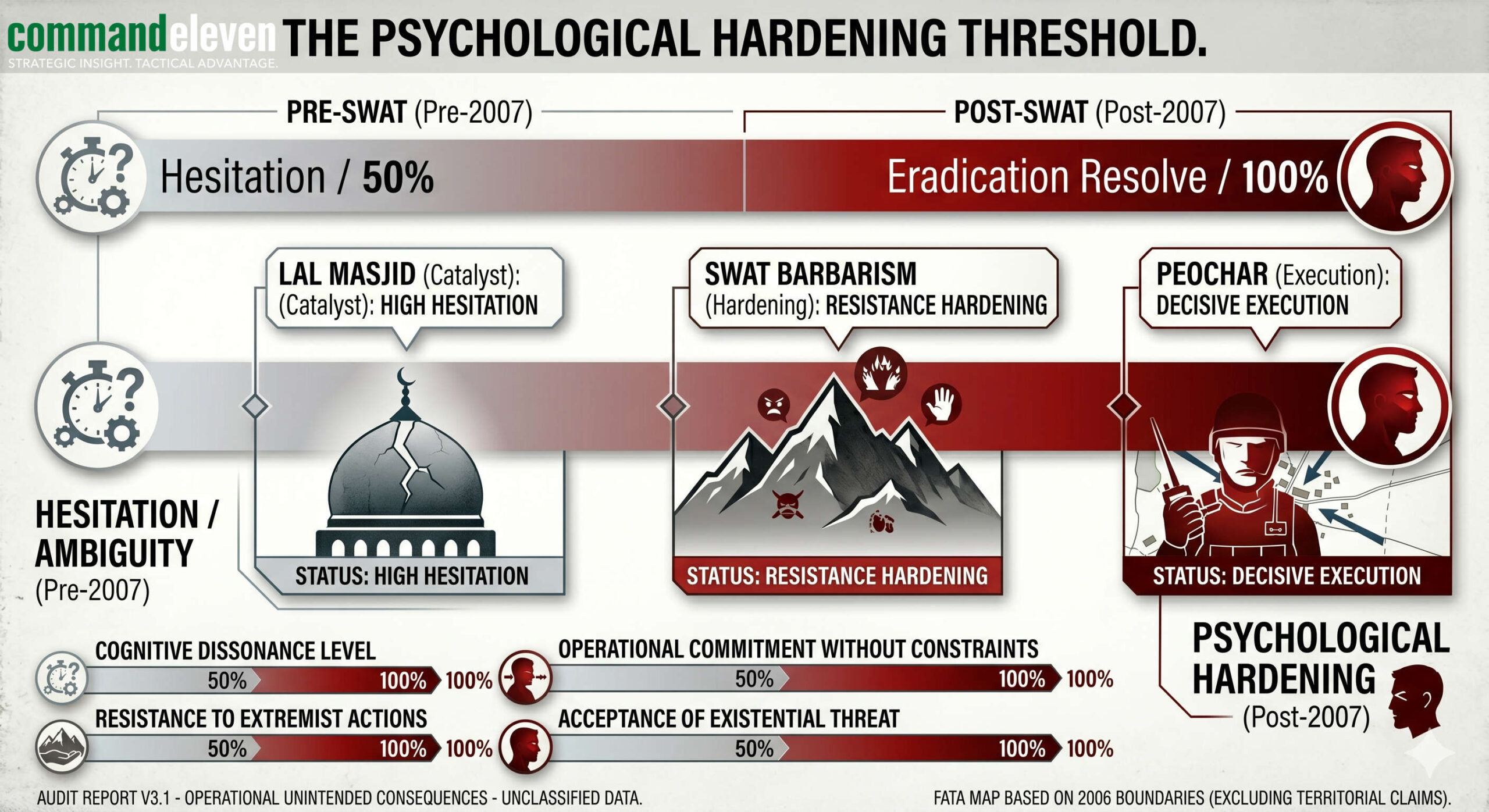
BLUF: Operation Silence (July 2007) served as the terminal catalyst for the unification of the domestic insurgency. By executing a high-intensity kinetic clearance in the heart of the capital, the state achieved a tactical success but triggered a Total Doctrinal Collapse of existing peace accords. This event effectively transitioned fragmented tribal skirmishes into a declared, ideologically driven war against the Pakistani state, culminating in the formation of the Tehreek-e-Taliban Pakistan (TTP).
Operational Context: The Urban Insurgency Baseline
By early 2007, the Lal Masjid complex in Islamabad had evolved from a religious center into a fortified hub for parallel governance. Led by brothers Abdul Aziz and Abdul Rashid Ghazi, the complex’s students engaged in “Moral Policing” and kidnappings, directly challenging the state’s Administrative Persistence. The state’s initial Institutional Hesitation allowed the complex to stockpile weaponry and reinforce urban defensive perimeters.
Tactical Breakdown: Operation Silence
The final kinetic phase (July 3–11, 2007) was a high-stakes urban siege executed by the Special Service Group (SSG).
The Fortification of the Complex
The siege revealed sophisticated urban defensive tactics. The mosque and Jamia Hafsa school were reinforced with bunkers, sandbags, and firing slits.
- The Adversary: A convergence of radicalized students and battle-hardened foreign militants (Al-Qaeda and IMU remnants) who had achieved Urban Infiltration.
- The Armament: SSG units encountered RPGs, heavy machine guns, and IEDs, proving the complex was a frontline military objective within the capital’s Red Zone.
The SSG Engagement
The kinetic clearance was characterized by intense close-quarters combat.
- Vertical and Horizontal Envelopment: The SSG utilized explosive breaches to enter the fortified basement and school wings.
- The High Cost: The operation resulted in significant casualties, including the death of SSG Lieutenant Colonel Haroon-ul-Islam. This loss underscored the Tactical Whiplash felt as the military pivoted from border patrols to capital-city combat.
Strategic Impact: The Tipping Point
Operation Silence was the Tipping Point that altered the trajectory of the 25-year conflict.
- Catalyst for the TTP: The casualties—specifically the death of Abdul Rashid Ghazi—provided the propaganda oxygen necessary for Baitullah Mehsud to unify disparate tribal cells into the TTP in December 2007.
- Wave of Urban Attrition: The siege triggered an immediate and relentless wave of suicide bombings targeting military installations and high-readiness assets in urban centers like Rawalpindi and Lahore.
- End of Ambiguity: The operation forced the state to accept that the threat was no longer localized to the border; it was an existential, national-level crisis.
Clinical Conclusion
Operation Silence was a tactical success but a strategic catastrophe. While it cleared a radical stronghold, it acted as the Total Doctrinal Collapse point for existing peace accords (e.g., the Miranshah Accord). It proved that kinetic clearance in an urban environment, if not preceded by electronic sovereignty and narrative control, creates a “martyrdom loop” that fuels the next generation of insurgents.