
Executive Summary
This volume establishes operational contingency protocols for high-intensity, peer-on-peer conflicts characterized by the total degradation of advanced technological systems. When long-range communications, satellite reconnaissance, and precision-guided munitions (PGMs) are neutralized via electronic warfare or kinetic anti-satellite (ASAT) actions, the theater of operations enters a “dark” state.
Commanders must navigate this friction without lowering compliance standards under the Law of Armed Conflict (LOAC).
The Legal Reality of Degraded Means
Technological degradation does not suspend international humanitarian law. A commander’s legal obligations under the principles of distinction, proportionality, and precautions remain absolute, even when their technical capacity to fulfill them is stripped away. Operating in a denuded data environment shifts the baseline of what constitutes a “reasonable commander.”
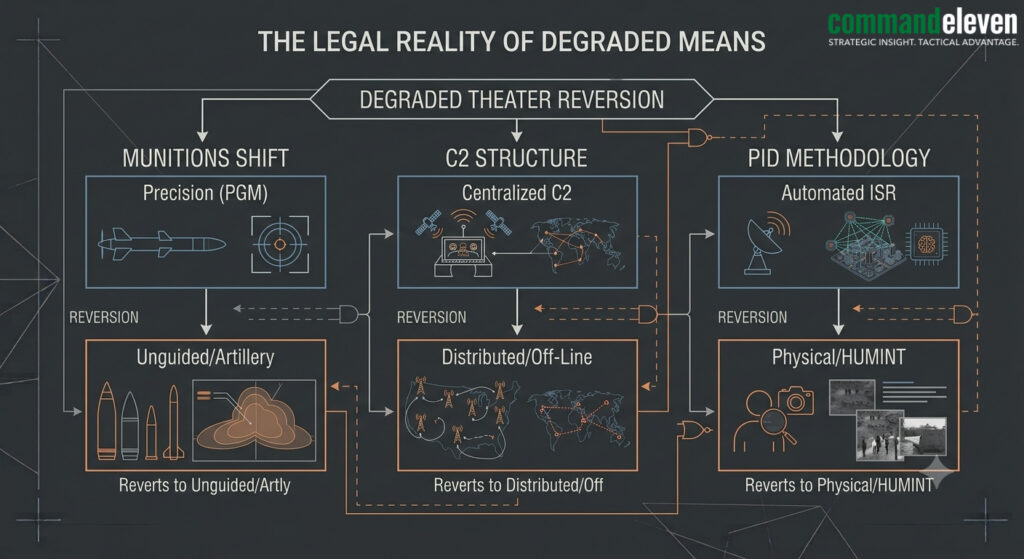
The primary operational hazard during a systemic system failure is doctrinal panic,the tendency to revert to indiscriminate, wide-area saturation tactics when precision instruments fail. This playbook establishes the mandatory tactical adjustments required to maintain legal boundaries under total technological denial.
Proportionality Adjustments for Unguided Munitions
The loss of GPS/GNSS and laser guidance networks forces a reliance on unguided artillery, mortar systems, and dumb bombs. This shift exponentially expands the Circular Error Probable (CEP),the radius containing 50% of a weapon’s impacts.
- The Collateral Damage Estimation (CDE) Escalation: When precision tools are unavailable, a target that was legally viable under a PGM strike package may become unlawful due to the expanded CEP. If the unguided weapon’s expanded dispersion footprint overlaps with a civilian structure, the anticipated incidental damage often outweighs the direct military advantage.
- Mandatory Target Pruning: Planners must systematically eliminate high-value targets located within dense urban or suburban sectors from active target lists if those targets can only be engaged via area-denial, unguided ordnance.
Decentralized Accountability and Fractured Command
Total electromagnetic spectrum denial isolates tactical sub-units from centralized joint-staff command elements and legal advisors. Under a fragmented Command and Control (C2) architecture, operational authority must devolve to the tactical edge.
The Shift in Liability
When communications lines are cut, the individual field officer at the point of contact bears sole, unmediated responsibility for LOAC compliance. Tactical actions can no longer be justified by citing upstream predictive intelligence feeds or generalized theater directives.
Rigid Reversionary ROE
To prevent ad-hoc, unlawful escalations, isolated units must automatically trigger highly restrictive, pre-approved Rules of Engagement (ROE). These reversionary rules strip the local commander of the authority to engage in signature-based or predictive targeting, forcing a transition to purely defensive or visually verified offensive profiles.
Degraded-State Operational Validation Protocol
When electronic and digital validation systems collapse, commanders must execute a manual, analog verification process to preserve the structural requirements of positive identification (PID).
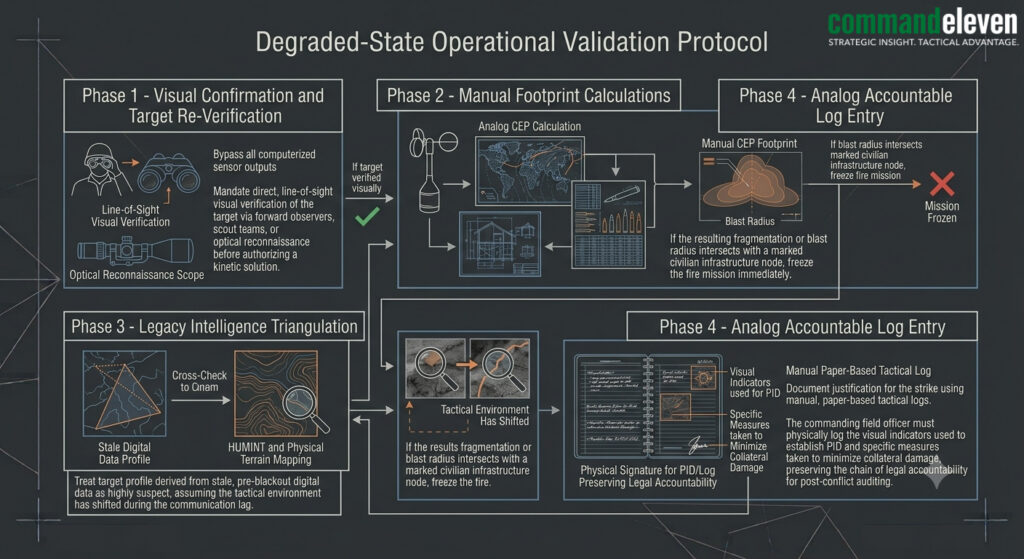
Operational Directive: Operating in the dark does not create a legal vacuum. If a commander cannot verify a target visually or calculate its fragmentation footprint due to a complete lack of tactical instruments, the attack cannot be executed. Technical blindness never excuses indiscriminate warfare.