Executive Summary
This volume addresses the exploitation of the electromagnetic spectrum (EMS) and the strategic manipulation of the information environment. Both domains operate primarily below the threshold of kinetic destruction, yet their misapplication directly induces kinetic accidents and structural violations of operational law.
EMS Denial and Non-Belligerent Navigation Risks
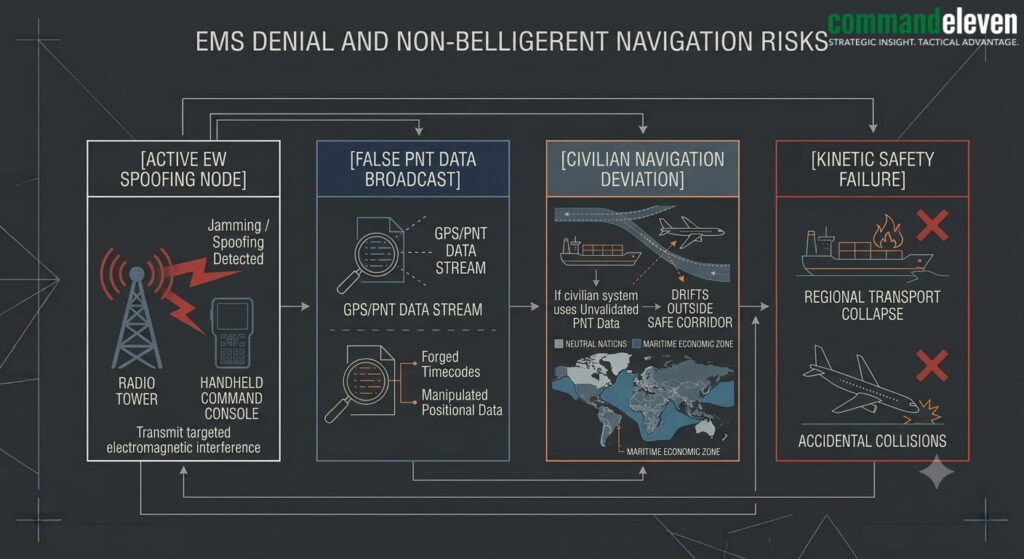
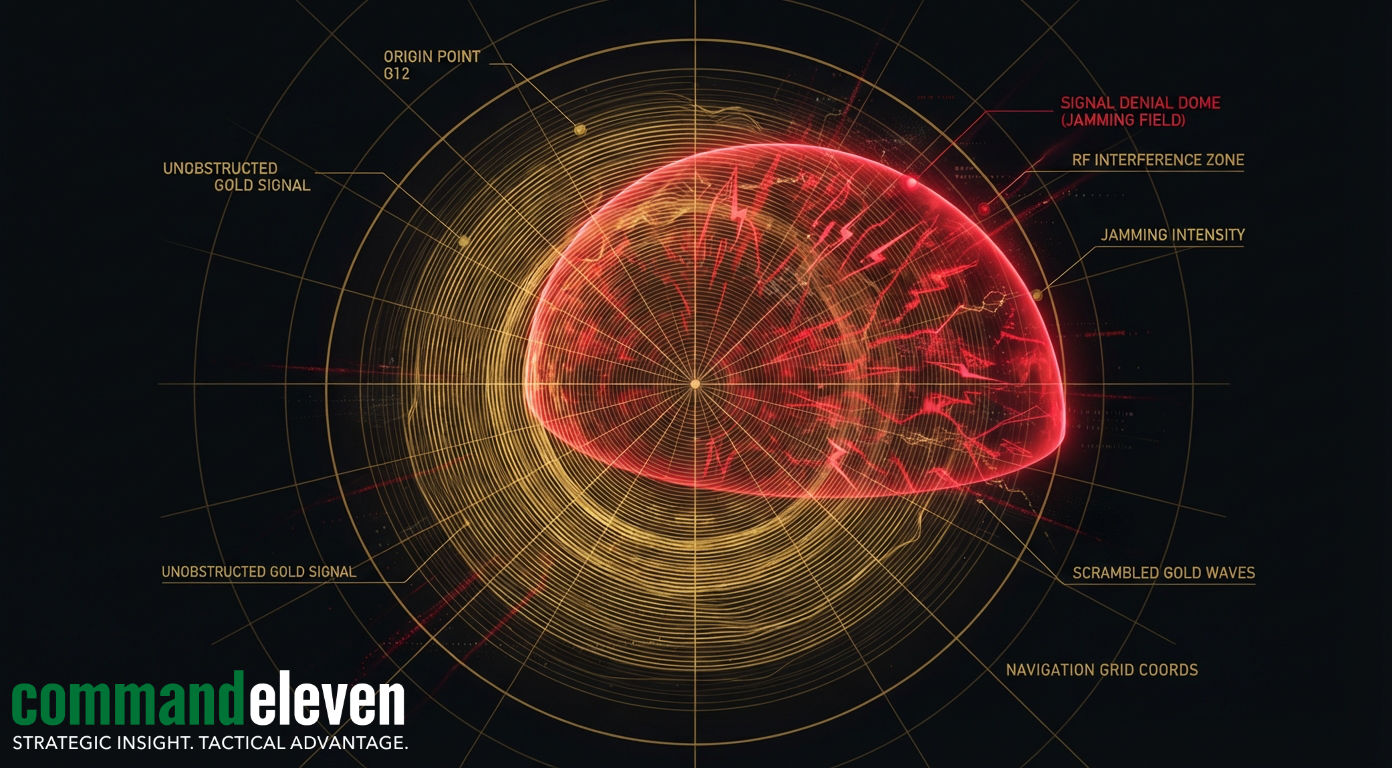
Electronic warfare (EW) is no longer confined to localized tactical jamming. The deployment of theater-wide Global Navigation Satellite System (GNSS) spoofing and high-power radio-frequency (RF) denial has transformed the electromagnetic environment into a highly toxic, non-permissive space.
This saturation introduces extreme risk to non-belligerent assets. When an operational force projects false Positioning, Navigation, and Timing (PNT) data to mask its movements or protect high-value infrastructure, the signal inevitably bleeds into international commercial aviation corridors and maritime transport lanes. Forcing a civilian airliner or commercial cargo vessel to deviate from safe routing—potentially steering them into active air-defense engagement zones—violates the fundamental obligation to take all feasible precautions to protect civilian lives.
Cognitive Operations and the Threshold of Perfidy
Cognitive warfare targets the human decision-making loop through synthetic media, psychological manipulation, and algorithmic amplification. While psychological operations (PSYOPs) are historically permissible methods of deception, the introduction of hyper-realistic generative models creates a severe legal hazard: perfidy.
The Legal Boundary of Deception
Under Article 37 of Protocol I, ruses of war are legal, but acts inviting the confidence of an adversary to lead them to believe they are entitled to protection under the law of armed conflict constitute perfidy.
Synthetic Violations
Deploying deepfakes or synthetic audio to fabricate non-existent humanitarian corridors, forge cease-fire declarations, or mimic United Nations humanitarian distributions is an absolute violation of customary law. These methods compromise the structural protective symbols of international law, eroding the basic trust required to preserve civilian life during active hostilities.
Algorithmic Information Manipulation
The strategic weaponization of local information networks via bot swarms and targeted narrative injection directly impacts civilian safety.
- Forced Displacement Vectors: Projecting targeted, false warnings of imminent kinetic strikes into specific urban sectors to force mass civilian migration creates chaotic, unmanageable refugee corridors.
- Humanitarian Obstruction: Weaponizing local social platforms to systematically delegitimize local medical services or humanitarian actors increases their operational vulnerability, effectively converting the information ecosystem into an indirect kinetic enabler.
EMS and Cognitive Validation Protocol
To ensure multi-domain electronic and information operations remain within acceptable legal and operational bounds, targeting cells must execute a strict pre-launch validation sequence.
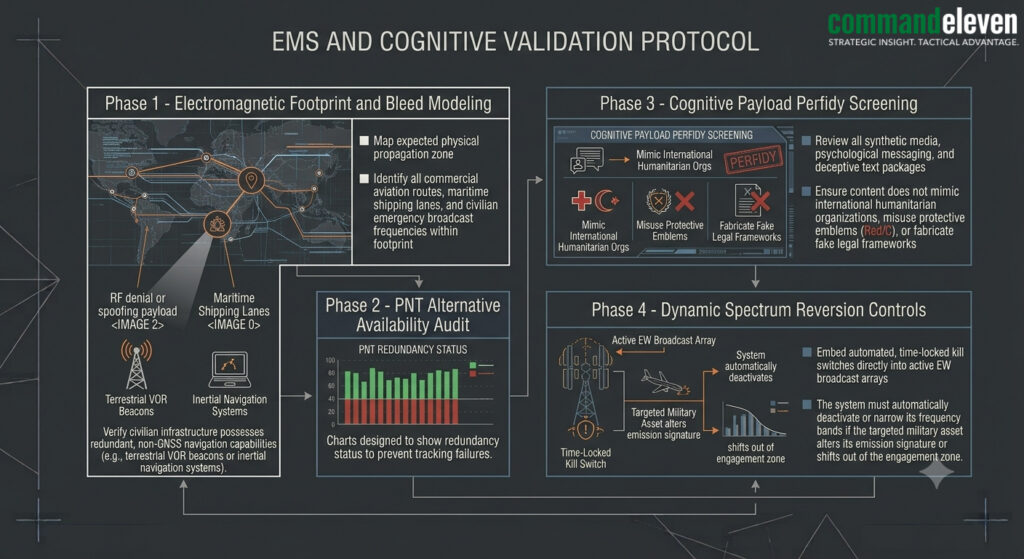
Operational Directive: The absence of physical casualties at the immediate point of transmission does not exempt EMS and cognitive operations from legal liability. If an electronic or narrative operation predictably causes a systemic civilian safety failure, the commander authorizing the deployment bears full legal responsibility for the resulting kinetic fallout.
Rules of the Modern Battlefield
- Rules of the Modern Battlefield: Series Introduction
- Algorithmic Target Generation and LOAC Compliance – Part 1
- Autonomous Swarm Allocation and Mass Attrition – Part 2
- Subsea Infrastructure Vulnerabilities and Cyber Law – Part 3
- Electromagnetic Spectrum Denial and Cognitive Warfare – Part 4 (you are here)
- The Degraded-Environment Playbook: LOAC in the Dark – Part 5
- Consolidated Operational Axioms of Modern Warfare – Part 6
- Adversarial Machine Learning & Data Corruption – Appendix