
Executive Summary
The cumulative technical and legal assessments compiled across this five-volume series yield four foundational axioms for modern multi-domain operations. These principles establish that technological complexity neither dilutes command responsibility nor excuses indiscriminate methods of warfare.
Axiom 1: Probabilistic Logic Cannot Override Binary Legality
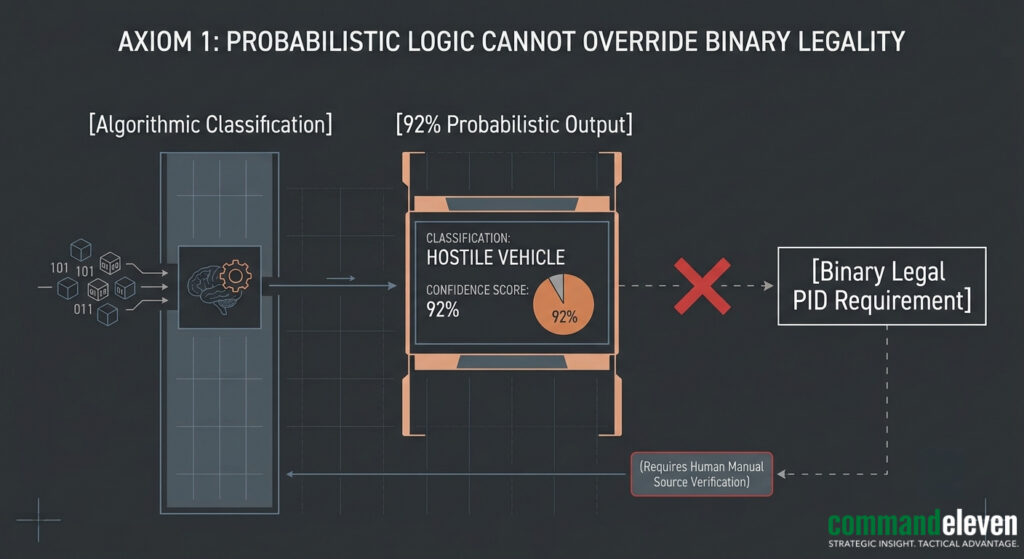
Algorithmic targeting engines operate on statistical correlation, processing sensor inputs to output classification metrics based on probability (e.g., “T-72 Main Battle Tank: 92% Confidence”). Conversely, International Humanitarian Law (IHL) demands the complete elimination of reasonable doubt before authorizing kinetic release.
A mathematical confidence score, regardless of its statistical precision, does not constitute positive identification (PID). Treating probabilistic outputs as absolute ground truth introduces severe legal exposure under the Principle of Distinction.
Command Operational Directive
- Threshold Verification: Statistical outputs below mandated theater Rules of Engagement (ROE) confidence thresholds must trigger an immediate, mandatory drop from active strike queues.
- Veto Accountability: Human analysts must independently audit the raw sensor data underlying an algorithmic classification. Automation bias,accepting software outputs without physical source verification,transfers full legal liability directly to the authorizing officer.
Axiom 2: The Physicality of Effect Dictates the Law
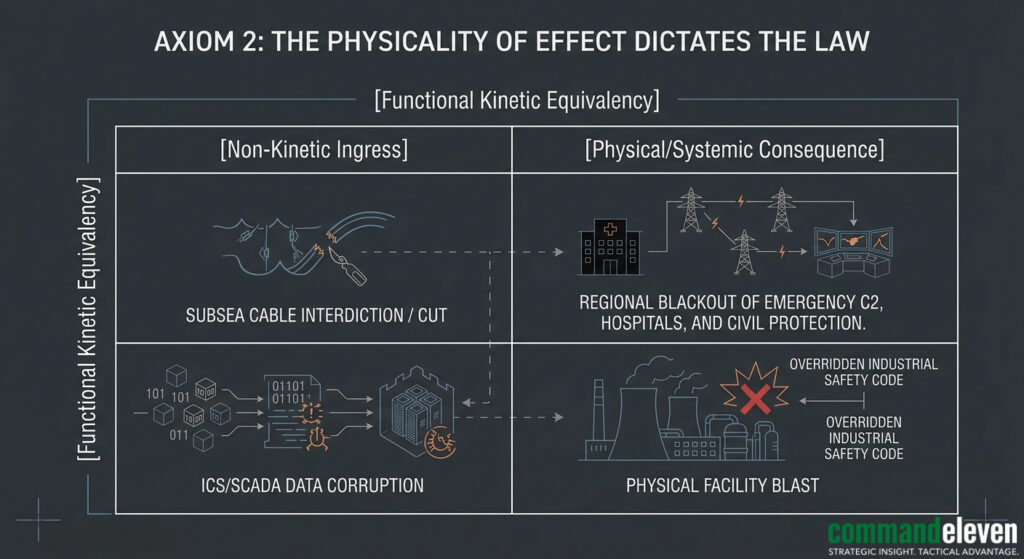
The domain or medium of an attack,whether an airborne precision munition, an electromagnetic signal, or a malicious digital payload delivered via subsea fiber-optic cables,is legally irrelevant under customary LOAC. The legal classification of an operation is governed exclusively by its functional physical consequence.
If a non-kinetic or cyber operation corrupts data or disables networks in a manner that predictably causes structural failure, physical destruction, injury, or severe disruption to essential civilian life-support systems, it crosses the threshold into a kinetic effect.
Command Operational Directive
- Dual-Use Isolation: Prior to launching offensive cyber or spectrum interdiction against shared infrastructure, intelligence cells must map secondary and tertiary dependencies to ensure civilian collateral impact remains strictly proportional to the concrete military advantage.
- Escalation Control: Operations executed below the visual threshold that result in cascading physical damage are classified as armed attacks, subjecting the executing authority to immediate kinetic reprisal under international law.
Axiom 3: Mass Expenditure Exposes the Commander to Systemic Liability
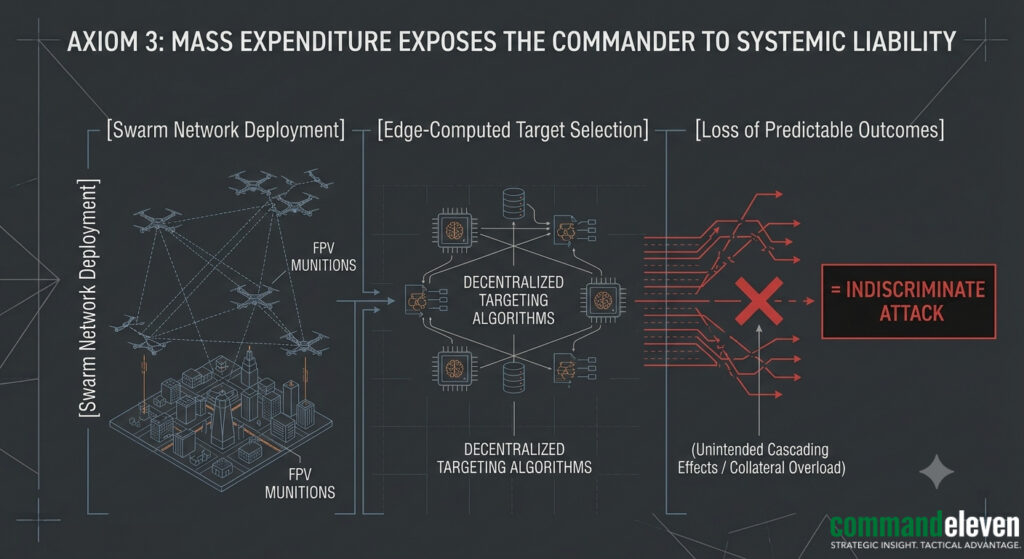
The deployment of autonomous networks, loitering munitions, and decentralized drone swarms shifts strike allocation to edge-computing nodes. However, decentralizing technical execution does not decentralize legal culpability.
When an operational force deploys hundreds of expendable autonomous assets into a compressed geographic sector, the velocity and volume of engagements outpace traditional real-time legal review. If a decentralized system’s network complexity prevents a human commander from predicting its kinetic outcomes with reasonable certainty, the launch sequence violates the absolute prohibition against indiscriminate methods of warfare.
Command Operational Directive
- Geofencing Enclaves: Hard-coded geographic, temporal, and signature boundaries must be embedded into autonomous swarm firmware prior to launch.
- Command Override Links: Theater commanders must maintain a continuous, high-power radio-frequency override link capable of executing an immediate global stand-down command across the active mesh network.
Axiom 4: Technical Blindness Demands Tactical Restriction
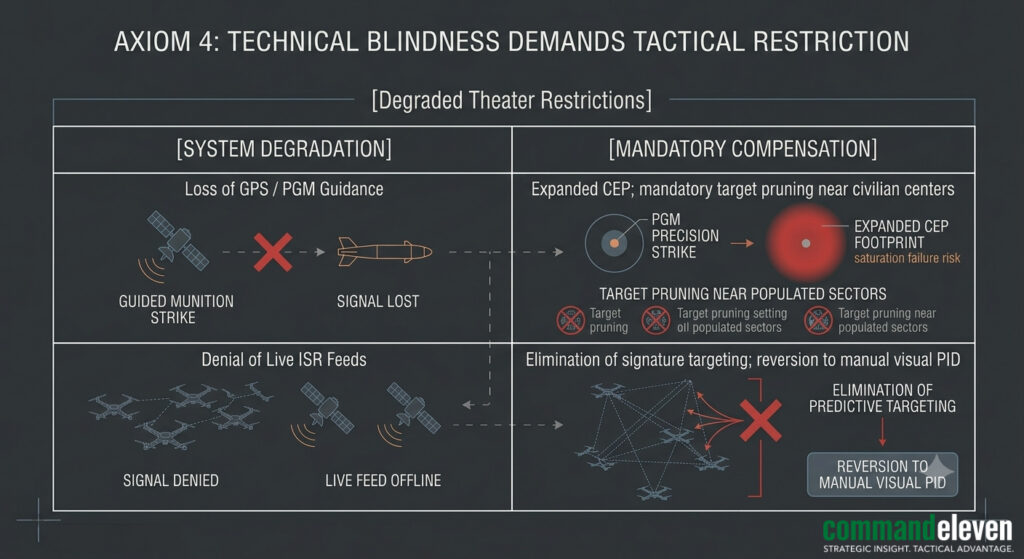
When electronic warfare, cyber neutralization, or kinetic anti-satellite (ASAT) strikes plunge the theater into a degraded “dark” state, the legal baseline established by LOAC remains static. Operating under total technological denial shifts the standard of what constitutes a “reasonable commander.”
The loss of precision-guided munitions (PGMs), real-time satellite imagery, and secure communications cannot be used to justify a reversion to unguided, area-denial saturation tactics in sectors containing non-combatants.
Command Operational Directive
- CEP Footprint Audit: When forced to switch from PGMs to unguided ordnance, planners must recalculate the expanded Circular Error Probable (CEP). If the weapon’s fragmentation radius overlaps civilian infrastructure, the target must be pruned from active lists.
- Analog Reversion: Sub-units isolated from central C2 must automatically transition to restrictive, pre-delegated Rules of Engagement, relying exclusively on direct visual confirmation before authorizing weapon release.
Operational Core Directive: Technology alters the speed, means, and methods of modern warfare, but it cannot alter the fundamental obligations of the state. The ultimate authority to execute lethal force remains a uniquely human responsibility, anchored by manual verification, explicit command sign-off, and unmediated legal accountability at the point of release.