Executive Summary
Between 2009 and 2014, the state encountered Asymmetric Multiplicity: a structural pincer effect created by simultaneous religiously motivated insurgencies in the North and ethno-nationalist movements in the South. This audit reveals that while these fronts lacked ideological unity, they achieved functional synergy by exploiting the state’s Persistence Gap. The dual-front pressure diluted kinetic resources and exposed the mechanical failure of “India-Centric” conventional doctrine. Sovereignty during this peak crisis was compromised not by a lack of lethality, but by a catastrophic deficit in administrative durability and infrastructure security.
3 Key Takeaways
- Tactical Pincer Effect: The dual fronts created a resource-drain loop where Northern operations consumed heavy infantry and air assets, while Southern sabotage operations exhausted intelligence and paramilitary reserves.
- Logistical Vacuum Exploitation: Both insurgencies thrived by providing shadow alternatives to state services – the North through utility interdiction and the South through the disruption of national economic arteries.
- Conventional Structural Deficit: The crisis proved that centralized, top-down command structures are incapable of processing the high-velocity, disparate data streams inherent in a multi-front asymmetric environment.
Tactical Summary
During the peak of the regional internal crisis (2009–2014), the state encountered a condition of Asymmetric Multiplicity. This dual-front insurgency – comprising a religiously motivated network in the North and an ethno-nationalist movement in Balochistan – successfully exploited the state’s Persistence Gap. While these fronts remained ideologically distinct, they achieved a functional “pincer effect.” This effect systematically diluted kinetic resources and exposed a profound structural deficit in conventional military doctrine. This brief audits the mechanical signatures of both fronts and the resulting systemic strain on state sovereignty.
The Northern Front: The Logistical Oxygen Capture
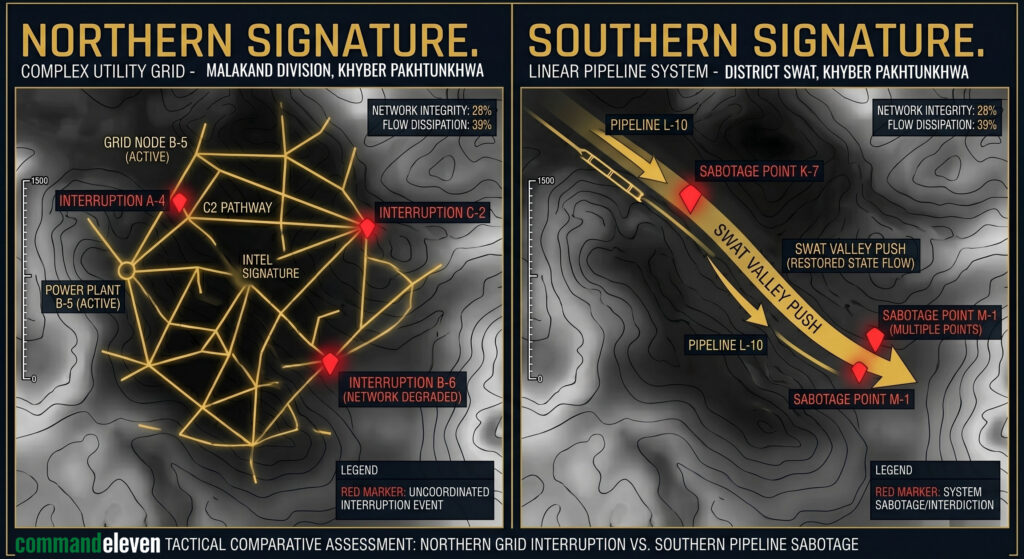
The Northern theater, encompassing the former FATA and the Malakand Division, represented a transition from managed proxy elements to an open rebellion against the state’s central authority.
- The Adversary Matrix: Led primarily by the Tehreek-e-Taliban Pakistan (TTP), with specialized support from the Islamic Movement of Uzbekistan (IMU) and Al-Qaeda Central.
- The Strategy of Utility Interdiction: As documented in the Malakand Utility Siege, the Northern insurgency did not merely seek territorial denial; it sought Administrative Persistence. By seizing the “Logistical Oxygen” of the population – electricity grids, water distribution, and the judicial vacuum – the TTP established a shadow state that functioned more efficiently than the distant, centralized bureaucracy.
- Kinetic Response Failure: The state’s reliance on division-strength surges, such as Rah-e-Nijat and Rah-e-Rast, achieved tactical clearance. However, these operations were optimized for conventional battlefields. The lack of a #72/48 Protocol during this era meant that every kinetic gain was temporary. Without an immediate administrative follow-through, the “clear” phase inevitably reverted to an insurgent “re-infiltration” phase.
The Balochistan Front: The Kinetic Drain
Simultaneously, the Southern front in Balochistan presented a different mechanical signature that targeted the state’s economic and logistical arteries.
- The Adversary Matrix: Composed of decentralized ethno-nationalist cells including the BLF, BLA, and BRA.
- The Strategy of High-Velocity Sabotage: Unlike the Northern front’s attempt at shadow governance, the Southern insurgency focused on increasing the Conflict Premium. By targeting national infrastructure – specifically gas pipelines, railway lines, and transit corridors – the insurgency forced the state into a perpetual defensive posture.
- Kinetic Overextension: The vast, high-friction geography of Balochistan neutralized the state’s conventional mass. To secure the province, the state was forced to deploy a high-density footprint of paramilitary and intelligence assets. This led to Kinetic Overextension, as the force was spread too thin to maintain any localized persistence.
The Pincer Effect: Mechanical Convergence
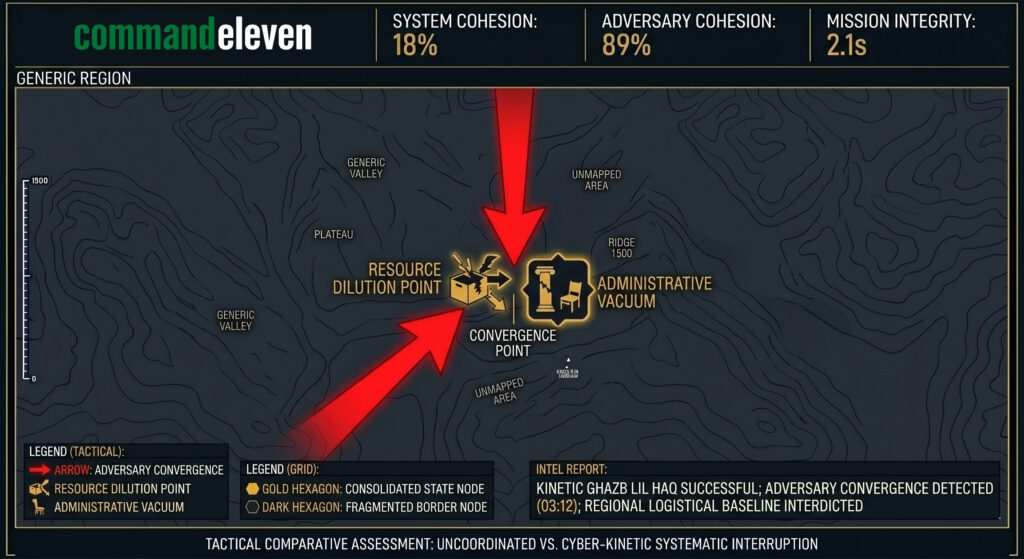
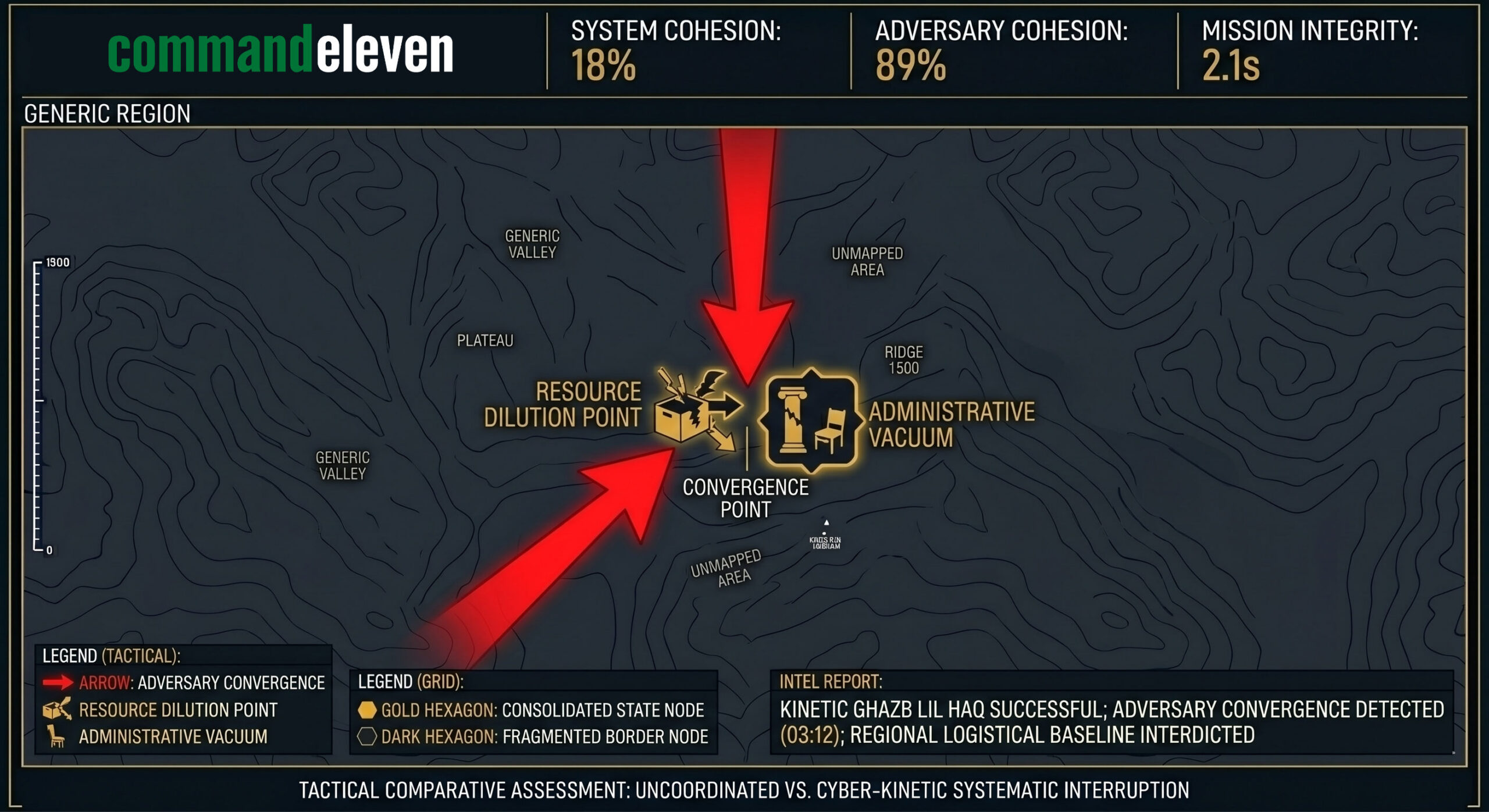
The “Handshake” between these two fronts was not a matter of shared ideology, but of tactical synergy. They functioned as a mechanical pincer that exploited the state’s centralized structural weaknesses.
- Resource Dilution: The Northern front consumed the bulk of the air assets and heavy infantry, while the Balochistan front drained the state’s specialized intelligence and counter-sabotage units. This ensured that neither front could be decisively addressed.
- The Persistence Vacuum: Both insurgencies thrived in the absence of the state’s administrative presence. In the North, it was the absence of utilities; in the South, it was the absence of functional economic integration. Both fronts utilized this vacuum to lower the local cost of living under insurgent control relative to state control.
- Talent and Ratline Exchange: Clandestine transit corridors along the Pakistan-Afghanistan border allowed for the exchange of specialized skill sets. We identify a technical signature handshake where Northern IED expertise was transferred to Southern strike cells to facilitate more effective sabotage of hardened infrastructure.
The Conventional Structural Deficit
The dual-front crisis proved that the India-Centric conventional model is mechanically incapable of defending against simultaneous internal asymmetric threats.
- Centralized Command Failure: The military’s top-down command structure could not process the high-velocity, disparate data streams coming from two entirely different theaters of war.
- Infrastructure Vulnerability: The state lacked Hardware Truth – the ability to physically secure its vital infrastructure. A single strike on a gas pipeline in Sui could paralyze industrial output in Faisalabad, creating a ripple effect of instability that fueled the Northern narrative of state failure.
Toward a Mosaic Defense
The peak of the internal crisis (2009–2014) was a period of survival, not sovereignty. It demonstrated that tactical lethality is irrelevant if it cannot be converted into administrative durability. To resolve the dual-front threat, the state must move beyond conventional surges and adopt the Tile Guardian model – decentralized, autonomous administrative nodes capable of independent persistence in both the North and the South.