Executive Summary
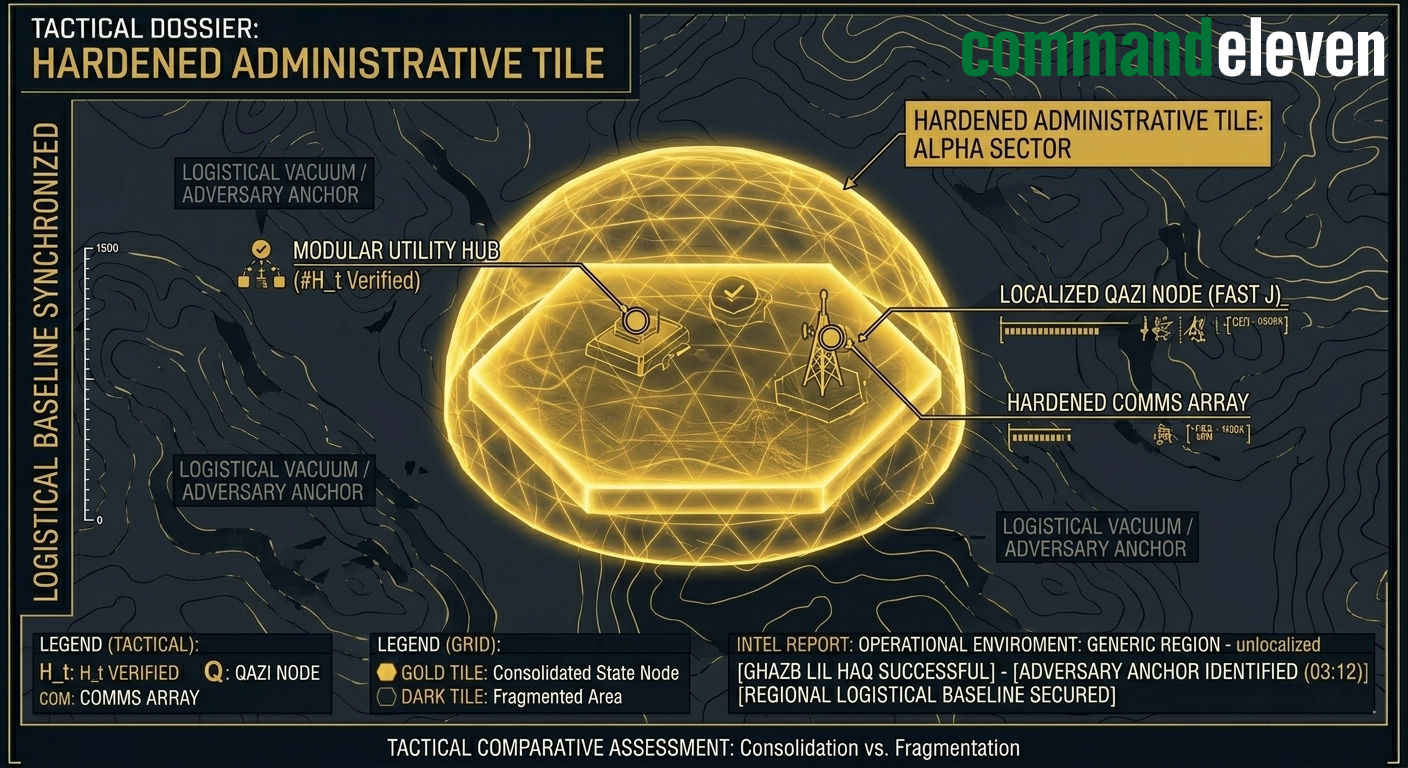
The #72/48 Protocol is a doctrinal framework designed to eliminate the Persistence Gap in contested environments. It establishes a mechanical timeline for the transition from kinetic clearance to administrative sovereignty. The protocol mandates that within 72 hours of a kinetic effect, the state must establish a physical administrative presence, and within 48 hours thereafter, it must achieve functional utility and justice delivery. This creates a “Hardened Tile” that prevents insurgent re-infiltration by denying them the logistical vacuum they require to survive.
3 Key Takeaways
- The Persistence Timer: Sovereignty is not won during the strike; it is won in the 120-hour window following the strike. If the state fails to provide “Logistical Oxygen” in this window, the kinetic gain is neutralized.
- Tile Hardening: The protocol moves governance from a centralized, slow-moving bureaucracy to a decentralized, autonomous “Administrative Tile” capable of independent survival.
- Hardware Truth: Persistence is maintained through physical infrastructure (energy, water, functional law) that is resistant to shadow logistical interdiction.
The Strategic Vacuum: Defining the Persistence Gap
Twenty-five years of kinetic data from the Pakistan-Afghanistan border confirms a recurring failure in regional security doctrine. Conventional forces consistently achieve “territorial clearance”,the physical removal of an adversary from a geographic space,yet fail to convert that clearance into sovereignty. This failure occurs within a specific temporal window. We define this as the Persistence Gap.
In legacy operations, the military footprint acted as a placeholder for the state. However, a military presence is not a sovereign presence. Sovereignty is defined by the physical delivery of utilities, justice, and logistical stability. When a kinetic effect occurs, it creates a vacuum. If the state does not fill this vacuum with Logistical Oxygen within a precise timeframe, the adversary re-occupies the space through shadow logistics. The #72/48 Protocol is the mechanical solution to this vacuum.
The Anatomy of the #72/48 Protocol
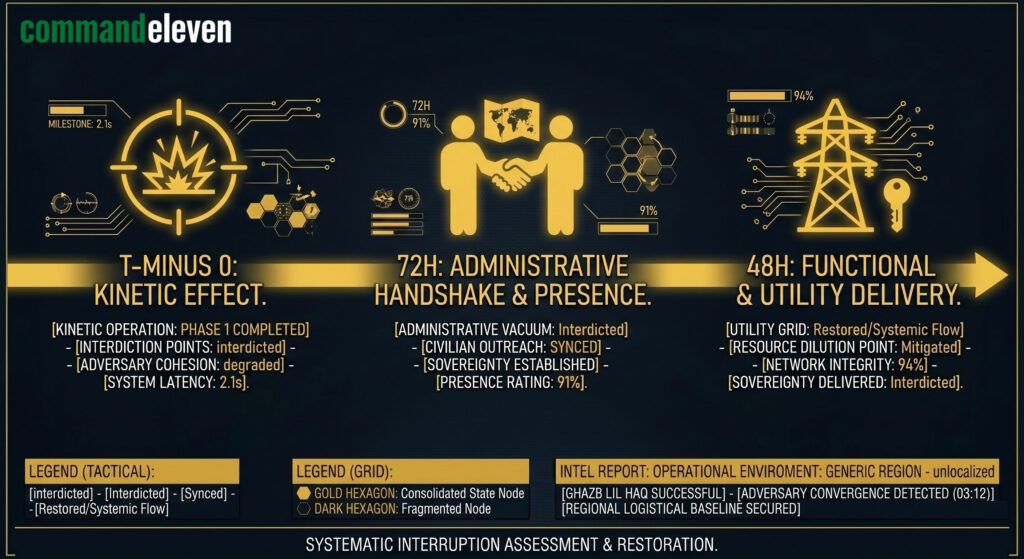
The protocol is not a suggestion; it is a rigid administrative mandate. It divides the post-kinetic window into two critical phases: the 72-Hour Administrative Handshake and the 48-Hour Utility Hardening.
The 72-Hour Administrative Handshake
Within 72 hours of a kinetic strike or territory clearance, the state must transition from military command to civil-administrative authority.
- The Tile Guardian Initialization: A designated administrative lead (the Tile Guardian) must be physically present on-site.
- The Handover: Kinetic units shift from “Clear” mode to “Perimeter Protection.” The interior of the Administrative Tile is handed over to civil contractors and administrative officers.
- The Logic: Insurgent networks rely on the “Silent Echo” – the period where the population is left without any authority. By establishing an administrative handshake within 72 hours, the state mutes this echo before it can resonate.
The 48-Hour Utility Hardening
Following the administrative handshake, the state has a 48-hour window to achieve “Functional Sovereignty.”
- Utility Delivery: Restoration of electricity, water, and basic sanitation is prioritized over political narrative. In the N-45 corridor, the delivery of a kilowatt-hour is more strategically significant than a broadcast speech.
- Justice High-Velocity: The establishment of a localized, functional legal node. This node must provide dispute resolution faster than the shadow courts of the adversary.
- Hardware Truth: Infrastructure must be hardened. This involves deploying mobile utility hubs and communication arrays that are physically secured and resistant to interdiction.
Lessons from the Conventional Failure
To understand the necessity of #72/48, one must audit the failures of the Musharraf-era “Whiplash” and the Kiyani-era “Surges”.
In operations like Kalosha (2004), the military cleared terrain but lacked any mechanism for administrative follow-through. The result was a kinetic overextension that led to capitulatory accords. These accords were not peace treaties; they were logistical surrenders that granted the insurgency the time and space to reorganize.
Similarly, during Operation Rah-e-Rast (2009), division-strength maneuvers achieved massive territorial gains. However, the state’s inability to manage the subsequent internal displacement crisis allowed the TTP to exploit the administrative vacuum. The #72/48 Protocol prevents this by mandating that the “Build” phase begins concurrently with the “Hold” phase, rather than as a delayed afterthought.
The Conflict Premium and Logistical Oxygen
The #72/48 Protocol is designed to manipulate the Conflict Premium, which represents the economic and social friction generated by instability. High Conflict Premium favors the insurgent, as shadow logistics thrive in high-friction environments.
By saturating a cleared tile with Logistical Oxygen (utilities and functional justice) within the 120-hour total window, the state artificially lowers the Conflict Premium. When the cost of living under state administration is lower than the cost of surviving under shadow logistics, the insurgent’s recruitment base collapses.
The Mosaic Defense Integration
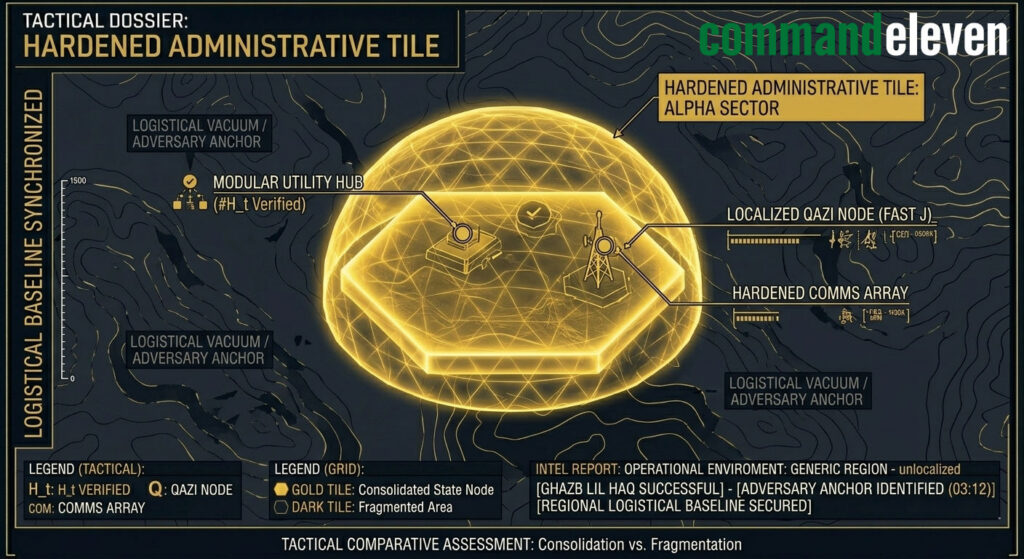
The #72/48 Protocol is the operational heart of the Mosaic Defense doctrine. It treats the theater of operations not as a single front, but as a series of autonomous, interconnected Administrative Tiles.
- Decentralization: Each tile operates with its own #72/48 mandate. This prevents a failure in one geographic zone from cascading across the entire theater.
- Resilience: A tile that has been “Hardened” via the protocol becomes an inhospitable environment for decentralized networks like ISKP or the HQN.
Tactical Conclusion: The Sovereignty Mandate
The 2026 security landscape does not permit the luxury of slow-moving, centralized bureaucracy. The #72/48 Protocol recognizes that kinetic force is merely a tool to create the space for administrative persistence.
If the state cannot establish a handshake within 72 hours and functional utilities within the following 48, it should not engage kinetically. To do so is to invite Kinetic Overextension and to gift the adversary a fresh logistical vacuum. Sovereignty is not found in the strike; it is found in the persistence that follows.