Executive Summary
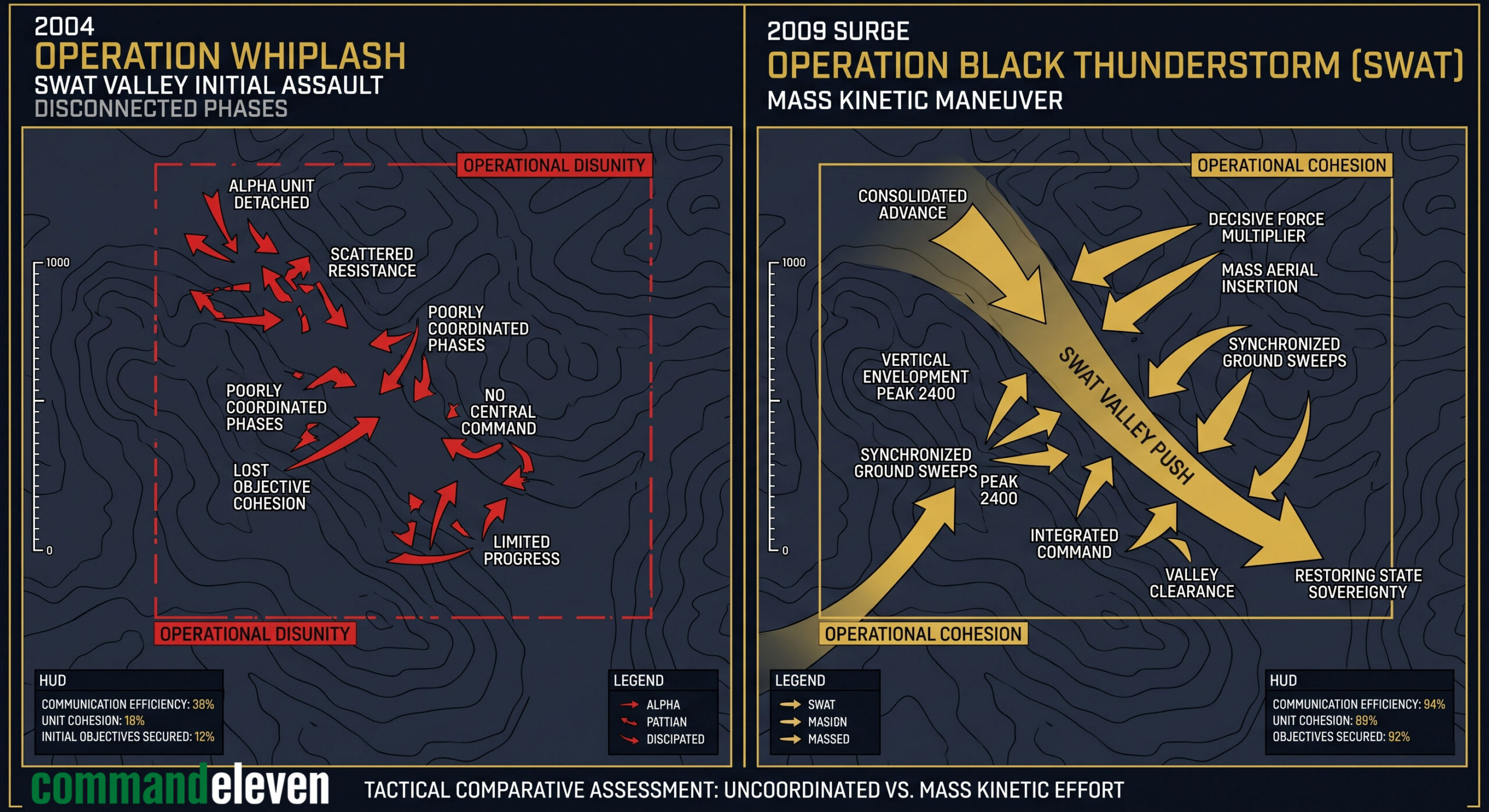
This audit contrasts the “Strategic Whiplash” of the Musharraf era (2004–2007) with the conventional surges of the initial Kiyani period (2009). While Operation Rah-e-Rast demonstrated superior tactical lethality and air-land coordination, it inherited the same structural deficit as its predecessors: the inability to convert kinetic clearance into Administrative Persistence. The transition represents a shift in operational scale, but a stagnation in strategic logic, leaving the Persistence Index (PI) at a critical low despite territorial gains.
3 Key Takeaways
- Conventional Inertia: The transition moved from reactionary “whiplash” incursions to massed division-strength surges, yet remained anchored to an India-Centric doctrine ill-suited for asymmetric hold operations.
- Administrative Vacuum: Rah-e-Rast successfully displaced the TTP from Swat but created a massive internal displacement crisis, increasing the Conflict Premium and complicating the re-establishment of state authority.
- Persistence Stagnation: Both eras failed to bridge the gap between “Clear” and “Build,” proving that territorial sovereignty cannot be sustained by kinetic presence alone.
Tactical Understanding
This update audits the mechanical shift in security doctrine between 2004 and 2009. It contrasts the reactionary, “whiplash” maneuvers of the early conflict with the massive, conventional surges of the initial Kayani period. While tactical lethality increased, the Persistence Index (PI) remained critically low, exposing a recurring failure to transition from kinetic clearance to administrative durability.
Musharraf-Era: The “Strategic Whiplash” (2004–2007)
Primary Characteristic: Reactionary Kinetic Bursts.
- Doctrinal Anchor: Legacy India-Centric conventional models applied to asymmetric terrain.
- Operational Signature: Small-to-mid-scale incursions (e.g., Kalosha) followed by rapid withdrawal and capitulatory accords (Shakai, Sararogha).
- The Failure: “Whiplash” refers to the violent oscillation between extreme kinetic force and total administrative surrender. This granted the insurgency the Logistical Oxygen to reorganize.
Kiyani-Era: The “Conventional Surge” (Rah-e-Rast, 2009)
Primary Characteristic: Massed Clearance and Population Displacement.
- Doctrinal Anchor: “Clear-Hold-Build” (CHB), though heavily skewed toward the “Clear” phase.
- Operational Signature: Operation Rah-e-Rast (Swat) utilized massive division-strength maneuvers, heavy artillery, and air dominance to physically displace the TTP.
- The Failure: While Rah-e-Rast achieved tactical clearance, it generated a massive internal displacement crisis. The state succeeded in removing the adversary but failed to establish the Administrative Tiles necessary to prevent insurgent reinfiltration.
Comparative Tactical Matrix
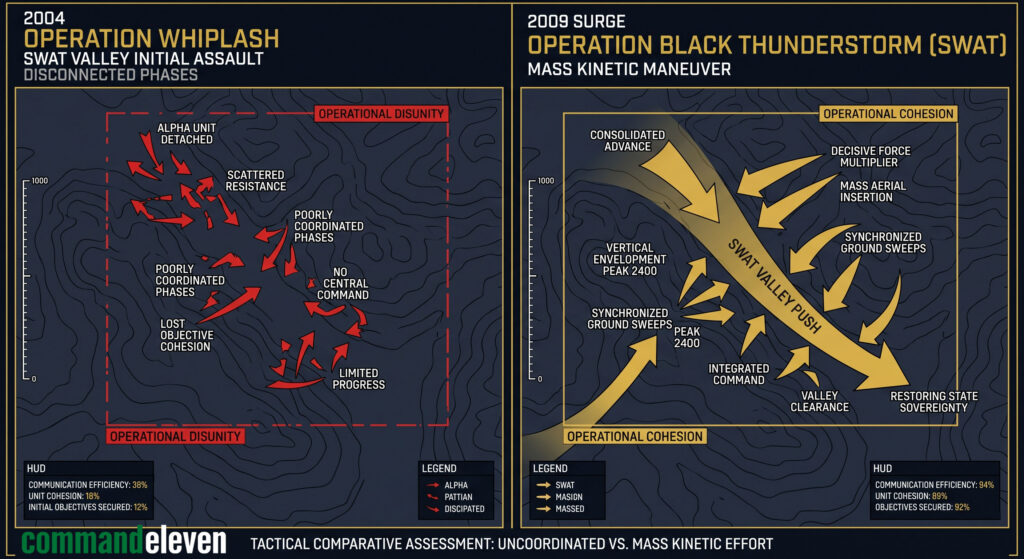
| Metric | Musharraf “Whiplash” | Kiyani “Surge” (Rah-e-Rast) |
| Force Multiplier | Kinetic Surprise | Massed Conventional Fires |
| Administrative Goal | Status Quo Ante | Territorial Sovereignty |
| Insurgent Response | Attrition & Negotiation | Tactical Retreat & Re-Infiltration |
| Persistence Outcome | Total Collapse | Kinetic Hold (Administrative Vacuum) |
Audit Findings: The Persistence Gap
The transition from Musharraf to Kiyani was a shift in scale, not logic.
- Kinetic Over-Reliance: Both eras prioritized “Clear” over “Build.”
- Hardware Truth: The state’s assets were optimized for territorial denial, not service delivery.
- Conflict Premium: The surge model in Rah-e-Rast increased the social friction through mass displacement, inadvertently creating long-term instability in the administrative vacuum.