
Technical Takeaways
- Decoupling of Weaponry from Physical Ordnance: The operational foundation of Chaoxian Zhan dictates that the concept of weaponry is permanently untethered from kinetic, explosive delivery systems. Under this framework, globalized financial networks, international technical standards bodies, and civilian data supply chains do not merely support state power; they function as primary, active weapons systems capable of producing strategic effects equivalent to conventional military campaigns.
- Exploitation of Democratic Structural Vulnerabilities: Unrestricted Warfare deliberately targets the open, transparent, and legalistic nature of democratic societies. By injecting complex statutory challenges into international bodies and executing micro-targeted cognitive subversion via commercial algorithms, the doctrine forces adversary leadership structures into protracted internal debates and policy friction, neutralizing their capacity for rapid collective response.
- Regime Paranoia as an Asymmetric Vulnerability: While the total integration of state, military, and corporate entities grants the PRC unprecedented coordination across all non-kinetic axes, it remains structurally dependent on absolute internal information control. This extreme centralization creates a critical vulnerability. Proactively injecting unclassified, high-fidelity data regarding internal elite corruption and systemic institutional failures directly into the domestic Chinese information ecology forces the state apparatus to aggressively redirect its cyber and intelligence assets inward to preserve regime security, blunting its external offensive capacity.
Executive Summary

This strategic white paper delivers a comprehensive, doctrine-level analysis of the landmark 1999 military treatise Chaoxian Zhan (Unrestricted Warfare , 超限战), authored by People’s Liberation Army (PLA) Air Force Colonels Qiao Liang and Wang Xiangsui. Published in the wake of the 1991 Gulf War, the text has transcended its original role as an academic critique of Western military hegemony. Today, it serves as the ultimate philosophical and operational meta-blueprint guiding the grand strategy, institutional design, and asymmetric campaigns executed by the People’s Republic of China (PRC) against the Western hemisphere and its regional partners.
The core premise of Unrestricted Warfare is the systematic erasure of all traditional, legally defined boundaries between the military and civilian spheres, between combatants and non-combatants, and between kinetic and non-kinetic battlespaces. Qiao and Wang argued that for a technologically inferior nation to defeat a superior superpower, it must move past conventional battlefield engagements.
Instead, the state must view the entire global landscape,including financial systems, legal regimes, international commerce, critical networks, and target population psychology,as an integrated, multi-axis theater of war.
By weaponizing the open, interconnected nature of globalized democratic societies, this doctrine aims to induce systemic exhaustion, institutional paralysis, and strategic capitulation within an adversary nation, achieving the supreme objective of state-level submission without requiring open kinetic conflict.
The 1999 Thesis: Contextual Genesis and Philosophical Shift
To understand the operational implementation of Unrestricted Warfare, the text must be examined within its historical context. The 1991 Gulf War demonstrated a level of American conventional military dominance that shattered legacy PLA defense doctrines. The rapid destruction of Iraq’s massive, Soviet-equipped conventional army via synchronized precision-guided munitions, total air superiority, and space-based network-centric command structures forced PLA theorists to a stark conclusion: contesting the United States on a conventional, platform-versus-platform battlefield was a recipe for rapid military defeat.
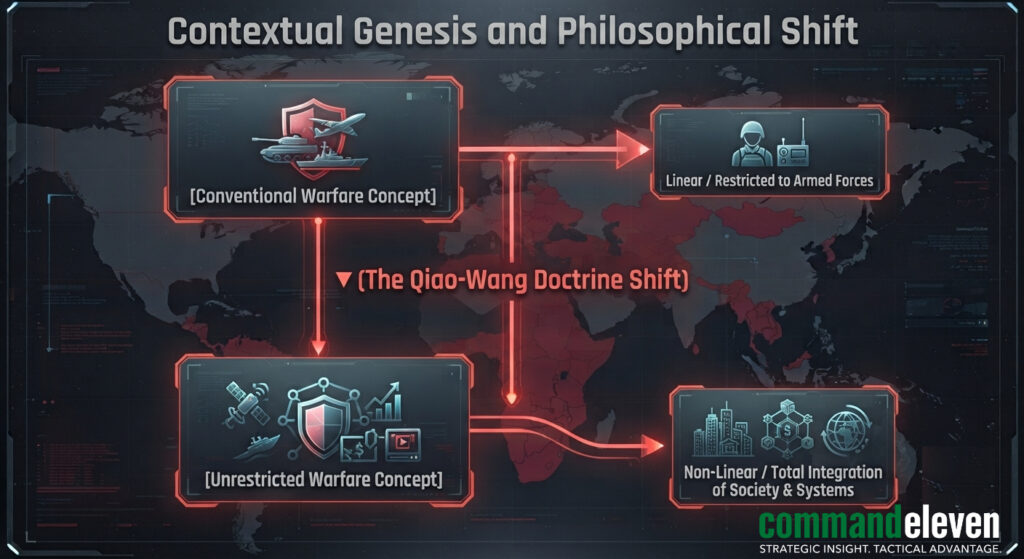
Qiao and Wang did not respond by advocating for a purely symmetrical, multi-billion-dollar conventional modernization program. Instead, they executed a profound philosophical shift:
- The Globalization Vector: They recognized that the rise of globalization, international financial networks, and the early internet had created deep interdependencies among sovereign nations. While these networks accelerated economic wealth, they simultaneously created unprecedented structural vulnerabilities.
- The New Definition of Weaponry: The authors argued that the concept of weaponry had been permanently decoupled from physical, explosive ordnance. A financial attack on a currency exchange, a fabricated legal brief filed within an international tribunal, a coordinated cyber-interdiction of a critical utility grid, or a targeted disinformation campaign aimed at a domestic election cycle were classified as military operations.
- The Erasure of Boundaries: The treatise declared that the new battlefield is omnipresent. War is no longer fought exclusively by men in uniform across defined geographic front lines. It is executed continuously by hackers, financial analysts, corporate entities, state lawyers, and media figures. Under this framework, civilian spaces are not collateral damage; they are the primary, decisive theater of operations.
Deconstructing the Multi-Axis Conflict Model
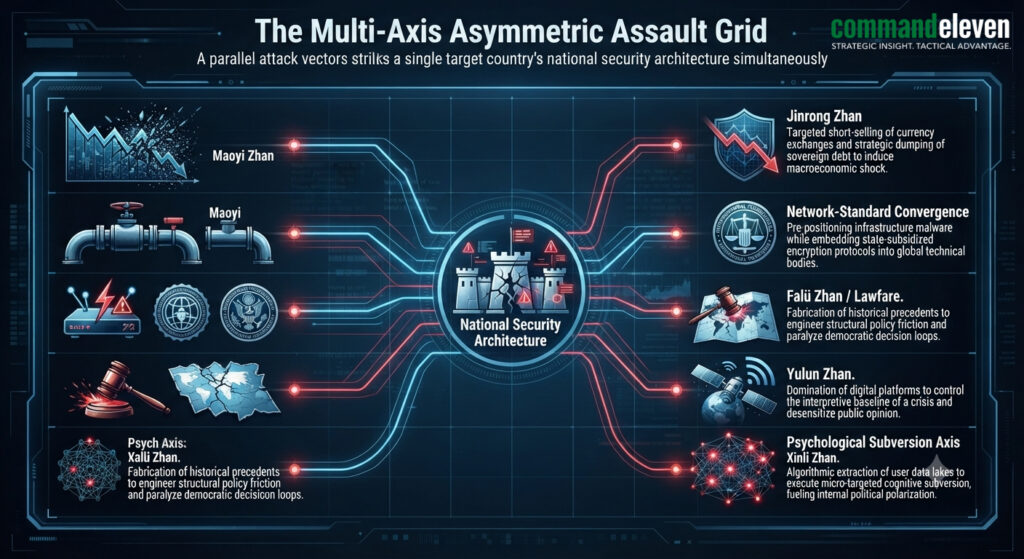
Unrestricted Warfare identifies dozens of distinct, non-military warfare types that can be combined into custom, asymmetric assault vectors. When operationalized by the modern PRC state security apparatus, these capabilities group into six primary non-kinetic axes, synchronized to strike an adversary’s national infrastructure simultaneously.
Financial Warfare , Jinrong Zhan
Financial Warfare is the manipulation of global capital markets, currency flows, and sovereign debt instruments to cause localized economic shock, erode investor confidence, and destabilize the macroeconomic foundations of an adversary state.
- Operational Execution: This axis involves the coordinated short-selling of target currencies, the strategic dumping of sovereign debt holdings during sensitive political junctures, and the manipulation of global commodity exchanges to induce artificial inflation or scarcity. It aims to force the target nation into structural insolvency or severe economic austerity, degrading its capacity to fund long-term defense modernization.
Trade Warfare , Maoyi Zhan
Trade Warfare is the weaponization of economic interdependencies, supply chain monopolies, and international market access to compel political submission.
- Operational Execution: Rather than standard protectionist tariffs, this involves the sudden, state-directed restriction of critical resources. The primary example is China’s absolute control over the processing of rare earth elements and critical minerals required for Western advanced defense manufacturing, aerospace systems, and consumer technology. By implementing sudden export controls or administrative embargoes under fabricated environmental or national security pretexts, Beijing can freeze the industrial production pipelines of its strategic competitors.
Regulatory and Network Warfare , Wangluo & Guize Zhan
This axis combines the cyber-kinetic penetration of critical national infrastructure with the manipulation of international regulatory and technical standards bodies.
- Operational Execution: While cyber operations (executed by groups like Volt Typhoon) pre-position malware within civilian water, power, and transport networks to enable physical sabotage, the regulatory arm works to control the technical architecture of the future. By securing leadership seats and voting blocs within international organizations like the International Telecommunication Union (ITU) or the International Organization for Standardization (ISO), China embeds its own state-subsidized technologies (such as 5G/6G architecture, encryption protocols, and satellite tracking standards) into global frameworks, creating permanent technical dependencies and intelligence collection windows.
Legal Warfare (Lawfare) , Falü Zhan
The utilization of domestic, international, and institutional legal systems to constrain adversary operational freedom, invalidate sovereign defensive treaties, and manufacture automatic justification for unilateral state revisionism.
- Operational Execution: Lawfare operates by rewriting the statutory baseline of international commons. It includes the continuous generation of historical legal claims, the manipulation of maritime transit definitions under UNCLOS, and the passage of domestic laws containing extraterritorial jurisdiction. By forcing Western bureaucratic leadership structures into protracted, defensive litigation and domestic statutory reviews during a developing crisis, Falü Zhan injects institutional hesitation that delays the deployment of conventional military forces.
Media (Public Opinion) Warfare , Yulun Zhan
The total domination of global communication pipelines, digital platforms, and information conduits to shape the perception, cognitive frameworks, and risk-assessment thresholds of foreign populations and elite decision-makers.
- Operational Execution: This involves the mass saturation of international media with state-engineered narratives, the strategic acquisition of foreign entertainment and news conglomerates, and the deployment of advanced computational propaganda across social media ecosystems. By ensuring that Beijing’s strategic interpretation of an event is delivered first and loudest, Yulun Zhan controls the interpretive baseline of a crisis, desensitizing global public opinion to gray-zone aggression.
Psychological Warfare and Subversion , Xinli Zhan
The long-range, targeted exploitation of societal fault lines, political polarization, and psychological vulnerabilities within the adversary’s populace to erode institutional trust, national identity, and the collective will to fight.
- Operational Execution: Leveraging harvested psychographic data lakes, this axis executes automated, micro-targeted cognitive subversion campaigns. It amplifies domestic civil unrest, fuels political polarization, and propagates narratives of fatalism regarding China’s inevitable strategic dominance. Subversion achieves total victory when the target population becomes so internally fragmented and cynical regarding its own democratic institutions that it actively participates in its own destabilization, rendering conventional kinetic victory by the PRC unnecessary.
Modern Synthesis: The Institutional Engine of the PRC State
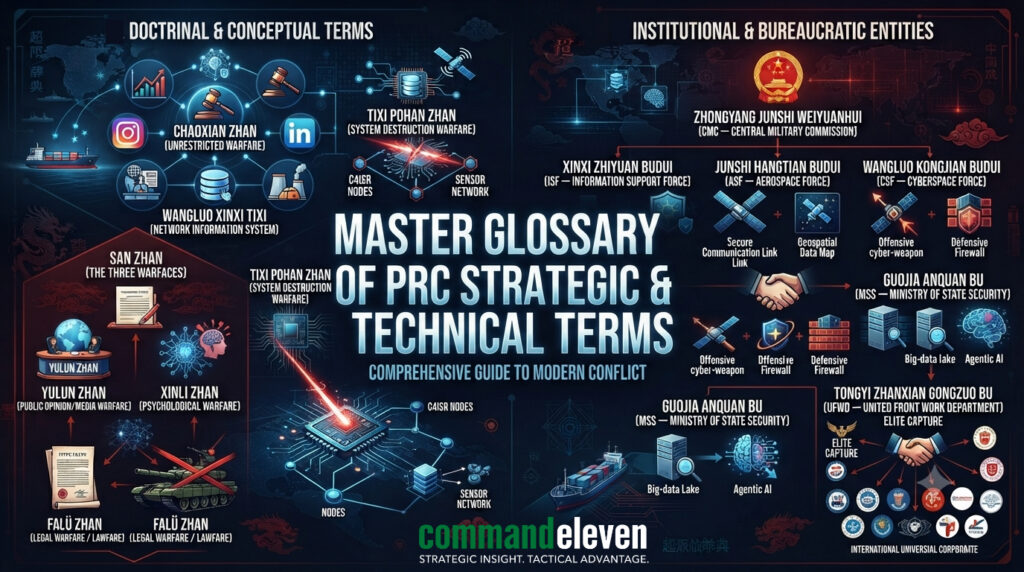
The defining characteristic of modern Chinese power is that the theoretical insights of the 1999 treatise have been institutionalized across the entirety of the state, military, and corporate bureaucracy. Unrestricted Warfare is not a rogue doctrine; it is the operational methodology driving the synchronization of the Information Support Force (ISF), the Ministry of State Security (MSS), and the United Front Work Department (UFWD).
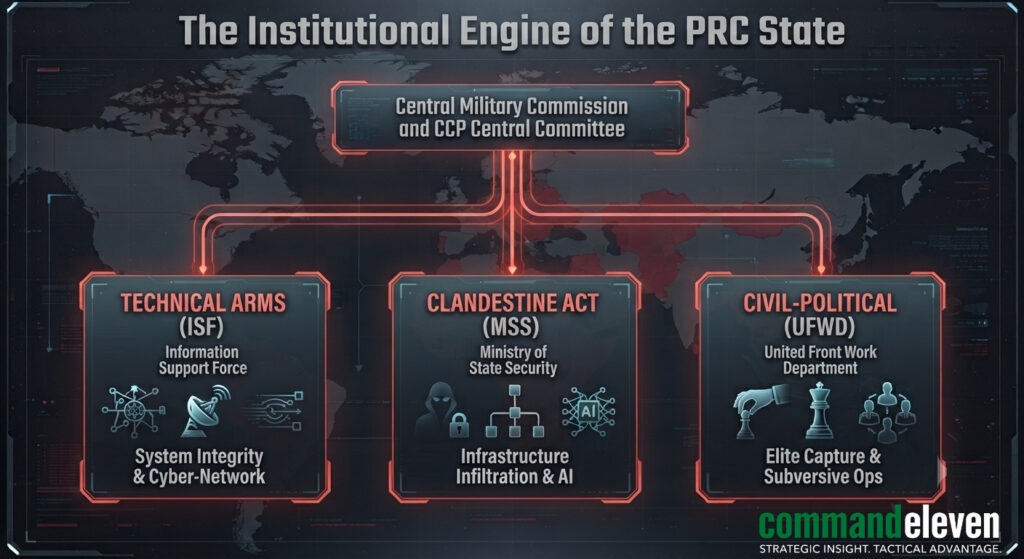
The execution functions through a clear division of state labor:
- The Technical Infrastructure (ISF): The Information Support Force manages the security, encryption, and operational integrity of the unified Network Information System. It ensures that China’s own C2 pipelines, big-data analytical hubs, and satellite communication networks are insulated from Western counter-strikes while managing the technical deployment systems for automated information warfare.
- The Offensive Cyber-Kinetic Engine (MSS): The Ministry of State Security operationalizes the cyber, data-harvesting, and infrastructure penetration vectors. By deploying elite cyber actor units alongside agentic AI analytics, the MSS extracts global psychographic data, targets critical Western telecom and energy networks, and provides the raw intelligence assets required to calibrate long-range perception-shifting campaigns.
- The Influence and Elite Capture Net (UFWD): The United Front Work Department manages the human and political layers of Unrestricted Warfare. Operating outside traditional diplomatic channels, the UFWD targets foreign academic institutions, corporate boardrooms, and political parties. Through economic incentivization, intellectual property acquisition, and the cultivation of influential proxy figures, the UFWD shapes foreign policy debates from within the adversary’s borders, neutralizing institutional resistance to Beijing’s geopolitical trajectory.
Strategic Defensive Countermeasures
The total integration of Unrestricted Warfare within the PRC apparatus means that Western national security architectures can no longer rely on traditional, compartmentalized defense strategies. Treating economic coercion, cyber penetration, and narrative manipulation as separate, non-military issues creates a structural blind spot that ensures steady strategic retreat.
To survive and neutralize this multi-axis assault, modern national security doctrines must implement three fundamental counter-strategies:
The Statutory Unification of National Defense
Democratic nations must legally expand their operational definition of national defense to match the reality of unrestricted conflict. This dictates the creation of centralized, inter-agency command frameworks that unify military intelligence, financial regulatory oversight, cybersecurity enforcement, and trade administration into a single operational interface.
Economic and corporate activities linked to state-backed entities must be evaluated through a strict national security lens. If a foreign corporate platform, infrastructure acquisition, or supply chain contract is verified as a delivery vector for Chinese state influence or data extraction, it must be legally interdicted and dismantled under emergency national defense statutes.
Comprehensive Supply Chain and Financial Hardening
Defensive frameworks must prioritize the total decoupling of critical technical, industrial, and financial sectors from the PRC ecosystem. This requires:
- Mandatory Mineral Onshoring: Establishing independent, resilient processing supply chains for rare earth elements and critical minerals within allied territories, completely eliminating dependency on Chinese state monopolies.
- The Invalidation of Extraterritorial Jurisdiction: Western states must pass aggressive defensive legislation that shields domestic corporations, tech vendors, and academic institutions from compliance with China’s National Intelligence and Data Security laws, implementing severe criminal penalties for any corporate entity that streams Western citizen metadata back to PRC-localized servers.
A Proactive Asymmetric Information Offensive
Passive fact-checking and defensive cybersecurity measures are insufficient against a scalable, automated cognitive engine. Allied intelligence agencies must launch a proactive information offensive that targets the core existential vulnerability of the PRC state: its absolute paranoia regarding domestic stability and control.
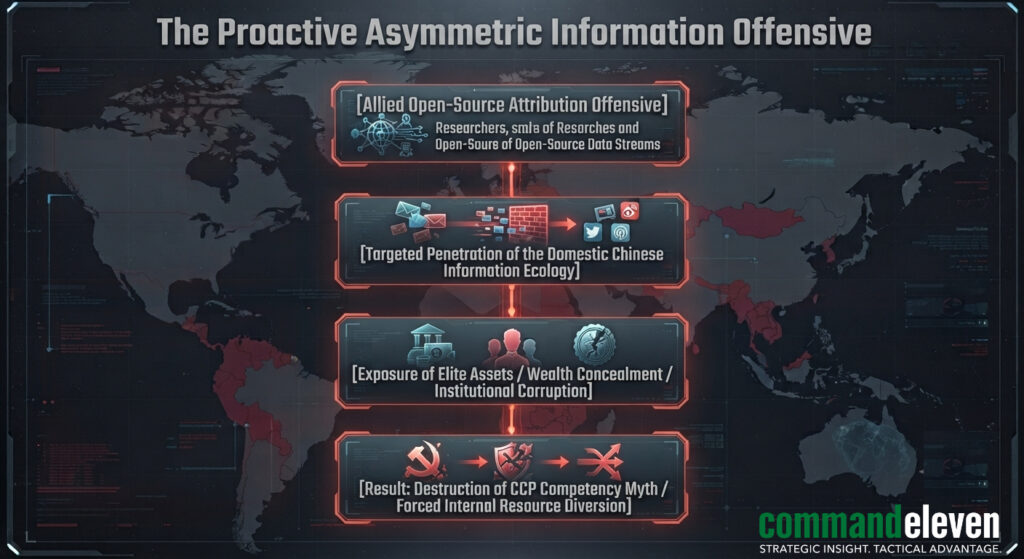
Allied operations must aggressively declassify, translate, and inject high-fidelity intelligence regarding the internal vulnerabilities of the CCP leadership directly into the domestic Chinese information ecology. By exposing the hidden financial assets held abroad by senior party elites, the pervasive corruption inside the PLA procurement networks, and the economic systemic strains hidden by state statistics, allied networks can destroy the myth of absolute administrative competence propagated by the party.
Forcing Beijing to confront sudden, unmanageable domestic political friction and internal narrative instability will compel the state apparatus to redirect its technical, cyber, and intelligence resources inward to maintain regime survival, effectively blunting its capacity to execute long-range cognitive subversion against the Western hemisphere.