
Executive Summary
The character of contemporary conflict has mutated, outpacing the classical frameworks established under the Geneva Conventions and traditional International Humanitarian Law (IHL). The modern battlespace is no longer defined by linear geographic fronts or distinct physical domains. Instead, commanders operate within an environment characterized by cyber-kinetic convergence, algorithmic processing speeds, and persistent, total surveillance.
This transformation creates profound systemic friction. The core tenets of the Law of Armed Conflict (LOAC),Distinction, Proportionality, and Precautions,are not legally invalidated by technological progress, but their practical execution has been structurally altered.
This five-volume series serves as a definitive operational manual for intelligence planners, legal advisors, and theater commanders, bridging the gap between legacy doctrine and multi-domain reality.
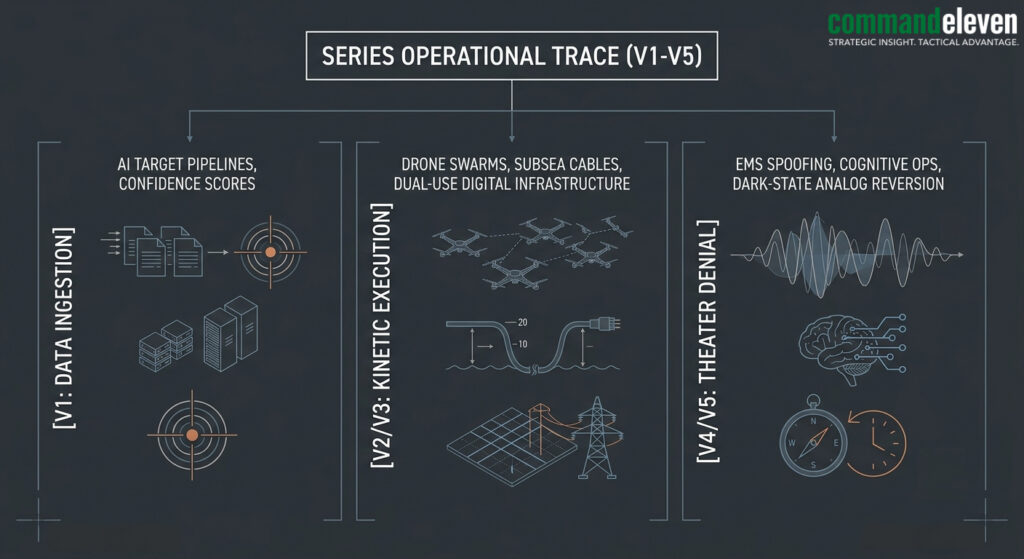
Series Structural Blueprint
The compendium systematically transitions from backend automated decision loops to physical execution at the tactical edge, concluding with the legal parameters for non-kinetic and degraded operations.
- Volume 1: The Algorithmic Kill-Chain , Sensor-to-Shoot Automation Under LOAC
An interrogation of automated target generation systems (ATGS), addressing machine learning classification models, statistical confidence thresholds, automation bias, and adversarial data poisoning vectors. - Volume 2: Unmanned Systems and Dynamic Mass Expenditure
A tactical analysis of decentralized drone swarms, edge-computed strike allocation, and the legal paradoxes introduced by mass expendable munitions in high-density urban geography. - Volume 3: Cyberspace, Subsea Infrastructure, and Dual-Use Thresholds
A guide defining the exact parameters where digital manipulation crosses the physical threshold into a kinetic effect, with specific focus on subsea fiber-optic cables and the sovereign cloud. - Volume 4: Electromagnetic Spectrum Denial & Cognitive Warfare
An operational framework governing wide-area GNSS spoofing, electronic navigation denial, and the boundary where synthetic media (deepfakes) violates the absolute prohibition against perfidy. - Volume 5: The Degraded-Environment Playbook (“LOAC in the Dark”)
A contingency manual for peer-on-peer operations under total communications blackout, establishing the rules for manual positive identification (PID) and unguided munitions deployment.
Consolidated Operational Axioms
The cumulative assessments compiled across this series yield four foundational axioms for modern multi-domain operations. These principles dictate that technological complexity neither dilutes command responsibility nor excuses indiscriminate methods of warfare.
Axiom 1: Probabilistic Logic Cannot Override Binary Legality
Algorithms operate on statistical correlation, producing target profiles with variable confidence metrics (e.g., “92% Probability”). Conversely, operational law demands the complete elimination of reasonable doubt before weapon release. A high confidence score does not equal positive identification (PID).
Axiom 2: The Physicality of Effect Dictates the Law
The medium of an attack,whether a digital payload delivered via fiber-optic networks or a kinetic shell delivered via artillery,is legally irrelevant. If a cyber or electronic operation causes structural failure, injury, or systemic societal collapse, it is measured by its physical consequences and bound entirely by traditional LOAC targeting constraints.
Axiom 3: Mass Expenditure Exposes the Commander to Systemic Liability
The deployment of autonomous networks or mass loitering munitions does not distribute legal culpability. If a decentralized system’s operational tempo or network architecture prevents a human commander from predicting its kinetic outcomes with precision, the launch sequence violates the structural prohibition against indiscriminate warfare.
Axiom 4: Technical Blindness Demands Tactical Restriction
When electronic warfare or kinetic anti-satellite actions plunge the theater into a degraded “dark” state, compliance baseline requirements remain static. If a unit loses precision-guided capabilities and live sensor feeds, it must restrict its offensive profile, reverting to manual visual verification and tight geographic containment zones rather than resorting to area-saturation tactics.
Operational Core Directive: Technology alters the speed, means, and methods of modern warfare, but it cannot alter the fundamental obligations of the state. The ultimate authority to execute lethal force remains a uniquely human responsibility, anchored by manual verification, explicit command sign-off, and unmediated legal accountability at the point of release.
Operational Framework: The Rules of the Modern Battlefield
This master blueprint integrates structural international humanitarian law (IHL) with the tactical realities of multi-domain, high-latency conflict.
Layer 1: The Doctrinal Baseline (Systemic Architecture)
This layer establishes the baseline legal thresholds and analytical methodologies required to evaluate modern operations under the Law of Armed Conflict (LOAC).
The Redefined Principle of Distinction
- Dual-Use Virtual & Physical Nodes: Methodology for classifying infrastructure that simultaneously services military command-and-control (C2) and civilian survival (e.g., cloud computing enclaves, subsea fiber-optic cables, localized power distribution grids).
- Data as a Protected Object: Legal and technical criteria to determine when the manipulation, corruption, or erasure of adversary operational data crosses the threshold into property destruction under the Geneva Conventions.
- Dynamic Combatant Status: Protocols for identifying and classifying non-state actors, civilian cyber operators, and private contractors executing kinetic or digital effects within the battlespace.
Algorithmic Proportionality Assessments
- Collateral Damage Estimation (CDE) in High-Velocity Cycles: Standardized formulas to balance the anticipated concrete and direct military advantage against systemic, cascading secondary effects on civilian populations.
- Quantifying Non-Kinetic Harm: Frameworks for assessing the human cost of long-term infrastructure degradation (e.g., water treatment failures caused by cyber operations or electronic warfare denial).
Layer 2: Core Operational Drivers (High-Impact Technical Components)
This layer isolates the specific technological friction points where traditional rules fail or mutate under battlefield conditions.
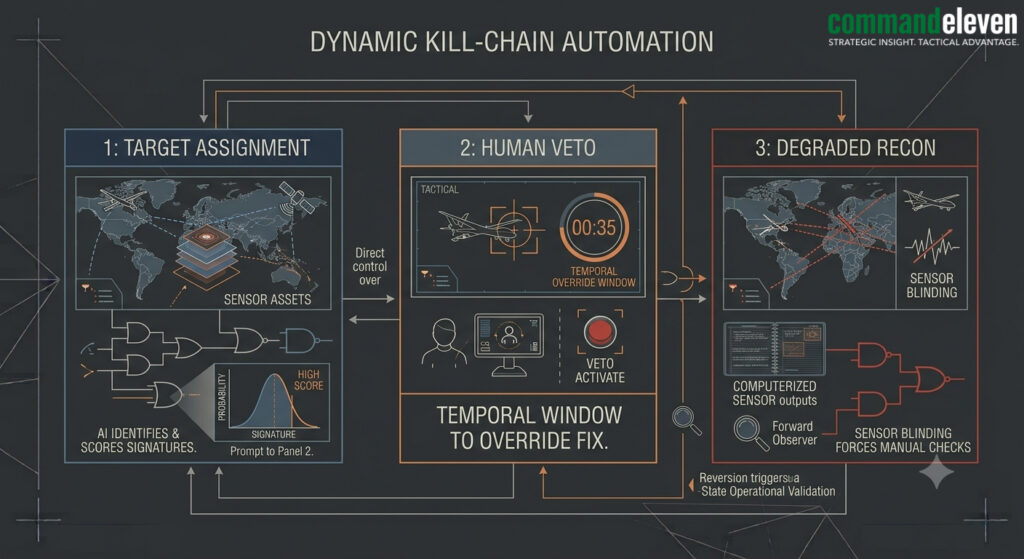
The Sensor-to-Shoot Pipeline & Algorithmic Target Generation
- Automation Bias Mitigation: Operational checklists designed to counteract human analyst complacency when validating AI-generated target packages during high-intensity operations.
- Confidence Score Verification: Establishing mandatory verification protocols before an automated target signature (derived from electronic emissions, biometric tracking, or pattern-of-life analysis) can be authorized for kinetic release.
- Adversarial Countermeasures: Assessing target validity when an adversary utilizes data poisoning, machine learning spoofing, or physical decoys designed to trick autonomous sensor suites.
Unmanned Systems and Dynamic Mass Expenditure
- Autonomous Swarm Allocation: Defining legal and command accountability when decentralized drone swarms dynamically distribute targets via edge computing without individual human authorization for each strike.
- The Urban FPV Paradox: Tactical guidelines for the mass deployment of First-Person View (FPV) loitering munitions in dense urban terrain, where the tempo of engagement outpaces traditional legal review structures.
Electromagnetic Spectrum Denial & Cognitive Warfare
- Navigation and Timing Denial: Evaluating the legality of wide-area GPS/GNSS spoofing and jamming operations that systematically impact non-belligerent commercial aviation, maritime transport, and search-and-rescue infrastructure.
- Synthetic Media and Perfidy: Defining the operational boundaries of psychological operations (PSYOPs) involving deepfakes or AI-generated messaging to ensure they do not violate the absolute prohibition against treacherous means of warfare.
The Degraded-Environment Playbook (“LOAC in the Dark”)
This section serves as a contingency framework for peer-on-peer conflicts where electronic warfare and anti-satellite (ASAT) strikes have systematically neutralized modern command infrastructures.
| Operational Condition | Doctrinal Baseline Requirement | Tactical Adjustment Protocol |
| Loss of Precision Munitions (PGMs) | Maintenance of Distinction and Proportionality standards under high circular error probable (CEP) conditions. | Strict geographic containment zones; mandatory shift from spot-targeting to area-denial thresholds near populated sectors. |
| Compromised C2 / Total Comms Isolation | Maintenance of clear chains of legal accountability despite fractured command links. | Reversion to rigid, pre-delegated Rules of Engagement (ROE); tactical liability shifts directly to local field commanders. |
| Denied ISR / Blind Sensors | Positive identification (PID) must be achieved before kinetic authorization. | Elimination of predictive or signature-based targeting; mandatory reversion to legacy human intelligence (HUMINT) and physical reconnaissance verification. |
Analytical Standard: This dual-layer structure ensures the final product functions simultaneously as a definitive reference for legal compliance (Layer 1) and an essential tactical manual for modern multi-domain planners (Layer 2).
Operational Understanding
The shifting character of contemporary conflict has fundamentally strained the traditional frameworks governing the use of force, Jus ad Bellum, and conduct during hostilities, Jus in Bello. As cyber-kinetic convergence, algorithmic targeting, and persistent multi-domain surveillance render the theater of operations entirely transparent, the structural application of the Law of Armed Conflict (LOAC) faces deep operational friction.
A rigorous, high-fidelity guide to the rules of the modern battlefield must reconcile classical international humanitarian law (IHL) with the current technological reality.
Core Structural Principles Under Tension
The foundational pillars of Customary IHL remain legally binding regardless of technological evolution, yet their operational execution has been altered by automation and remote systems.
The Principle of Distinction
Belligerents must at all times differentiate between combatants and military objectives, and civilians and civilian objects.
- Modern Friction: The ubiquity of dual-use infrastructure,specifically commercial satellite networks, subsea fiber-optic data cables, and civilian cloud architectures,creates deep legal ambiguity. Under Article 52(2) of Protocol I, an object must offer a “definite military advantage” upon neutralization to be deemed a valid target.
- The Reality: Intertwined digital architecture means a kinetic or cyber strike on an adversary’s military command-and-control node frequently degrades local civilian telecommunications, energy grids, and emergency services simultaneously.
The Principle of Proportionality
An attack is prohibited if the anticipated incidental loss of civilian life, injury to civilians, or damage to civilian objects is excessive in relation to the concrete and direct military advantage anticipated.
- Algorithmic Inflation: The integration of AI-driven target generation systems,which compress the traditional kill chain,tends to artificially inflate the perceived “military advantage” of a strike package during high-intensity peer-on-peer operations.
- Collateral Quantification: When automated systems assign confidence scores to human or structural targets, human analysts are prone to automation bias, accepting algorithmic collateral estimates without verifying ground-level civilian density or systemic secondary effects (e.g., the long-term public health fallout of destroying power plants).
The Operational Rules of Multi-Domain Conflict
Modern engagement rules are defined by specific operational domains that did not exist when the Geneva Conventions were codified. Modern warfare has now crossed over 3 domains the Geneva Conventions never envisioned:
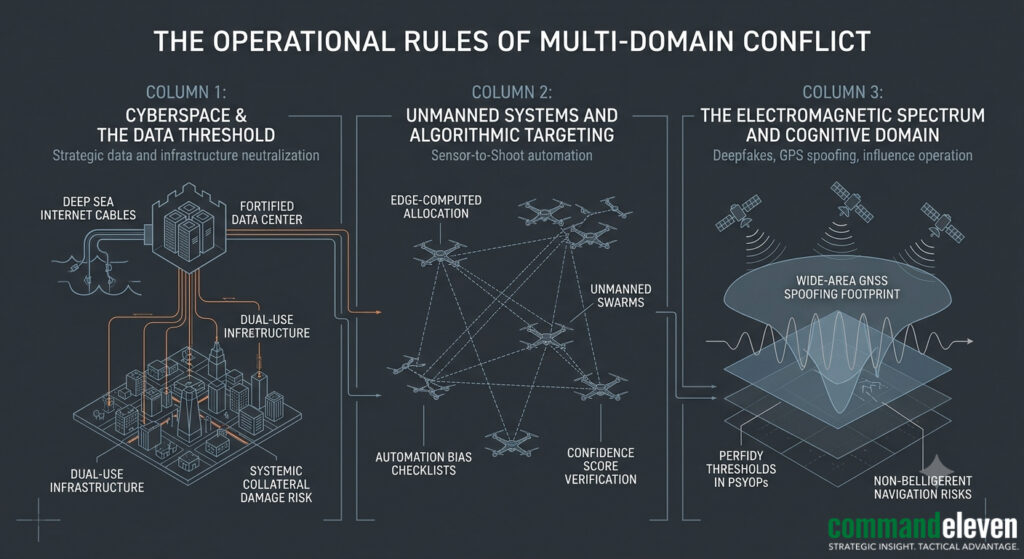
Cyberspace & The Data Threshold
- Status of Data: A primary legal debate centers on whether civilian data constitutes an “object.” If data is not legally classified as an object, its manipulation or destruction does not technically violate the rule of distinction under traditional definitions. However, standard operational doctrine increasingly dictates that if the corruption of data leads to physical, kinetic consequences (e.g., manipulating a dam’s control software to cause downstream flooding), it crosses the threshold of a kinetic attack.
- Strategic vs. Tactical Exploitation: Cyber operations are shifting from tactical battlefield support to strategic societal disruption. Disrupting an adversary’s domestic financial routing networks or public infrastructure to erode political resilience often flirts with the unlawful targeting of civilian morale.
Unmanned Systems and Algorithmic Targeting
- The Human-in-the-Loop Imperative: Current operational law mandates that a human operator must retain a genuine veto at the selection and execution phases of a lethal strike pipeline. Fully autonomous weapon systems (LAWS) that select and engage targets via sensory signatures without human intervention remain highly restricted due to their inability to assess contextual variables inherent to “reasonableness” and “doubt.”
- Mass vs. Precision Paradox: First-Person View (FPV) drones and coordinated drone swarms are marketed as high-precision instruments. However, mass deployment in dense urban zones often results in de facto indiscriminate warfare when the operational speed exceeds the processing capacity of tactical legal reviews.
The Electromagnetic Spectrum and Cognitive Domain
- GPS Spoofing and Navigation Denial: Denying positioning and timing data to an adversary is a legitimate method of warfare. However, localized electronic warfare (EW) that causes non-belligerent maritime commercial transport or civilian aviation to drift into hazardous areas violates the obligation to take feasible precautions in planning attacks.
- Information Operations: While psychological operations (PSYOPs) are permissible, the deployment of synthetic media (deepfakes) to falsify humanitarian corridors or mask chemical/biological incidents violates basic tenets of good faith and the prohibition against treacherous means of warfare (perfidy).
The “LOAC in the Dark” Framework
A critical emerging vulnerability is the total degradation of technological capabilities in a near-peer or peer-on-peer conflict. When satellite reconnaissance, secure satellite communications, and precision-guided munitions (PGMs) are neutralized via kinetic anti-satellite (ASAT) strikes or electronic jamming, commanders face “LOAC in the Dark.”
| Operational Condition | Legal Consequence / Expectation |
| Loss of Precision Guided Munitions (PGMs) | Reverting to unguided, dumb artillery forces reliance on area-denial tactics. This drastically raises the legal threshold for proving an attack meets proportionality standards in proximity to populated areas. |
| Degraded Intelligence, Surveillance, & Reconnaissance (ISR) | The legal standard of “reasonable commander” shifts. Without live sensor feeds, a commander must rely on potentially stale human intelligence (HUMINT), increasing the legal risk under the rule of precautions. |
| Compromised Command & Control (C2) | Decentralized execution means tactical sub-units must operate under highly rigid, pre-approved Rules of Engagement (ROE), shifting legal accountability from centralized joint-staff command elements down to local field officers. |
Operational Directive: Technology changes the means and methods of warfare, but it does not alter the obligations of the law. Operational efficiency or compressed latency can never be used as a legal justification for bypassing the requirement to verify a target’s military status or to calculate potential civilian blowback.