
Technical Takeaways
- Continuous Strategic State Action: Unlike Western Information Operations, which function as localized tactical support mechanisms deployed exclusively within defined operational windows, San Zhan is non-linear and permanent. It recognizes no operational boundary between peacetime and active conflict, functioning as an omnipresent strategic campaign to shape international legal regimes and adversary threat perceptions.
- Friction-Based Policy Paralysis: Legal Warfare (Lawfare) operates by engineering a veneer of historical and domestic legitimacy over clear gray-zone violations. By embedding complex, fabricated statutory challenges into international frameworks, the doctrine forces democratic leadership structures into protracted legalistic reviews, creating policy friction that delays or eliminates the political will to deploy physical military assets during a developing crisis.
- Systemic Centralization Fragility: The San Zhan architecture relies on strict ideological alignment with the central leadership directives of the Central Military Commission. This rigid, top-down structure creates a significant institutional vulnerability. The system is naturally fragile when confronted with rapid, unpredictable counter-narratives that target internal corruption, elite financial exposures, or domestic civilian friction inside the state apparatus.
Executive Summary
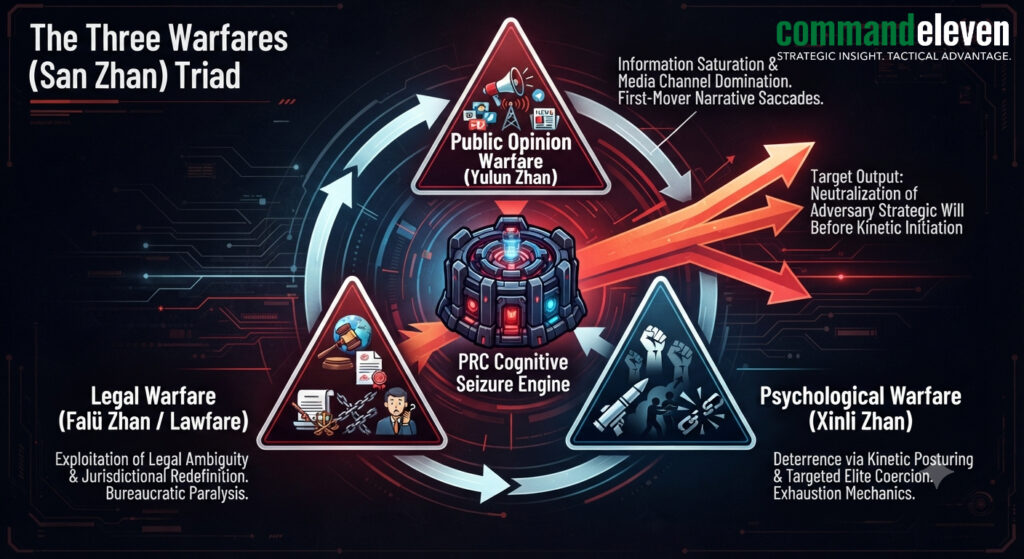
This dossier delivers a structural analysis of the People’s Liberation Army (PLA) conceptual framework known as The Three Warfares (San Zhan , 三战). Originally codified into the formal Political Work Regulations of the Chinese People’s Liberation Army in 2003 and updated in 2010, San Zhan represents a fundamental departure from Western concepts of information operations. Rather than acting as a tactical capability deployed to support physical maneuvers during active hostilities, the Three Warfares operate as a continuous, state-level strategic mechanism designed to control the psychological, legal, and informational terrain during peacetime, gray-zone competition, and open conflict.
The doctrine integrates three mutually reinforcing vectors: Public Opinion Warfare, Psychological Warfare, and Legal Warfare (Lawfare). The strategic objective is not the destruction of enemy forces, but the neutralization of the adversary’s political will, the fragmentation of domestic and international alliances, and the pre-emptive seizure of cognitive dominance. By altering the conceptual framework through which an adversary perceives reality, San Zhan seeks to compel submission to the strategic interests of the People’s Republic of China (PRC) without requiring the initiation of conventional kinetic conflict.
Doctrinal Lineage and Theoretical Foundations
The Historical Shift
The conceptual foundations of San Zhan are rooted in classical Chinese strategic thought, specifically the Sun Tzu premise that the supreme art of war is to subdue the enemy without fighting. However, its modern institutionalization was accelerated by the PLA’s intensive study of Western military performance during the 1991 Gulf War, the 1999 Kosovo Campaign, and the 2003 invasion of Iraq.
PLA theorists observed that the United States and its allies maintained overwhelming conventional and technological superiority in the physical domains (land, sea, air, space). Concurrently, they recognized that the decisive vulnerability of modern democratic states lay within the cognitive and political dimensions: public opinion, legal justification, and psychological endurance.
Contrast with Divergent Frameworks
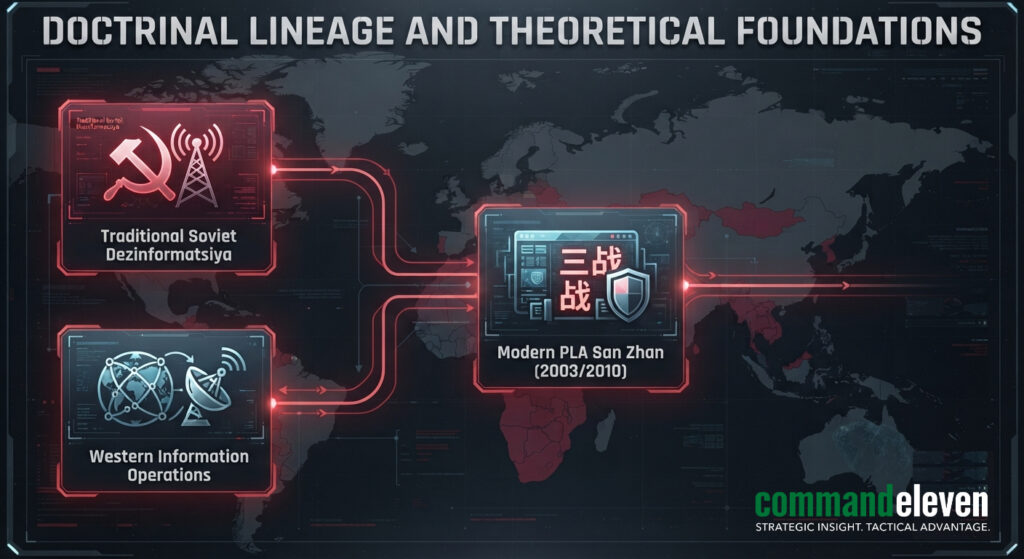
To understand the operational profile of San Zhan, it must be contrasted against Soviet-era subversion models and contemporary Western Information Operations (IO):
- Soviet Dezinformatsiya vs. San Zhan: Traditional Soviet active measures focused primarily on covert destabilization, ideological subversion, and the long-term erosion of societal trust from the bottom up. San Zhan is distinct in its highly institutionalized, top-down integration directly into military command structures. It operates out of the PLA Political Work Department and is synchronized directly with state administrative, legal, and economic instruments to achieve specific, state-directed geopolitical outcomes.
- Western IO vs. San Zhan: Western doctrine treats information operations primarily as a support mechanism designed to shape the information environment, achieve localized operational security, or degrade enemy command and control networks during a defined campaign. Conversely, San Zhan is non-linear and permanent. It recognizes no boundary between peacetime and wartime. It functions as an omnipresent strategic campaign targeting foreign decision-makers, regional populations, and international legal regimes simultaneously.
The Triad Mechanics: Operationalizing the Vectors
The Three Warfares function as an integrated operational triad. Each vector targets a specific layer of the adversary’s national power architecture, executing coordinated actions to achieve systemic paralysis.
Public Opinion (Media) Warfare , Yulun Zhan
Public Opinion Warfare is the systematic exploitation of global and domestic information channels to guide public perception, manipulate narrative frameworks, and secure political dominance. It acts as the primary transmission belt for the other two vectors, ensuring that Beijing’s strategic messaging is continuously infused into the global consciousness.
- Tactical Execution: Operationally, Yulun Zhan relies on a combination of overt state media dissemination (e.g., CGTN, Xinhua), covert cyber-enabled amplification networks, and the strategic cultivation of foreign elite proxies in academia, journalism, and politics.
- The Content Engine: The narrative architecture is engineered around the principles of “first-mover advantage” and saturation. During a developing crisis, Chinese information nodes rapidly deploy highly structured, state-sanctioned narratives to fill the informational vacuum, establishing an interpretive baseline before Western or regional competitors can formulate a response.
- Algorithmic Injection: The vector increasingly utilizes advanced computational propaganda, deploying automated bot swarms and deep-learning algorithms to map foreign psychological profiles, identify societal fault lines, and amplify divisive or compliant viewpoints within the adversary’s domestic information ecosystem.
Psychological Warfare , Xinli Zhan
Psychological Warfare targets the cognitive processing, emotional stability, and resolve of the adversary’s civilian population, political leadership, and military personnel. Its primary purpose is to induce shock, demoralization, and cognitive dissonance, thereby undermining the will to resist or intervene against PRC initiatives.
- Tactical Execution: Xinli Zhan combines explicit military signaling with targeted psychological conditioning. This involves the highly publicized deployment of advanced military hardware, live-fire drills timed to political events, and the strategic leaking of next-generation capabilities (e.g., hypersonic glide vehicles, anti-satellite testing) to project an aura of technological inevitability.
- Cognitive Degradation: On a granular level, Psychological Warfare targets individual decision-makers and high-value demographics. By combining cyber-harvested psychographic data with targeted intimidation or incentivization campaigns, it seeks to convince foreign elites that resistance to Beijing’s geopolitical trajectory is economically catastrophic and militarily futile.
- Coercive Messaging: The overarching theme is designed to force a binary choice within the adversary’s mind: accept a structural fait accompli or risk catastrophic, uncontainable kinetic escalation.
Legal Warfare (Lawfare) , Falü Zhan
Legal Warfare is the weaponization of domestic, international, and institutional legal frameworks to assert sovereignty, justify unilateral state actions, restrict adversary operational freedom, and compromise foreign defensive alignments.
- Tactical Execution: Falü Zhan operates by fabricating or manipulating historical precedents, bilateral treaties, and domestic legislation to create a veneer of absolute legality for legally dubious gray-zone actions. This includes the unilateral declaration of Air Defense Identification Zones (ADIZ), the redefinition of internationally recognized maritime boundaries, and the domestic codification of extraterritorial jurisdictional claims (e.g., the National Intelligence Law of 2017 and the Coast Guard Law of 2021).
- Operational Restriction: By embedding legal challenges into international bodies, China forces Western and regional legalistic systems into protracted, bureaucratic reviews. For democratic leadership structures, this creates significant policy friction, introducing legal risk and ambiguity that delays or completely paralyzes the decision to deploy military assets during the critical initial phases of a crisis.
Empirical Application: The South China Sea and Taiwan Strait
The operational efficacy of San Zhan is most clearly demonstrated in its synchronized deployment across the First Island Chain, specifically within the South China Sea (SCS) theater and the Taiwan Strait.
Case Study 1: The South China Sea Enclosure Campaign
The transformation of the South China Sea from a disputed maritime commons into a fortified, PRC-dominated zone represents a classic execution of the Three Warfares triad operating in absolute synchronization.
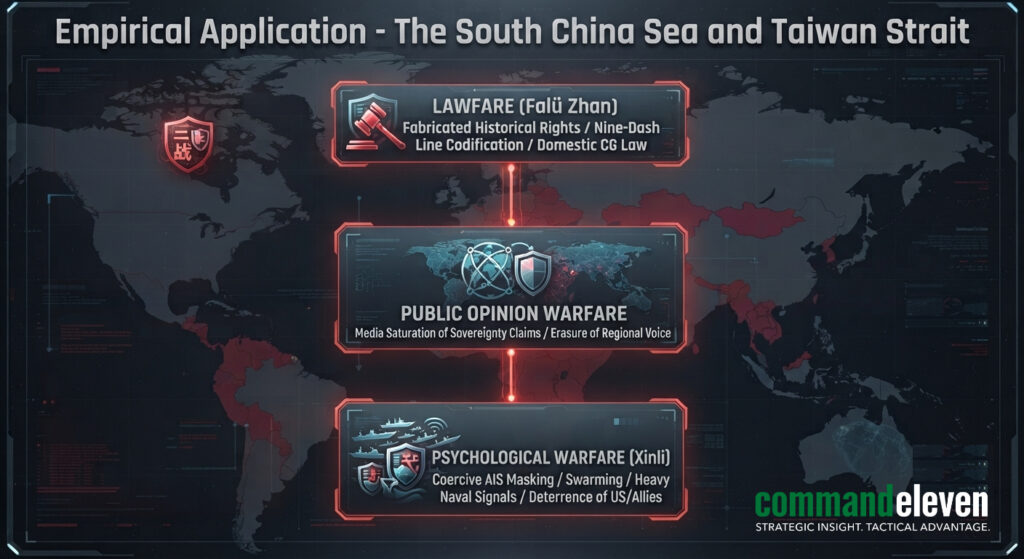
- The Lawfare Foundation: Beijing initiated the campaign by asserting “historical rights” over the area enclosed by the Nine-Dash Line, systematically embedding this claim into domestic maritime legislation. By passing the 2021 Coast Guard Law, which explicitly authorizes the use of force against foreign vessels in claimed waters, China unilaterally altered the legal baseline, shifting the burden of escalation onto regional neighbors and international freedom of navigation operations (FONOPs).
- Public Opinion Symmetrical Action: Simultaneously, Public Opinion Warfare networks saturated global and regional media with historical narratives framing China’s island-building activities as peaceful, ecologically conscious infrastructure projects designed to provide public goods (e.g., maritime search and rescue). Regional protests were systematically reframed as Western-instigated provocations designed to destabilize regional harmony.
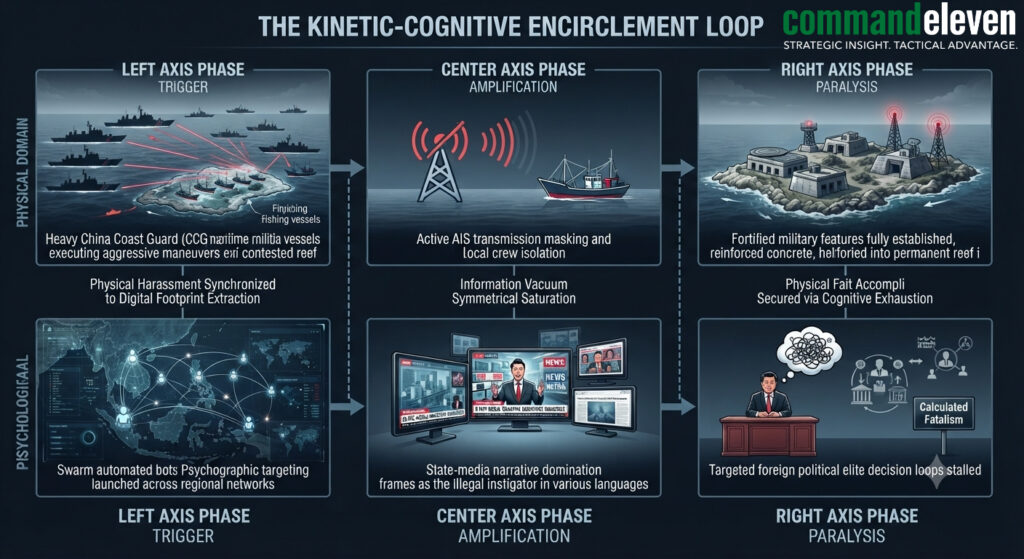
- Psychological Deterrence Execution: Underneath this legal and media cover, Psychological Warfare was deployed against regional coast guards and militaries. The continuous, aggressive swarming of contested features (such as Scarborough Shoal or Second Thomas Shoal) by the People’s Armed Forces Maritime Militia (PAFMM), backed by heavily armed China Coast Guard (CCG) hulls and visible PLA Navy (PLAN) capital ships, created an overwhelming psychological environment of asymmetric escalation.
Regional crews were subjected to persistent harassment (water cannons, military-grade lasers, acoustic devices) designed to induce fatigue, fear, and institutional resignation. The operational calculus achieved its objective: China altered the physical status quo and constructed fortified airbases without triggering a kinetic intervention from the United States or regional treaty allies.
Case Study 2: The Cognitive Encirclement of Taiwan
The campaign targeting Taiwan demonstrates how San Zhan shifts from regional geographic isolation to systemic cognitive penetration of an adversary state.
- Strategic Objective: The primary goal is the systematic dismantling of the Taiwanese population’s psychological will to resist unification, while legally and geopolitically cutting off the island from international support structures.
- The Lawfare Domain: Falü Zhan focuses on the relentless manipulation of United Nations Resolution 2758. Beijing systematically propagates a revised legal interpretation that claims the resolution codified international acceptance of the “One China Principle” over Taiwan, attempting to transform any potential international intervention or cross-strait military support into an illegal violation of PRC sovereign territory.
- The Psychological-Media Matrix: Psychological and Public Opinion operations run concurrently. Daily gray-zone military incursions across the median line of the Taiwan Strait and into the southwestern ADIZ are not designed for physical invasion preparation; they are cognitive calibration exercises. They exhaust the Taiwanese air defense crews, desensitize global observers to high-intensity military posture, and provide the raw visual content for media campaigns emphasizing the absolute vulnerability of the island.
This is coupled with cyber-enabled disinformation campaigns targeting Taiwan’s civilian population. These operations exploit internal political polarization, amplify societal grievances, and systematically propagate the narrative that the United States is an unreliable strategic partner that will ultimately abandon Taipei during a crisis. The intended outcome is the cultivation of deep fatalism within the target population, forcing the conclusion that political capitulation is the only path to survival.Strategic Outlook and Institutional Vulnerability
As the PLA transitions further into the era of intelligentized warfare, the Three Warfares doctrine is undergoing a technological evolution. The integration of advanced generative artificial intelligence, large-scale psychographic data aggregation, and autonomous disinformation vectors allows for the near-total automation of perception-shifting campaigns. San Zhan is no longer restricted to traditional media or linear legal channels; it has become highly tailored, dynamic, and capable of operating at a scale and speed that can outpace democratic decision-making structures.
However, the highly centralized, top-down nature of the San Zhan architecture reveals a critical systemic vulnerability. Because the doctrine requires strict alignment with the ideological directives of the Central Military Commission (CMC) and the Chinese Communist Party (CCP) leadership, its narrative structures are fundamentally rigid and fragile when confronted with rapid, unpredictable structural disruption.
The system cannot easily adapt to or process counter-narratives that directly expose internal institutional corruption, elite financial vulnerabilities, or domestic civil friction within the PRC. Defensive national security frameworks seeking to neutralize San Zhan must move past passive fact-checking and defensive legal arguments.
True counter-strategy dictates the aggressive, proactive exploitation of Beijing’s internal structural contradictions, turning the transparency of open-source information into a direct threat to the highly insulated, authoritarian cognitive bubble of the PRC leadership.