
Technical Takeaways
- Bureaucratic Flattening for Hyper-Velocity C2: The dissolution of the Strategic Support Force (SSF) and the creation of the independent Information Support Force (ISF) removes an entire intermediate headquarters layer. This architectural shift grants the Central Military Commission direct operational control over the technical pillars of information dominance, streamlining the sensor-to-shooter kill chain for joint theater commanders during high-intensity regional contingencies.
- System Preservation as a Strategic Priority: Under the doctrine of System Destruction Warfare (Tixi Pohan Zhan), modern conflict is won by the side that maintains network integrity while severing the enemy’s interconnected systems. The ISF acts as the institutional guardian of China’s operational system, shifting the technical focus from localized tactical signaling to the continuous administration, encryption, and protection of the entire military network information framework.
- Vulnerability to Data Poisoning and Ingestion Corruption: The ISF’s reliance on automated big-data processing and machine-learning algorithms to integrate global intelligence sources creates a premium vulnerability. Because the force prioritizes high-speed distribution across the Network Information System, poisoning the automated data ingestion pipelines with deceptive telemetry will cause the ISF to rapidly propagate flawed operational assessments directly to joint force commanders.
Executive Summary
This dossier delivers an institutional and structural evaluation of the massive reorganization of the People’s Liberation Army (PLA) command architecture, executed by order of Central Military Commission (CMC) Chairman Xi Jinping. The restructuring dismantled the Strategic Support Force (SSF),established during the 2015–2016 reforms,and replaced it with a streamlined, direct-reporting command structure characterized as the system of “four services and four arms.”
The premier outcome of this bureaucratic shift is the creation of the Information Support Force (Xinxi Zhiyuan Budui , 信息支援部队), standing alongside two newly independent sibling components: the Aerospace Force (Junshi Hangtian Budui , 军事航天部队) and the Cyberspace Force (Wangluo Kongjian Budui , 网络空间部队).
This restructuring represents a significant adjustment in the PLA’s modernization trajectory. By revoking the intermediate SSF headquarters layer, the CMC has seized direct operational and administrative control over the technical pillars of information dominance.
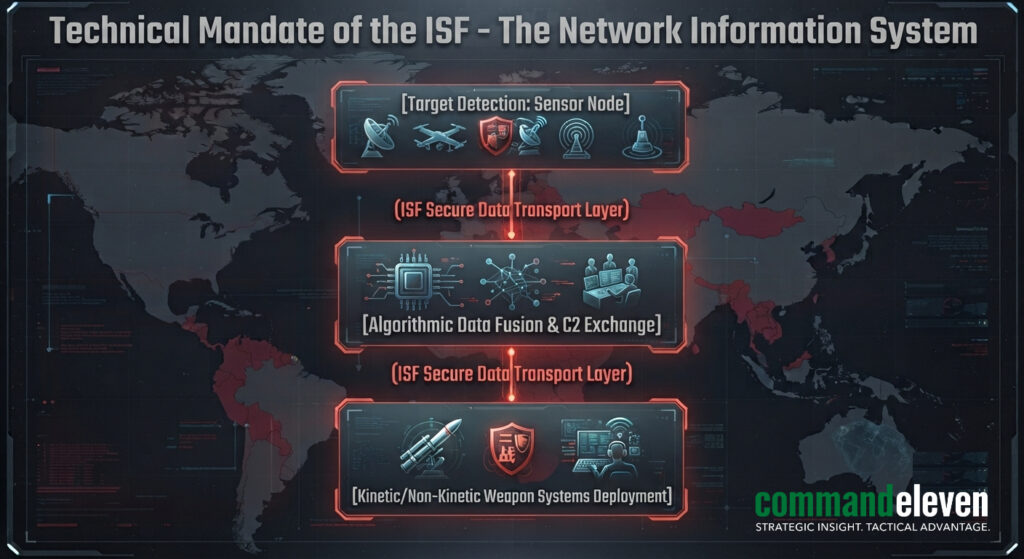
The mandate of the ISF is the centralized management, development, and execution of the PLA’s unified Network Information System (Wangluo Xinxi Tixi , 网络信息体系). This infrastructure serves as the fundamental technical backbone enabling multi-domain joint operations, real-time command and control (C2), big-data analytics, and the accelerated execution of “system destruction warfare” against Western national security architectures.
The Dissolution of the Strategic Support Force: Strategic and Operational Drivers
The dissolution of the SSF marks the first time a major Xi-era structural military reform has been completely overturned. For eight years, the SSF served as an incubator designed to foster synergies between space, cyber, electronic warfare, and psychological operations.
Its elimination indicates a calculated assessment by the CMC that the centralized, conglomerate model failed to deliver the operational agility required for high-intensity, intelligentized warfare.
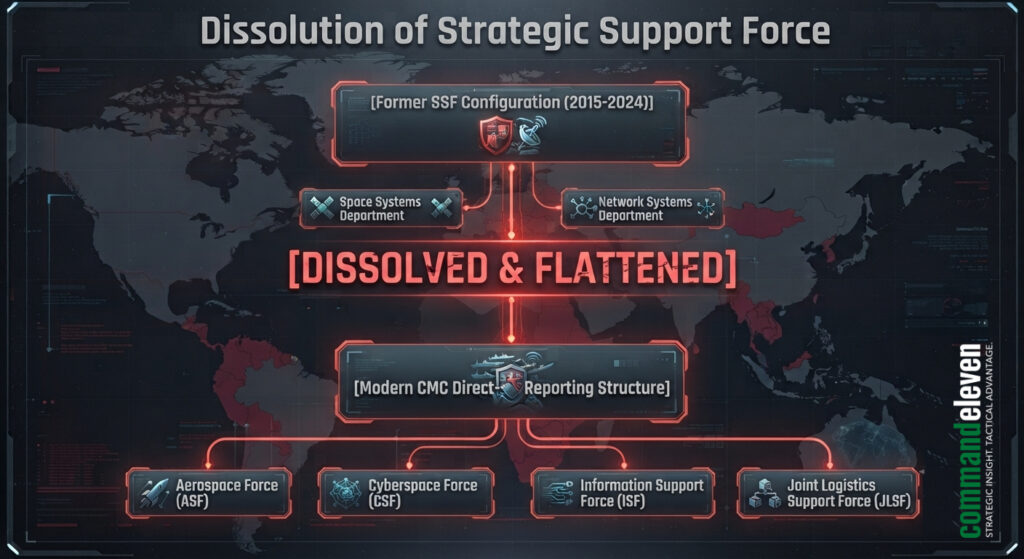
The transition was driven by three primary operational and political imperatives:
- The Elimination of Bureaucratic Layering: The SSF operated as a massive, top-heavy intermediate administrative layer sandwiched between the functional departments (Space and Network Systems) and the CMC. In a fast-moving crisis, this intermediate headquarters introduced unnecessary delay into the decision-making loop. By flattening the hierarchy, joint theater commanders can now interface directly with domain-specific forces, accelerating the sensor-to-shooter kill chain.
- Operational Friction and Integration Deficits: The SSF struggled to balance its status as an independent service branch with its mandate to act as a force-multiplier providing services to the geographic Theater Commands. Rather than seamlessly embedding information capabilities into joint warfighting formations, the SSF headquarters operated as an insular power center, leading to integration deficits during cross-service exercises.
- Anti-Corruption Cleansing and Regime Security: The dissolution coincided with widespread purges targeting high-level corruption within the PLA’s technical branches, including the Rocket Force and equipment procurement organs. The public disappearance and investigation of senior SSF leadership,including former commander General Ju Qiansheng,confirmed that systemic corruption had compromised the institutional integrity of the force. The restructuring allowed the CMC to break up legacy patronage networks, replace compromised personnel, and enforce absolute loyalty to the Chinese Communist Party (CCP) leadership.
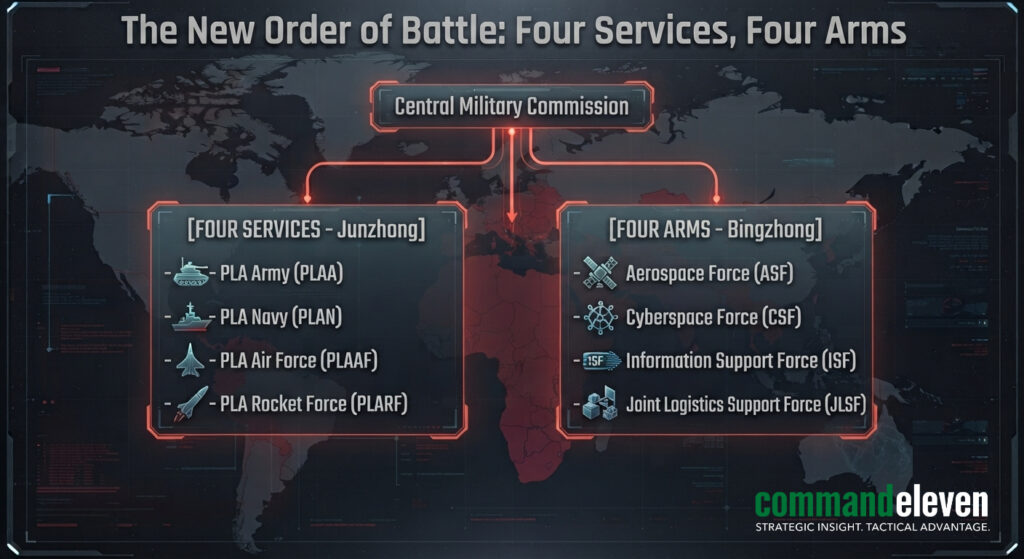
3. The New Order of Battle: Four Services, Four Arms
The current organization of the PLA splits capabilities into four traditional military services (Junzhong) and four specialized strategic arms (Bingzhong). All eight components report directly to the CMC, eliminating intermediate operational commands.
Protocol Seniority and the Information Operations Group
The functional interdependencies of these arms are maintained through an operational construct known as the Information Operations Group (IOG). While they parade and administer independently, the ASF, CSF, and ISF function as a single, integrated engine during active operations.
Protocol order reveals their relative seniority: the Aerospace Force (inheriting the legacy SSF Space Systems Department assets) ranks first; the Cyberspace Force (inheriting the Network Systems Department offensive/defensive cyber assets) ranks second; the Information Support Force holds the foundational supporting slot.
Technical Mandate of the ISF: The Network Information System
The ISF does not focus on kinetic delivery or offensive cyber-attacks. Its mandate is the preservation, management, and optimization of the PLA’s unified network information system,the critical terrain upon which all other capabilities depend.
The Foundation of System Destruction Warfare
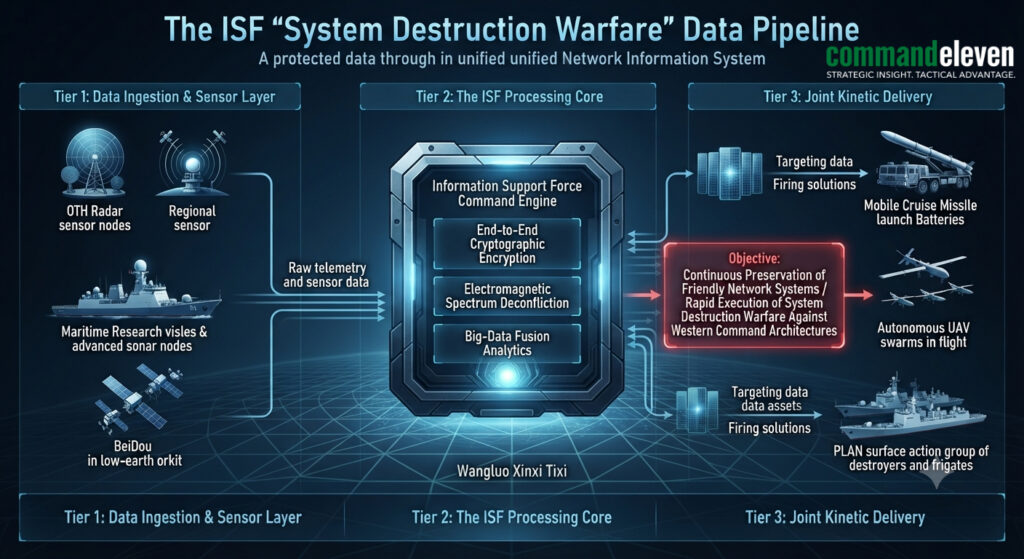
PLA doctrine dictates that modern conflict is not a clash of individual platforms (ships, aircraft, tanks), but an asymmetric confrontation between adversarial operational systems. Under this framework,System Destruction Warfare (Tixi Pohan Zhan , 体系破击战),victory goes to the side that can preserve its own complex informational and command networks while systematically degrading, severing, or blinding the enemy’s interconnected systems.
The ISF is the primary institutional protector of China’s own system integrity.
Core Functional Areas
- Communications and Network Assurance: The ISF manages the physical and digital architecture of the military internet, integrating secure fiber-optic terrestrial lines, satellite communication arrays, and tactical data links. It enforces end-to-end data encryption and cryptographic security protocols to prevent Western signals intelligence (SIGINT) penetration.
- Electromagnetic Spectrum Management: The force holds administrative authority over electromagnetic spectrum allocation across all service branches. This prevents mutual interference among friendly radar, electronic warfare, and communication systems during high-density joint operations, while coordinating defensive Electronic Counter-Countermeasures (ECCM).
- Geospatial, Meteorological, and Positional Support: The ISF oversees the military application of the BeiDou Navigation Satellite System, ensuring high-precision positioning, navigation, and timing (PNT) data is delivered securely to cruise missiles, unmanned aerial vehicles (UAVs), and naval vessels. It integrates military mapping, terrain visualization, and real-time combat weather forecasting into a single, accessible intelligence layer for joint commanders.
5. Strategic Implications and Defensive Countermeasures
The emergence of the ISF marks a significant shift in China’s preparation for high-tech regional conflicts, specifically a potential contingency over Taiwan or the East/South China Seas. By consolidating all communication, geospatial, and network defense assets into a single command, the PLA has streamlined its capacity to execute rapid, automated decision-making.
The ISF acts as the critical glue that transforms individual service actions into a synchronized, multi-axis offensive. It accelerates the speed of data transmission from sensors to shooters, allowing the PLA to execute long-range precision strikes against Western naval groups and forward bases with unprecedented velocity.
Targeted Exploitation Strategies
To neutralize the advantages offered by the ISF, defensive national security strategies must exploit the inherent vulnerabilities of a highly centralized network architecture:
- Targeted Node Interdiction: The consolidation of the Network Information System under a single force creates centralized infrastructure choke points. Western cyber and electronic warfare operations must shift focus from broad, distributed networks to the specific physical transit hubs, data centers, and landing stations managed directly by the ISF. Interdicting these key nodes can cause cascading systemic disconnects across the entire PLA joint force.
- Exploitation of Inter-Service Bureaucratic Friction: While the “four arms” model flattens the chain of command to the CMC, it introduces novel friction lines between the newly independent technical arms and the legacy combat services (Army, Navy, Air Force). Theater commanders no longer possess organic control over their primary informational infrastructure; they must request it from a separate arm. Cyber and cognitive operations should intentionally target these bureaucratic interfaces, injecting conflicting resource allocation data to exacerbate internal institutional friction and slow down operational execution.
- Algorithmic Corruption and Ingestion Poisoning: Because the ISF relies heavily on automated big-data processing and machine-learning algorithms to fuse intelligence, its data ingestion pipelines represent a premium target. Rather than attempting to block data transmission, defensive forces should feed highly sophisticated, deceptive, or corrupted telemetry data into PLA sensors. By poisoning the automated data ingestion layer, the ISF’s processing engines will generate flawed situational assessments, turning their speed into a liability by forcing the rapid dissemination of corrupted operational choices to joint force commanders.