
Technical Takeaways
- Overt Institutional Pivot for Strategic Shaping: Under Minister Chen Yixin, the Ministry of State Security has abandoned its traditional, highly compartmentalized shadow posture. By leveraging public communication networks to enforce continuous domestic vigilance and designate cyberspace as the premier battlefield, the MSS has transitioned to a proactive model of early warning and strategic shaping designed to contest international narratives in real time.
- Statutory Abolition of Private Data: The application of the National Intelligence Law of 2017 removes the concept of independent commercial operation within the PRC tech ecosystem. By compelling corporate entities to serve as frontline collection engines, the state converts foreign user behavioral metadata into centralized intelligence assets, eliminating traditional human collection bottlenecks through automated, agentic AI pattern extraction.
- Infrastructure Access as a Cognitive Force Multiplier: Long-range cyber campaigns executed by threat actors like Salt Typhoon demonstrate that infrastructure penetration is no longer restricted to industrial theft or potential sabotage. Infiltrating core routing systems and legal wiretap architectures grants the MSS direct, real-time visibility into the internal debates of foreign leadership cadres, allowing for the precise calibration of targeted subversion to paralyze adversary decision loops.
Executive Summary
This dossier delivers a strategic and operational analysis of the convergence between civilian intelligence collection and kinetic military application within the People’s Republic of China (PRC). Under the direction of Minister Chen Yixin, the Ministry of State Security (MSS) has undergone a profound bureaucratic transformation. Historically a covert, inward-facing counter-espionage and human intelligence (HUMINT) service, the modern MSS has emerged as an assertive, public-facing cyber-kinetic and cognitive actor.
This evolution is characterized by the systematic weaponization of advanced artificial intelligence (AI), mass psychographic profiling, and state-backed cyber-espionage groups (such as Volt Typhoon and Salt Typhoon).
The operational focus of the MSS has shifted from traditional industrial espionage to active, long-range perception-shifting campaigns across foreign target populations. By exploiting regulatory frameworks like the National Intelligence Law of 2017, the MSS forces civilian commercial technology assets, AI research entities, and global data supply chains into active intelligence pipelines.
The resulting infrastructure enables the precise synchronization of cyber-kinetic operations with automated, algorithmic cognitive warfare, directly threatening the societal cohesion and institutional decision-making architectures of Western and regional adversaries.
The Overt Transformation of the Ministry of State Security
The traditional profile of the MSS,defined by deep compartmentalization and absolute public invisibility,was dismantled following the appointments and consolidation of power under the current state leadership. Under Chen Yixin’s tenure, the MSS has integrated public communication channels, notably its official WeChat presence, directly into its operational posture.
This transformation from a shadow apparatus to an overt institutional voice serves critical domestic and international strategic imperatives:
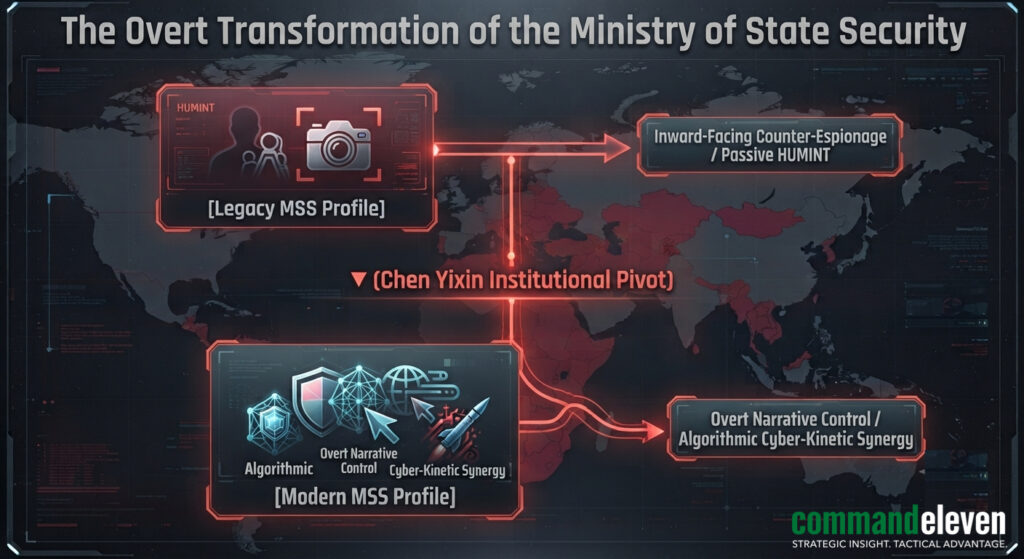
- Total Societal Mobilization: The modern MSS leverages public-facing campaigns to cultivate an environment of continuous vigilance within the Chinese domestic populace. By publishing detailed alerts regarding foreign espionage, critical mineral security, and anti-China narratives, the ministry operationalizes the “Overall National Security Outlook.” This effectively transforms civilian corporate enterprises, academic institutions, and individual citizens into active defensive nodes of the state security apparatus.
- Proactive Information Shaping: Minister Chen Yixin has explicitly mandated that state security work transition from a model of reactive response to one of early warning, rapid response, and proactive shaping. Cyberspace is officially designated as the premier strategic high ground and battlefield for major powers under conditions of advanced informatization. The overt posture allows the MSS to contest international narratives in real time, projecting state power and executing legal counter-sanctions while masking its continuous offensive cyber campaigns under a defensive, anti-hegemonic public framework.
The Data Harvesting Engine: Statutory and Technical Foundations
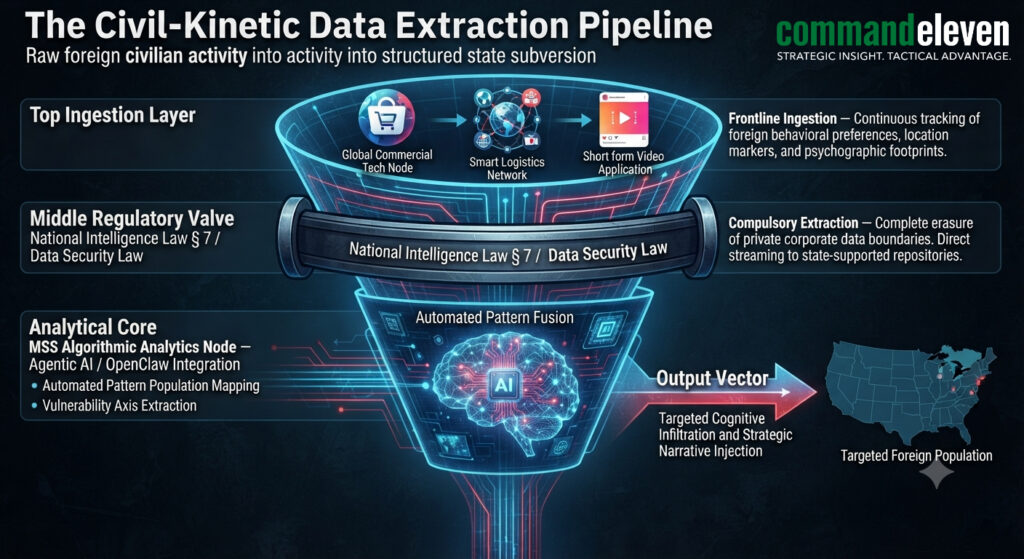
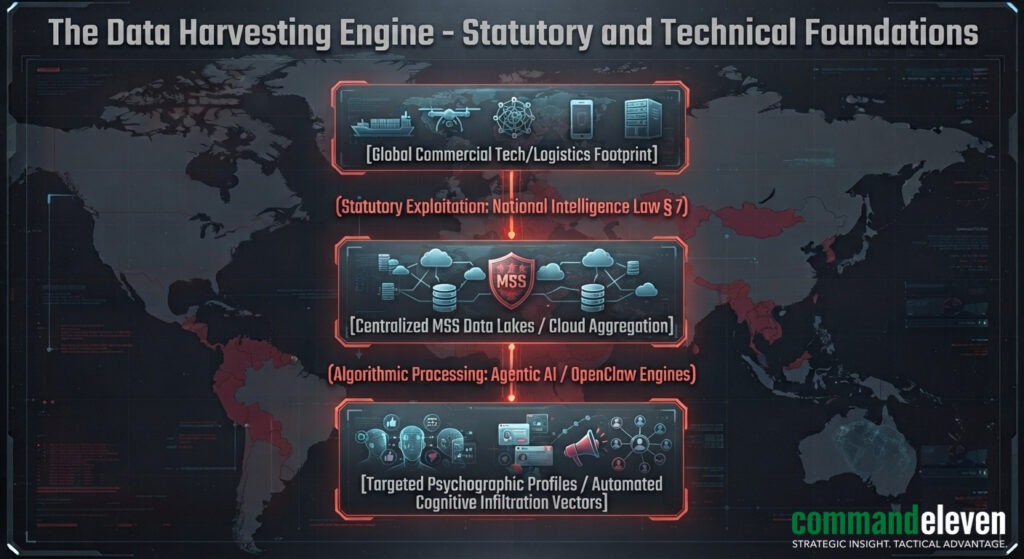
The operational efficacy of modern Chinese cognitive warfare depends on continuous access to vast, unstructured global data sets. The MSS does not operate in isolation; it utilizes a comprehensive statutory framework to turn the entirety of China’s domestic tech industry into a global data ingestion engine.
The Data Harvesting Engine
Statutory Extraction Mechanisms
The primary legal mechanisms driving this civil-kinetic convergence include:
- The National Intelligence Law of 2017 (Article 7): This statute explicitly mandates that all organizations and citizens shall support, assist with, and cooperate with state intelligence work according to the law, while guarding the secrecy of any state intelligence work they are privy to. This law effectively eliminates the concept of private corporate data or independent commercial operation within the PRC tech ecosystem.
- The Data Security Law and Personal Information Protection Law (PIPL): These statutes regulate data sovereign lines, forcing all data collected within the PRC to be localized and vetted. Crucially, recent updates to the Cybersecurity Law increase administrative and criminal liabilities for corporate operators failing to immediately report technical vulnerabilities or security defects to state monitoring organs. This ensures that the MSS maintains first-access monopolies over zero-day vulnerabilities discovered by Chinese security researchers before they are disclosed to global software vendors.
The Technical Processing Infrastructure
Once data is extracted via statutory mechanisms, it is processed through a highly sophisticated technical pipeline designed to convert raw telemetry into actionable cognitive profiles:
- Civilian Tech Exploitation: Corporate entities operating international e-commerce platforms, AI translation systems, smart logistics networks, and short-form video algorithms act as frontline collection nodes. Every interaction, location marker, biometric profile, and behavioral preference generated by foreign users is streamed back to domestic data infrastructure.
- Agentic AI Expansion: The harvested information is fed into centralized, state-supported data lakes. The MSS increasingly leverages the domestic boom in agentic AI architectures,exemplified by advanced large language model frameworks,to automate deep intelligence fusion. These AI agents execute automated pattern recognition and anomaly detection at a continental scale, bypassing traditional human analytical bottlenecks.
- Psychographic Profile Formulation: The ultimate output of this processing infrastructure is the creation of highly detailed, hyper-segmented psychographic matrices of foreign populations. The system maps the emotional vulnerabilities, localized grievances, political polarization axes, and network trust rings of specific target demographics across Western and regional competitor states.
Advanced Persistent Threat (APT) Synchronization and Case Analysis
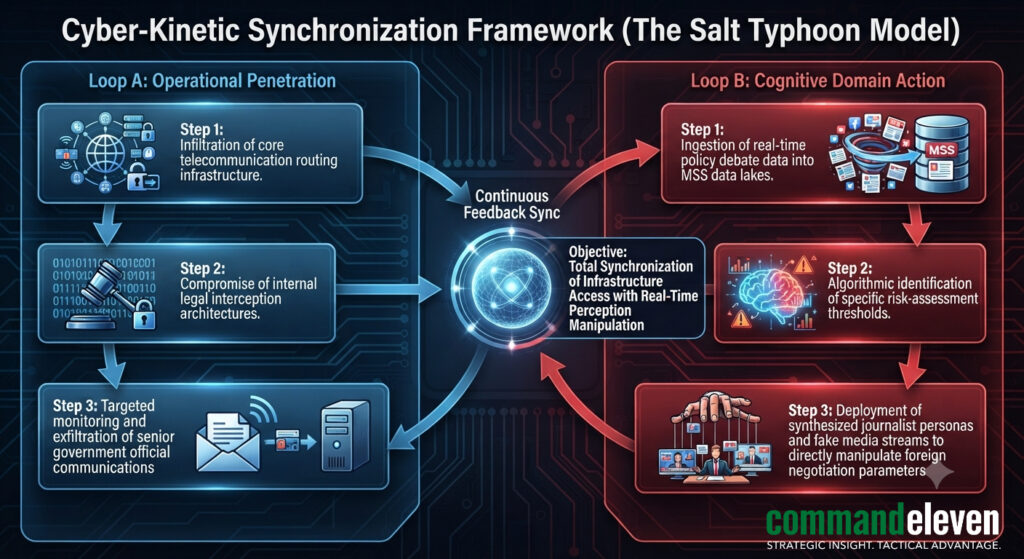
The translation of processed data into active strategic influence is executed via highly coordinated cyber-espionage and cyber-influence networks. These operations demonstrate a precise synchronization between cyber-kinetic infiltration and cognitive domain exploitation.
The Salt Typhoon Infiltration
A definitive example of the modern civil-kinetic convergence model is the long-range campaign executed by the state-backed cyber actor designated as Salt Typhoon.
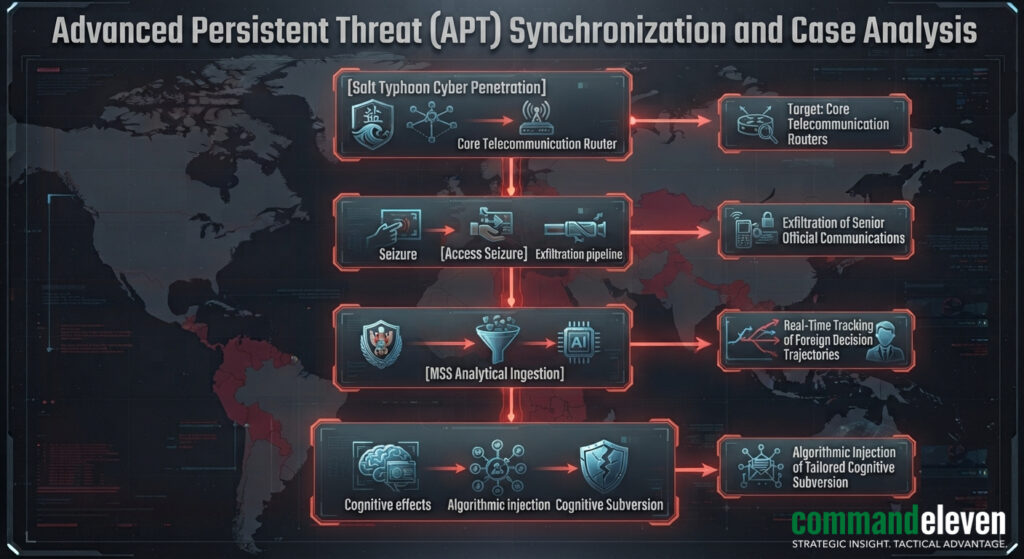
- The Core Penetration: Salt Typhoon systematically compromised the core routing infrastructure of multiple major Western telecommunication and internet service providers. Rather than executing standard industrial theft, the group targeted the internal legal interception architecture,the systems built by providers to comply with court-ordered wiretap requests.
- The Intelligence Loop: This exploit granted the MSS direct access to the active communications, call logs, and unencrypted data packages of senior government officials, diplomatic figures, and national security decision-makers. This raw intelligence was immediately looped back into the MSS’s analytical engines.
- The Cognitive Multiplier: By knowing the precise, real-time concerns, policy debates, and internal vulnerabilities of foreign leadership cadres, the MSS was able to construct tailored cognitive operations. These campaigns injected targeted disinformation, fabricated whistle-blower reports, and artificial media narratives designed to manipulate the specific risk assessments and negotiation parameters of Western policymakers during sensitive bilateral disputes.
Fake Journalist Network Probing
Simultaneously, the MSS deploys highly specialized cyber-influence cells to target international investigative bodies, media watchdogs, and human rights non-governmental organizations (NGOs).
- Operation Mechanics: Following major international investigations into PRC state surveillance practices, cyber-influence networks deployed sophisticated digital spear-phishing campaigns. MSS operatives constructed highly credible, synthetic personas posing as legitimate, well-regarded regional investigative journalists and human rights advocates.
- The Subversive Infiltration: These fake entities approached actual journalists, Taiwanese media executives, and human rights advocates via encrypted communication channels. They deployed deepfake landing pages mimicking international journalism networks to solicit sensitive source data, internal witness files, and psychographic breakdowns of dissident communities.
- The Joint Outcome: This tactic serves a dual purpose: it maps the internal network trust rings of anti-authoritarian organizations to neutralize their effectiveness, while collecting the necessary psychographic material to launch automated character assassination and narrative inversion campaigns across global media spaces.
Strategic Deficiencies and Countermeasures
The modern MSS model represents an aggressive, highly scalable synthesis of law, technology, and subversive doctrine. By combining global data harvesting with advanced machine-learning processing, Beijing possesses an unprecedented capability to conduct continuous, long-range perception-shifting operations. The traditional boundary between civilian economic activity and state kinetic warfare has been systematically erased.
Tactical Exploitation Parameters
Despite its advanced scale, this model exhibits critical strategic deficiencies that defensive security frameworks can exploit:
- Authoritarian Cognitive Confirmation Bias: Because the MSS reporting hierarchy under Chen Yixin is strictly subordinated to the ideological parameters of the CCP leadership, its analytical tools are highly prone to political confirmation bias. The AI systems and human analysts are incentivized to interpret global data through the rigid lens of party doctrine. Defensive cognitive operations should intentionally feed the ingestion layers information that mirrors these ideological paranoias. By over-saturating their channels with data confirming their worst political fears, Western agencies can induce structural resource misallocation and decision-making paralysis within the MSS apparatus.
- The Trust Infrastructure Chokepoint: The reliance on civilian commercial tech companies to execute state intelligence collection represents a profound economic vulnerability for the PRC. The moment specific commercial platforms, software packages, or data logistics services are conclusively linked to active MSS cognitive operations, their global market access craters. Defensive operations must focus on the aggressive, public declassification and attribution of the specific commercial nodes used by the MSS. Forcing the decoupling of these tech entities from Western markets starves the MSS data lakes of the raw material required to power their psychographic profiling engines.
- The Transparency Counter-Offensive: The modern MSS is highly sensitive to external exposure regarding its internal structural dynamics, personnel profiles, and operational failures. Because the ministry has adopted an overt public profile to enforce domestic stability, it has introduced a novel vulnerability to its own brand. Proactive information campaigns should target the domestic Chinese information ecology, exposing the financial corruption, elite assets held abroad, and operational failures of senior MSS leadership. Breaking the illusion of absolute competence and security within their own domestic platform undermines the ministry’s authority, forcing it to redirect critical operational resources inward to manage domestic narrative containment.