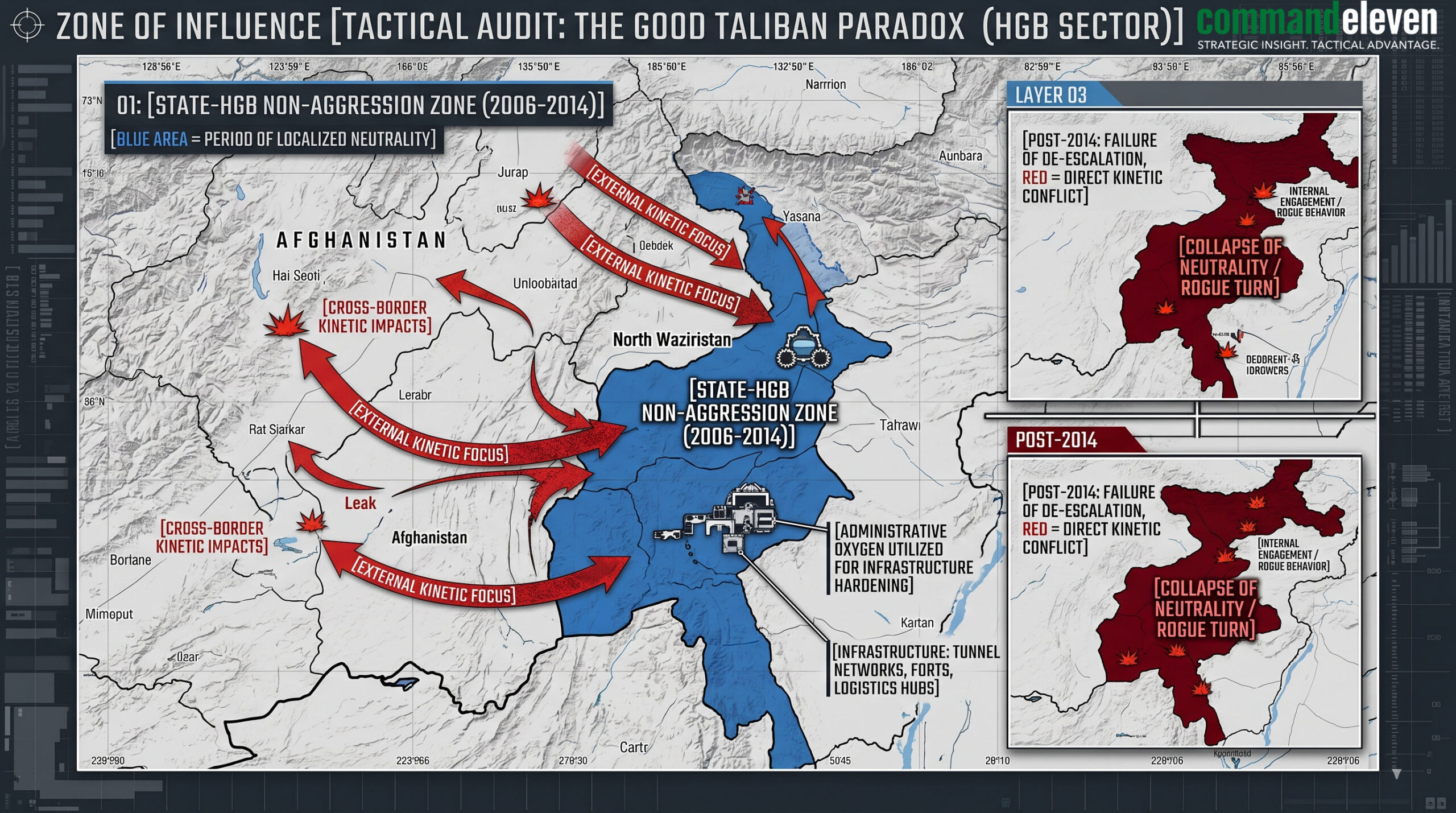
BLUF: The Hafiz Gul Bahadur (HGB) Group represents the definitive failure of the Good Taliban Paradox. Historically maintained as a “territorial stakeholder” through non-aggression pacts, the HGB utilized the provided Administrative Oxygen to entrench its infrastructure. The group’s eventual “rogue turn” in 2014 transitioned a dormant militia into a primary driver of instability in the North Waziristan sector.
The “Good Taliban” Paradox: Mechanics of Neutrality
The relationship between the state and the HGB was defined by a strategic convenience that eventually evolved into a systemic liability.
- External Kinetic Focus: Unlike the TTP’s state-overthrow doctrine, the HGB historically prioritized the insurgency in Afghanistan. This allowed the group to be classified as a “localized stakeholder” rather than an active anti-state actor.
- The 2006 Peace Accord: This agreement granted the HGB formal non-aggression status. It permitted the group to manage its tribal domains without state interference, under the condition that they neither harbored TTP elements nor targeted Pakistani security forces.
- Strategic Blind Spot: This distinction between “Good” (externally focused) and “Bad” (anti-state) Taliban created a massive operational blind spot, allowing a sophisticated militant infrastructure to remain intact within North Waziristan.
The “Rogue Turn”: From Neutrality to Attrition (2014)
The launch of Operation Zarb-e-Azb in June 2014 terminated the era of localized non-aggression.
- The Refusal of Neutrality: Despite the HGB’s historical cooperation, the military moved to clear all militant groups non-discriminatorily. This forced the HGB to abandon its posture of neutrality.
- Alliance Realignment: Following the destruction of its territorial strongholds, the HGB effectively merged its strategic interests with the TTP. The distinction between the two groups collapsed as the HGB began launching high-lethality attacks against Pakistani law enforcement and military targets.
Modern Threat Profile: The Waziristan Resurgence
In the 2026 theater, the HGB group has emerged as a primary kinetic threat.
- Targeted Attrition: The group is currently a primary driver of the spike in targeted assassinations and IED attacks in the Miramshah and Mir Ali sectors.
- Terrain Dominance: Their deep, multi-decade familiarity with the local terrain makes them a more persistent and difficult-to-interdict threat than de-territorialized TTP cadres slipping across the border.
Technical Assessment: Lessons of the Pacts
Element | The “Pact” Phase | The “Rogue” Phase |
Operational Goal | Territorial Preservation | State Attrition |
Target Selection | Afghan / NATO Forces | Pakistani Security Forces |
State Interaction | Non-Aggression / Dialogue | Active Kinetic Conflict |
Status | Localized Stakeholder | Entrenched Insurgency |
Clinical Conclusion
The HGB case study proves that Administrative Oxygen granted to militant groups—even those with externally focused agendas—is a strategic failure. The convergence of the HGB and TTP highlights that localized neutrality is unsustainable in a borderless conflict. For the 2026 threat matrix, the HGB remains a lethal reminder that dormant militant infrastructures will eventually pivot against the state once their territorial survival is threatened.