BLUF: The Tehreek-e-Taliban Pakistan (TTP) is a mutating insurgency. Since its inception in 2007, the group has transitioned through four command phases, evolving from a tribal umbrella into a structured, “nationalist” guerrilla force. This evolution confirms the TTP is a learning organization that recalibrates its violence to ensure long-term persistence.
The Four Eras of Command
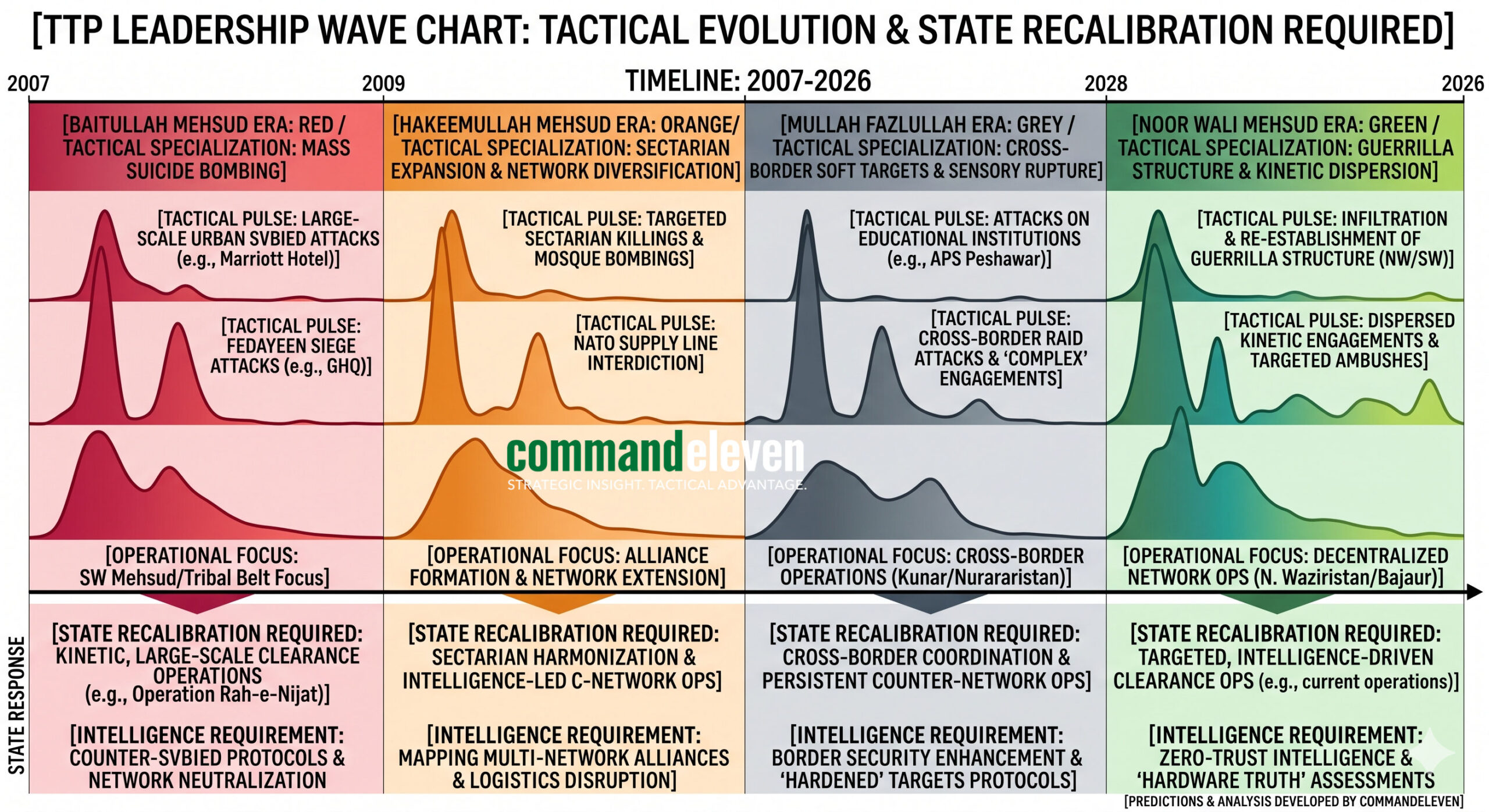
Baitullah Mehsud (2007–2009): The Unification
- Objective: Synthesized fragmented tribal militias into a single umbrella organization to challenge state territorial writ.
- Tactical Wave: Initiated mass-casualty suicide bombings and established a unified front against state coercion.
- Result: Formally launched the insurgency and established the Mehsud tribe as the central power center.
Hakeemullah Mehsud (2009–2013): The Sectarian Bleed
- Objective: Expanded the war into major urban centers and deepened ties with Al-Qaeda and Lashkar-e-Jhangvi (LeJ).
- Tactical Wave: Erased lines between sectarian terror and anti-state insurgency, leading to relentless urban bombings.
- Result: Plunged the state into hyper-violent instability and maximum asymmetric pressure.
Mullah Fazlullah (2013–2018): The Swat Era & Afghan Sanctuary
- Objective: Focused on survival of central command after displacement by Operation Zarb-e-Azb.
- Tactical Wave: Focused on cross-border raids and “soft” targets (e.g., APS Peshawar Massacre) to inflict trauma from a distance.
- Result: Shifted command away from the Mehsud tribe and entrenched the group within Afghan sanctuaries.
Noor Wali Mehsud (2018–Present): The Re-centralization
- Objective: Rebranding as a domestic, “nationalist” insurgency to regain public sympathy and institutional survival.
- Tactical Wave: Transitioned to structured Guerrilla Warfare, banning civilian attacks and focusing on military/police targets.
- Result: Absorbed splinter groups and adopted a bureaucratic structure modeled after Al-Qaeda, creating a disciplined and persistent threat.
Technical Assessment of Command Shifts
Era | Command Center | Primary Tactical Doctrine | Public Perception |
Baitullah | S. Waziristan | Territorial Seizure / Suicide Wave | Tribal Insurgency |
Hakeemullah | S. Waziristan | Urban Sectarian/Anti-State Hybrid | Existential Threat |
Fazlullah | Kunar/Nangarhar | Cross-Border Raids / Soft Targets | Total Societal Rejection |
Noor Wali | Re-centralized | Structured Guerrilla Attrition | Rebranded “Nationalism” |
Clinical Conclusion
The Noor Wali era represents a sophisticated war of attrition designed to avoid the total societal rejection triggered by the Fazlullah era. By shifting to structured guerrilla warfare, the TTP has complicated the state narrative, attempting to portray the conflict as a struggle against an “oppressive state”.