
3 Key Takeaways
- Low-Cost Precision Upgrades: Project 2200 allows Hezbollah to convert existing, unguided heavy rockets into precision missiles by adding modular, external guidance kits, bypassing the need to manufacture complete new missiles.
- Resilience to Jamming: The integration of spatial filtering, Controlled Reception Pattern Antennas (CRPA), and Angle of Arrival (AoA) analysis allows these guided weapons to operate successfully in highly contested electronic environments.
- Fragmented Supply Networks: The reliance on dual-use commercial components sourced through global front companies makes the PGM supply chain highly resilient against standard military and export controls.
Executive Summary
The strategic balance in the Levant is heavily influenced by the proliferation of Precision Guided Munitions (PGMs). This threat is driven by the Islamic Revolutionary Guard Corps (IRGC) Quds Force through Project 2200—a coordinated program to upgrade thousands of unguided heavy artillery rockets in Hezbollah’s inventory into precision-guided missiles.
This technical analysis provides a forensic deconstruction of the guidance kit retrofitting process, focusing on the mechanics of the Guidance and Control Unit (GCU), the integration of Inertial Navigation Systems (INS) with satellite navigation, and the technologies used to resist electronic countermeasures, such as GPS jamming and spoofing.
By detailing the supply chain pathways and assembly sites, this document provides defense planners with actionable insights into the technical vulnerabilities of this proliferation network.
The GCU Retrofit Architecture: Converting Unguided Rockets

The core of Project 2200 is the conversion of unguided heavy rockets, such as the Fateh-110 (and its Syrian equivalent, the M-600) and the Zelzal-2, into precision-guided systems.
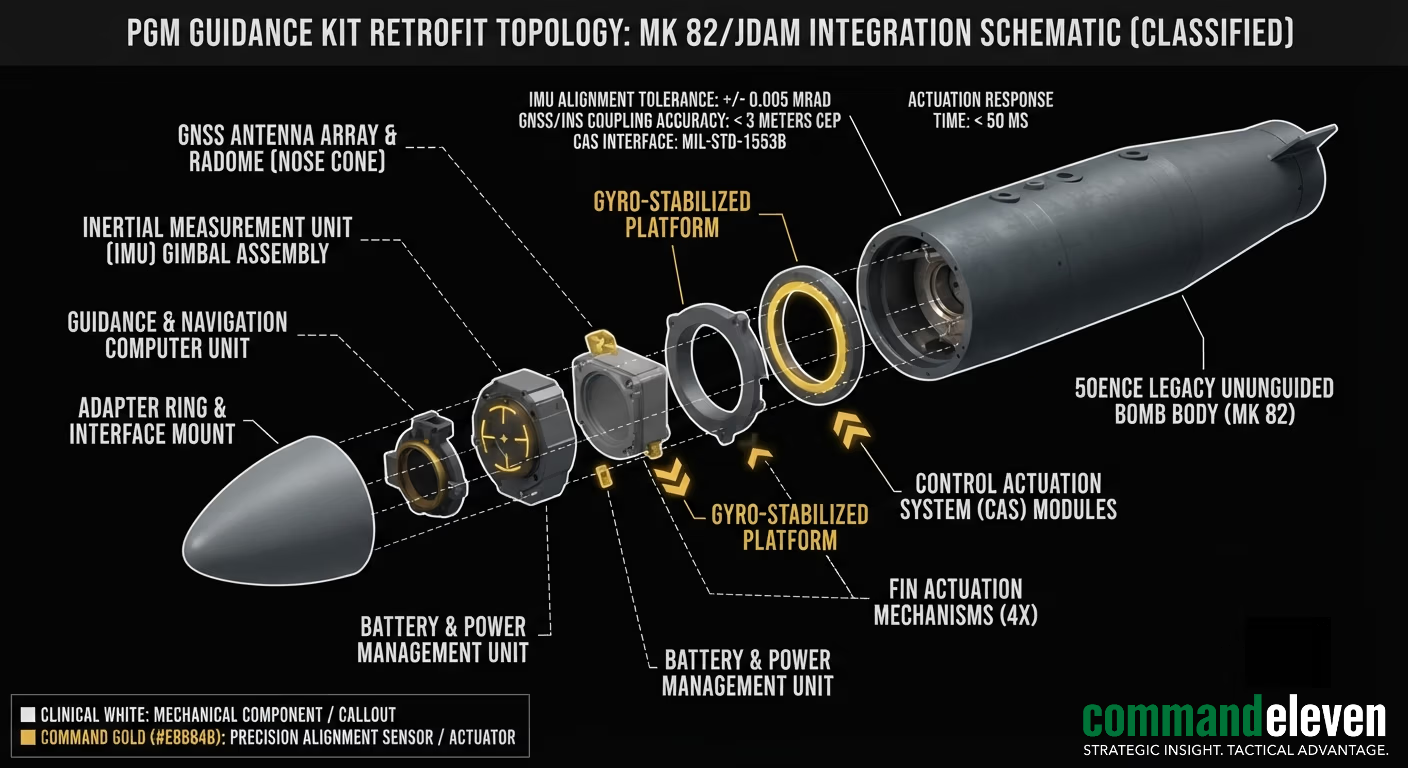
This conversion is achieved by installing an external retrofit kit between the rocket’s original warhead and its solid-propellant motor section.
Mechanical Modification
The rocket is unbolted at the forward coupling point behind the warhead. Technicians insert a self-contained, cylindrical Guidance and Control Unit (GCU), which adds approximately 35 to 50 centimeters to the missile’s length.
This insert is secured using standardized military-grade ring clamps and electrical wiring harnesses that connect the GCU directly to the rocket’s primary battery and ignition systems.
Aerodynamic Control Surfaces (Canards)
The GCU features four independent, electrically actuated canards mounted in a cruciform configuration. These canards provide the aerodynamic forces necessary to adjust the missile’s trajectory during its mid-course and terminal flight phases.
Unlike the fixed tail fins of the original rocket, which only provide passive stabilization, these active canards allow the missile to make rapid flight corrections in response to guidance computer commands.
Guidance and Sensor Fusion Mechanics
The precision of the converted missile depends on a sensor fusion system located within the GCU. This system combines an Inertial Navigation System (INS) with a Global Navigation Satellite System (GNSS) receiver, typically compatible with both GPS and GLONASS constellations.
Inertial Sensor Array
To resist electronic jamming, the primary guidance system is inertial. The GCU utilizes low-cost, military-grade Micro-Electro-Mechanical Systems (MEMS) or higher-end Ring Laser Gyroscopes (RLGs) alongside three-axis accelerometers.
These sensors continuously measure the missile’s angular velocity and linear acceleration, calculating its position, velocity, and orientation relative to its launch point.
Electronic Countermeasures and Anti-Jamming Resiliency
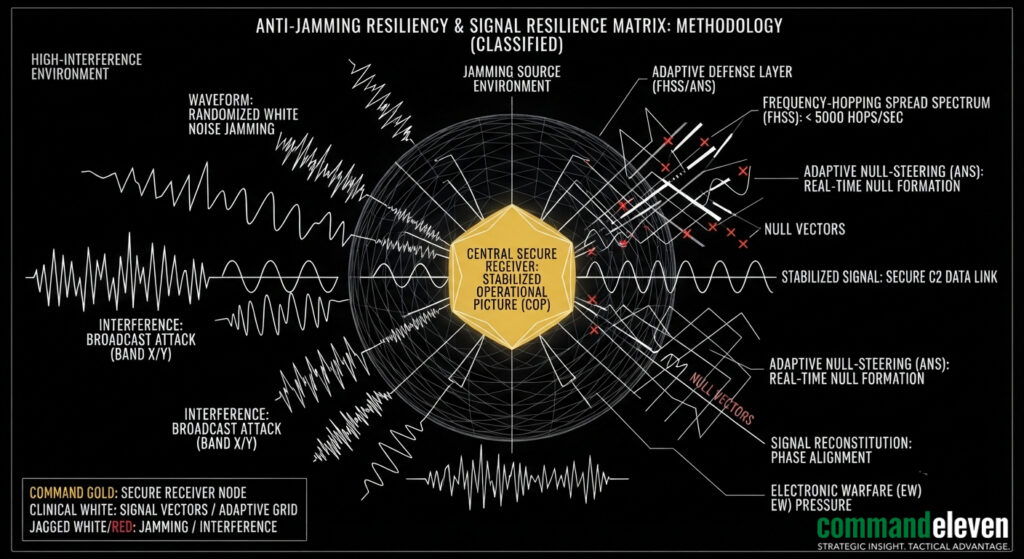
Because the Eastern Mediterranean is a highly contested electronic environment, Hezbollah’s guidance systems must be capable of operating under heavy GPS jamming and spoofing. To maintain guidance during these conditions, the GCU incorporates several advanced electronic protection features:
Controlled Reception Pattern Antennas (CRPA)
To counter broad-spectrum jamming, the GCU uses a Controlled Reception Pattern Antenna (CRPA) array. This system typically consists of a four- or seven-element antenna mounted flush on the outer skin of the GCU.
By comparing the phase and amplitude of the signals received at each antenna element, the onboard processor can identify the direction of incoming signals.
Digital Beamforming and Nulling
When the system detects a jamming source, the digital signal processor calculates a spatial filter that applies a “null” in the antenna’s reception pattern toward the direction of the jammer. This reduces the antenna’s sensitivity in that specific direction by up to 40dB, effectively blocking out the interference while maintaining reception from valid GPS satellites orbiting overhead.
Angle of Arrival (AoA) Spoofing Defense
To counter GPS spoofing—where fake signals are transmitted to deceive the missile’s receiver—the GCU analyzes the Angle of Arrival (AoA) of the incoming signals.
Legitimate GPS signals must originate from high-elevation satellite orbits. If the processor detects high-power GPS signals coming from a low elevation angle (suggesting a ground-based transmitter), it flags the signal as a spoof and ignores it, relying on pure INS guidance for the remainder of the flight.
The PGM Proliferation Supply Chain (Project 2200)
The proliferation of PGMs relies on a distributed supply chain that moves components from manufacturers in Iran to assembly and launch locations in Syria and Lebanon.
Component Manufacturing and Procurement
The primary guidance components—such as industrial-grade MEMS gyroscopes, micro-actuators, and specialized microchips—are sourced by Iranian procurement networks.
Many of these components are dual-use commercial items purchased through front companies operating in East Asia and Europe, bypassing direct military export restrictions.
Airborne and Overland Smuggling Channels
Once compiled in Iran, the guidance kits are shipped in disassembled “knock-down” packages to reduce their size and avoid detection. These packages are transported through two primary routes:
- The Land Bridge: Shipments travel in commercial cargo trucks from western Iran through Iraq, entering Syria via the Al-Bukamal/Al-Qaim border crossing.
- Air Corridors: Kits are flown directly from Tehran to Damascus International Airport or the T-4 Airbase, hidden within humanitarian or commercial cargo shipments.
Secure Syrian Storage Hubs
Before entering Lebanon, these components are stored in underground military depots in western Syria, particularly around Al-Qusayr and the Qalamoun Mountains. These sites are heavily fortified and protected against airstrikes.
Cross-Border Transport and Final Assembly
The components are smuggled across the Lebanon-Syria border using remote, unmonitored mountain tracks in the Hermel region or through official border crossings like Masnaa, hidden in hidden compartments of commercial vehicles.
In Lebanon, the components are delivered to underground assembly facilities managed by Hezbollah’s military wing, where technicians install the guidance kits onto existing rocket frames.
Technical Specifications of Proliferated Levantine PGMs
| Missile System (Original) | Guided Designation | Maximum Range | Warhead Payload | Guidance Integration | Circular Error Probable (CEP) |
| Zelzal-2 | Converted Zelzal PGM | 210 kilometers | 600 kg High-Explosive | GPS/GLONASS assisted MEMS-INS | 10 to 15 meters (With active GPS) |
| Fateh-110 (Gen 4) | Fateh Guided Variant | 300 kilometers | 500 kg High-Explosive | RLG-INS with CRPA Anti-Jam GNSS | Under 5 meters (Resistant to heavy jamming) |
| Fajr-5 | Guided Fajr-5 | 75 kilometers | 175 kg Fragmentation | Solid-state INS with GPS update | 15 to 20 meters (Tactical fire support) |
Defensive Engineering & Interdiction Guide
Signature Analysis for Border Interdiction
Security forces and border patrols can identify PGM component shipments by monitoring for specific technical items:
- High-Torque Servo Actuators: Shipments of industrial servo motors that operate at high temperatures (>120° C) and feature military-grade electrical connectors should be treated as potential missile control components.
- Multi-Channel GNSS Processors: The presence of specialized digital signal processors designed to interface with multi-element antenna arrays (such as 4- or 7-port RF front-ends) indicates a CRPA anti-jamming guidance system.
Electronic Defense Strategies
To counter Hezbollah’s updated guidance kits, electronic warfare systems must adapt:
- Dynamic, Multi-Angle Spoofing: Because the GCU filters out ground-based spoofing signals based on their angle of arrival, defense forces should deploy elevated spoofing transmitters on aerostats or unmanned aerial vehicles (UAVs) to simulate satellite signals originating from high elevation angles.
- Coordinated Multi-Frequency Jamming: Electronic countermeasures must target both GPS (L1/L2) and GLONASS (G1/G2) frequencies simultaneously to force the missile’s guidance computer to rely entirely on its INS, which will naturally drift over the course of its flight.
Strategic Analytical Outlook (2026–2030)
CommandEleven Intelligence assesses that the proliferation of PGM kits remains the most significant threat to the security balance in the Levant. By converting its existing inventory of unguided rockets into precision-guided weapons, Hezbollah has acquired the capability to target critical infrastructure—such as power stations, military bases, and transport hubs—with high accuracy.
Over the next four years, this technology is expected to become more accessible. The integration of low-cost optical terminal seekers, which use onboard cameras to match the terrain with pre-loaded satellite imagery, will allow these missiles to achieve precision guidance without relying on satellite signals.
To counter, regional defense forces must invest in multi-layered air defense systems, enhanced electronic warfare capabilities, and persistent intelligence monitoring of the supply chain to disrupt the flow of guidance components before they can be assembled.