Executive Summary
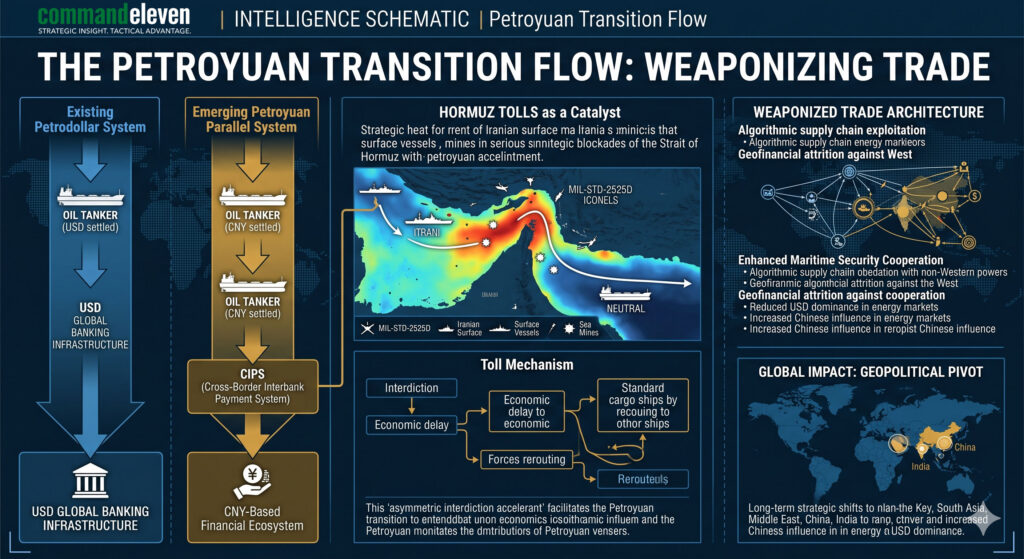
The weaponization of trade in the Strait of Hormuz has accelerated the transition from USD-settled energy to the Petroyuan. By establishing a kinetic “toll” in the Middle East, oppositional actors are forcing East Asian economies into the CIPS (Cross-Border Interbank Payment System) ecosystem. This shift represents a fundamental realignment of global geofinancial power, where physical maritime security directly dictates currency dominance.
Key Takeaways
- Kinetic Currency Trigger: Interdiction in Hormuz functions as a physical enforcement mechanism for Petroyuan adoption.
- CIPS Integration: China’s 15th Five-Year Plan leverages maritime instability to bypass SWIFT-based sanctions.
- Supply Chain Modularization: Energy-dependent hubs are pivoting to “Safe Routes” that bypass Western banking infrastructure.
The “Toll-Gate” Doctrine: Geography as a Financial Instrument
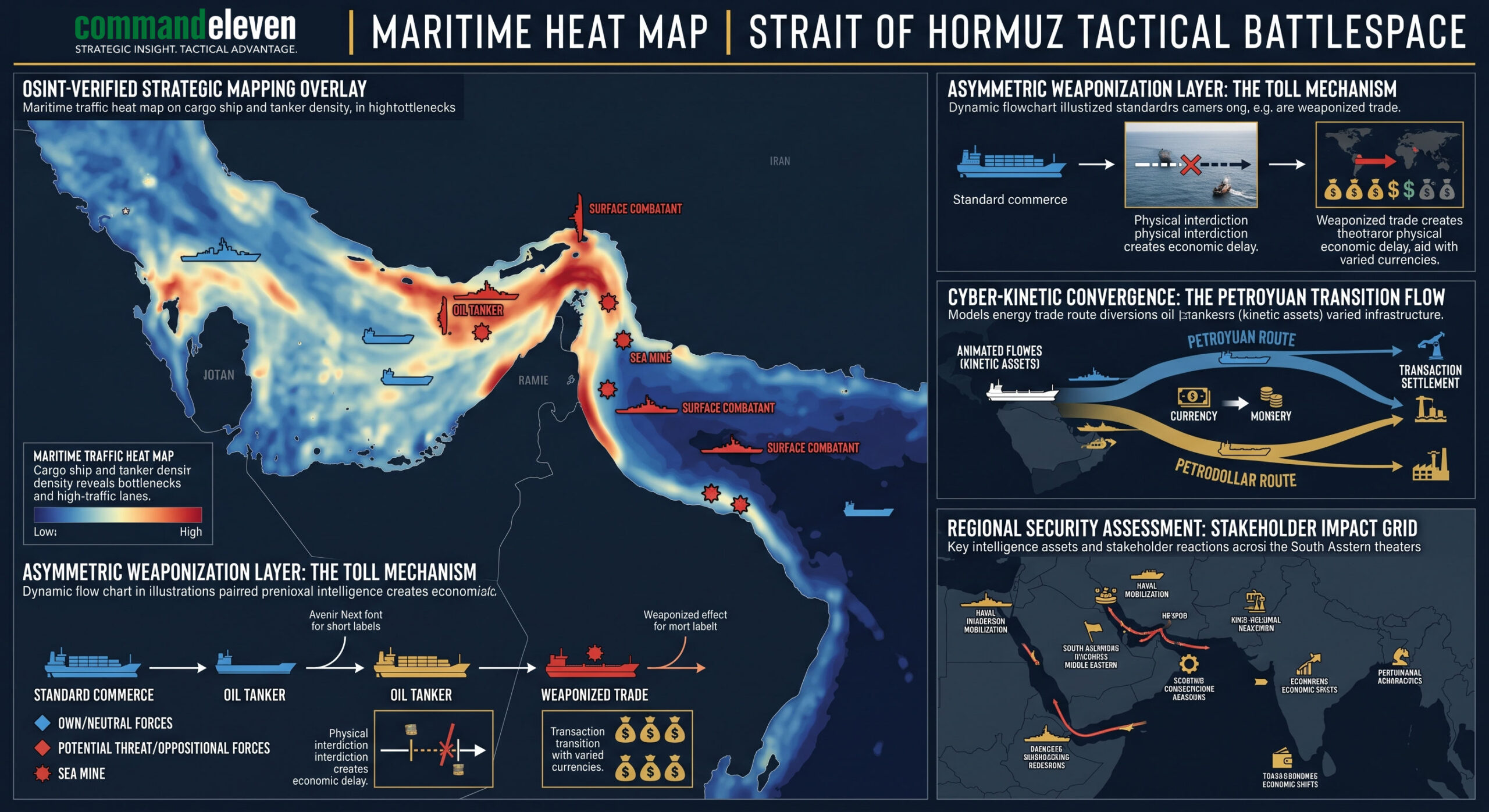
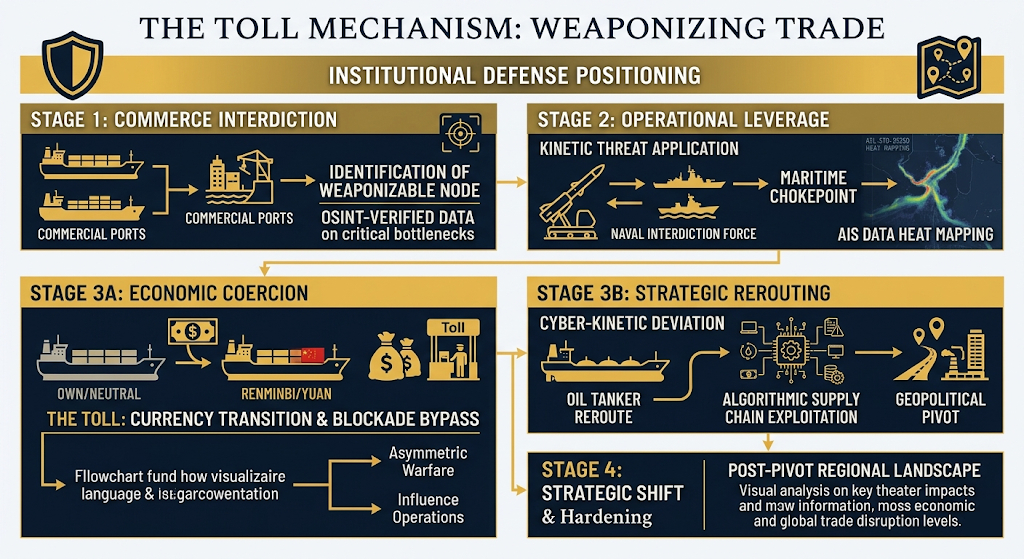
Since the March 4 closure of the Strait of Hormuz, the Islamic Revolutionary Guard Corps (IRGC) has transitioned from kinetic harassment to a structured fiscal extraction model. This “Toll-Gate” doctrine requires all non-hostile vessels to submit to a vetting scheme, obtain clearance codes, and settle transit fees.
Crucially, intelligence indicators and maritime records from April 2026 confirm that a significant portion of these fees is being settled in Chinese Yuan (RMB). This is not merely a revenue-generation tactic; it is the formalization of a parallel energy economy that bypasses the U.S. dollar (USD) clearing system. By weaponizing geography, Tehran and Beijing have converted a physical chokepoint into a financial funnel for the Petroyuan.
The Erosion of the Petrodollar Standard
The Petrodollar, the cornerstone of U.S. global financial hegemony since 1974, relies on the mandatory pricing and settlement of energy in USD. The Hormuz Tolls represent the first successful large-scale “Sub-Threshold” assault on this standard.
- The RMB Discount: Iran is offering a tiered toll structure where settlement in Yuan grants a “Security Discount.” This incentivizes energy-dependent Asian economies (China, India, South Korea) to accelerate their adoption of the Cross-Border Interbank Payment System (CIPS).
- The “Dark Fleet” Legitimatization: Vessels previously operating in the shadows to avoid sanctions are now being codified under the IRGC vetting scheme. This creates a “Sanitized Corridor” where trade is protected by Iranian kinetic assets and financed by Chinese capital.
- Liquidity Shift: Daily transaction volumes on CIPS exceeded 1 trillion yuan (~$179 billion) in mid-April 2026, a direct correlate to the increased volume of “Toll-compliant” energy transits.
The U.S. Response: The Indian Ocean “Kinetic Gate”
The U.S. has countered this financial pivot with a maritime interdiction strategy. On April 23, 2026, U.S. forces conducted a “Right-of-Visit” boarding of the M/T Majestic X in the Indian Ocean, a vessel carrying 1.88 million barrels of Iranian crude destined for China.
This indicates a pivot in U.S. naval doctrine:
- Impartial Blockade: The U.S. 5th and 7th Fleets are now treating any vessel paying the “Hormuz Toll” as a material supporter of a Foreign Terrorist Organization (FTO), effectively expanding the blockade to the high seas.
- The Indonesia Nexus: By leveraging the newly signed maritime security pact with Jakarta, the U.S. is establishing a second blockade at the Malacca and Sunda straits. If energy cannot be settled in USD, the U.S. intent is to ensure it does not reach its destination at all.
Geoeconomic (GER) Vector Analysis: The Investment Delta
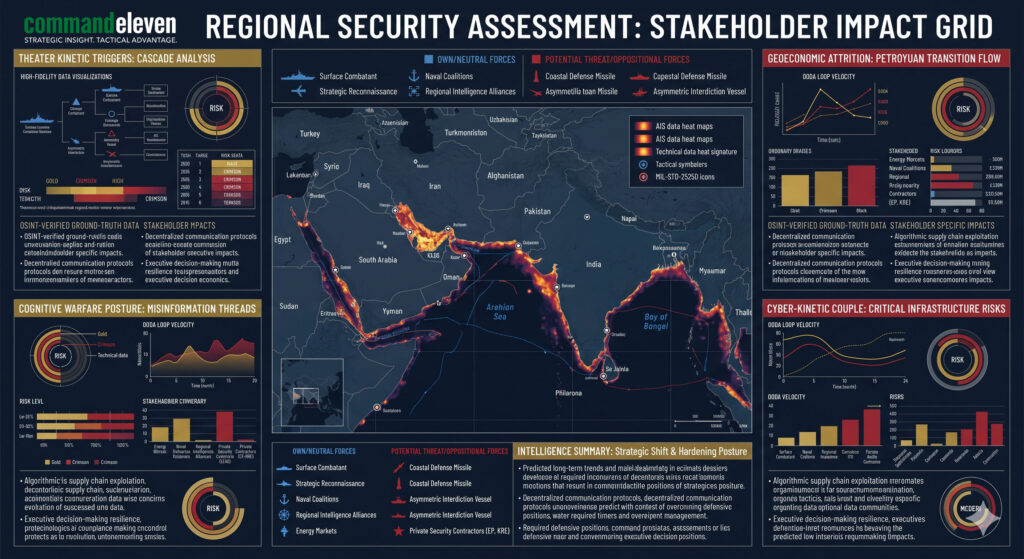
For the C-Suite and institutional investors, the “Petroyuan Pivot” creates a permanent Geopolitical Risk Premium.
- Valuation Gap: Firms with heavy exposure to the Strait of Hormuz must now account for “Toll Volatility.”
- Supply Chain Resilience: The value is no longer in the energy resource itself but in the Security of Transit. We anticipate a decisive shift in capital toward Regional Diversification and firms that provide military-grade Command and Control (C2) integration for their logistics fleets.
- Narrative Attrition: The U.S. “Vietnam-style” commitment to a long-duration conflict, as stated by Washington on April 23, suggests that the Petrodollar-Petroyuan friction is the new baseline for global energy markets.
Conclusion: The Bifurcated Global Ledger
The Hormuz Tolls have achieved what years of diplomacy could not: the creation of a viable, non-USD energy trade route. While the U.S. maintains kinetic superiority, the geoeconomic reality is shifting toward a bifurcated global ledger.
CommandEleven Red Team Assessment
The transition to the Petroyuan is no longer a theoretical risk; it is an operational reality. The “Kinetic Gate” in the Indian Ocean is the final U.S. lever to prevent the total collapse of the Petrodollar’s relevance in the Eastern hemisphere.