Executive Summary
The formation of the Jakarta-Washington Axis via the Major Defense Cooperation Partnership (MDCP) has effectively closed the “Southern Gateway” to unauthorized shadow-fleet transit. By synchronizing U.S. technical intelligence with Indonesian littoral control, the axis establishes a secondary interdiction layer in the Sunda and Lombok Straits. This “Hardened Battlespace” serves as a direct counter-measure to the geofinancial attrition strategies employed in the Western Indian Ocean.
Key Takeaways
- The Second Toll: The MDCP creates a mandatory “Right-of-Visit” (ROV) barrier in the Indonesian archipelago.
- Shadow Fleet Attrition: Fused technical telemetry (AIS + SAR) has eliminated the “Dark Fleet” advantage in the Southern Gateway.
- Regional Flanking: The INS Sunayna’s Jakarta port call signals India’s operational alignment with the axis.
The April 13, 2026, establishment of the Major Defense Cooperation Partnership (MDCP) between the United States and the Republic of Indonesia represents the most significant shift in Indo-Pacific naval architecture since the post-WWII era. This axis effectively terminates Jakarta’s historic “Active and Independent” (Bebas Aktif) passivity in favor of a formalized, high-intensity security integration with Washington.
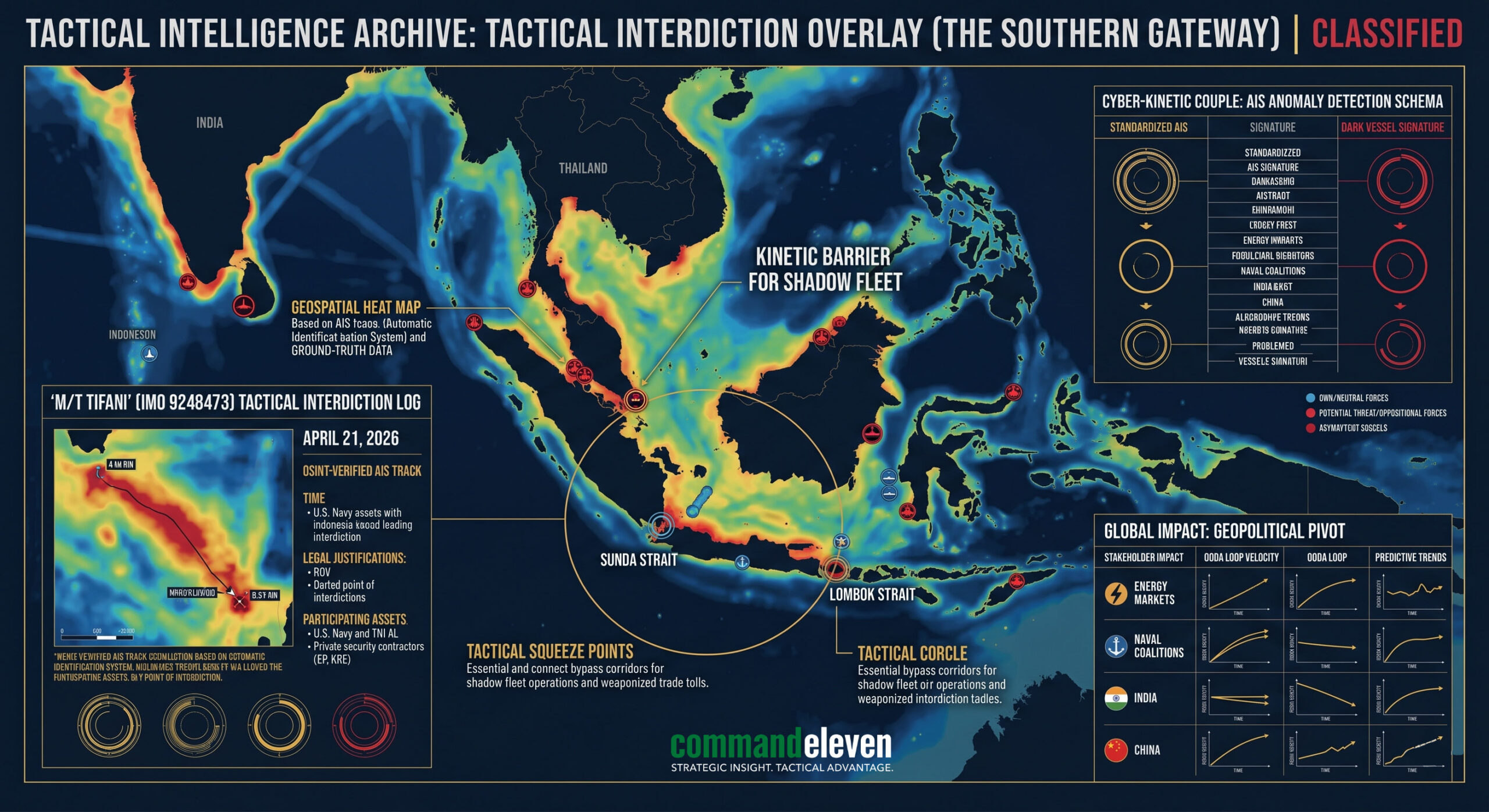
The MDCP is not merely a diplomatic communiqué; it is an operational trigger for a “Global Blockade” posture. By securing the Indonesian archipelago,specifically the Malacca, Sunda, and Lombok Straits,the U.S. has established a kinetic “Southern Gateway” that mirrors the “Northern Chokepoint” strategy in the Strait of Hormuz. The inaugural proof of concept for this axis occurred on April 21, 2026, with the high-seas interdiction of the M/T Tifani, a sanctioned VLCC (Very Large Crude Carrier) carrying Iranian crude through the Bay of Bengal. This assessment details the tactical mechanics of the interdiction, the legal framework of “Right-of-Visit” (ROV) protocols, and the broader geoeconomic implications for the Petroyuan transition.
The MDCP: Architectural Pillars of the Axis
The transition from a “Comprehensive Strategic Partnership” (2023) to a “Major Defense Cooperation Partnership” (2026) was facilitated by the convergence of Indonesian territorial anxiety regarding foreign sub-surface surveillance and the U.S. “Peace through Strength” doctrine. The MDCP is built upon three clinical pillars:
Asymmetric Capability Co-Development
Under this pillar, Washington and Jakarta have initiated the joint development of sophisticated subsurface and autonomous systems (UUVs/USVs).
- Operational Goal: To provide Indonesia with a “Transparent Littoral” capability.
- Intelligence Context: The deployment of these systems in the Natuna Sea and the Makassar Strait is designed to neutralize the “silent transit” of foreign nuclear-powered attack submarines (SSNs) and unattributed maritime militia vessels. This capability bridges the gap between Jakarta’s limited traditional naval tonnage and its vast archipelagic domain.
Advanced Maritime Modernization & MRO
The agreement establishes Indonesia as a primary hub for Maintenance, Repair, and Overhaul (MRO) for U.S. and allied naval assets.
- Strategic Depth: By localizing MRO capabilities in Surabaya and Batam, the U.S. Seventh Fleet reduces its reliance on extended supply lines to Guam or Yokosuka.
- Kinetic Readiness: This infrastructure ensures that interdiction forces operating in the Indian Ocean have immediate forward-deployed technical support, a critical requirement for sustained blockade operations.
High-Intensity Operational Interoperability
The expansion of the Super Garuda Shield exercises now includes specific modules for “Non-Permissive Boarding” and “Sanctions Enforcement Operations.”
- Tactical Shift: Indonesian special forces (KOPASKA) are now training directly with U.S. Navy SEALs and Coast Guard Tactical Law Enforcement Teams (TACLETs) on Right-of-Visit (ROV) manoeuvers. The goal is a seamless “Hand-off Interdiction” where U.S. intelligence identifies a target and Indonesian assets provide the sovereign “legal cover” for the boarding within or near their Exclusive Economic Zone (EEZ).
Tactical Case Study: The Interdiction of M/T Tifani
On the night of April 21, 2026, U.S. Marines and naval assets conducted a “Right-of-Visit” maritime interdiction of the M/T Tifani in the Bay of Bengal, marking the first kinetic action of the Jakarta-Washington Axis.
Vessel Profile: Shadow Fleet Operations
The M/T Tifani (IMO 9248473) is a 20-year-old Botswana-flagged VLCC.
- Sanction Context: The vessel had been previously blacklisted for its role in the “Shadow Fleet” transporting Iranian crude to East Asian markets.
- Deception Tactics: Prior to interception, the vessel had disabled its Automatic Identification System (AIS) and was operating under a “stateless” profile, a common tactic used to obfuscate ownership and cargo origin.
The Interdiction Logic
The Pentagon’s justification for the boarding reflects a radical expansion of maritime enforcement:
- UNCLOS Exceptions: Under Article 110 of the UN Convention on the Law of the Sea, warships are permitted to board a foreign merchant ship if there are reasonable grounds to suspect the ship is “without nationality” or engaged in piracy/unauthorized broadcasting.
- The “Stateless” Pivot: By categorizing shadow-fleet vessels with expired or false registrations as “stateless,” the U.S. has created a legal pathway to interdict sanctioned cargo in international waters without a formal declaration of war.
- Execution: The boarding was conducted “without incident” while the vessel was underway at approximately 6 knots between Sri Lanka and the northern entrance to the Malacca Strait. This location,the Great Channel,is the primary tactical node for the Jakarta-Washington Axis.
The Geoeconomic Coupling: Petroyuan vs. Petrodollar
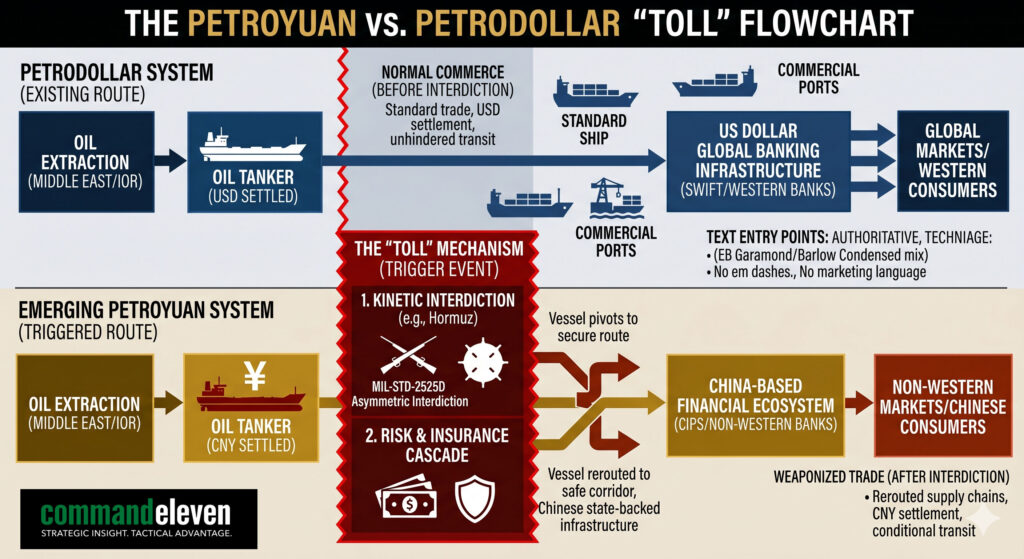
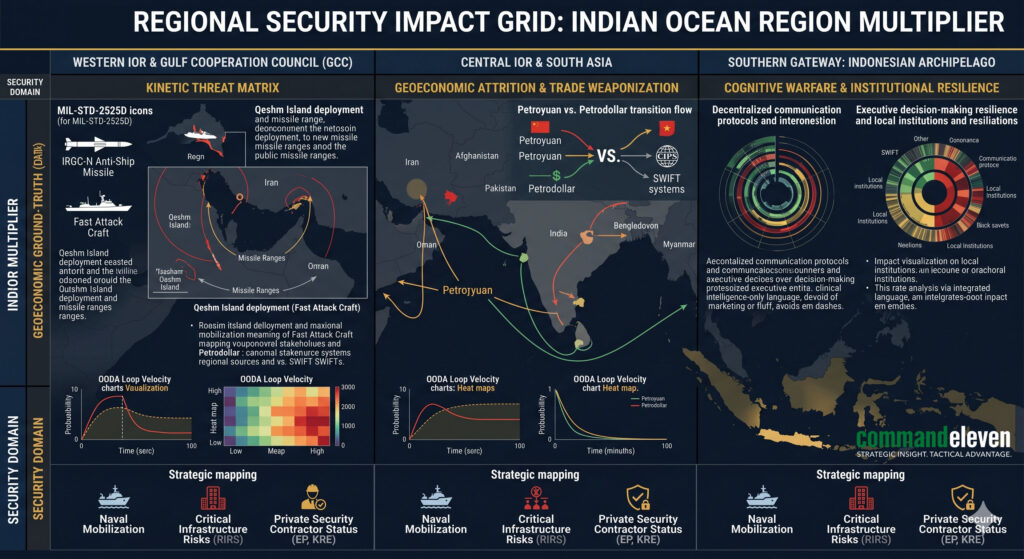
The Jakarta-Washington Axis is fundamentally a counter-measure to the weaponization of the Petroyuan as a tool for geofinancial attrition. The current conflict in the Strait of Hormuz has served as a catalyst, forcing East Asian industrialized economies,primarily China,to accelerate their transition away from the USD-based global banking infrastructure.
The Hormuz Catalyst and Energy Vulnerability
East Asia’s structural exposure to the Strait of Hormuz is extreme. As of early 2026, Japan remains dependent on the Middle East for approximately 95% of its crude, while South Korea relies on the region for 70%. China, though more diversified, still routes over 40% of its total imports through Hormuz.
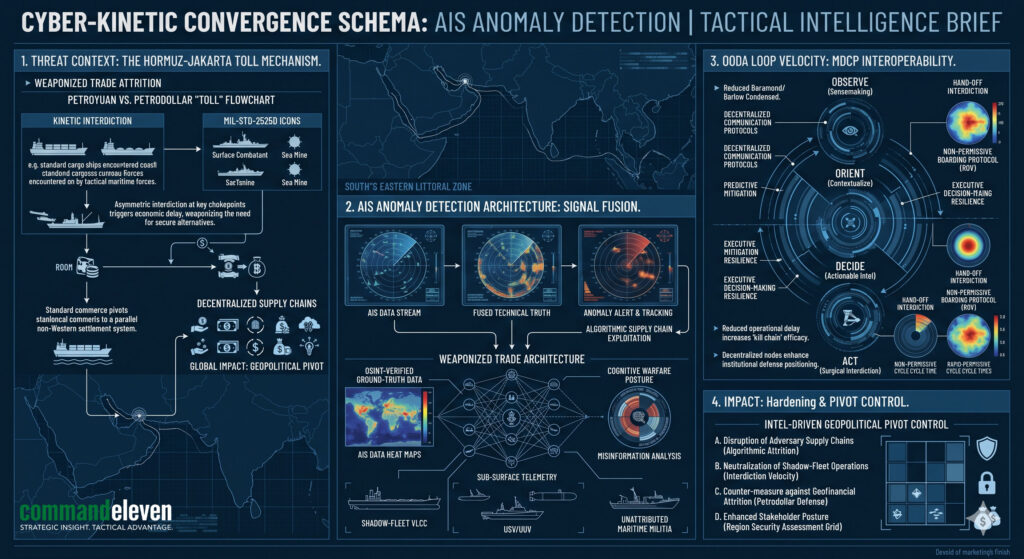
- The “Toll” Logic: The kinetic interdiction by Iranian surface combatants and the deployment of sea mines in the Strait function as a geoeconomic “toll.” By creating an environment where physical transit is tied to extreme risk and astronomical insurance premiums, oppositional forces incentivize the use of “Safe Routes” that utilize non-Western settlement systems.
- Petroyuan Acceleration: China’s 15th Five-Year Plan (2026–2030) specifically prioritizes the integration of the Cross-Border Interbank Payment System (CIPS) as a workaround for SWIFT. The blockade in Hormuz acts as a physical enforcement mechanism for this shift, as cargo settled in CNY via CIPS is granted “privileged transit” status by regional actors controlling the chokepoint.
The Jakarta Counter-Blockade
The Jakarta-Washington Axis effectively creates a “Second Toll” in the Indian Ocean. By establishing the Major Defense Cooperation Partnership (MDCP), Washington has ensured that the “Southern Gateway” (Malacca, Sunda, and Lombok Straits) remains under the operational supervision of Western-aligned interdiction forces.
- Strategic Squeeze: If a vessel bypasses the Western banking system at Hormuz to secure “safe passage,” it now risks interdiction in the Indonesian straits under the new MDCP “Right-of-Visit” (ROV) protocols. This forces shipping companies into a binary choice: comply with Western sanctions and maintain access to the Indian Ocean gateways, or pivot fully to the Petroyuan ecosystem and face the high probability of kinetic interdiction in the Southern Gateway.
Algorithmic Supply Chain Exploitation
The modern maritime battlespace is increasingly defined by cyber-kinetic coupling. The Jakarta-Washington Axis utilizes advanced algorithmic oversight to identify and exploit vulnerabilities in oppositional supply chains.
AIS Obfuscation and “Dark” Fleet Tracking
The interdiction of the M/T Tifani was enabled by a fusion of OSINT-verified ground-truth data and ELINT (Electronic Intelligence).
- AIS Heat Mapping: Allied forces utilize automated heat mapping to detect “anomalous behavior”,vessels that disable their AIS or deviate from established commercial lanes.
- Technical Data Heat Signatures: When a vessel “goes dark,” algorithmic surveillance platforms switch to secondary sensors (synthetic aperture radar and acoustic monitoring) to maintain track. This data is then used to generate a “Probable Interdiction Point,” allowing U.S. and Indonesian assets to intercept the vessel with surgical precision.
Algorithmic Attrition
The axis doesn’t just stop ships; it exploits the modular and geographically fragmented architecture of global trade. By interdicting a single critical VLCC like the Tifani, the MDCP triggers a cascade of delays throughout the “just-in-time” supply chain.
- Just-In-Case Resilience: CommandEleven assessments indicate that the “Toll Mechanism” is designed to force East Asian manufacturing hubs (semiconductors, electronics, automotive) into a state of permanent energy anxiety, driving up operational costs and delaying project timelines for state-level AI ambitions.
Stakeholder Posture: India and the “MAHASAGAR” Doctrine
The arrival of the INS Sunayna in Jakarta on April 21, 2026, underscores India’s role as a silent but critical partner in this new axis.
- IOS SAGAR Initiative: India’s vision of “Mutual and Holistic Advancement for Security and Growth Across Regions” (MAHASAGAR) aligns with the MDCP’s goal of securing the Indian Ocean Region (IOR).
- Tactical Interoperability: Indian Navy port calls and Passage Exercises (PASSEX) with the Indonesian Navy (TNI AL) serve as a strategic flanking maneuver, ensuring that the Bay of Bengal remains a “Hardened Battlespace” for shadow-fleet operations. India’s “Neighbourhood First” policy ensures that while it maintains strategic autonomy, its operational goals regarding maritime interdiction are synchronized with the Washington-Jakarta pivot.
Cognitive Warfare Posture: Strategic Framing of the Indian Ocean
The Jakarta-Washington Axis represents the first operational application of NATO’s “Cognitive Warfare 2026” doctrine within the Indo-Pacific theater. This pillar focuses on manipulating the interpretation of maritime security events to ensure institutional legitimacy while degrading oppositional decision-making.
Narrative Sanitization and “Legal Hardening”
The April 2026 interdictions, such as the M/T Tifani case, are framed not as aggressive blockades, but as “Environmental and Safety Enforcement” actions.
- The “Blue Card” Digital Mandate: By 2026, the U.S. and its partners have implemented mandatory digital insurance checks. Vessels without verified Protection and Indemnity (P&I) insurance,common in the shadow fleet,are categorized as “Environmental Hazards.”
- Legal Inoculation: This framing uses “prebunking” techniques to build international resilience against oppositional narratives. By highlighting the environmental risk of “rust-bucket” tankers, Washington justifies interdiction to a global public, effectively isolating the target state’s claims of “maritime piracy.”
Degrading Adversary Decision Cycles
Cognitive warfare in the Southern Gateway is designed to induce “Epistemic Chaos” within oppositional naval commands.
- Sensemaking Disruption: Utilizing “middle-out” psychological targeting, the axis generates conflicting signals regarding the status of various interdiction zones. This attentional saturation forces adversary commanders to over-allocate resources to false-alarm sectors, leaving legitimate shadow-fleet routes vulnerable to surgical ROV boardings.
- Distrust Engineering: Targeted influence operations exploit the lack of transparency in shadow-fleet ownership, fueling paranoia within oppositional networks about potential “insider threats” or compromised shell companies.
Legal Framework of the “Global Blockade”
The legal architecture of the Jakarta-Washington Axis rests on the strategic exploitation of the United Nations Convention on the Law of the Sea (UNCLOS) Article 110.
The “Statelessness” Pivot
The primary legal weapon against the shadow fleet is the designation of vessels as “without nationality.”
- The Mid-Voyage Trap: Under Article 91, vessels are prohibited from changing flags mid-voyage. When the M/T Tifani attempted to switch from a false Guyanese registration to Russian state protection during the April 21 chase, U.S. government lawyers utilized this as grounds for “statelessness,” triggering the Right-of-Visit.
- Hybrid Lawfare: The axis combines international “Right-of-Visit” authorities with domestic law. Once a vessel is boarded under UNCLOS for flag verification, domestic sanctions law is applied to seize the cargo. This “bridge” allows for high-seas enforcement without the complexity of a formal prize court.
Regulatory Enforcement as Kinetic Tool
European coastal states have pioneered the use of “Environmental Protection Mandates” to detain sanctioned vessels. The Jakarta-Washington Axis has adopted this “Blue Intruder” model. By March 2026, NATO-aligned states have standardized the detention of vessels based on “seaworthiness investigations,” effectively creating a blockade through regulatory attrition.
Final Strategic Outlook: The Hardened Battlespace
The Indo-Pacific has entered a state of “Permanent Kinetic-Economic Friction.” The Jakarta-Washington Axis is the foundational infrastructure for this new reality.
The “Southern Gateway” Multiplier
With Jakarta’s pivot, the U.S. has effectively closed the loop on Indian Ocean interdiction. The capability to track, board, and seize vessels in the Great Channel means that any actor attempting to bypass the Petrodollar system at Hormuz will face a secondary, more technically advanced barrier in the South Asian littoral.
Risk for CommandEleven Clients
The primary operational risk for 2026 is “Collision by Proxy.” As oppositional forces begin deploying military escorts for their most valuable shadow-fleet tankers (e.g., Russian naval escorts in the Baltic), the probability of a direct kinetic exchange during an ROV boarding increases.
- Intelligence Warning: Clients should anticipate “Grey Zone” retaliations, particularly in the form of algorithmic supply chain sabotage targeting the ports of Jakarta and Singapore.