Executive Summary
As mediation stasis transitions into active hostility, corporate leadership must pivot from monitoring to Active Defense. This assessment translates military Mission Command and OODA Loop principles into a corporate survival architecture. It provides a clinical roadmap for maintaining operational continuity during domestic aerial sieges, cyber-physical infrastructure attrition, and logistics collapses.
Key Takeaways
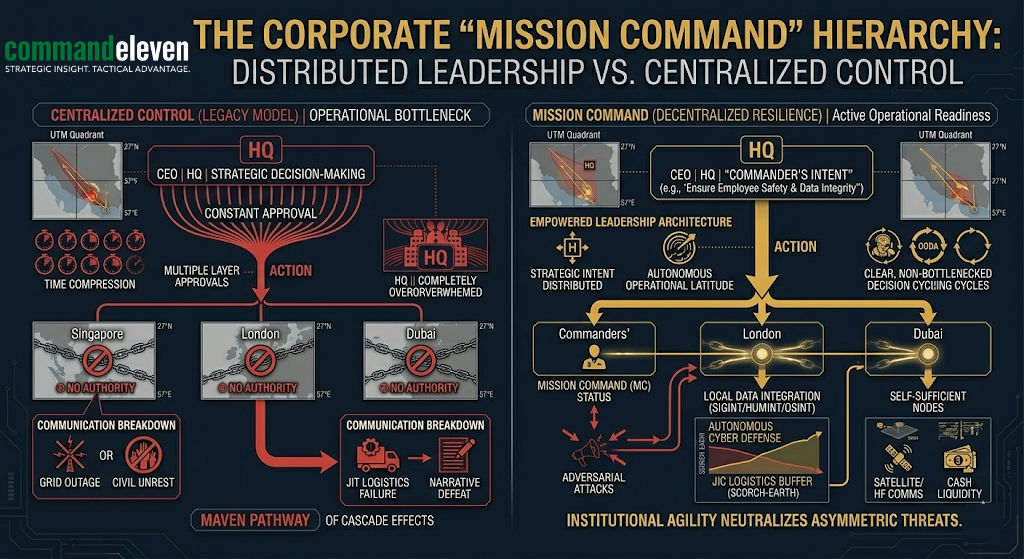
- Mission Command Implementation: Decentralize authority to regional “Nodes” to prevent HQ bottlenecks during communication blackouts.
- OODA Velocity: Survival depends on cycling through Observe-Orient-Decide-Act faster than adversarial sleeper cells or cyber-APT groups.
- Just-in-Case (JIC) Logistics: The “Just-in-Time” model is a liability in 2026; firms must transition to redundant, buffered supply chains immediately.
- The 72/48 Protocol: Specific, time-bound hardening and reaction steps to be triggered the moment geopolitical mediation is declared a failure.
The Hybrid Siege: Beyond the Firewall
The past three months have confirmed that adversarial doctrine (primarily Iranian and Russian) has shifted from “Espionage” to “Infrastructure Attrition.” The recent exploitation of internet-facing Programmable Logic Controllers (PLCs) across U.S. water, energy, and municipal sectors is not an isolated cyber event; it is the “pre-kinetic” phase of a larger hybrid siege.
Sleeper Cell Activation & Domestic Kinetic Risk
The activation of clandestine cells – leveraging high-magnitude cognitive triggers like the Operation Epic Fury school strike – has introduced a Kinetic Homefront Vector. For the C-Suite, this means:
- Physical-Digital Convergence: A cyber-attack on the electric grid is now a potential diversion for a kinetic strike on a physical data center or logistics hub.
- The Insider Threat: Heightened sociopolitical polarization increases the risk of “Sleeper” or “Lone Wolf” sabotage within critical corporate units.
Corporate OODA Loop: Real-Time Tactical Adaptation
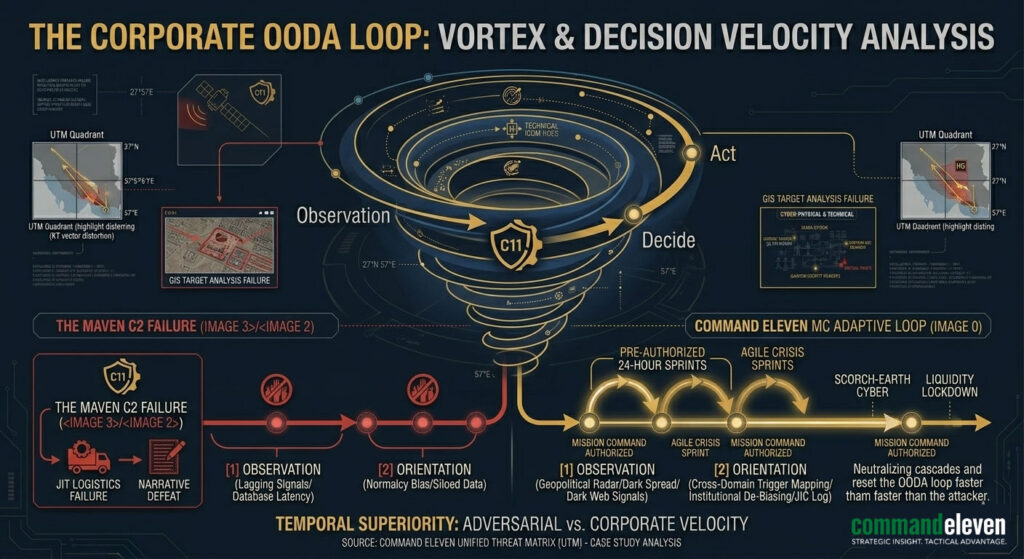
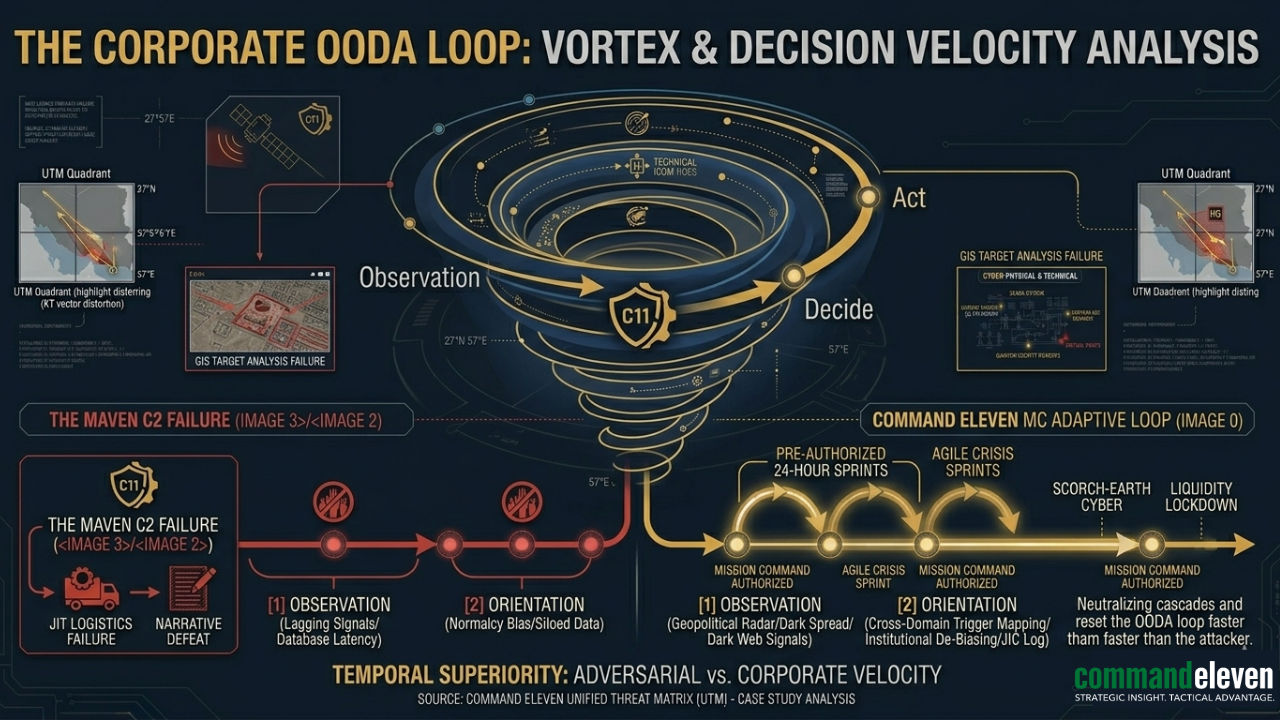
To survive mediation failure, the C-Suite must execute the OODA Loop at a velocity that exceeds adversarial deployment.
- Observe (Signal Detection): Shift from lagging financial indicators to leading Intelligence Signals. Monitoring the “dark spread” in regional energy markets and real-time social media sentiment regarding “Homefront” unrest.
- Orient (Institutional De-Biasing): Management must explicitly reject “Normalcy Bias.” Assume that the Just-In-Time (JIT) model is already broken and that fuel-driven inflation is a permanent strategic constraint, not a temporary market fluctuation.
- Decide (Strategic Friction Reduction): Eliminate bureaucratic multi-layered approvals. Empower regional managers with Mission Command protocols to shutter facilities or reroute assets based on local threat telemetry.
- Act (Operational Posturing): Transitioning from “Just-in-Time” to “Just-in-Case” inventory modeling and analog-redundant communication channels (HF/Satellite) that bypass the compromised civilian internet.
The Continuity Paradox: Logistics & Consumer Reaction
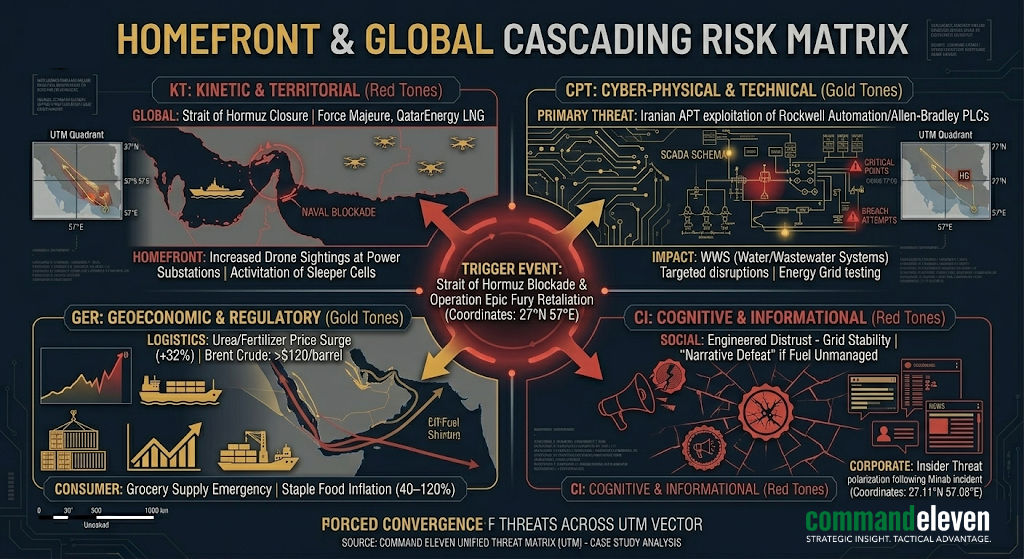
The closure of the Strait of Hormuz and the subsequent Urea Price Surge (+32%) have destabilized global fertilizer and transportation costs. Continuity is no longer about maintaining the “status quo,” but about managing Strategic Retreat & Re-Entry.
- JIT Failure Management: Transitioning to “Buffer-Stock” models. The cost of carrying inventory is now lower than the cost of a complete production halt.
- Fuel & Consumer Sentiment: As fuel prices surge, the “Consumer Outrage” vector will target corporations perceived as “war profiteers.” C-Suite leadership must manage the Cognitive (CI) vector by transparently communicating the strategic costs of regional defense.
Checklists for Imminent Mediation Failure
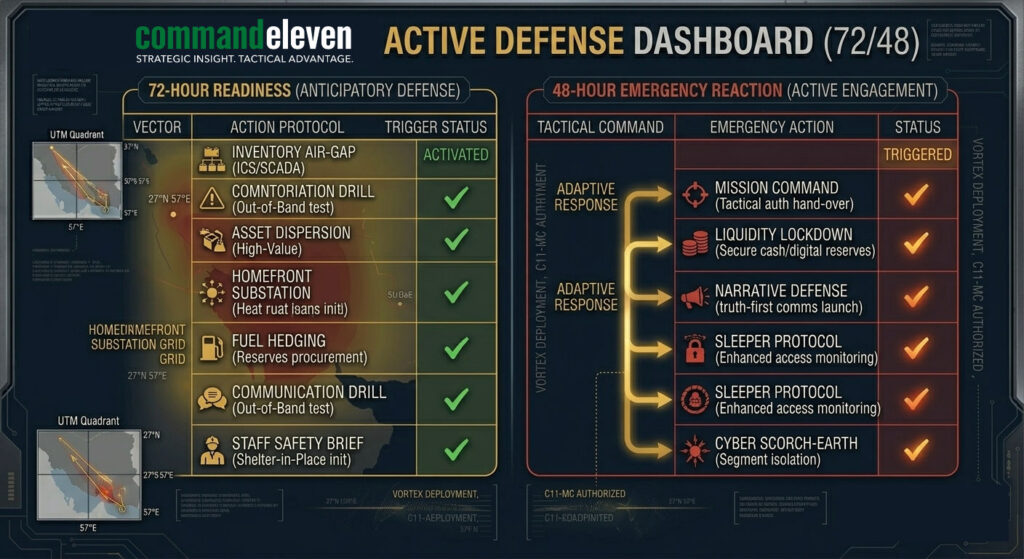
The 72-Hour Readiness Checklist (Anticipatory Defense)
- Inventory Air-Gap: Disconnect non-essential ICS/SCADA interfaces from the public internet.
- Asset Dispersion: Physically disperse high-value inventory from centralized hubs to smaller, redundant locations.
- Fuel Hedging: Finalize immediate procurement of fuel reserves for back-up power systems and logistics fleets.
- Communication Drill: Execute an out-of-band communication test (Satellite/Encrypted Messaging) with all global regional leads.
- Staff Safety Brief: Initiate “Work-From-Home” or “Shelter-in-Place” protocols for facilities near high-value critical infrastructure targets.
The 48-Hour Emergency Reaction Checklist (Active Engagement)
- Trigger Mission Command: Formally hand over tactical authority to regional “Emergency Response Commanders.”
- Liquidity Lockdown: Secure accessible cash and digital asset reserves to bypass potential banking system “freezes” or cyber-outages.
- Narrative Defense: Launch pre-prepared “Truth-First” communication streams to employees and customers to neutralize disinformation regarding corporate status.
- Sleeper Protocol: Initiate enhanced biometric and digital access monitoring for all “High-Security” physical and virtual zones.
- Cyber Scorch-Earth: If a breach is detected in a non-essential segment, proactively isolate (and if necessary, shut down) that entire segment to prevent lateral movement to the Core UTM.
Conclusion
The Mediation Failure is not a market risk; it is a Systemic Threat Vector. The C-Suite’s primary objective for the next 14 days is to harden the human and technical infrastructure against the “Forced Convergence” of cyber, kinetic, and civil unrest.